How the Luxury Handbag Market Values Craft: Questions Answered
The market pays for craft only where craft can be seen, felt or tested, and it pays most at three places: the edge, the stitch line and the alignment. An edge built in four passes at 0.2-0.3 mm and flexed 500 times without cracking is visible in a photograph. A stitch line held at 8-9 SPI is legible at arm's length. Grain and pattern alignment within 1 mm is what separates a considered piece from an assembled one. This page answers the questions buyers actually ask about them, with the numbers attached and with inspection at AQL 2.5 under ISO 2859-1. Our validated partner factory Quanzhou Yingming Bags, an SGS-validated site with 7 production lines and roughly 200,000 pcs per month of capacity, holding export experience since 2014, builds to those figures at 500 pieces per style and colourway.

Does the Market Actually Pay for Craft?
It pays for the part of craft that survives a photograph and a season, and it ignores the rest. That distinction matters more than any argument about hand work, because it decides where a house should put its effort. Craft that is visible at arm's length and still visible after a year is priced. Craft that requires the piece in hand, or that disappears under use, is not.
Three places carry almost all of the value. The edge, because it is the first thing a close photograph shows and the first thing to crack. The stitch line, because it is legible at arm's length and because irregular density is instantly read as haste. And alignment, because a mismatched grain or a pattern that breaks at a seam is noticed even by people who could not say why.
Everything else is secondary, and some of it is actively mispriced. A hand-stitched seam that is less regular than a machine seam will be judged worse, not better, because the judgement is on the result rather than on the method. That is uncomfortable for houses built on hand-work narratives, and it is consistently what buyers do.
What Does Craft Mean Once It Is Specified?
Craft becomes real at the point where it can be written down. Until then it is a claim, and claims are what buyers set aside. The conversion is simple: every craft decision becomes a number with a band, a method and a check. Edge paint becomes a thickness and a pass count; stitching becomes a density and a thread; alignment becomes a tolerance in millimetres.
Three fields are enough for each line on a pack: the figure, the method used to reach it and the check that confirms it. Thickness 0.2-0.3 mm, applied in four passes, checked by flexing 500 times. Density 8-9 SPI, sewn on a locked stitch, checked by counting over 25 mm. Alignment within 1 mm, set at cutting, checked before assembly. Written that way, craft survives contact with a schedule.
It also stops the argument about whose work is better, which is the least useful conversation in the category. A spec sheet does not care who made the piece; it cares whether the figure was reached. Houses that accept this find that their craft claims start landing, because they have stopped asking buyers to take anything on trust.
Where Does Craft Show First?
At the edge. Ask anyone who evaluates bags professionally what they look at first and the answer is almost always the same: the edge, then the stitch line, then how the pieces meet. The edge is where a piece is either finished or merely closed, and it is where both the best and the worst work in the category is most obvious.
The reasons are practical. An edge is handled constantly, it flexes every time the piece is opened, and it is photographed at close range in nearly every listing. It is also the component most sensitive to shortcuts: too few passes, too thick a coat, insufficient cure before flexing, or paint applied over a poorly skived fold. All four show within a season.
So the edge is where a house should spend first, and it is where a buyer should look first. Everything else being equal, two pieces of identical design are separated in the market by how their edges look after twelve months, and that difference is worth more than any amount of detailing elsewhere on the body.
How Is an Edge Built and Tested?
Four passes at 0.2-0.3 mm total build, not two thick coats. Thin passes cure through and flex with the leather; thick coats sit on the surface and crack when the fold moves. Between passes the edge is dressed, and the fold itself is skived to 0.6-0.8 mm so the leather turns rather than bunches. Skiving is the step most often skipped and the one that decides whether an edge survives.
Cure time is not optional. Edge paint needs its full cure before the piece is flexed, packed or shipped; packing a piece before the edge has set transfers the pattern of the packing onto the finish and produces a soft edge that marks under a fingernail. Give it the full window, then flex it 500 times and look for hairline cracking at the fold.
Colour matters as well, and it is specified rather than matched by eye. An edge darker than the body is a deliberate contrast; an edge that was supposed to match and does not is a defect, and the two look very different at close range. State the edge colour on the pack as a reference rather than as a description, and keep the reference with the retained sample.
What Does Stitch Density Really Tell a Buyer?
Density is read as care, and irregularity as haste, which is why it carries weight beyond its structural role. Eight to nine stitches per inch is a reasonable band for a body seam on a luxury piece: dense enough to read as considered, open enough that the leather is not perforated into a tear line. Below about 6 SPI the seam looks casual; above about 11 SPI on a soft leather it can weaken the material.
Consistency matters more than the figure. A seam that runs 8 SPI at the start and 10 SPI at the corner is worse than one that runs 8 throughout, because the change is read as a problem with control. Hold the density across every colourway and every size, and check it by counting over 25 mm rather than by looking at the line.
Thread is half the specification and is usually the half that is missing. State the thread type, the gauge and the colour reference, and state whether the seam is locked. A locked seam fails at one point and stops; an unlocked one unravels, and the difference is the difference between a repair and a ruined panel. Buyers who know this ask. Buyers who do not still notice the result.
How Is Alignment Judged?
Alignment is noticed without being named. A grain that runs at a different angle on two adjacent panels, a stripe that breaks by 3 mm at a seam, a pocket set 2 mm off centre: none of these are described in a review, and all of them lower the judgement of the piece. Alignment is the craft quality most buyers feel and few can articulate.
Set it in numbers. Grain direction within 5 degrees across adjacent panels. Pattern or stripe continuity within 1 mm at a seam. Pocket and handle placement within ±1.5 mm of the marked position. All three are cutting and marking decisions rather than sewing ones, which is why alignment should be checked before assembly begins rather than after.
Then hold it across the run, which is harder than holding it on a sample. Alignment drifts when panels are nested for yield, and the drift is invisible until two pieces sit side by side in a store. Specify a nesting rule alongside the tolerance, because a rule the cutter can follow beats a standard the finisher has to interpret.
- Edge build
- Four passes, 0.2-0.3 mm total, dressed between passes
- Edge skiving
- 0.6-0.8 mm at the fold so the leather turns rather than bunches
- Edge cure
- Full cure before flexing, packing or shipment
- Edge flex test
- 500 cycles at the fold, no hairline cracking
- Edge colour
- Stated as a retained reference, contrast and mismatch treated differently
- Stitch density
- 8-9 SPI, held across every colourway and every size
- Stitch check
- Counted over 25 mm rather than judged by eye
- Thread
- Type, gauge and colour reference stated; seam locked
- Grain alignment
- Within 5 degrees across adjacent panels
- Pattern continuity
- Within 1 mm at a seam
- Placement
- Handles and pockets within ±1.5 mm of the marked position
- Bench time
- Edge finishing accounts for about a quarter of it on a structured body
- Inspection
- AQL 2.5 under ISO 2859-1, with defect classes defined
- Cost anchor
- USD 4.80 trim and hardware allowance before material
Does Hand Work Still Matter on a Line?
Yes, but not in the way it is usually argued. Hand work matters where a machine cannot reach or cannot judge: dressing an edge between passes, easing a corner, setting a lining so it does not fight the shell, deciding where on a hide a panel should come from. Those are decisions, and decisions are what a machine cannot make.
It does not matter where consistency is the goal. A machine produces a more regular stitch line than a hand does, and regularity is what buyers reward at arm's length. The useful position is to use hand work where judgement is needed and machine work where repetition is needed, and to say so honestly rather than to claim that everything is done by hand.
The honest version sells better. A house that says which operations are done at the bench and why is making a craft argument with content in it, and buyers respond to that. A house that says everything is handmade is making a claim that a close photograph will test within seconds, usually to the house's disadvantage.
What Does Craft Cost?
Craft costs bench time rather than material, which is why it is so often the first thing cut when a schedule tightens. On a structured body, edge finishing alone accounts for roughly a quarter of bench time, and a four-pass edge costs meaningfully more than a two-pass one. That is the trade: a day on the line against a season in the customer's hands.
Hold the conversation against one planning anchor. We use USD 4.80 as the reference allowance for trim and hardware on a mid-specification piece, before material, and discuss upgrades as deltas against it. Moving from a two-pass to a four-pass edge adds bench time and stays within reach of that anchor on a 500 piece run; adding a hand-set lining usually exceeds it.
The cost that never appears on a sheet is the return. Edge failure, seam failure and misalignment are three of the most common reasons a piece comes back, and each one costs more than the bench time that would have prevented it. Houses that cost craft properly rarely argue about it, because they have already counted the alternative.
How Is Craft Verified Before Shipment?
By inspection and by test, and neither alone is enough. Attribute inspection at AQL 2.5 under ISO 2859-1 catches what can be counted and classified: missed stitches, edge defects, misalignment, finish inconsistency. Testing catches what only appears under load or cycling: edge flex at 500 cycles, closure pull after about 200 cycles, handle growth after 24 hours at 4 kg.
Define the defect classes before the inspection rather than during it. A critical defect is one that will cause a return: an edge cracked through, a seam unlocked, a fitting detached. A major defect is one that will cause a complaint: visible misalignment, uneven density, finish mismatch. A minor defect is one that will be noticed and forgiven. Classification is what makes an inspection result usable.
Then keep the record. Every lot should leave with a result, and the result should name the sample it was checked against rather than the drawing it was made from. This is the discipline set out on our craftsmanship page, and it is what allows a craft claim to be made with evidence behind it rather than with adjectives.
Can Craft Be Held Across a Second Run?
Only if the piece is approved against an object. This is the question underneath every craft discussion, because a house that cannot repeat its work does not have craft; it had a good day. The mechanism is unglamorous: retain one approved sample per style and colourway, retain the hardware finish reference, retain the hide swatch, and measure each new run against all three.
Digitise the pattern with version control and name the person who approves a change. A pattern redrawn for the second run is a different pattern, and it will produce a different edge, a different alignment and a different stance. Most drift in this category is not carelessness; it is redrawing, done quietly because the original was not archived.
Then hold the tolerance. Panels within ±1.5 mm, gussets within ±2 mm, density at 8-9 SPI, edge at 0.2-0.3 mm. Those four numbers are what make the second run the same piece, and the discipline of not loosening them on a difficult run is what makes a house worth returning to. Sequencing and reset rules sit on our sampling page.
| Craft element | What buyers read | Specification | Check before shipment |
|---|---|---|---|
| Edge | Finished or merely closed | Four passes at 0.2-0.3 mm, skived 0.6-0.8 mm | 500 flex cycles, no hairline cracking |
| Stitch line | Care or haste | 8-9 SPI, locked seam, thread stated | Counted over 25 mm, consistent to the corner |
| Alignment | Considered or assembled | Grain within 5 degrees, pattern within 1 mm | Checked before assembly, against a nesting rule |
| Hardware | Even ageing or part-by-part | 0.15-0.3 µm decorative, above 0.3 µm load-bearing | Matched against the retained finish reference |
Where Craft Is Heading
Two directions are visible. The first is evidence: buyers increasingly ask what was measured rather than what was claimed, and a house that can produce a flex count, a density count and an inspection record holds an advantage no photograph can match. Craft is becoming a documentation discipline as much as a bench one.
The second is restraint. The craft that is being rewarded is the craft that removes evidence of effort: an edge that looks like part of the leather, a seam that does not announce itself, alignment so exact that nobody comments on it. Showy craft is losing ground to the kind that is only noticed when it is missing.
Both point the same way for a house: specify the numbers, keep the records, and let the piece look effortless. For the wider market picture behind that shift, and for how material choice interacts with it, see our materials page and our luxury trends page.
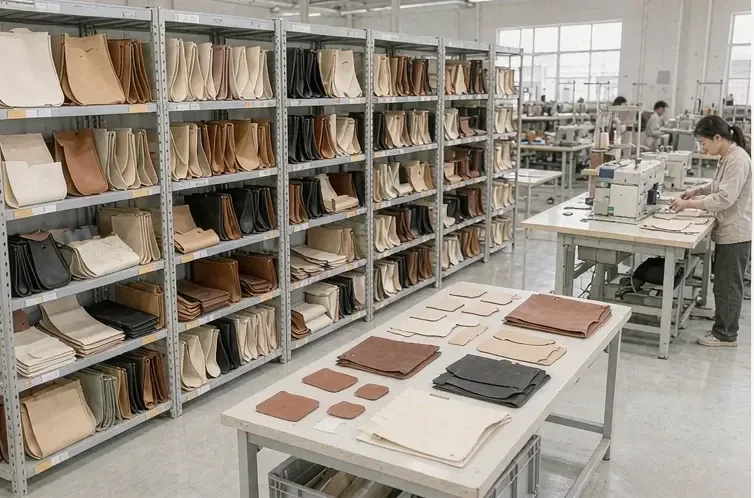
What We Hold At the Bench
Our validated partner factory Quanzhou Yingming Bags, an SGS-validated site with 7 production lines and roughly 200,000 pcs per month of capacity, holding export experience since 2014, works to the four numbers above on a minimum of 500 pieces per style and colourway, with sampling in 6-10 working days, 12-15 for complex builds, bulk in 35-50 days from approval, and shipment on FOB Xiamen terms.
What that means in practice is four checks before anything leaves: edges flexed, density counted, alignment checked against the nesting rule, and hardware matched against the retained finish reference, all alongside attribute inspection at AQL 2.5 under ISO 2859-1. Craft is not a story about the past. It is four checks, repeated on every run.
Edge at 0.2-0.3 mm in four passes, 8-9 SPI, alignment within 1 mm, hardware matched to a retained reference. Flex it, count it, check it, match it.
Put your craft claim behind numbers
Send the shape and the finish level you want. You will receive a written specification covering edges, stitch density, alignment and hardware, with the checks named and sampling and bulk windows quoted. Request a quote.
Frequently Asked Questions
Does the luxury market really pay more for craft?
It pays for craft that survives a photograph and a season, and ignores the rest. Three places carry most of the value: the edge, the stitch line and the alignment. A hand-stitched seam less regular than a machine one is judged worse, because the judgement is on the result.
What is the right edge paint thickness on a bag?
Around 0.2-0.3 mm total, built in four thin passes rather than two thick coats. Thin passes cure through and flex with the leather; thick coats sit on the surface and crack when the fold moves. Skive the fold to 0.6-0.8 mm first.
How is an edge tested before shipment?
By flexing it about 500 times at the fold and looking for hairline cracking, after the paint has had its full cure. Packing before cure transfers the packing pattern onto the finish and produces an edge that marks under a fingernail within weeks.
What stitch density should a luxury bag use?
Eight to nine stitches per inch on a body seam, held across every colourway and every size. Below about 6 SPI the seam reads casual; above about 11 SPI on a soft leather the perforation can weaken the material. Consistency matters more than the figure.
Why does the thread specification matter?
Because a locked seam fails at one point and stops, while an unlocked one unravels. State the thread type, gauge and colour reference along with the density. That is the difference between a repair and a ruined panel when a stitch eventually breaks.
How is alignment specified on a handbag?
In millimetres and degrees: grain direction within 5 degrees across adjacent panels, pattern or stripe continuity within 1 mm at a seam, handles and pockets within ±1.5 mm of the marked position. All three are cutting decisions, checked before assembly.
Does hand work still matter on a production line?
Where judgement is needed, yes: dressing an edge between passes, easing a corner, choosing where on a hide a panel comes from. Where repetition is needed, a machine is more regular. Saying which operations are done at the bench sells better than claiming everything is.
How much bench time does edge finishing take?
About a quarter of the total on a structured body, which is why it is the first thing cut when a schedule tightens. A four-pass edge costs meaningfully more than a two-pass one, and that day on the line is what buys a season in the customer's hands.
What is a critical defect versus a major one?
A critical defect causes a return: an edge cracked through, an unlocked seam, a detached fitting. A major defect causes a complaint: visible misalignment, uneven density, finish mismatch. Classifying them before inspection is what makes the result usable.
How is craft consistency held on a second run?
By approving against a retained object rather than a drawing or a photograph, keeping the hardware finish reference and hide swatch with it, and holding the four numbers: ±1.5 mm panels, ±2 mm gussets, 8-9 SPI, 0.2-0.3 mm edges.
How long do sampling and bulk take on a craft-led build?
Six to ten working days for a standard sample and twelve to fifteen for a complex one, then 35-50 days for bulk from approval. Edge cure and cycle testing should be built into the round rather than added after it.
What should a house keep as evidence of craft?
A flex count for the edge, a density count for the seam, an alignment check against the nesting rule, and an inspection result at AQL 2.5 under ISO 2859-1 naming the sample the lot was checked against. Evidence is becoming part of the craft claim.
People Also Ask
What makes a handbag well made?
Three things carry most of it: an edge built in four thin passes to 0.2-0.3 mm that survives 500 flex cycles, a stitch line held at 8-9 SPI and counted over 25 mm with a locked seam, and alignment set in numbers, grain within 5 degrees, pattern within 1 mm, fittings within ±1.5 mm.
How can you tell if a luxury bag is high quality?
Look where wear lands first. The edge should be thin, even and free of cracks when the fold is flexed; the seam should count 8-9 stitches per inch over 25 mm and stay locked at the end; and grain and pattern should run continuously across adjacent panels within about a millimetre.
What is edge painting on leather bags?
It is a built finish rather than a coat: the fold is skived to 0.6-0.8 mm so the leather turns instead of bunching, then four thin passes bring the edge to 0.2-0.3 mm total, dressed between passes. It must cure fully before packing or the finish marks under a fingernail.
How many stitches per inch should a luxury bag have?
The working band is 8-9 SPI on a body seam, applied identically across every colourway and size. Under about six the seam reads casual; beyond about eleven on a soft leather the perforation begins to weaken the material. Measure it over 25 mm instead of judging by eye.
Is handmade better than machine-made for bags?
Not as a blanket rule. Hand work wins where judgement is needed, dressing an edge between passes, easing a corner, choosing where on a hide a panel comes from. Machine work wins where repetition is needed, because regularity is the visible standard, and a hand seam less even than a machine one is judged worse.
Sources and further reading
Every figure on this page is either our own programme data or attributed below. Open the originals before you write them into a specification.
- ISO - International Organization for StandardizationISO Publisher of ISO 2859-1 for attribute sampling and the ISO 105 series covering colour fastness of leather, thread and trim.
- ASTM International standardsASTM International Publisher of test methods covering seam strength, flex resistance and abrasion performance of finished leather assemblies.
- International Union of Leather Technologists and Chemists SocietiesIULTCS Body publishing international leather test methods covering finish adhesion, flex behaviour and temper.
- SGS - Testing, Inspection and CertificationSGS Third-party verification body covering pre-shipment inspection, finish testing and site audit protocols.