How to Communicate Sample Revisions in Luxury Bags: A Note Format, a 48-Hour Window and Nine Comment Types That Close a Round
How should you communicate sample revisions on a luxury bag? Return one consolidated note inside 48 hours, write every dimensional change as a measurement against the drawing, mark the drawing rather than describing it, and split the list into must-change and nice-to-change. Nine comment types cover almost everything a round produces, and each has a fixed form. Anything written as an adjective — softer, higher, neater — produces a second piece that is still wrong.

Why Revision Notes Fail More Often Than Patterns Fail
Most extra sample rounds are not caused by bad work on the bench. They are caused by a note that could be read two ways, and by the fact that a note read two ways will be read the cheaper way, because the cheaper reading is faster to execute and nobody on the bench has an incentive to argue.
Three failure modes recur. The first is the adjective: make the gusset neater. The second is the unsorted list, in which a genuine defect sits next to a preference and both get treated as optional. The third is the drifting note, where comments arrive across four emails over ten days and the piece is cut against a partial set.
The Revision Note Format We Ask For
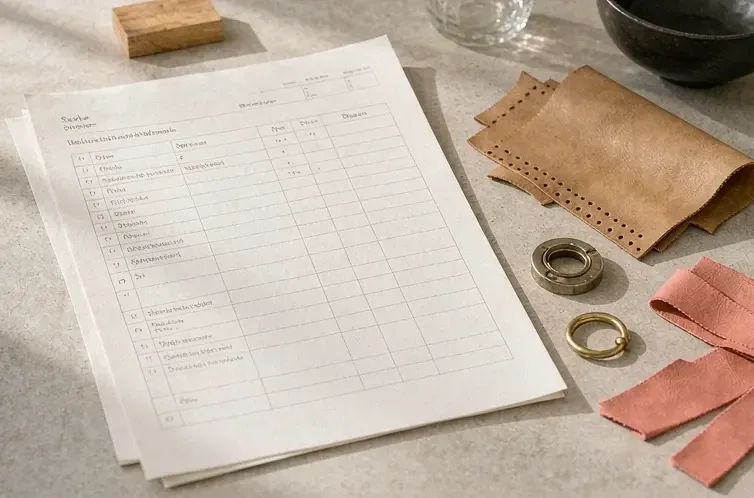
A revision note is a single document with a fixed header, and the header is what makes it executable rather than conversational.
- Revision code
- R1, R2, R3, incremented per round, quoted in every later message
- Style and colourway
- Named exactly as on the tech pack, including the colourway reference
- Sample received date
- The day the parcel arrived, since the review window runs from it
- Priority column
- Must, should or consider, assigned to every single comment
- Reference column
- Drawing number or photograph number each comment attaches to
- Measurement column
- The existing figure, the requested figure, and the tolerance at ±1.5 mm
Six columns look like bureaucracy and behave like insurance. A note with a reference column cannot produce the commonest failure of all, which is a comment that nobody can locate on the piece.
Checklist: Before You Write Anything
Twelve minutes spent before writing saves a round. This is the order we use, and each step exists because skipping it has a known cost.
- Let the piece rest in the room for two hours so the leather reaches handling temperature before you judge it.
- Photograph it from six angles under the same light you will use for the reference images, and number the photographs.
- Measure it against the drawing line by line and note every variance, including the ones you are willing to accept.
- Cycle every closure ten times, because a fitting that looks right and binds on the fourth pull has not been approved.
- Look at the piece on the body, at arm's length and in a mirror, before you look at it on a table.
- Read the provisional list first, and put a line through anything on it before commenting on it.
- Only then write, working from the measurements sheet rather than from memory.
Step three does most of the work. A variance you are willing to accept still has to be recorded, because silence on it reads as approval and approval is what the next round will be measured against. Step six matters for the same reason in reverse: a comment on a component that was declared provisional is a comment on something that will never appear in bulk, and it spends a line of the note on nothing.
How to Write a Dimensional Change
A dimensional change states the existing figure, the requested figure, and where it is measured. Anything else is an opinion about a number rather than a number.
| Weak comment | Executable comment | Why it lands |
|---|---|---|
| The handle feels too short | Handle drop from 145 mm to 155 mm, measured crown to body top, piece empty | Gives a figure, a direction and a datum the bench can measure against |
| The gusset is too deep | Gusset depth from 105 mm to 90 mm at the centre, piece empty | Names the dimension and the state of the piece when measured |
| The stitching looks coarse | Stitch pitch from 7 to 8-9 per inch, thread held at 0.45 mm | Pitch and thread are a matched set, so both are stated together |
| The edge is messy | Edge to three thin coats; the current one thick coat is cracking at the fold after cold conditioning | States the construction and the evidence rather than an impression |
| The hardware looks light | Plating to 0.15-0.3 microns, finish matched to reference chip number 4 | Attaches to a physical chip that both sides hold |
The tolerance is part of the comment. Writing to ±1.5 mm tells the bench how much care the dimension needs; leaving it out means the dimension will be treated as approximate, and approximate is what produces the second round.
Photographs That Support a Comment
A photograph is evidence only if it is taken under conditions the other side can reproduce, and most sample photographs are not.
- One light temperature, held across the whole programme; 5000 K daylight-balanced is the working default.
- A fixed distance of about 30 cm for detail shots, so two photographs of the same feature are comparable.
- A scale bar or a coin in the frame for anything whose size is the subject of the comment.
- Raking light for stitching and edge work, because direct light hides both.
- A numbered caption restating the comment in one line, so the photograph cannot be separated from it.
Phone cameras are adequate for all of this and preferable to nothing. What is not adequate is a photograph taken under warm restaurant light and captioned colour is wrong, which is a photograph that will be argued about rather than acted on.
Separating Must-Change from Nice-to-Change
A list in which everything is urgent is a list in which nothing is urgent, and the bench will work through it top to bottom rather than by consequence.
Must
The piece cannot go to bulk as it is: a dimensional variance beyond tolerance, a closure that binds, an edge that cracks, a lining that shows at the opening.
Should
The piece works but reads below the intended standard: a stitch line that wanders, a shade slightly off the chip, a pocket 5 mm shallow.
Consider
A preference worth testing if the round allows: a softer interlining, a different pull, a marginally narrower base.
Nothing at all
Silence is a decision and it must be recorded. Note the variances you accept explicitly, so the next round is not measured against them.
The useful discipline is a cap: no more than five Must items per round. A round producing more than five is usually a round in which the specification was never agreed, and the fix is to stop and settle the numbers rather than to send a longer list.
Material and Shade Comments Need a Chip
Shade is the most disputed attribute in this trade because it is the one most often communicated without a physical reference. A comment about colour should attach to a numbered chip held by both sides, and it should state the light under which the comparison was made.
Where the programme hide has not yet arrived, the correct comment is not make it darker but hold the piece and re-review against the programme hide on arrival. Approving a substitute shade in order to keep the calendar moving is how a run ends up in a colour nobody chose.
Hardware Comments Need a Drawing, Not an Adjective
Hardware is the slowest thing to change and the easiest to specify wrongly, because an adjective about a finish has no physical meaning at all.
- Name the fitting by its catalogue reference or by its drawing number, not by its look.
- State the plating thickness at 0.15-0.3 microns and the salt spray expectation at 24 to 48 hours.
- Attach a finish chip number for anything described as brushed, antique or polished.
- Say whether the engineered fitting or the stock substitute is being commented on, since the sample probably carries the substitute.
- Cycle the closure ten times and report the count at which it binds, if it binds.
A marked-up drawing removes the translation step between what you meant and what was cut. Prose reintroduces it, and the translation step is where most second rounds are created.
Closing the Round: The Written Confirmation
A round is closed by one email that restates the whole list, and that email is the document the next piece is made against.
Six lines that must appear in the closing email
- The revision code, quoted in the subject line and at the head of the body.
- Every Must item, restated as a measurement, numbered identically to the note.
- Every Should and Consider item, with a line saying which were accepted for this round.
- Confirmation of the material and the hardware, since both carry lead times.
- The variances explicitly accepted, listed so they cannot be reopened later.
- The date, and the next review date, both written out in full.
The fifth line is the one most often skipped and the one that prevents the most arguments. An accepted variance that is not written down is a variance that will be discovered again at bulk, by which point it is no longer a note but a claim.
A Worked Example: One Round, Nine Comments
A Milan label reviewing a second-round shoulder bag sent nine comments in one note and closed the programme in that round. The shape of the note is worth copying.
| # | Priority | Comment as written | Reference |
|---|---|---|---|
| 1 | Must | Handle drop 145 mm to 155 mm, crown to body top, piece empty, ±1.5 mm | Drawing 2, photo 3 |
| 2 | Must | Gusset 105 mm to 90 mm at the centre, piece empty | Drawing 2, photo 5 |
| 3 | Must | Turn-lock binds on the fourth cycle; re-seat the strike plate by 1 mm | Photo 8 |
| 4 | Should | Stitch pitch to 8-9 per inch, thread held at 0.45 mm | Drawing 3 |
| 5 | Should | Edge to three thin coats; current single coat cracks after cold conditioning | Photo 11 |
| 6 | Should | Interior slip pocket 120 mm to 135 mm deep | Drawing 4 |
| 7 | Consider | Interlining from 1.0 mm to 0.8 mm if the panel will still hold | Drawing 3 |
| 8 | Consider | Pull to match chip 4 in brushed brass, subject to lead time | Chip 4 |
| 9 | Accepted | Body width 268 mm against 265 mm specified; accepted, no change | Measurements sheet |
What made that note work was not its length. It was that every line had a number, a reference and a priority, and that the accepted variance was written down as deliberately as the required changes.
The same label had spent the previous season sending comments as a threaded conversation, and the comparison is instructive: the programme went from four rounds to two without any change in the work on the bench. The only variable that moved was the format of the note. Where a buyer cannot resource a full six-column document, the minimum viable version is a numbered list with a figure, a reference and a priority on every line, sent once rather than built up over a week.
Send your revision note in the format we can act on
Share the drawings, the current sample and your quantity and we will return a marked-up revision plan with dates for the next round. Request a quote.
Frequently Asked Questions
How quickly should sample revision comments be returned?
Inside 48 hours of the parcel arriving. The sample window is 6-10 working days, and a piece held for two weeks does not pause the calendar so much as restart the material and hardware lead times that were running alongside it.
Why should comments be consolidated into one note?
Because a piece cut against a partial set of comments produces a second round built on the missing ones. Comments arriving across four emails over ten days are the most reliable way to add a round to a programme that did not need one.
What is a revision code and why does it matter?
A short identifier, R1, R2, R3, incremented each round and quoted in every message. It lets both sides refer to one specific version of the piece, which is what stops two people discussing two different samples in the same thread.
How should a dimensional change be written?
State the existing figure, the requested figure, where it is measured and the tolerance. Handle drop from 145 mm to 155 mm, crown to body top, piece empty, plus or minus 1.5 mm is executable; make it higher is not.
Why is marking the drawing better than describing the change?
Prose has to be translated before it can be cut, and the translation step is where most second rounds are created. A marked-up drawing removes the step entirely and leaves a record of what was actually requested.
What light should sample photographs be taken under?
One consistent temperature across the whole programme, with 5000 K daylight-balanced as a working default. Around 30 cm for detail shots, raking light for stitching and edge work, and a scale bar wherever size is the subject.
How many Must items should one round contain?
No more than five. A round producing more than five Must items usually means the specification was never agreed, and the correct response is to stop and settle the numbers rather than to send a longer list.
How should a comment about colour be written?
Attach it to a numbered finish chip held by both sides and state the light used for the comparison. Where the programme hide has not arrived, hold the piece and re-review on arrival rather than approving a substitute shade.
What does a hardware comment need to include?
The catalogue reference or drawing number, the plating thickness at 0.15-0.3 microns, the salt spray expectation of 24 to 48 hours, a finish chip number, and whether the comment applies to the engineered fitting or the stock substitute.
Should accepted variances be written down?
Yes, and listed as deliberately as the required changes. An accepted variance that is not recorded will be discovered again at bulk, at which point it stops being a note and becomes a claim against the run.
What if the sample carries a provisional component?
Read the provisional list first and strike those items before commenting on them. A comment on a stock substitute fitted only for the sample produces a change to a fitting that was never going into bulk.
How is a revision round formally closed?
With one email carrying the revision code, every Must item restated as a measurement, the accepted Should and Consider items, confirmation of material and hardware, the accepted variances, and the date of the next review.
Why is stitch pitch specified alongside thread gauge?
Because pitch and thread are a matched set against the needle. Asking for 8-9 per inch while leaving the thread unspecified risks an oversized hole, which weakens the seam rather than refining it.
What happens after a round is closed?
The next piece is made in 6-10 working days, or 12-15 for a framed opening, an exotic skin or engineered hardware. Once approved, the programme moves to bulk in 35-50 days at MOQ 500 pcs per style and colourway.
People Also Ask
How do you give feedback on a handbag sample?
One consolidated note with a revision code, every dimensional change written as a figure with a tolerance, a marked-up drawing, and a priority on each line.
What makes a sample revision note ineffective?
Adjectives instead of figures, an unsorted list where defects sit beside preferences, and comments arriving across several emails over many days.
Should I photograph the sample?
Yes, at 5000 K and about 30 cm, with a scale bar and a numbered caption. Raking light for stitching and edges, since direct light hides both.
How many sample rounds are normal?
Two plus a pre-production reference for most styles. A third usually means comments were written as impressions rather than as measurements.
What is a provisional component?
A part fitted to the sample because the specified one has a longer lead time than the sample window. It should be listed in the parcel and struck from your comments.
Sources and further reading
Every figure on this page is either our own programme data or attributed below. Open the originals before you write them into a specification.
- ISO — International Organization for StandardizationISO Publisher of ISO 2859-1 for inspection and of the material and hardware test methods referenced in revision notes.
- SATRASATRA Technology Centre Independent testing organisation for leather and hardware, including salt spray and flex testing cited in sample comments.
- Leather Working GroupLeather Working Group Tannery audit protocol behind the hide batch records used when shade comments are reviewed against a programme hide.
- American Association of Textile Chemists and ColoristsAATCC Test methods and evaluation procedures for colour fastness and appearance assessment under controlled lighting.
- Sourcing JournalSourcing Journal Reporting on development calendars, sampling practice and communication breakdowns across the accessories trade.