How to Avoid Hidden Luxury Bag Sampling Costs: A Nine-Point Pre-Quote Checklist
Hidden sampling costs come from five places: pattern re-cuts, hardware tooling, finishing specifications written too late, courier and duty on returned pieces, and change orders raised after approval. In our programmes, the gap between a two-round sample and a four-round sample is roughly 2.4 times the bench cost, and each additional round puts another 6-10 working days on the clock. This guide lists nine checks that keep a luxury sampling round inside its quote, with the numbers we use at the bench: 62%-78% cutting yield, 8-9 stitches per inch, three-coat edge finishing, and hardware plating at 0.15-0.3 µm.
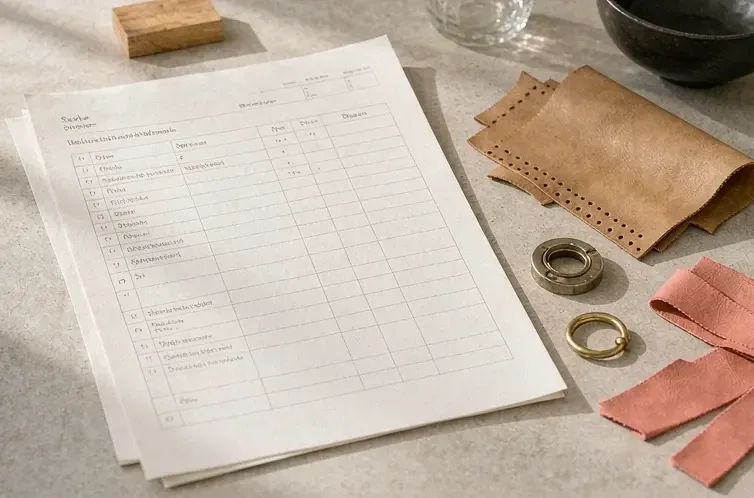
Most sampling quotes are honest. What makes them drift is not the number on the page but the number of decisions left open when the page is signed. A quote that carries four unresolved questions will produce four rounds of bench work, and each round is charged on its own. This checklist is written for designers, buyers and programme managers who sign sampling quotes and then have to explain the variance to the people who approved them.
Where Hidden Sampling Costs Actually Originate
Sampling cost is bench time multiplied by open decisions. When a specification is complete, a round costs roughly what it was quoted. When four of eight lines are still open, the bench has to guess, and a guess produces a rework cycle that is billed separately. Across the programmes we run, five origins account for the great majority of variance between a quoted sampling figure and the invoiced one, and none of them is a pricing decision made in bad faith.
Pattern re-cuts
A revised panel shape can move cutting yield from 78% to 62%. That raises the leather allowance on every piece that follows, not only on the sample.
Hardware tooling
An original zip pull or lock needs a physical tool. Choosing stock hardware in the same finish usually removes the charge entirely.
Finishing written late
Edge coats, stitch density and hardware finish decided after round one force the bench to undo operations it has already completed.
Returned pieces
Courier, duty and re-inspection on samples shipped back for revision add a second logistics leg to every extra round.
Programme Diary: Two Rounds Against Four
A structured top-handle programme arrived with a complete tech pack: full-grain calfskin at 1.2-1.4 mm, 8-9 stitches per inch, three-coat edge paint, a #5 zip, and palladium-finish hardware plated at 0.15-0.3 µm. Round one came back in 8 working days carrying two notes: the gusset was 3 mm tight at the base and the shoulder strap drop sat 12 mm short of the drawing. Both notes were corrected on paper, with the pattern re-graded and the strap length re-issued, before the bench touched leather again.
Round two closed in 6 working days. The programme ran two rounds across 14 working days, used one courier return and one re-inspection. A parallel programme on the same silhouette ran four rounds across 31 working days because the lining colour, the edge paint shade and the zip length were each raised as separate notes in separate rounds. The second programme spent about 2.4 times the bench cost of the first and reached confirmation 17 days later, with the same leather and the same hardware specification.
The Nine-Point Pre-Quote Checklist
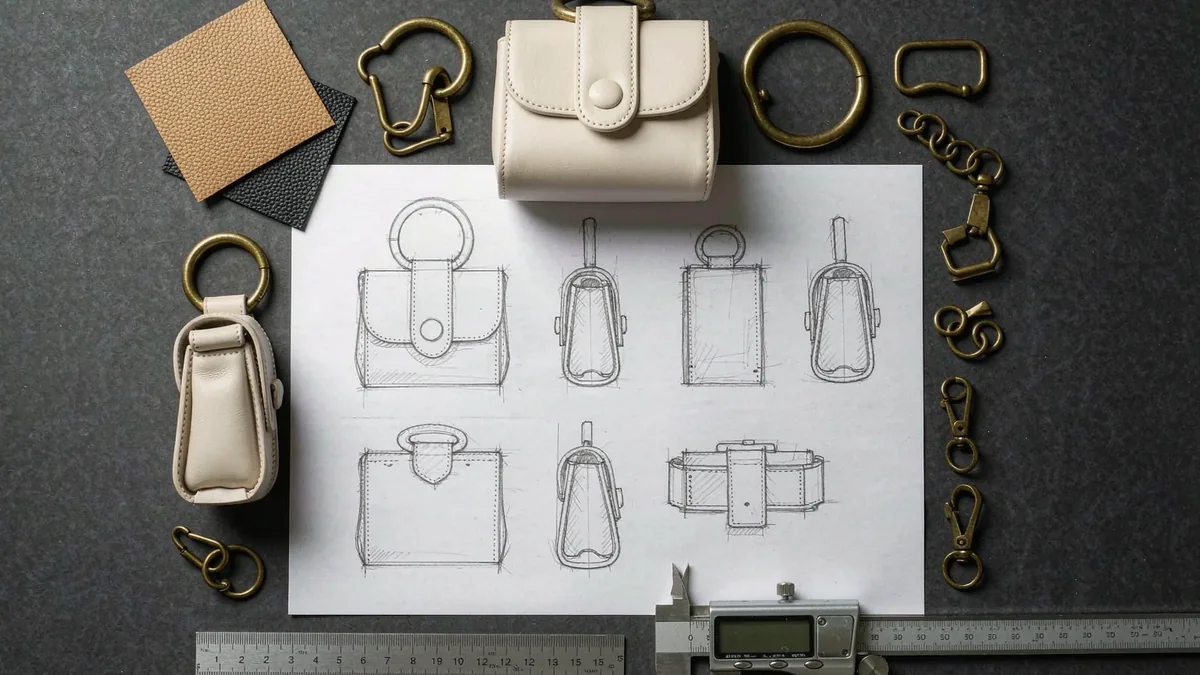
Run these nine checks before you release a sampling quote. Each one closes a decision that would otherwise become a rework cycle, and each one is a line you can point at later if the invoice moves.
- Confirm leather substance and temper in millimetres. Structured calfskin body panels sit at 1.2-1.4 mm; a swatch reference alone does not fix substance.
- Fix stitch density at 8-9 stitches per inch and name the thread ticket size in the same line. The two together determine needle hole spacing and seam strength.
- State edge treatment as a coat count. Three coats is our house standard; five coats adds meaningful hand time to every piece in the run.
- Choose hardware from the stock library where the silhouette allows it, and record plating thickness at 0.15-0.3 µm where a custom finish is required.
- Specify closure by size, not by description: a #5 zip, a 20 mm turn-lock, a 25 mm magnetic catch.
- Name the lining, its weight and its colour reference against a standard, not against a photograph taken under retail lighting.
- Set the tolerance you will accept on linear dimensions, typically plus or minus 2 mm on panels below 300 mm.
- Decide who carries courier, duty and insurance on returned pieces before the first sample leaves the bench.
- Agree in writing what happens to the sampling charge when the style proceeds to bulk at 500 pcs per style and colourway.
Pattern Re-Cuts and Cutting Yield
Cutting yield is the share of a hide that becomes bag panels. A well-graded pattern on full-grain calfskin reaches 78% on a structured silhouette; a pattern revised twice without re-grading often sits near 62%. The difference is not a one-off sampling charge, because the leather allowance per piece is set from the pattern rather than from the sample. A yield decision made in round two follows the style into bulk and into every repeat of it.
| Cost driver | Structured programme | Unstructured programme | What to lock first |
|---|---|---|---|
| Pattern revisions before round one | 1 graded pattern | 3 ungraded revisions | Grade the pattern before the first cut |
| Cutting yield on body panels | 78% | 62% | Confirm hide size and panel layout |
| Leather substance | 1.2-1.4 mm calfskin | 1.4-1.6 mm substituted in round three | Specify substance in millimetres |
| Stitch density | 8-9 per inch, fixed | Raised as a note in round four | Name SPI and thread ticket together |
| Edge coats | 3 coats | 5 coats added in round three | Write the coat count into the tech pack |
| Hardware source | Stock library, palladium finish | Bespoke tool raised in round two | Approve stock hardware first |
| Sampling rounds | 2 rounds, 14 working days | 4 rounds, 31 working days | Close every open note in one revision |
Hardware Tooling and Plating Choices
Hardware is the largest single source of a one-off sampling charge, because a bespoke tool is a physical object that has to be cut and proven before a sample can be assembled around it. A stock zip pull, a stock turn-lock and a stock foot stud carry no tooling charge at all. The moment a silhouette needs an original shape, the tool has to exist first, and the sampling clock extends accordingly.
- Hardware approach
- Stock library first, bespoke only where the silhouette demands it
- Plating thickness
- 0.15-0.3 µm
- Standard finishes held
- Palladium, light gold, brushed nickel
- Salt spray reference
- 24 h for light gold, 48 h for palladium
- Closure sizes held in stock
- #5 zip, 20 mm turn-lock, 25 mm magnetic catch
- Reinforcement under hardware
- 0.8 mm interlining
- Sampling lead time, standard
- 6-10 working days
- Sampling lead time with a custom tool
- 12-15 working days
Finishing Specifications Written Too Late
Finishing operations sit at the end of the build sequence, so a late decision on them reopens work that has already been completed. Three coats of edge paint applied, sanded and cured cannot be converted into five coats without the piece returning to the bench. A seam sewn at 8 stitches per inch cannot be re-stitched at 9 without new needle holes in the same panel, which changes how the panel behaves under load.
- Edge paint: state the coat count and the colour reference in the first tech pack revision, not after first sight of the sample.
- Stitch density: 8-9 per inch on structural seams, named together with the thread ticket so both are fixed at once.
- Edge creasing: decide whether a creased line is drawn, and at what distance from the seam it sits.
- Logo application: blind deboss, foil or a metal plate. Each needs a different tool and a different press setting.
- Interior finishing: bound seams, turned seams or raw edge, declared before the lining is cut.
- Hardware setting: riveted, screwed or stitched, because the reinforcement under the plate is built into the panel.
Courier, Duty and Returned Pieces
Every revision round that requires the physical piece to travel adds a logistics leg, and logistics legs are the costs most often missing from the original quote. A structured programme ships the round-one sample out, receives notes by video or by a marked photograph, and makes corrections without shipping anything back. An unstructured programme ships the piece, receives it, ships it back, and re-inspects it on arrival.
Two courier legs and one re-inspection on a single style is normal; four legs and three re-inspections is where the variance lives. The fix is procedural rather than commercial: mark corrections on a photograph with a written note, keep the physical piece at the bench, and ship only when the change can be verified against a finished reference. Export documentation should be issued on the same commercial terms as the bulk order. Handover is on FOB Xiamen in our programmes, so the sample is not valued on a different basis from the piece that follows it.
Change Orders After Approval
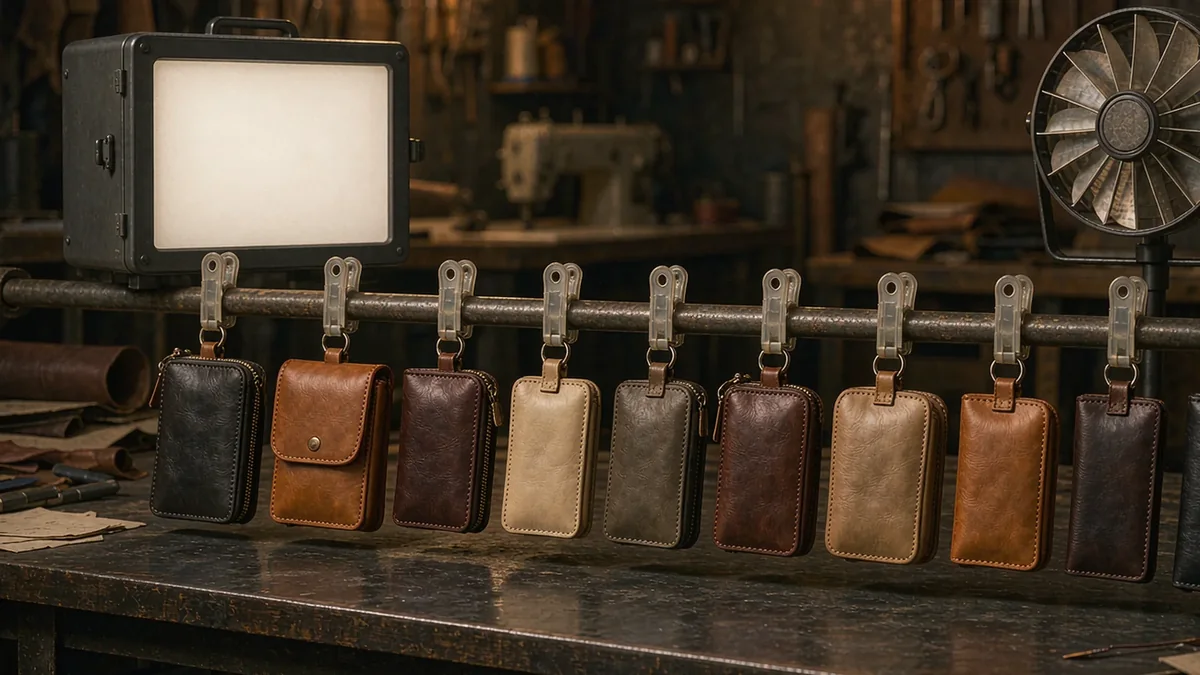
An approved sample is a reference object, and a change order against it restarts the clock. The bench work itself is usually small: USD 4.80 covers the parts and hand time on a typical single closure rework. The administrative sequence around it is not small. The piece is retrieved from the reference shelf, the operation is reversed, the operation is redone, the piece is re-inspected against the drawing, and the reference photography is retaken so the bulk run has something to be measured against.
A change order raised in week one of bulk is no longer a sampling cost. One closure change applied after cutting begins can affect an entire colourway of 500 pcs, which is why approval is treated as a hard gate rather than a milestone.
How to Read a Sampling Quote Line by Line
A sampling quote should separate three things: bench work, materials, and one-off charges. When those three are merged into a single figure, you cannot tell which part will move when the specification moves, and you lose the ability to negotiate the part that actually changed.
- Bench work: the cost of cutting, skiving, assembling, stitching and finishing one sample piece.
- Materials: leather by the hide or by the panel, lining, interlining, hardware, thread and adhesive.
- One-off charges: hardware tools, cutting dies, logo blocks and any plating bath run.
- Logistics: packing, courier, export documentation and the commercial terms on which the piece travels.
- Credit terms: what share of the sampling charge, if any, is credited against the bulk order at 500 pcs per style and colourway.
- Revision allowance: how many correction notes are included before additional bench time is billed.
Locking the Specification Before Round One
The most economical sampling round is the one that does not need a second. Programmes that reach confirmation in two rounds share one habit: every note that could have been raised in round three was written down before round one. Sampling runs 6-10 working days for standard constructions and 12-15 for complex ones. Bulk follows in 35-50 days, inspection is set at AQL 2.5 under ISO 2859-1, and handover is on FOB Xiamen terms. Those numbers hold when the specification holds, and they move together when it does not.
Take this to the bench
- Close leather substance, stitch density, edge coat count, hardware finish, closure size, lining, tolerance, courier responsibility and sample-fee credit before round one. Nine decisions written down is the difference between 14 working days and 31 working days on the same silhouette.
Request a sampling quote
Send the tech pack you have and we will mark every open decision before the first cut. Work runs through our validated partner factory Quanzhou Yingming Bags, an SGS-validated site operating since 2014 with 7 production lines and capacity of about 200,000 pcs per month. Request a quote
Frequently Asked Questions
What counts as a hidden sampling cost in a luxury bag programme?
A hidden sampling cost is any charge that was not visible as a line on the original quote. In practice it is one of five things: a pattern re-cut after the first assembly, a hardware tool that had to be cut for an original shape, a finishing note raised after the operation was completed, a courier leg on a returned piece, or a change order against an approved reference sample.
How many sample rounds should a luxury bag need?
Two is the working target for a structured silhouette built from a complete tech pack. The first round proves the pattern and the construction; the second proves the corrections. Four rounds usually signals that decisions were left open rather than that the construction is difficult, and each extra round adds 6-10 working days to the programme.
Why does a second hardware finish change the sampling quote?
A second finish means a second plating bath run and a second set of reference samples, because the bench cannot prove a finish without setting it on a completed piece. Plating thickness in our programmes sits at 0.15-0.3 µm, and salt spray reference testing runs 24 h for light gold and 48 h for palladium.
Does cutting yield really affect the cost of a single sample?
On one sample the effect is small, but the pattern is the same pattern that bulk will be cut from. A graded pattern on full-grain calfskin reaches 78% yield; an ungraded pattern revised in place often sits near 62%. The gap becomes a material allowance on every piece in the run, not a one-off charge.
How long does a sampling round take?
Standard constructions take 6-10 working days from a released tech pack to a finished sample. Complex constructions, including any style that needs a bespoke hardware tool or a hand-built frame, take 12-15 working days. Bulk follows in 35-50 days once the reference sample is approved and the order is released.
Who pays courier and duty on returned samples?
Whoever the quote says pays them, which is why it should be written down before the first piece ships. In our programmes samples travel on the same commercial basis as the bulk order, FOB Xiamen, so a sample is not documented on a different valuation from the pieces that follow it into the same market.
Can a complete tech pack reduce sampling cost?
Yes, and it is the single largest lever available to a buyer. A tech pack that fixes leather substance in millimetres, stitch density, edge coat count, hardware finish, closure size and lining reference removes most of the guesswork that produces a second round, and removes the rework that follows a guess.
Is a bespoke zip pull worth the tooling charge?
It is worth it when the hardware is the signature of the house and the shape will carry across several seasons, because the tool is then amortised over more than one programme. For a single style, stock hardware in the same finish usually delivers the same reading at the shelf without the one-off charge or the extra sampling days.
What is the minimum order quantity for a sampling programme?
Sampling itself has no minimum; a single reference piece can be built. The minimum applies to what follows: 500 pcs per style and colourway. That figure matters to sampling because a style that will never reach it should use stock hardware and standard constructions rather than bespoke tools.
How is a sample fee credited against a bulk order?
Credit arrangements differ by programme and should be stated on the quote rather than assumed. The cleanest arrangement credits the bench-work portion against the bulk order at 500 pcs per style and colourway, while one-off charges for tools and dies are treated separately because they have a physical existence beyond the sample.
What happens if a change order arrives after approval?
The approved reference sample stops being the reference and the clock restarts. A single closure rework runs about USD 4.80 in parts and hand time, but the piece also has to be retrieved, re-inspected and re-photographed. Raised after cutting has begun, the same change can affect an entire colourway of 500 pcs.
How does AQL 2.5 relate to the sampling stage?
AQL 2.5 under ISO 2859-1 is a bulk inspection level, not a sampling standard, but it shapes what the reference sample has to prove. The sample becomes the object that bulk pieces are measured against, so a defect class tolerated on a sample will be tolerated across the run. Approval is therefore a hard gate.
People Also Ask
Why are luxury bag samples expensive?
Because the first piece carries the whole cost of proving a pattern. The bench cuts one hide, sets one tool, sews one seam sequence and finishes one edge treatment, and none of those operations benefits from repetition. The second piece of the same style is materially less work than the first.
How do I reduce the number of sample rounds?
Close decisions before the first cut rather than after the first sight of a sample. Fix substance, stitch density, edge coat count, hardware, closure size, lining and tolerance in the tech pack, then raise every correction note in one revision rather than across three.
What should a sampling quote include?
Six separated lines: bench work, materials, one-off charges for tools and dies, logistics and terms, the credit arrangement against bulk, and the revision allowance. A single merged figure makes it impossible to see which part moved when the specification changed.
Do samples ship on the same terms as bulk?
They should. Documenting samples on the same commercial basis as the bulk order, FOB Xiamen in our programmes, avoids a mismatch in valuation and keeps the export paperwork consistent across the sample and the run that follows it.
What is a fair revision allowance on a sampling quote?
One consolidated revision is normal, meaning one round in which every correction note is raised together. Charges begin when notes arrive in separate rounds, because each round retrieves the piece, re-opens completed operations and re-inspects the result against the drawing.
Sources and further reading
Every figure on this page is either our own programme data or attributed below. Open the originals before you write them into a specification.
- ISO standards catalogueInternational Organization for Standardization Reference source for ISO 2859-1 sampling procedures and the Textiles and Leather technical committees.
- Incoterms 2020 rulesInternational Chamber of Commerce Defines FOB, CIF and DDP delivery terms used for sample and bulk handover.
- Consumer product safety requirementsU.S. Consumer Product Safety Commission Background on CPSIA obligations for bags entering the United States market.
- Convention on International Trade in Endangered SpeciesCITES Secretariat Permit requirements that affect sampling where exotic skins are specified.
- Leather Working Group audit protocolLeather Working Group Environmental audit reference used when selecting tanneries for calfskin programmes.