Fit Samples vs Production Samples for Luxury Bags: What Each One Decides, the Three Checks That Separate Them and When to Run Both
What is the difference between a fit sample and a production sample for luxury bags? A fit sample settles how the piece behaves on the body: handle drop, strap fall, gusset depth and balance, measured to ±2 mm and meant to be argued with. A production sample settles what the run will look like: the programme hide, the specified hardware, stitch at 8-9 per inch and three edge coats. Run the fit sample first, and never let it define bulk.
One Paris House, Two Rounds, Two Different Questions
A Paris house brought us a structured top-handle in box calf, four colourways and a trunk show eleven weeks out. The first sample came back and the founder rejected it because the handle drop felt wrong against the shoulder. The second came back and she rejected it because the gusset read too deep in the lookbook photographs. Neither rejection was about the same thing, and neither sample had been asked the question it was rejected for.
What had happened is common: the piece was being reviewed twice against two different standards, one about how it sat on the body and one about how it would reproduce 500 times, and nobody had written down which round was for which. Once the two rounds were named and separated, the programme settled in one further round and hit the show date.
What a Fit Sample Actually Decides
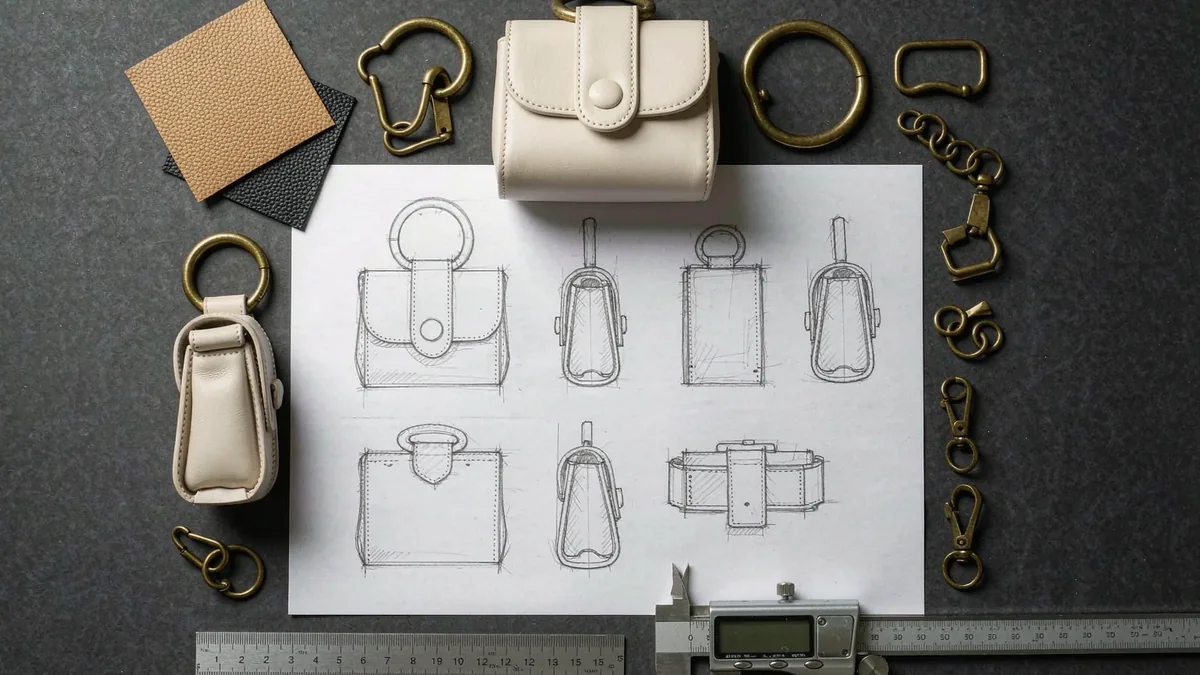
A fit sample decides how the piece behaves on the body: handle drop, strap fall, gusset depth, balance empty and loaded, and whether the opening can be worked with one hand. Nothing else about it is authoritative, and treating it as authoritative is the single most expensive misreading in sampling.
- Handle drop
- Measured from the crown of the handle to the top of the body, held at ±2 mm of the drawing
- Strap length
- 1050 mm as a working cross-body reference, checked under a 4 kg load for 30 minutes
- Gusset depth
- 90 mm on a day bag; the dimension most often misread in photographs and least often drawn
- Balance
- The piece must sit flat when set down and must not tip forward when empty
- Opening
- The closure must work one-handed, and it is cycled ten times before any judgement is made
- Base
- A 1.5 mm base board keeps the floor flat without adding visible bulk at the fold
A fit sample may be cut from a trial hide and may carry the closest stock fitting rather than the engineered one. That is acceptable, and it is the point: geometry is the question, material is not, and spending a round on shade before the shape is settled spends the round on the less important thing.
What a Production Sample Actually Decides
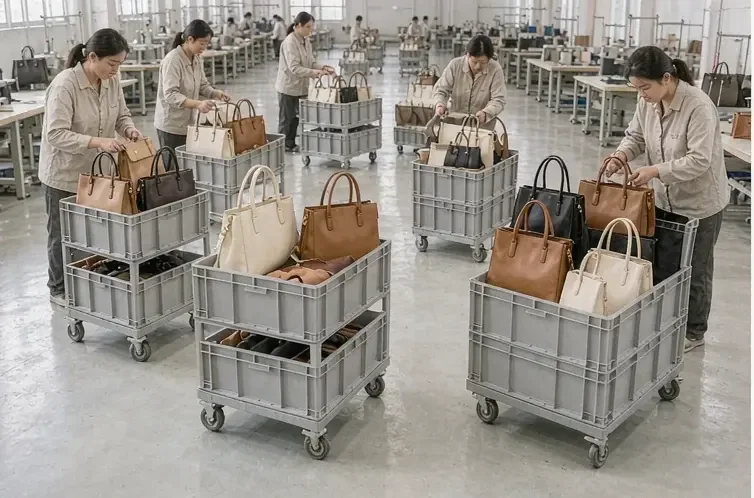
A production sample decides what the run will look like. It is the first piece of bulk rather than a better version of the prototype, and it is made on the bulk tooling, by the bulk method, from the programme hide.
- Leather cut from the programme hide rather than the nearest shade on the shelf.
- The specified hardware fitting, plated at 0.15-0.3 microns, cycled and photographed.
- Stitch pitch at 8-9 per inch in 0.45 mm thread, counted over 25 mm rather than estimated.
- Three thin edge coats, examined after conditioning cold and warm rather than at room temperature only.
- Interlining at 0.8 mm, the same weight the run will use, not a heavier one that flatters the panel.
- Interior layout, pocket depth and whether the lining shows at the opening.
- Packing identical to bulk packing, because a piece presented better than bulk proves nothing.
The discipline here is unglamorous. A production sample made by the strongest hand on the bench from the best hide in the store defines a standard the run cannot hold, and the rejection it eventually causes is really a rejection of the sampling method rather than of the work.
Three Checks That Separate Them
Three checks distinguish the two samples quickly, and they are worth writing at the head of the tech pack so that nobody on either side has to infer which round is running.
| Check | Fit sample | Production sample |
|---|---|---|
| Question it answers | How does this sit on the body? | What will 500 pieces look like? |
| Material used | Nearest available hide from the same tannery | The programme hide, ordered for the run |
| Hardware used | Closest stock fitting in the correct finish | The specified fitting at 0.15-0.3 microns |
| How it is made | Bench methods, one skilled hand, trial interlining | Bulk tooling, bulk sequence, bulk interlining at 0.8 mm |
| Working tolerance | ±2 mm, because geometry is the subject | ±1 mm, because this piece defines the run |
| What it authorises | Changes to the pattern, freely | No further change; it becomes the sealed standard |
The last row is the one that carries weight. A fit sample invites change; a production sample ends it. Programmes that treat the production sample as another draft discover, somewhere in week three of bulk, that nothing has actually been approved.
Where Programmes Confuse the Two
Four confusions account for most of the extra rounds we see, and all four are procedural rather than technical.
Approving shade from a fit sample
The fit piece is often cut from the nearest hide, so a colour approved there may not be a colour bulk can be cut from. Approve the hide submission separately and in writing.
Approving geometry from a production sample
By the time the production piece exists the pattern is set. A handle drop changed at that stage costs a round and 6-10 working days rather than a pencil line.
Asking for both answers in one round
One piece cannot be argued with and sealed at the same time. Naming which round is running is what keeps a programme to two rounds.
Re-sealing after bulk has started
A reference replaced mid-run means the first half of the run was made to a standard that no longer exists. Seal once, at the end.
None of these is a failure of skill. They are failures of labelling, and labelling is free.
The remedy we use is a single line at the head of every sample parcel note stating which round is running and what that round is entitled to decide. It takes twenty seconds to write and it removes the ambiguity that produces the extra round. Where a buyer wants a piece that can be photographed for press at the same time, we make a separate piece rather than loading one sample with two jobs, because the two jobs pull the review in opposite directions.
How the Two Sit Inside One Calendar
The sequence is short and fixed, and the two samples occupy specific positions in it rather than floating.
- Tech pack complete, with the seven numbers written: leather 1.2-1.4 mm, stitch 8-9 per inch, thread 0.45 mm, three edge coats, plating 0.15-0.3 microns, interlining 0.8 mm, #5 zip.
- Fit sample in 6-10 working days, or 12-15 where the piece carries a frame, an exotic skin or engineered hardware.
- Fit review returned inside five working days, written as measurements rather than impressions.
- Production sample made on the bulk tooling from the programme hide.
- Sealing: three references, one held by each side and one held back, each signed across the seal.
- Bulk in 35-50 days, inspection at AQL 2.5 under ISO 2859-1, handover on FOB Xiamen terms.
Two windows inside that sequence absorb almost all the delay in a programme: the review period after the fit sample, and the hide lead time before the production sample. Both can be run in parallel with other work if they are anticipated, and both stop the calendar dead if they are not.
What Each One Costs to Get Wrong
The cost of a mistake rises by an order of magnitude at each gate, which is the whole argument for separating the two samples rather than collapsing them into one.
Read as insurance, the arithmetic is not close. A round spent early is a few days; the same correction discovered in week four of bulk is a commercial problem rather than a technical one, and it is usually the same correction, because dimensional errors do not correct themselves across a larger run.
Tolerances and the Paper Trail
Written tolerances are what make the two samples comparable, and they belong on the tech pack rather than in correspondence.
| Measurement | Fit sample tolerance | Production sample tolerance | How it is taken |
|---|---|---|---|
| Handle drop | ±2 mm | ±1 mm | Tape from the crown of the handle to the top of the body, piece empty |
| Body width | ±2 mm | ±1 mm | Steel rule across the base at the widest point |
| Gusset depth | ±2 mm | ±1 mm | Rule at the centre of the gusset, piece empty and unloaded |
| Strap length | ±5 mm | ±3 mm | Laid flat and unloaded, measured end to end |
| Stitch pitch | 8-9 per inch | 8-9 per inch | Counted over 25 mm and multiplied by 25.4, on a straight run |
A measurements sheet comparing the piece against the drawing, line by line, should travel with both samples. It is the item most often omitted from a parcel and the one that prevents the most disputes, because a discrepancy found on paper costs an email and the same discrepancy found at bulk costs a season.
Hardware, Edges and What Only the Second Sample Proves
Three attributes cannot be proven by a fit sample at all, and attempting to judge them there is what generates the third round.
- Plating durability: a stock fitting in the right finish says nothing about 0.15-0.3 microns carrying 24 to 48 hours of salt spray.
- Edge behaviour: three thin coats look identical to one thick one at handover, and only conditioning cold and warm separates them.
- Grain consistency: one hide tells you nothing about whether the tannery can supply 500 pieces that match it.
A fit sample is allowed to be wrong about colour, hardware and grain. A production sample is allowed to be wrong about nothing. Keeping that distinction in writing is most of what keeps a programme to two rounds.
From Both Samples Into Bulk
Once the production sample is approved, the programme moves onto fixed commercial terms: MOQ 500 pcs per style and colourway, bulk in 35-50 days, inspection at AQL 2.5 under ISO 2859-1 with third-party inspection available, and handover on FOB Xiamen terms. Export experience on this programme runs since 2014 across 7 production lines with about 200,000 pcs per month of capacity, delivered through our validated partner factory Quanzhou Yingming Bags.
What carries across the boundary is not the sample itself but three things derived from it: the sealed reference, the written specification sheet, and the agreed tolerances. Those are the instruments that make bulk measurable, and they are all created on the day of approval rather than at any point afterwards.
Plan both samples before the first cut
Send the drawings, the material direction and the quantity, and we will return a sampling plan naming which round settles geometry and which settles the run. Request a quote.
Frequently Asked Questions
What is a fit sample in luxury handbag development?
A fit sample is a piece made to settle geometry rather than finish. It establishes handle drop to ±2 mm, strap fall, gusset depth and balance, and it may be cut from a trial hide with a stock fitting. It is meant to be argued with and changed.
What is a production sample?
A production sample is the first piece of the run rather than a refined prototype. It is made on the bulk tooling, by the bulk method and from the programme hide, with the specified hardware, three edge coats and interlining at 0.8 mm.
Which sample should come first and why?
The fit sample comes first, because geometry is the cheaper thing to change. Altering a handle drop on the pattern costs a pencil line; altering it after the production sample has been made costs a round and 6-10 working days.
Can one sample serve both purposes?
Rarely, and only on a very simple construction with stock hardware and a hide already held. Asking one piece to be argued with and sealed at the same time usually produces a third round, because the approval ends up covering neither question properly.
How tight should the tolerance be on a fit sample?
Two millimetres on body dimensions and five millimetres on strap length is a working range, because the piece is still being shaped. Those tolerances tighten to one millimetre and three millimetres on the production sample, which defines the run.
How is handle drop measured?
From the crown of the handle to the top of the body, with the piece empty and standing on its base. It is taken with a tape rather than a rule so the curve is followed, and it is recorded against the drawing figure rather than against a feeling.
Why is a 4 kg load used on the strap?
Because a strap that measures correctly flat behaves differently loaded. Thirty minutes at 4 kg shows how much the leather and the webbing give, and that figure is what tells you whether 1050 mm still falls where you want it to fall.
Must the production sample use the bulk leather?
Yes. A production sample cut from a substitute hide approves a colour, a grain and a handle that bulk cannot repeat. The programme hide should be ordered before the piece is made, and the offcuts should be retained with the batch record.
Does every colourway need its own production sample?
Each colourway needs a hide submission and a sealed reference in that hide, but the pattern work is not repeated. A second colourway of an approved style is a fraction of the original effort, provided the sealing discipline is kept.
What happens if the fit sample is rejected?
The pattern is corrected and the round is repeated, normally inside another 6-10 working days. The important thing is that the rejection is written as measurements, because a rejection written as an impression produces a second piece that is still wrong.
How long does each sample take?
Six to ten working days each from a complete tech pack, stretching to 12-15 where the piece carries a framed opening, an exotic skin or engineered hardware. The first two days of each window produce nothing visible, which is normal.
What is sealed at the end of the process?
Three references in the approved specification, one held by each side and one held back, each signed across the seal. Alongside them sits a written specification sheet recording every number the piece was approved against, including tolerances.
People Also Ask
What is the difference between a fit sample and a production sample?
A fit sample tests geometry on the body and is meant to change. A production sample is made on bulk tooling from the programme hide and defines what the run must match.
Do I need both samples for one style?
Usually yes. The fit sample settles shape inexpensively, the production sample proves the run can be repeated. Collapsing them into one round tends to produce a third.
Why is gusset depth so often disputed?
It is the dimension least often drawn and most often judged from photographs. Ninety millimetres is a working default on a day bag, and it should be on the tech pack before cutting.
Can a production sample be re-approved later?
It can, but it should not be. A reference replaced mid-run leaves the first half of the run measured against a standard that no longer exists, which is how disputes begin.
What should travel with the sample parcel?
The piece packed as bulk packs it, photographs from six angles, a provisional list, a materials card and a line-by-line measurements sheet against the drawing.
Sources and further reading
Every figure on this page is either our own programme data or attributed below. Open the originals before you write them into a specification.
- ISO — International Organization for StandardizationISO Publisher of ISO 2859-1, the sampling procedure behind AQL 2.5 inspection at bulk handover.
- SATRASATRA Technology Centre Independent testing organisation for leather and accessories, covering flex, rub and hardware durability on sample pieces.
- Leather Working GroupLeather Working Group Tannery audit protocol behind the hide identification and batch records used for production samples and bulk.
- OEKO-TEXOEKO-TEX Testing and certification system for leather and textile articles against restricted substance lists.
- Sourcing JournalSourcing Journal Reporting on sampling calendars, development lead times and material availability across the accessories trade.