Building Signature Luxury Bag Shapes That Resell: A Maker's Checklist
A signature shape is not a best seller; it is a shape that is still recognisable, and still wanted, three seasons after launch. Building one requires four recognition cues that a stranger can name, a proportion anchor held at a base-to-height ratio of 0.6-0.7, hardware specified as the anchor cue at 0.15-0.3 µm plating, and a pattern archived with version control so the shape cannot quietly drift. The checklist below runs through all four against a 500 pc minimum.
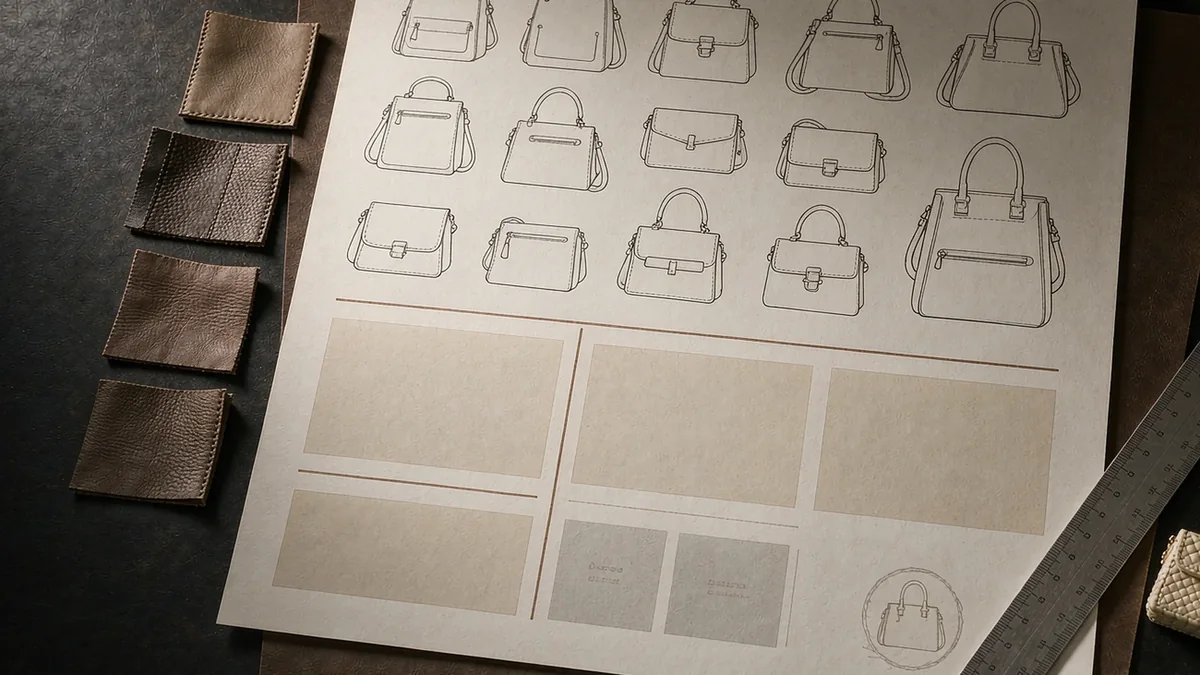
A Shape That Held for Three Seasons
One programme launched a medium top-handle piece with a single unusual decision: the handle was set 15 mm forward of the vertical centre line. It was not announced, not explained and barely visible in a photograph. What it did was make the piece sit differently on the arm, and within two seasons customers were describing it to sales staff by that behaviour rather than by its name.
Three things then happened that separate a signature from a good season. The pattern was archived with version control, so a second run two years later produced the same lean. The hardware was specified as a custom die rather than a catalogue part, so no competitor could buy the same fitting. And the colourway count was held at three per run, which kept the shape legible instead of fragmenting it into variants.
None of those three is a design decision. All three are production decisions, and that is the argument of this page: a shape becomes a signature through what is controlled after approval, not through what was drawn before it.
What Actually Makes a Shape a Signature
Recognition comes from a small number of cues that survive reproduction at small scale, in poor light and in a photograph taken by a stranger. Four cues do the work: outline, proportion, hardware and behaviour. Outline is what is identified from across a room. Proportion is what makes a photograph of the piece recognisable without scale reference. Hardware is what is recognised up close. Behaviour is how it sits or moves.
Most programmes invest in outline and stop there. Outline is also the easiest cue for another house to echo, since a silhouette can be drawn from a photograph. Hardware and behaviour are far harder to copy, because one requires a custom die and the other requires the construction to be right. A signature built only on outline is a signature that lasts one season.
Outline
Recognisable from across a room and from a single angle. The easiest cue to echo, so it should never be the only one carrying the shape.
Proportion
Recognisable in a photograph with no scale reference. Held at a base-to-height ratio of 0.6-0.7 and written into the pack as a number.
Hardware
Recognised up close and the hardest cue to copy, provided it is a custom die rather than a catalogue part bought by everyone else.
Behaviour
How the piece sits, leans or moves. It comes from construction rather than drawing and cannot be copied from a photograph at all.
Cue One: Set the Proportion Anchor in Numbers
Proportion has to be written as a number or it will drift. The figure worth fixing is the base-to-height ratio, which for most signature bodies sits between 0.6 and 0.7. Below about 0.6 a piece reads tall and tips when set down; above 0.7 it reads wide and loses presence on the arm. Fix it, and fix the handle set relative to the vertical centre line, since that is the second thing a customer perceives.
Then hold it across every size in the family. A miniature that carries the same ratio as the medium reads as the same shape; one that carries a different ratio reads as a different bag that happens to share a name. This is where most families break, because scaling a pattern uniformly is easy and preserving a ratio while scaling is not.
- Base-to-height ratio
- 0.6-0.7 on a signature body, held across every size in the family
- Handle set
- Offset from the vertical centre line and recorded in millimetres, not described
- Panel tolerance
- ±1.5 mm on matched panels, ±2 mm on gusset depth
- Stitch density
- 8-9 SPI on body seams, held across every colourway
- Plating thickness
- 0.15-0.3 µm decorative, above 0.3 µm on load-bearing fittings
- Colourways per run
- Three per 500 pc run, so the shape stays legible
- Pattern control
- Digitised pattern with version control and a retained reference
- Serviceability
- Cord and strap replaceable without unpicking the body
Cue Two: Make the Hardware a Custom Die
If hardware is the cue a customer recognises up close, it should not be a part anyone else can order. A custom die costs more at the start and pays for itself across seasons, because it removes the possibility of a near-identical fitting appearing on a comparable piece. It also gives the piece a detail that photographs well in close product shots.
Specify it properly. Plating at 0.15-0.3 µm for decorative fittings and above 0.3 µm on anything carrying load, verified by 24 hour salt spray exposure. Match the finish across every part in the set, since a lock and a foot in visibly different brass is read as an inconsistency rather than as two components. And keep the die under your control rather than leaving it with the house.
Cue Three: Build Behaviour Into the Construction
Behaviour is the only cue that cannot be copied from a photograph, and it comes entirely from construction. A piece that leans, that settles low, that holds its mouth open when set down, does so because of where reinforcement sits, where the handle attaches and how the base is built. All three are specification decisions rather than drawing decisions.
Write the behaviour you want as a measurable statement so it can be checked: it stands within 5 degrees empty; it leans forward by about 5 degrees when set down loaded; it recovers fully within a day after compression. A behaviour that is not measured will not be held, and the second run will differ from the first in a way nobody can explain.
Why Most Signature Attempts Fail
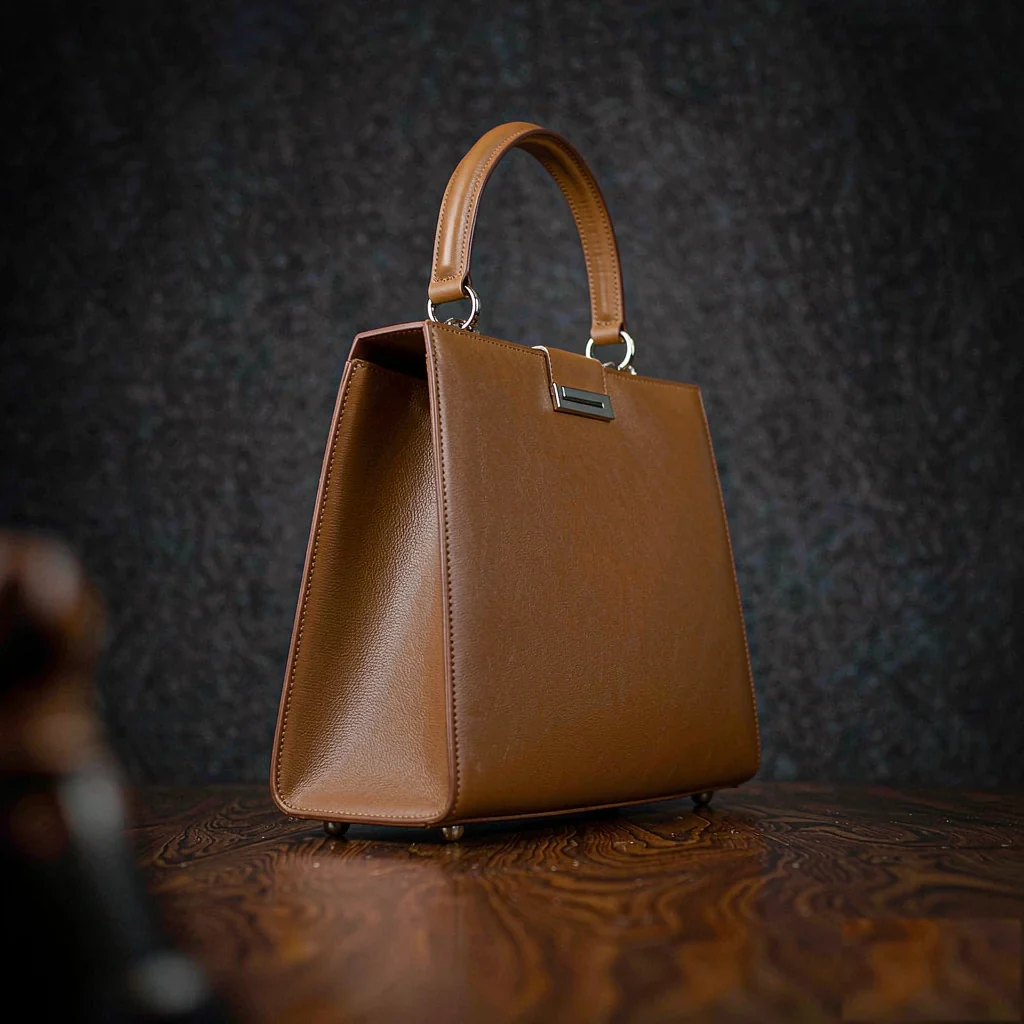
Four failure modes account for nearly all of them, and none is a design failure. The pattern is not archived, so the second run is cut from a redrawn pattern that differs by a few millimetres. The hide changes, and because temper behaves like a structural component, a hide 0.2 mm firmer makes the piece stand where it used to slouch.
The third is colourway sprawl: eight colourways fragment a shape into eight pieces that no customer can recall as one. The fourth is uncontrolled substitution of a catalogue fitting when a custom part runs short, which quietly removes the cue that made the piece identifiable. All four are prevented by the same discipline: archive everything, and require written approval for any substitution.
| Failure | Cause | Control |
|---|---|---|
| Second run differs | Pattern redrawn rather than retrieved | Digitised pattern with version control |
| Stance changes | Hide substituted at 0.2 mm firmer | Temper stated as a measured bend value |
| Shape becomes illegible | Eight colourways fragmenting one form | Three colourways per 500 pc run |
| Cue disappears | Catalogue fitting substituted when stock runs short | Written approval required for any substitution |
| Proportion drifts | Family scaled uniformly rather than by ratio | Ratio held at 0.6-0.7 across every size |
Designing for the Second Owner
Resale is now part of the first purchase decision, and a shape that holds value is easier to sell new. What a second owner needs is legibility and serviceability. Legibility means the piece is identifiable without its packaging, which is the same four cues working again. Serviceability means the parts that fail can be replaced.
Specify for that. A cord or strap that can be replaced without unpicking the body. Feet that can be renewed. A lining that can be cleaned rather than one that stains permanently. And a construction that ages predictably, since a second owner is buying a piece with history and needs to know what year three looks like.
Colourway and Size Discipline
Three colourways per 500 pc run is the working discipline, and it is a commercial decision rather than an aesthetic one. A minimum of 500 pcs per style and colourway means each colourway is a committed quantity, so eight colourways is eight commitments against a shape that customers have not yet learned to recognise.
Sizes follow the same logic. Launch the shape in one size, prove it, then extend to a small and a large that preserve the ratio. Extending before the shape is recognised produces three bags competing for the same recognition and none of them getting it. Extending afterwards produces a family.
Archived patterns, fixed temper, three colourways and no unapproved substitutions. Those four do more for recognition than any decision made at the sketch stage.
The Signature Shape Checklist
Run these twelve before launch and again before every subsequent run. The second pass matters more than the first, because drift is what ends signature programmes, and drift happens on the run after the one everybody was watching.
- Name four recognition cues in writing: outline, proportion, hardware, behaviour.
- Fix the base-to-height ratio at 0.6-0.7 and hold it across every size.
- Record the handle set in millimetres relative to the vertical centre line.
- Commission a custom die for the anchor fitting and keep the die under your control.
- Specify plating at 0.15-0.3 µm with 24 hour salt spray exposure.
- Write the intended behaviour as a measurement: stance, lean and recovery.
- Archive the digitised pattern with version control and a retained reference sample.
- State hide temper as a measured bend value, not as a description.
- Hold colourways to three per 500 pc run until the shape is recognised.
- Require written approval for any component substitution, however minor.
- Make cord and strap replaceable without unpicking the body.
- Re-run the whole checklist before the second production run, not only the first.
Holding the Shape Across a Second Run
The second run is the real test, and it should be treated as a new approval rather than a repeat. Pull the archived pattern, confirm the version, cut a confirmation sample, and measure it against the retained reference held since launch. Panel dimensions within ±1.5 mm, gusset depth within ±2 mm, stitch density at 8-9 SPI, and the behaviour measurements taken again rather than assumed.
If any figure has moved, stop and find out why before cutting bulk. The cause is almost always one of the four failures above, and it is far less expensive to find at confirmation sample stage than at goods-in on a finished run of 500 pieces.
Programme Figures for a Signature Shape
Signature programmes run through our validated partner factory Quanzhou Yingming Bags, an SGS-validated site with 7 production lines and roughly 200,000 pcs per month of capacity, holding export experience since 2014. Sampling takes 6-10 working days, or 12-15 where a custom die or insert has to be developed; bulk occupies 35-50 days; and minimums sit at 500 pcs per style and colourway leaving FOB Xiamen.
Every run is drawn at AQL 2.5 under ISO 2859-1 and read against the retained reference rather than against memory. Hide and temper selection for repeat runs sits on luxury materials, the construction behind each behaviour cue on craftsmanship, and the approval sequence on luxury sampling.
Build a shape that survives its second run
Send the outline, the proportion you have in mind and how the piece should behave when set down. You will receive a written specification covering pattern control, hardware, temper and colourway discipline. Request a quote.
Frequently Asked Questions
What makes a handbag shape a signature?
Four cues a stranger can name: outline recognisable across a room, proportion recognisable in a photograph, hardware recognised up close, and behaviour in how the piece sits or moves. Most programmes invest in outline alone, which is the easiest cue for anyone to echo.
Why is proportion more important than outline?
Outline can be copied from a photograph; proportion is harder to reproduce exactly and is what makes a piece recognisable without a scale reference. Fix it as a base-to-height ratio of 0.6-0.7 and write that number into the pack rather than describing it.
Should hardware be a custom die or a catalogue part?
A custom die, if hardware is the cue customers recognise up close. It costs more at the start and pays across seasons by removing the possibility of a near-identical fitting appearing elsewhere. Keep the die under your control rather than leaving it with the house.
What plating thickness should signature hardware carry?
0.15-0.3 µm for decorative fittings and above 0.3 µm on anything carrying load, verified by 24 hour salt spray exposure. Match the finish across every part in the set, since a lock and a foot in visibly different brass reads as inconsistency.
How should the behaviour of a shape be specified?
As measurements rather than impressions. It stands within 5 degrees empty, leans forward by about 5 degrees when set down loaded, and recovers fully within a day after compression. A behaviour that is never measured will not be held across runs.
Why do second runs differ from first runs?
Most often because the pattern was redrawn rather than retrieved, or because the hide changed. Temper behaves like a structural component, so a hide 0.2 mm firmer will make a piece stand where it used to slouch. Archive the pattern and fix temper as a measured value.
How many colourways should a signature shape carry?
Three per 500 pc run until the shape is recognised. A minimum of 500 pcs per style and colourway means each colourway is a committed quantity, so eight colourways fragments one shape into eight pieces no customer can recall as one.
When should a family be extended to more sizes?
After the launch size is recognised, not before. Extending early produces three bags competing for the same recognition and none getting it. Extending afterwards produces a family, provided the base-to-height ratio is preserved at every size.
What does resale value require from the specification?
Legibility and serviceability. The piece must be identifiable without its packaging, which is the four cues working again, and the parts that fail must be replaceable: a cord or strap without unpicking the body, renewable feet, and a lining that can be cleaned.
How is a repeat run approved?
Treat it as a new approval. Pull the archived pattern, confirm the version, cut a confirmation sample and measure it against the retained reference: panels within ±1.5 mm, gusset within ±2 mm, stitch density at 8-9 SPI, and behaviour measured again.
What happens if a component runs short mid-run?
Require written approval for any substitution, however minor. Uncontrolled substitution of a catalogue fitting when a custom part runs short is one of the four common ways a signature quietly loses the cue that made it identifiable.
What are the programme figures for a signature shape?
Sampling takes 6-10 working days, rising to 12-15 where a custom die or insert has to be developed. Bulk occupies 35-50 days with minimums at 500 pcs per style and colourway leaving FOB Xiamen, inspected at AQL 2.5 under ISO 2859-1.
People Also Ask
Can a small label build a signature shape?
Yes, and more easily than a large one, because discipline is easier to hold at 500 pcs per colourway than across a wide range. Three colourways, one custom fitting and an archived pattern are within reach of any programme, and they do most of the work.
Does a signature shape have to be unusual?
No. Many recognised shapes are restrained. What matters is that the cues are consistent and that at least one of them cannot be copied from a photograph, which usually means behaviour or a custom fitting rather than an unusual outline.
How long does a signature shape take to establish?
Plan for three seasons of consistent production. Recognition requires repetition, and a shape that changes its hide, hardware or proportions each season never accumulates the familiarity that makes a piece identifiable to strangers.
Should the packaging carry recognition too?
It helps, but it should not be the cue. A second owner rarely has the original box, so a shape that is only identifiable with its packaging loses legibility exactly where resale value is decided.
Is it worth paying for a custom die?
Usually, if hardware is the anchor cue. The cost sits at the start and is recovered across every subsequent run, because it removes the possibility of a near-identical fitting appearing on a comparable piece at a comparable price.
Sources and further reading
Every figure on this page is either our own programme data or attributed below. Open the originals before you write them into a specification.
- ISO - International Organization for StandardizationISO Publisher of ISO 2859-1 for attribute sampling and the ISO 105 series covering colour fastness of leather and trim.
- ASTM International standardsASTM International Publisher of test methods covering seam strength, abrasion resistance and dimensional stability of assemblies.
- Leather Working GroupLeather Working Group Environmental auditing programme for tanneries, referenced when assessing hide provenance and temper consistency.
- SGS - Inspection and verificationSGS Third-party validation and goods-in inspection body referenced for site validation and pre-shipment checks.