How to Adapt Runway Luxury Bag Silhouettes for Production: A Seven-Stage Decision Tree
A runway shape reaches the bench as exaggeration: a hem dragged past the floor, a handle scaled beyond comfort, a volume held up by wire and the walk. Adapting one is not simplification. It is deciding which two of its four exaggerations actually carry the idea, and rebuilding the other two so they survive repetition. In practice that means fixing hide at 1.2-1.4 mm, stitch density at 8-9 SPI, plating at 0.15-0.3 µm and panel tolerance at ±1.5 mm before a pattern is cut, then proving the result on a third sample built in production tooling.
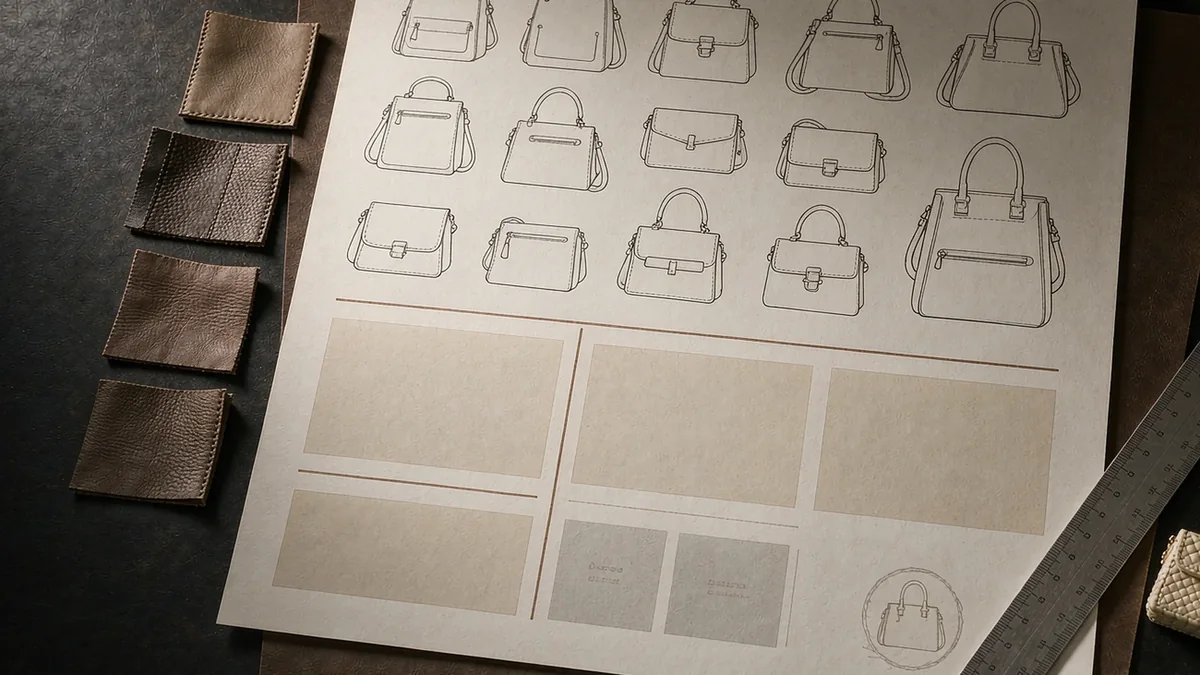
Why the Runway Version Cannot Be Built As Drawn
A show piece is engineered for eight minutes under light and one body it was fitted to. It may be pinned closed, weighted at the hem, held with a hidden armature, or cut from a hide selected by eye from a single skin. None of those conditions exist again. The moment a shape is repeated, every decision that depended on a single favourable circumstance becomes a specification someone has to write down.
That is the real work of adaptation, and it is an editing job far more than a technical one. Most failed adaptations fail aesthetically rather than structurally: the team preserves the outline but loses the gesture, producing a piece that is recognisably derived and quietly wrong. The seven stages below exist to force the gesture into the open early, while it can still be argued about inexpensively.
Stage One: Name the Gesture Before Touching the Pattern
Before any measurement, write one sentence describing what the shape does: it leans, it collapses at the mouth, it carries its volume low, it stands on a narrow base. If the team cannot agree on that sentence, the pattern will be argued over instead, which costs three weeks and produces nothing. Ask for the sentence in writing and attach it to the tech pack.
Then identify which exaggerations serve that sentence. A shape typically exaggerates four things at once: scale, volume, drape and proportion of detail. Two of them carry the idea and two are consequence. Adapting well means keeping the two carriers at full strength and quietly reducing the other two, rather than trimming everything by a little and flattening the whole thing.
- Scale: overall size relative to the body, usually the first thing to be reduced and the last thing that should be.
- Volume: how much air the piece encloses when empty, which drives hide consumption and freight more than size does.
- Drape: how the hide falls under its own weight, the hardest of the four to hold across a run.
- Detail proportion: hardware size relative to panel, which photographs differently at every scale.
- Closure logic: whether the mouth fastens or merely overlaps, a decision runway pieces routinely avoid.
Stage Two: Decide Where the Shape Comes From
Every silhouette gets its shape from one of three places, and the choice determines everything downstream. The hide itself, if it is thick enough and tempered to hold a form. Internal reinforcement, if the shape must hold whether the piece is full or empty. Or contents and gravity, which is what a genuinely soft piece relies on and what most runway drape actually is.
Runway drape is usually the third, and this is where adaptations go wrong: a team specifies interlining to reproduce a collapse that only ever came from a particular hide hanging under its own weight. The result is a piece that looks engineered and behaves limp. Decide the source of the shape first, and only then choose what, if anything, needs to be added inside.
Hide as structure
Best when the gesture is collapse. Needs 1.2-1.4 mm hide of consistent temper and near-perfect selection, and it is the least tolerant of variation across a run.
Reinforcement as structure
Best when the gesture is stance. Carries a base insert and bonded interlining, adds 15-25 percent weight, and forgives far more hide variation than a relaxed build.
Contents as structure
Best when the gesture is movement. Requires no internal work at all and no tolerance problem, but the piece must be photographed and sold loaded or it reads as shapeless.
Stage Three: Fix Hide and Temper Before Pattern Work
Hide is chosen too late in most programmes, after the pattern is cut and the sample has already been approved in a substitute material. Substitution is the single largest source of disappointment at bulk, because temper behaves like a structural component. A hide 0.2 mm thicker with a firmer temper will stand where the sample slouched, and no amount of pattern correction restores a collapse that came from the material.
Specify three numbers and refuse to proceed without them: substance, temper and finish. Substance at 1.2-1.4 mm for a body that must hold some form, lighter at 0.9-1.1 mm where collapse is the point. Temper as a stated bend value rather than a description. Finish as pigmented or aniline, because an open finish darkens at contact points within weeks and will change how the silhouette reads in month three.
- Body hide substance
- 1.2-1.4 mm where the piece holds form; 0.9-1.1 mm where collapse is intended
- Temper
- Stated as a measured bend value, not described as soft or firm
- Stitch density
- 8-9 SPI on body seams; 7-8 SPI where assemblies run thick
- Edge build
- Three coats of edge paint, each applied at 0.08-0.12 mm wet
- Reinforcement, where used
- 0.8-1.2 mm at the base with 180-260 gsm interlining bonded through panels
- Panel tolerance
- ±1.5 mm on matched panels; ±2 mm on gusset depth
- Handle drop variance
- ±3 mm between left and right on any paired handle
Stage Four: Set the Hardware Load Path
Hardware on a show piece is often decorative and often unloaded. On a production piece it carries every gramme of the contents, repeatedly, for years. Adapting means deciding where load actually travels: from handle to panel, from panel to base, from closure to frame. Each of those junctions needs reinforcement in the hide, and the reinforcement needs room in the pattern that the original drawing did not allow for.
Three figures settle most of this. Plating thickness at 0.15-0.3 µm for decorative hardware and above 0.3 µm for anything taking load, verified by salt spray exposure of 24 hours. Closure pull force at 1.2-1.8 kg for a magnetic fastening, high enough to stay shut in a bag and low enough to open one-handed. And foot clearance at 3 mm, so a base sits on its feet rather than on its seam.
| Runway condition | Production requirement | Consequence if ignored |
|---|---|---|
| Handle scaled for silhouette only | Load path into a reinforced panel, drop variance within ±3 mm | Handle stretch and visible lean after one season |
| Closure decorative or absent | Stated pull force of 1.2-1.8 kg and a cycle test before bulk | Mouth gapes under working weight |
| Hardware oversized for effect | Plating 0.15-0.3 µm, 24 hour salt spray exposure | Finish wear at contact points within weeks |
| Base unprotected | Feet with 3 mm clearance and a 0.8-1.2 mm insert | Corner rounding and crushed seams in transit |
| Volume exaggerated | Nesting study before carton costing | Freight quote arrives far above plan |

Stage Five: Reconcile Silhouette With Volume and Weight
Volume is the exaggeration that survives adaptation most often and costs the most when it does. A piece enclosing 30 percent more air than it needs adds hide, adds interlining, adds freight and adds storage, and it reads as heavy in the hand long before it reads as generous. Reduce volume before reducing outline: the eye measures the silhouette far more than it measures the capacity.
Weight follows the same arithmetic. A structured adaptation typically carries 15-25 percent more mass than the soft equivalent in the same hide, most of it reinforcement rather than leather. Selective reinforcement is the usual correction: hold the base and the top edge, relax the sides, and recover roughly half the penalty while keeping the stance that made the shape worth adapting.
Stage Six: Prove It at the Bench Before It Reaches a Line
Approve the third sample, not the first. Early samples are built by the most experienced hands with time that no repeated piece will receive, and they flatter the specification. A third sample built on production tooling and cut by production dies is the first honest evidence of what the run will look like, and it is where tolerance problems finally surface.
Run four checks on it. Load it to working weight for a week and measure sag. Set it empty on a level surface and measure lean, which should sit within 5 degrees for anything structured. Compress it to two thirds of packed volume for twenty-four hours and measure recovery within a further day. And cycle the closure two hundred times, which is roughly a season of ordinary use.
Stage Seven: Lock Tolerances That Survive Repetition
Tolerance is where adaptation either holds or quietly drifts. Write the numbers that matter into the tech pack as ranges rather than ideals, and inspect against them: ±1.5 mm on matched panels, ±2 mm on gusset depth, ±3 mm on paired handle drop, 8-9 SPI on body seams. Anything stated as a single figure will be missed half the time and argued about the other half.
Pair each tolerance with a retained reference rather than with memory. A stored approved sample, photographed under fixed light and kept beside the bench, settles disputes in minutes that otherwise consume days. It also gives an inspection team something to read against, which is what turns a written tolerance into an enforced one.
First samples are built by the best hands with time no repeated piece receives. Only a sample made on production tooling tells you what the run will actually look like.
The Decision Tree in One Pass
Work the seven stages in order and record an answer at each, because the sequence matters. Deciding shape source before hide, and hide before hardware, prevents most of the rework that makes adaptation expensive. The questions below compress the same route into a single page that can be walked through with a sketch on the table.
- Write one sentence naming the gesture, agreed in writing before any pattern work.
- List the four exaggerations and mark which two carry the idea.
- Choose the source of the shape: hide, reinforcement or contents.
- Fix hide substance, temper and finish as measured values.
- Draw the hardware load path and reinforce each junction in the pattern.
- Reduce volume before outline, and weigh the piece loaded rather than empty.
- Approve the third sample built on production tooling.
- Write tolerances as ranges and pair each with a retained reference sample.
Reading an Adapted Sample Honestly
Compare the adapted sample against the runway reference, not against the sketch, and compare them on the same day under the same light. Handle both loaded to working weight, carry each across a room and set it down. Both look their best standing still on a bench, which is precisely the condition in which no customer will ever assess either.
Then judge three things in order: gesture, access and sound. Gesture is whether the shape still does the thing the one sentence described. Access is whether the mouth opens and stays open, which changes daily use more than any other single decision. Sound is how much the hardware and structure talk when the piece moves, and it is the detail customers notice without being able to name.
Programme Figures for Adapted Runway Shapes
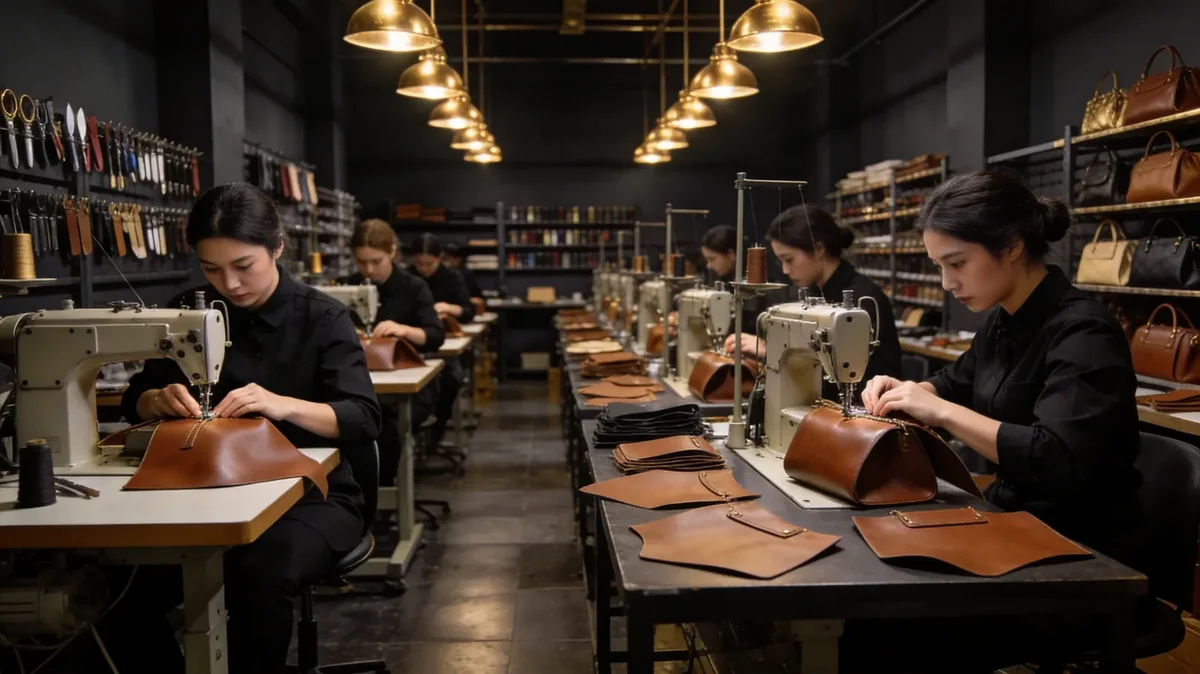
Development runs through our validated partner factory Quanzhou Yingming Bags, an SGS-validated site with 7 production lines and roughly 200,000 pcs per month of capacity, holding export experience since 2014. An adapted shape takes 6-10 working days for the first sample and 12-15 where a frame, insert or custom die has to be developed; bulk occupies 35-50 days; and minimums sit at 500 pcs per style and colourway leaving FOB Xiamen.
Every run is drawn at AQL 2.5 under ISO 2859-1 and read against the retained reference rather than against memory. Hide selection for adapted work sits on luxury materials, the construction detail behind each load path on craftsmanship, and the approval sequence on luxury sampling.
Bring the sketch before the pattern is cut
Send the runway reference, the one sentence describing the gesture, and how the piece will actually be carried. You will receive a written adaptation route naming hide, reinforcement, hardware load path and tolerance for each stage. Request a quote.
Frequently Asked Questions
Why can a runway bag shape not be produced exactly as shown?
Show pieces are engineered for eight minutes under light and one fitted body. They may be pinned, weighted at the hem or held by a hidden armature, and cut from a single skin chosen by eye. None of those conditions repeat, so every decision that relied on one favourable circumstance has to become a written specification.
What is the first step in adapting a runway silhouette?
Write one sentence naming the gesture, whether it leans, collapses at the mouth, carries volume low or stands on a narrow base. Agreement on that sentence in writing prevents the pattern being argued over instead, which costs weeks and produces nothing usable.
How many exaggerations should an adapted shape keep?
Two of the usual four. A show piece exaggerates scale, volume, drape and detail proportion at once, but only two carry the idea. Keeping those at full strength and quietly reducing the others preserves the gesture, whereas trimming everything flattens the result.
What hide thickness suits an adapted runway shape?
1.2-1.4 mm where the piece must hold some form, and 0.9-1.1 mm where collapse is the point. Temper should be stated as a measured bend value rather than described as soft or firm, because temper behaves like a structural component and cannot be corrected in the pattern afterwards.
Why should hide be specified before the pattern is cut?
Because substitution is the largest source of disappointment at bulk. A hide 0.2 mm thicker with firmer temper will stand where the sample slouched, and no pattern correction restores a collapse that came from the material. Specify substance, temper and finish up front and refuse to proceed without all three.
What stitch density should be specified on body seams?
8-9 stitches per inch on body seams, dropping to 7-8 where assemblies run thick. Stated as a range and inspected against it, stitch density is one of the few visible signals a customer reads as quality, and it costs little to hold if it is written down.
How thick should hardware plating be on an adapted piece?
0.15-0.3 µm for decorative hardware and above 0.3 µm for anything carrying load, verified by 24 hour salt spray exposure. Show hardware is often decorative and unloaded; production hardware carries the contents repeatedly, and under-plated finishes wear at contact points within weeks.
How much pull force should a magnetic closure carry?
Between 1.2 and 1.8 kg. That is high enough to keep the mouth shut inside another bag and low enough to open one-handed at a counter. It should be confirmed by a cycle test on the third sample rather than judged by feel on the first.
Should volume or outline be reduced first when adapting?
Volume. A piece enclosing 30 percent more air than it needs adds hide, interlining, freight and storage, and it reads as heavy in the hand before it reads as generous. The eye measures the silhouette far more than it measures the capacity, so outline is worth defending.
Why should the third sample be the one approved?
First samples are built by the most experienced hands with time no repeated piece will receive, and they flatter the specification. A third sample cut on production dies is the first honest evidence of what the run will look like, and it is where tolerance drift finally appears.
Which tests should an adapted sample pass before bulk?
Four: load to working weight for a week and measure sag; set empty and confirm lean within 5 degrees on structured work; compress to two thirds of packed volume for a day and confirm recovery within another; and cycle the closure two hundred times.
What tolerances should be written into the tech pack?
Ranges rather than ideals: ±1.5 mm on matched panels, ±2 mm on gusset depth, ±3 mm on paired handle drop, and 8-9 SPI on body seams. Pair each with a retained reference sample so disputes settle in minutes instead of consuming days of correspondence.
How long does an adapted runway shape take to develop?
6-10 working days for a first sample, rising to 12-15 where a frame, insert or custom die has to be developed. Bulk occupies 35-50 days, with minimums at 500 pcs per style and colourway leaving FOB Xiamen, inspected at AQL 2.5 under ISO 2859-1.
People Also Ask
Can a runway silhouette be adapted without losing its impact?
Yes, by editing rather than trimming. Name the gesture in one sentence, identify which two of the four exaggerations carry it, hold those at full strength and quietly reduce the other two. Trimming everything by a little is what flattens an adaptation into something merely derived.
Does adapting a shape usually mean adding structure?
Not necessarily, and adding it is a common error. Runway drape usually comes from a particular hide hanging under its own weight. Specifying interlining to reproduce a collapse produces a piece that looks engineered and behaves limp, so decide the source of shape first.
How much weight does reinforcement add to an adapted shape?
Typically 15-25 percent more than a soft equivalent in the same hide, and most of it is reinforcement rather than leather. Selective reinforcement at the base and top edge with relaxed sides recovers roughly half that penalty while keeping the stance.
What is the most expensive mistake in runway adaptation?
Approving a sample built in a substitute hide. Temper behaves like a structural component, so a hide 0.2 mm thicker and firmer will stand where the sample slouched, and nothing in the pattern can restore the intended collapse afterwards.
Should adapted pieces be photographed loaded or empty?
Both, on the same day and under the same light. A piece relying on contents for its shape reads shapeless if sold empty, while an engineered piece reads heavy if photographed loaded. The mismatch between photograph and reality is a common source of returns.
Sources and further reading
Every figure on this page is either our own programme data or attributed below. Open the originals before you write them into a specification.
- ISO - International Organization for StandardizationISO Publisher of ISO 2859-1 for attribute sampling and the ISO 105 series covering colour fastness of leather and trim.
- ASTM International standardsASTM International Publisher of test methods covering seam strength, abrasion resistance and dimensional stability of assemblies.
- Leather Working GroupLeather Working Group Environmental auditing programme for tanneries, referenced when assessing hide provenance and temper consistency.
- SGS - Inspection and verificationSGS Third-party validation and goods-in inspection body referenced for site validation and pre-shipment checks.