Best Selling Luxury Handbag Silhouettes Today: Six Shapes, Found by Walking One Decision Tree
The silhouettes that sell consistently are not six separate inventions; they are the six endpoints of one decision tree, and the tree is short. Five questions settle it: hands-free or carried, across the torso or at the hip, handle or grip, how much structure the capacity demands, and what closure the front will accept. Every shape on the current list answers those five the same way, which is why they keep reappearing across seasons while the shapes invented around them do not. Below, the tree is given first, then each of the six endpoints with the dimensions it sits on, then the figures all six share, and finally the way to read the tree for a line of your own.
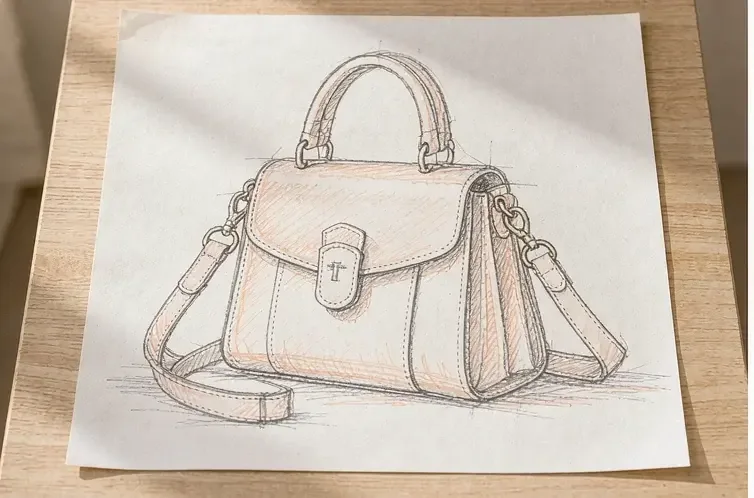
The Decision Tree Every Best Seller Passes Through
A silhouette arrives at its shape by answering five questions, and the answers are forced by the body rather than chosen from a mood board. The tree below is the short version, and it is walked in this order because each answer removes options from the next.
- Hands-free or carried? If hands-free, the piece is a shoulder or crossbody shape and the strap is decided before the body.
- If hands-free, does it cross the torso? If it does, the width is capped at 220-260 mm and the capacity moves into depth.
- If carried, is it a handle or a grip? A handle takes a 90-110 mm drop; a grip takes no strap at all and a taller body.
- How much structure does the capacity demand? Above 320 mm across, a base board is required or the shape will not hold.
- What closure will the front accept? On a front under 220 mm, a turn lock over 22 mm across is oversized.
Walking the tree in this order takes a few minutes and removes the two expensive errors: a body too wide for its carrying position, and a closure too large for its front. Both are only discovered at the toile, where they cost a round rather than a pencil stroke.
The Six Endpoints and the Figures Each One Sits On
These six are where the tree lands most often. The table gives the width, the structure, the carrying position and the sampling calendar for each, which is the set of figures a brief has to contain before development starts.
| Silhouette | Width and structure | How it carries |
|---|---|---|
| Semi-structured top handle | 260-300 mm, 1.2-1.4 mm over 0.8 mm interlining | Handle at 90-110 mm, or a removable strap |
| Soft shoulder tote | 320-380 mm, 1.0-1.2 mm without interlining | Two straps at 240-280 mm drop |
| Underarm piece | 220-260 mm, 1.2-1.4 mm, semi-structured | No strap; gripped at a 100-120 mm opening |
| Compact crossbody | 200-240 mm, 1.2-1.4 mm over 0.8 mm interlining | Strap at 480-560 mm with a 25 mm slide |
| Mini top handle | 160-200 mm, 1.2-1.4 mm on a 1.2 mm board | Handle at 60-90 mm, carried in one hand |
| Soft hobo | 300-360 mm, 1.0-1.2 mm without interlining | Single strap at 200-240 mm drop |
Two things are visible across the rows. The widths cluster into three bands, narrow at 160-240 mm, medium at 260-300 mm and wide at 320-380 mm, and the structure follows the width almost exactly, since only the widest two tolerate going without reinforcement. The third thing is that none of the six needs bespoke hardware to work.
The Semi-Structured Top Handle
The most requested of the six and the one that exercises every branch of the tree. It sits at 260-300 mm across on 1.2-1.4 mm panels over 0.8 mm interlining, with a 1.6 mm base board and a handle at 90-110 mm drop.
- A handle drop of 90-110 mm clears the hand and keeps the piece from swinging.
- The 1.6 mm base board is what lets the body hold its shape when it is set down empty.
- A removable strap at 18-20 mm adds two anchors and one more sample round.
- A #5 zip serves the main opening; a #3 is too light for a 300 mm front.
- It samples in 6-10 working days and usually needs two rounds to settle.
The Soft Shoulder Tote
The widest of the six and the only one that gains from being unstructured. At 320-380 mm across on 1.0-1.2 mm panels without interlining, it is meant to slump, and reinforcement would defeat the point of it.
- Two straps at 240-280 mm drop, since one strap at this width twists under load.
- Straps at 18-20 mm at the load point, or they cut into the shoulder when filled.
- An open top with a magnetic tab is the usual closure, and the fastest to build.
- The base is the weak point: a folded gusset alone will not hold a line at 380 mm.
- It is the fastest of the six through development, at one round of 6-10 working days.
The Underarm Piece
The shape that returned hardest, and the one with no strap at all. It works because the body is proportioned to be gripped: 220-260 mm across, 120-150 mm tall, with an opening of 100-120 mm that closes against the body when it is held.
- Height of 120-150 mm is what makes the piece grippable rather than merely small.
- The opening at 100-120 mm has to close, or the contents are visible when it is carried.
- Semi-structured construction at 1.2-1.4 mm keeps the sides from collapsing inward.
- A magnetic tab at the top edge is the commonest closure and the least visible.
- Proportion is everything here, and it is settled on a 10 oz calico toile in two passes.
The Compact Crossbody
The narrowest of the six, capped by the tree: a body that crosses the torso cannot exceed 220-260 mm, so this shape sits at 200-240 mm and takes its capacity from a depth above 110 mm instead.
- A strap at 480-560 mm drop with a 25 mm slide across a 100 mm working range.
- Strap width of 20-25 mm, because the load travels diagonally over a small area.
- A front flap over a #5 zip, which must be reachable while the piece is being worn.
- A 1.6 mm base board under the diagonal load, which pulls differently at the base.
- Two leather rounds at 6-10 working days, or 12-15 if the adjuster is bespoke.
It is also the shape that most often needs the strap width corrected. A 12 mm strap drawn because it looked refined will cut into the shoulder once the body is filled, and the correction is simply to widen it to 20-25 mm and leave the drawing alone.
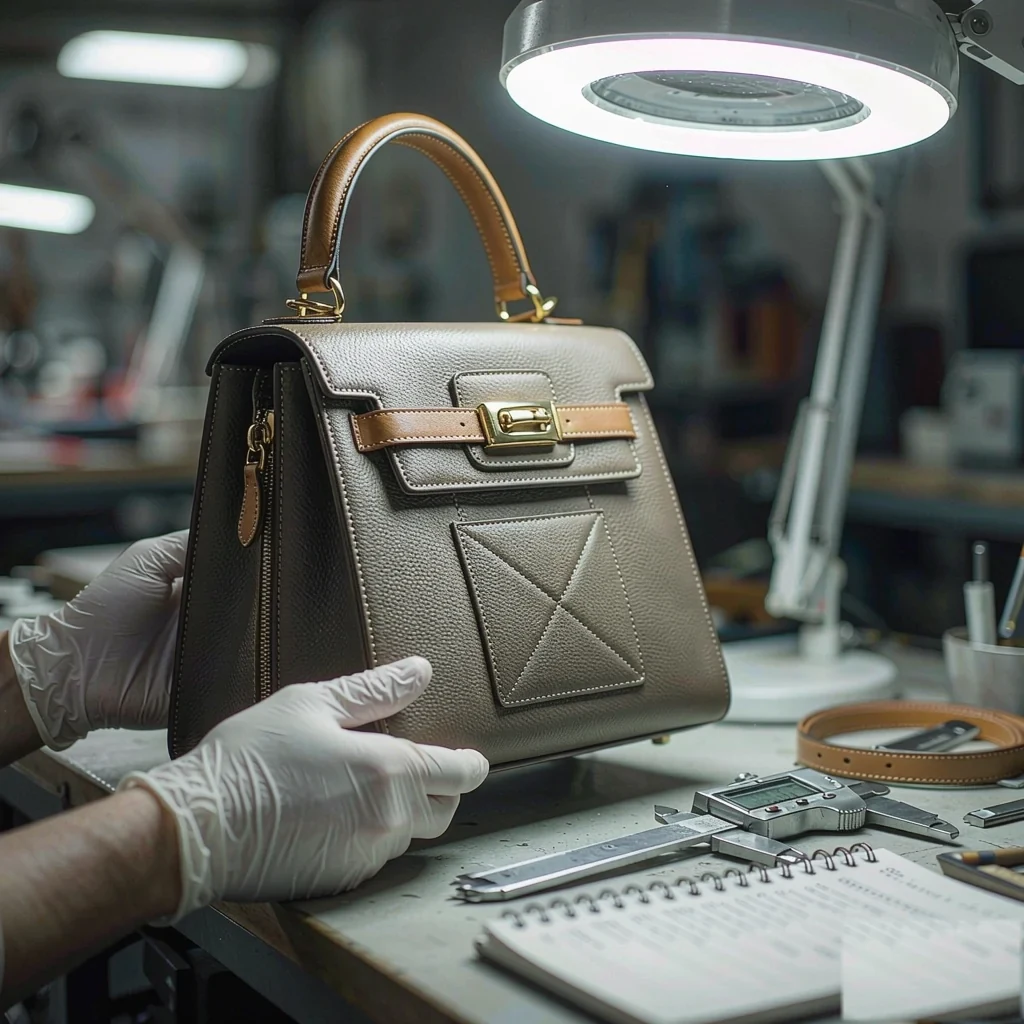
The Mini Top Handle
The smallest of the six and the most demanding to proportion. At 160-200 mm across on a 1.2 mm base board, it holds a phone and a card holder and very little else, and every element on the front is read at that scale.
- A handle at 60-90 mm drop, which is shorter than the 90-110 mm used at 300 mm across.
- A 1.2 mm base board rather than 1.6 mm, since the thicker board is visible at this width.
- A turn lock no larger than 18-22 mm across, or it dominates the whole front.
- A #3 zip for the opening; a #5 is too heavy for a 200 mm front.
- Two toile passes in 4 mm steps, since the errors at this scale are half the usual size.
The Soft Hobo
The sixth shape is the one that depends entirely on the shoulder. A single strap at 200-240 mm drop leaves the body to fall into a curve, and the curve is the whole design, which means the pattern has to be drawn for the slump rather than for the flat.
- A single strap at 200-240 mm drop, wider at 25-30 mm because it carries alone.
- Panels at 1.0-1.2 mm with no interlining, so the body can fall into its curve at all.
- A crescent top line, which is where the pattern differs most from a tote or a top handle.
- A dip at the centre of the opening of around 40-60 mm, which is what lets it collapse.
- A magnetic tab at the dip, since a zip would hold the top open and defeat the shape.
The hobo is the shape most often drawn wrong, because a crescent drafted flat does not fall into a curve when it is hung. It is also the one most worth toileing, since the correction is in the top line and not in the panels.
What All Six Share
The six shapes differ on width and carrying position and agree on almost everything else. These are the figures that recur across all of them, and they are the ones a specification has to state regardless of which shape is chosen.
- Working tolerance on cut panels
- ±1.5 mm, which nesting and skiving both have to respect
- Yield on a structured panel set
- 55-65% of purchased hide area reaches the piece
- Stitch density at load points
- 8-9 per inch with 0.45 mm braided polyester thread
- Trim plating on stock brass
- 0.15-0.3 µm, holding the trim line near USD 4.80 per bag
- Lining thickness
- 0.8-1.0 mm, with the edge specification stated separately
The shared figures are why six shapes can be developed on one calendar. The differences are in the panels and the trim list; the process behind them does not change, and neither does the time it takes.
Reading the Tree for Your Own Line
The value of the tree is that it tells you which of the six to start from and what to change. Three common briefs and the shape each one lands on.
A first capsule of three pieces
One narrow, one medium, one wide: the compact crossbody, the semi-structured top handle and the soft shoulder tote. Three widths and three carrying positions, sharing one trim list and one calendar.
A second season built on one shape
The mini top handle, graded down. It reuses the pattern logic of the 260-300 mm piece at 160-200 mm, which means one toile rather than two and fewer corrections in 4 mm steps.
An evening capsule
The underarm piece and the mini top handle, at 220-260 mm and 160-200 mm. Both are proportioned in 4 mm steps, both use a 1.2 mm board, and both skip the strap entirely.
The first case is the one most lines should run. Three widths across three carrying positions, one trim list and one development calendar, which is the least costly way to look like a collection rather than a single piece.
Whichever the brief lands on, the piece then moves to sampling at 6-10 working days, or 12-15 for complex builds, then to bulk at 35-50 days, with each style and colourway committed at MOQ 500 pcs and inspection drawn at AQL 2.5 under ISO 2859-1. Handover is on FOB Xiamen terms. The programme is delivered through our validated partner factory Quanzhou Yingming Bags, an SGS-validated site with 7 production lines and about 200,000 pcs per month of capacity, holding export experience since 2014.
Find your endpoint on the tree
Tell us the carrying position, the capacity and the material. You will receive the shape it lands on, with the width, the structure and the working days, within two. Request a quote.
Frequently Asked Questions
Which luxury handbag silhouettes sell most consistently?
Six of them: the semi-structured top handle, the soft shoulder tote, the underarm piece, the compact crossbody, the mini top handle and the soft hobo. They are not six inventions but six endpoints of one decision tree, which is why they reappear while shapes invented around them do not.
What is the most requested silhouette for a first capsule?
The semi-structured top handle, at 260-300 mm across on 1.2-1.4 mm panels over 0.8 mm interlining with a 1.6 mm base board. It exercises every branch of the tree and usually settles in two rounds of 6-10 working days.
Why are widths clustered into bands?
Because the carrying position caps them. A piece crossing the torso cannot exceed 220-260 mm, a hand-carried piece works at 260-300 mm, and a shoulder tote is widest at 320-380 mm. The bands are structural rather than fashionable.
Which silhouette is fastest to develop?
The soft shoulder tote, because it carries no interlining and no base board and closes with a magnetic tab. It typically settles in one leather round of 6-10 working days rather than the two a structured piece needs.
Which silhouette is hardest to proportion?
The mini top handle, at 160-200 mm across. Every element on the front is read at that scale, the errors are 4 mm rather than 8 mm, and it needs two toile passes. A lock over 22 mm across will dominate the whole front.
How many silhouettes should a first capsule contain?
Three: one narrow, one medium and one wide. In practice the compact crossbody, the semi-structured top handle and the soft shoulder tote, which together cover three carrying positions on one trim list and one calendar.
Do the six silhouettes use different materials?
They use the same materials in different thicknesses. The structured shapes take 1.2-1.4 mm panels over 0.8 mm interlining; the soft shapes take 1.0-1.2 mm without it. Trim, thread and lining are shared across all six.
What determines whether a base board is needed?
Width. Above 320 mm across the body will not hold a line without one, so a 1.6 mm board is fitted. Below 220 mm the 1.6 mm board is visible from the side, and a 1.2 mm board replaces it.
How much usable material does a structured panel set return?
Between 55 and 65% of purchased hide area, across all six silhouettes. The shortfall covers nesting constraints, consistent grain direction and keeping the neck and belly away from visible faces. It is measured against the lot, not assumed.
What stitch density is used on these silhouettes?
8-9 stitches per inch with 0.45 mm braided polyester thread at every load point, including handles and strap anchors. Fewer will not hold a handle join, and the handle is fixed to the reinforcement beneath the panel rather than to the panel.
How long does a six-piece line take to develop?
The three widths can be developed together, so a three-piece capsule runs within the calendar of the slowest piece in it: roughly 9-14 working days for a semi-structured shape, then bulk at 35-50 days from intake.
What happens once a silhouette is approved?
A counter sample is drawn from the frozen specification and retained, bulk runs 35-50 days from intake, and inspection is at AQL 2.5 under ISO 2859-1 with the plan agreed before intake. The counter sample is the reference the run is measured against.
People Also Ask
What are the best selling luxury bag shapes?
Six: the semi-structured top handle, the soft shoulder tote, the underarm piece, the compact crossbody, the mini top handle and the soft hobo.
How do I choose which silhouettes to develop?
Walk the five-question tree: hands-free or carried, across the torso or not, handle or grip, structure the capacity needs, closure the front accepts.
Why do some bag shapes keep selling and others do not?
Because the durable ones answer the five structural questions correctly. Widths that fight their carrying position look right in a drawing and wrong in use.
What width should a first bag be?
260-300 mm for a top handle, which exercises every branch of the tree and takes a 1.6 mm base board.
Can three silhouettes be developed at once?
Yes, if they sit in three different width bands and share a trim list. The calendar is then set by the slowest of the three.
Sources and further reading
Every figure on this page is either our own programme data or attributed below. Open the originals before you write them into a specification.
- ISO — International Organization for StandardizationISO Publisher of ISO 2859-1, the standard behind the AQL 2.5 inspection plan applied to bulk across all six silhouettes.
- Leather Working GroupLeather Working Group Tannery audit protocol, relevant when the lots behind 1.2-1.4 mm panels and 1.6 mm base board need their origin evidenced.
- ISO Online Browsing PlatformISO Public catalogue used to confirm standard names and scopes, including ISO 3376 for tensile strength and ISO 11644 for finish adhesion.
- WWDWWD Reporting on which silhouettes hold across the European and American accessories market, used here for the width bands.
- FashionUnitedFashionUnited Market reporting on the accessories sector, including the seasonal calendars that a three-piece capsule is planned against.