Best Practices for Luxury Bag Tech Packs: 12 Fields and 4 Tolerances That Decide Whether the First Sample Passes
Best practice for a luxury bag tech pack is to fix twelve fields before anything is cut, and to write four tolerances into them. The fields are dimensions with tolerance, material with substance, hardware with drawing, construction notes, interior layout, lining, identification, colour reference, packing, compliance, quantity and handover terms. Four tolerances do most of the work: plus or minus 1.5 mm on panel dimensions, 0.5 mm on strap and handle width, 2 mm on handle drop, and 0.3 mm on edge paint thickness. A pack missing any of these produces a sample that can be admired but not approved, because there is nothing to measure it against.
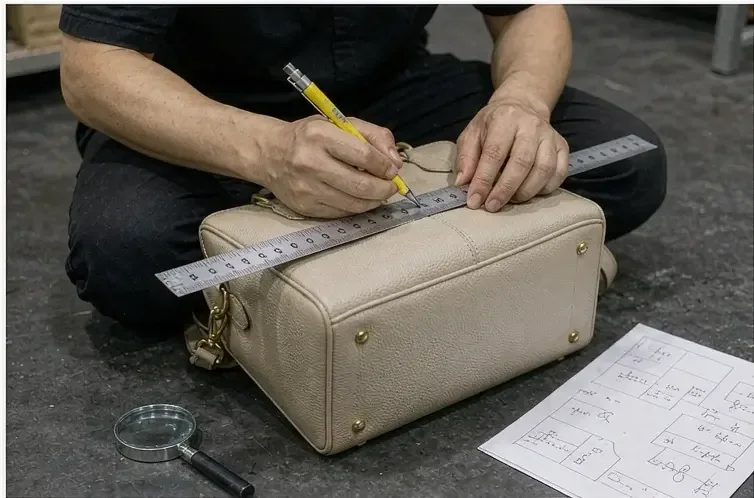
What a Tech Pack Is Actually For
A tech pack is not a drawing set and it is not a brief. It is the document that converts an intention into a specification, and its only test is whether two people reading it separately would produce the same bag. Anything that cannot survive that test is decoration on the page rather than instruction to the bench.
That test sounds abstract until it is applied. A drawing showing a beautiful side profile says nothing about how the gusset is closed, what the interlining weighs, or how many coats the edge carries. The bench will decide all three, and it will decide them differently on a Tuesday than on a Friday. The pack exists to remove those decisions from the moment of making.
The second purpose is settlement. When a bulk delivery is disputed, the pack is what settles it, not the sample and not the photographs. A sealed reference piece settles shade and grain; the pack settles everything measurable, which is most of what gets argued about.
The Twelve Fields, and What Each One Prevents
Twelve fields cover a luxury bag adequately, and the value of listing them as a set is that a missing field can be named before it becomes a fault rather than discovered when the parcel is opened.
| Field | What it must state | What is prevented |
|---|---|---|
| Dimensions | Every external measurement with a tolerance, plus gusset depth and base footprint | A bag that measures correctly but sits wrongly |
| Material | Hide type, grade, substance in mm, finish, tannery and dye lot reference | A sample approved in a hide that cannot supply the run |
| Hardware | Drawing, alloy, plating thickness in microns, finish, cycle count | A closure that loosens after three weeks of use |
| Construction | Stitch pitch, thread gauge, edge coats, interlining weight, seam sequence | Structure that reads as soft when the drawing reads as architectural |
| Interior | Pocket count, depth, placement, closure type, lining at the opening | An interior that fights the exterior for the client's attention |
| Lining | Fibre, weight in gsm, colour, and how it meets the shell at each edge | Lining creep visible at the opening within a season |
| Identification | Logo method, placement, dimensions, and the foil or debossing specification | A mark that reads as an afterthought on a considered piece |
| Colour reference | Physical swatch reference and the light source it was approved under | Shade disputes that no photograph can resolve |
| Packing | Dust bag, box, tissue, silica, carton marks and packing count | Arrival condition that undoes the work of the bench |
| Compliance | Restricted substance requirements, fibre labelling, country of origin marking | A shipment held at import for a document nobody prepared |
| Quantity | Per style and per colourway, with the split stated | A price quoted on a volume nobody is actually ordering |
| Handover terms | Incoterm, port, inspection standard and the acceptance level | Two different understandings of when the order is finished |
Tolerances: The Four Numbers That Decide Whether Bulk Matches the Sample
Four tolerances decide most disputes about whether bulk matches the approved piece, and they are worth writing onto the pack explicitly rather than leaving to convention.
- Panel dimensions at plus or minus 1.5 mm, which absorbs the natural movement of a hide without changing how the piece sits.
- Strap and handle width at plus or minus 0.5 mm, because width is visible in a way that length is not.
- Handle drop at plus or minus 2 mm, measured under a 500 g load, since an unloaded measurement flatters every bag.
- Edge paint thickness at plus or minus 0.3 mm, above which the edge reads as plastic rather than as finished leather.
The third one is the least intuitive and the most useful. A handle drop measured on the bench is not the handle drop a client experiences, because leather relaxes under load. Specifying the load conditions costs one line and removes a class of complaint that no amount of goodwill resolves.
There is a wider point about tolerance discipline. A tolerance of plus or minus 1.5 mm on a panel is achievable and meaningful; a tolerance of zero is neither. Packs written as though the material were sheet metal produce arguments that the bench cannot win and that the pack's author did not intend.
Material Specification: Grade, Substance and Finish
Material is the field most often written loosely, because the language of leather is descriptive where the bench needs it to be numerical. Naming a hide is not specifying one.
A complete material line states the animal and cut, the grade, the substance in millimetres, the finish, the tannery, and the dye lot reference where one has been booked. For a structured silhouette the default substance sits at 1.2-1.4 mm, with a thinner split specified where the panel is turned or gathered. The finish is specified separately because a hide can be correct in every other respect and wrong in the way it reflects light.
- Substance
- 1.2-1.4 mm for a structured shell; 0.9-1.1 mm where the panel turns or gathers
- Grade
- Full-grain for faces and visible panels; corrected grain only where the finish is opaque
- Temper
- Stated as firm, medium or soft, and confirmed against a physical swatch rather than a description
- Finish
- Aniline, semi-aniline or pigmented, with the rub-fastness expectation under ISO 11644
- Lot
- Dye lot booked and tagged before cutting, since a lot of 300-500 hides will not repeat exactly
The last item is the one that saves the most money. A dye lot is a finite quantity of hides finished together, and it will not reappear. Where a programme intends to reorder, the lot reference belongs on the pack so that season two can be cut from the same booking rather than from a near match that nobody will accept.
Hardware: Drawing, Plating and a Cycle Count
Hardware is specified in four parts, and the fourth is the one almost always missing.
- A dimensioned drawing rather than a photograph, with the fixing positions called out.
- The alloy, stated, because zamac, brass and stainless behave differently under the same finish.
- Plating thickness in microns, at 0.15-0.3 microns over a nickel-free undercoat as the working default.
- A cycle count the closure must survive, typically 5,000 open-and-close cycles for a main fastening.
Salt spray resistance follows from the plating figure and is worth stating separately: 24 hours as standard, extended to 48 hours where the piece will be sold into a humid market. The two figures are connected, and a pack that states one without the other invites a substitution that looks identical and performs differently.
For a magnetic closure, state the pull force as well. A magnet specified only by diameter will be substituted freely, and the difference between a closure that holds at 2.2 kgf and one that holds at 1.1 kgf is the difference between a bag that closes and a bag that does not.

Construction Notes: Stitch, Edge and Interlining
Construction notes are where an expensive piece is separated from an ordinary one, and they are three lines long.
- Stitch pitch at 8-9 stitches per inch, with the thread at 0.45 mm matched to the needle.
- Edge finish in three thin coats rather than one thick one, each dried before the next.
- Interlining at 0.8 mm where a panel needs body without stiffness at the fold.
Each of these is a default rather than a decision to agonise over, but each must be written. A sample approved against an unwritten stitch pitch approves whatever the bench happened to do, and bulk will then reproduce a choice nobody made deliberately.
The seam sequence is worth one more line where the construction is unusual. Standard practice closes the gusset before the lining is set; a piece designed to be turned through a single opening needs the sequence inverted, and stating that removes the most common reason a first sample comes back inside out.
Interior, Lining and Identification
The interior is specified with the same care as the exterior, because it is the part the client touches most and the part most often left to be decided on the bench.
Pocket count, depth and placement, closure type, and how the lining meets the shell at each edge are the four lines that matter. Lining weight is given in gsm, typically 110-140 gsm for a structured piece, with the colour stated separately from the shell colour since the two rarely match exactly and should not be assumed to.
Identification is a specification too. The method, hot foil, blind deboss or a metal plate, the placement to the nearest millimetre, and the dimensions of the mark all belong on the pack. A mark described as small and centred will be placed by whoever is holding the tool, and it will not be centred twice the same way.
Four Levels of Tech Pack Maturity Compared
Packs arrive at four levels of maturity, and the level predicts the number of sample rounds more accurately than any promise made on a call.
Level 1: Reference images only
A mood board and a photograph of a bag the founder admires. No dimensions, no material, no hardware. The bench designs the piece, which means the founder approves somebody else's decisions and usually dislikes the result. Four rounds or more.
Level 2: Drawing without tolerances
A clean elevation with overall dimensions. Material named but not specified. Hardware shown but not dimensioned. The sample is close and still not approvable, because close cannot be measured. Three rounds is typical.
Level 3: Specified pack
Twelve fields populated, tolerances written, materials given with substance and finish, hardware drawn. Two rounds plus the pre-production reference. This is the level a luxury programme should reach before the first cut.
Level 4: Specified pack with sealed reference
Level 3 plus a sealed physical reference and a written specification sheet recorded at approval. Reorders become confirmation rounds of 3-5 working days rather than developments, and season two moves faster than season one.
Moving a pack from Level 2 to Level 3 costs roughly a day of studio work and saves three weeks of calendar. There is no other intervention in this trade with that ratio, and it is available to any founder willing to write numbers instead of adjectives.
Compliance and Documentation Fields
Compliance fields are unglamorous and they are the ones that hold a shipment at a border rather than at a bench.
Restricted substance requirements apply to leather, lining, adhesives and coatings, and the relevant lists differ by market. Fibre labelling and country of origin marking are separate requirements again, and neither is satisfied by a logo. Where an exotic skin is used, the CITES documentation travels with the skin rather than with the bag, and the pack should state which appendices apply so the paperwork is prepared at the same time as the material.
The practical instruction is short: state the destination market on the pack. A piece destined for one market is not automatically compliant in another, and retrofitting compliance after bulk has been cut is not possible.
What a Complete Pack Does to the Calendar
A complete pack changes the calendar in three measurable ways, and all three are worth quoting to a founder deciding whether to spend the day.
Sampling holds at 6-10 working days rather than stretching to 12-15, because the bench is not waiting for decisions it is entitled to make. Feedback rounds settle at two rather than three or four. Bulk holds at 35-50 days because material was ordered against a specification rather than against a conversation.
From there the programme is conventional: MOQ 500 pcs per style and colourway, inspection at AQL 2.5 under ISO 2859-1, and handover on FOB Xiamen terms. Export experience on this programme runs since 2014 across 7 production lines with about 200,000 pcs per month of capacity, delivered through our validated partner factory Quanzhou Yingming Bags.
Hand it to somebody who has never seen the design and ask them to quote it. If they can, the pack is finished. If they have to ask six questions first, those six questions are the pack's remaining gaps, and each one is worth a sample round.
Have the pack reviewed before the first cut
Send what you have, however incomplete, and we will return the gaps against the twelve fields with the tolerances we would write. Request a quote.
Frequently Asked Questions
What is a tech pack for a luxury bag?
It is the document that converts an intention into a specification. Its only test is whether two people reading it separately would make the same bag, and anything that fails that test is decoration on the page rather than instruction to the bench.
How many fields should a bag tech pack contain?
Twelve: dimensions with tolerance, material with substance, hardware with drawing, construction notes, interior, lining, identification, colour reference, packing, compliance, quantity and handover terms. Missing fields become defects or disputes.
What tolerance should I put on panel dimensions?
Plus or minus 1.5 mm for a structured shell. That absorbs the natural movement of a hide without changing how the piece sits. A tolerance of zero is not achievable on a natural material and produces arguments nobody intended.
Why is handle drop measured under load?
Because leather relaxes when it carries weight. A drop measured on the bench flatters every bag and is not the drop a client experiences, so specifying 500 g of load costs one line and removes a whole class of complaint.
How should leather be specified?
By animal and cut, grade, substance in millimetres, finish, tannery and dye lot reference. A structured shell sits at 1.2-1.4 mm, with 0.9-1.1 mm where a panel turns or gathers. Naming a hide is not specifying one.
What hardware details belong on the pack?
A dimensioned drawing, the alloy, plating thickness at 0.15-0.3 microns over a nickel-free undercoat, salt spray resistance of 24 or 48 hours, and a cycle count, typically 5,000 for a main fastening.
Why state a cycle count for a closure?
Because a fastening that looks correct can loosen within weeks. A cycle count converts looks nice into a measurable requirement, and it is the only line on the pack that tests the closure rather than describing it.
What are the standard construction defaults?
Stitch pitch at 8-9 stitches per inch, thread at 0.45 mm matched to the needle, edge finish in three thin coats rather than one thick one, and interlining at 0.8 mm where a panel needs body without stiffness at the fold.
Should the interior be specified as carefully as the exterior?
Yes. Pocket count, depth and placement, closure type and how the lining meets the shell are four lines that matter, and lining weight belongs in gsm at 110-140 gsm for a structured piece.
What is a Level 3 tech pack?
One with all twelve fields populated, tolerances written, material given with substance and finish and hardware drawn. It predicts two sample rounds plus a pre-production reference, which is the level a luxury programme should reach before cutting.
Why does the destination market belong on the pack?
Because restricted substance requirements, fibre labelling and origin marking differ by market, and none can be retrofitted once bulk has been cut. Exotic skins additionally travel with CITES documentation prepared alongside the material.
Does a complete pack really shorten the calendar?
Yes, in three ways. Sampling holds at 6-10 working days instead of 12-15, feedback settles in two rounds instead of three or four, and bulk holds at 35-50 days because material was ordered against a written specification.
People Also Ask
What should a handbag tech pack include?
Twelve fields, from dimensioned drawings with tolerances through material substance, hardware drawings, construction notes, interior layout, lining weight, identification, colour reference, packing, compliance, quantity and handover terms.
How do I write tolerances on a bag specification?
Give every measurement a band: 1.5 mm on panels, 0.5 mm on strap width, 2 mm on handle drop under load and 0.3 mm on edge paint. A measurement without a band is a wish, not a specification.
Why do tech packs cause sample rework?
Because fields are left blank and the bench fills them. Each blank field is a decision made by whoever is holding the tool, and each one returns as a surprise in the parcel.
Do I need a physical swatch as well as a written colour?
Yes. Colour names and photographs do not resolve shade disputes. A physical swatch approved under a stated light source, plus a sealed reference piece, settles the question in seconds.
Is a tech pack the same as a design brief?
No. A brief describes what a piece should feel like and who it is for. A pack states what it must measure and how it must be made, and only the second document can be quoted against.
Sources and further reading
Every figure on this page is either our own programme data or attributed below. Open the originals before you write them into a specification.
- ISO - International Organization for StandardizationISO Publisher of ISO 2859-1 for inspection sampling and ISO 11644 for leather rub-fastness, both referenced in a complete specification.
- Leather Working GroupLeather Working Group Tannery audit protocol behind the grade, traceability and dye lot records entered on a material specification.
- SATRASATRA Technology Centre Independent testing organisation for leather and accessories, covering hardware cycle testing and closure performance.
- OEKO-TEXOEKO-TEX Testing and certification system for textile and leather articles against restricted substance lists by destination market.
- CITES - Convention on International Trade in Endangered SpeciesCITES Permit framework governing exotic skins, whose documentation travels with the skin rather than with the finished piece.