Why Handcrafting Matters in Exotic Leather Bags: A Shell You Cannot Re-Punch
Handcrafting matters on exotic leather bags because a shell cannot be re-worked: one misplaced stitch hole in a crocodile flank is permanent, and tile symmetry across a panel set is a layout decision rather than a finishing one. Hand laying, hand skiving and hand stitching at 6-8 per inch with a 0.35 mm thread are what protect a 500-piece run in which the material itself carries most of the unit cost.
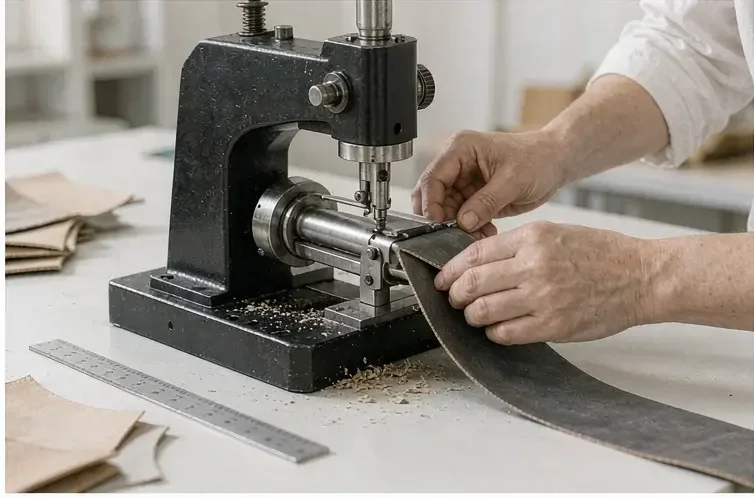
A First Exotic Capsule and the Three Decisions That Nearly Sank It
A European maison arrived with its first exotic capsule: three colourways, a high-gloss finish, and a tech pack written for calfskin and carried over without a change. The pitch was specified at 12 per inch, the edge was specified as painted, and the panels were left to be nested for yield. Every one of those three decisions is correct on a calf body and wrong on a crocodile flank, and the difference only became visible once the first pieces were closed.
At 12 per inch the holes began to perforate the membrane between the tiles rather than pass through it, and the seam lifted where the shell flexes at the gusset. The painted edge sat on top of a surface that had been polished to a different gloss, so the film read as a dull stripe along every boundary. And nesting for yield placed a 30 mm tile next to a 14 mm one on the same front panel, which no finishing operation can disguise.
The three fixes were all manual, and all three had to happen before the run rather than during it: pitch reduced to 6-8 per inch with a finer needle, the edge turned and hand-stitched instead of painted, and the panels laid by hand with a tile-size map drawn per panel position. Together they added bench time and saved the capsule.
Why an Exotic Shell Punishes Machine Work
The rule behind that case is simple: an exotic shell has no correction allowance. On calfskin a misplaced line can be unpicked, the holes closed with a bone folder and the seam re-run with only a small loss. On a crocodile, lizard or ostrich shell, the hole is a permanent perforation through a membrane that does not close, and a sewing machine feeds at a rate set for a uniform substrate rather than for a panel whose thickness varies from 0.6 mm at the flank to 1.6 mm at the spine scale ridge.
- A machine feed dogs a surface of uneven thickness and drifts; a hand awl follows the maker.
- Holes cannot be closed and re-punched, so every placement is final on the first attempt.
- The value of the panel means a wasted piece is not a material write-off but a programme one.
- Gloss finishes show every handling mark, so more of the work has to be done in gloves and by hand.
- Scale or quill direction reads differently under light, which no machine can see.
None of this means machine work has no place. Closing linings, long interior runs and any seam hidden inside the piece are sewn by machine in an exotic programme as they are elsewhere. The hand operations are concentrated where the shell is visible, where the panel is turned, and where an error could not later be corrected.
Scale Symmetry and the Tile-Matching Rule
Tile matching is the first hand operation and the one that decides how expensive the panel set becomes. On a crocodile flank the usable tiles run roughly 25-40 mm across the flank and narrow to 12-18 mm towards the spine; a front panel should carry tiles from one size band only, matched left to right, with the alignment line running through the centre of the piece rather than through the centre of the panel.
- Flank tile width
- 25-40 mm, one band per panel
- Spine tile width
- 12-18 mm, used on gussets and turns
- Left-right symmetry
- Matched within 3 mm across the centre line
- Tile rows per front panel
- 4-6, counted and drawn before cutting
- Panel placement tolerance
- 2 mm from the drawn alignment mark
- Hide consumption versus calf
- 2.5-3.5 times the area for the same panel
- Rejected panels
- Scar, scale loss or a tile break at the fold line
The hide consumption figure is the one that surprises buyers most. Matching a front panel pair can consume two and a half to three and a half times the area the same panel would take in calfskin, because the layout is driven by what the shell offers rather than by what the pattern wants. That is a cost of the material, not of the method, and it is why exotic minimums are discussed per colourway rather than per style.
Thread, Needle and Pitch on a Shell That Cannot Be Re-Punched
Pitch on an exotic seam runs lower than on calf: 6-8 per inch rather than 8-9. The reason is hole spacing relative to tile membrane. At 8 per inch the spacing is 3.18 mm; at 6 it is 4.23 mm, which is enough to leave an unbroken strip of membrane between two holes. The needle is a #7 sharp rather than the heavier point used on a bovine shell, and the thread drops to 0.35 mm waxed linen so the hole it leaves is as small as the hole the awl makes.
Pitch
6-8 per inch on visible exotic seams, giving 3.18-4.23 mm between holes so the membrane between them stays intact under flex.
Thread
0.35 mm waxed linen, roughly one size finer than the thread on a calf body, chosen so the thread does not enlarge the hole the awl makes.
Needle
A #7 sharp, replaced rather than re-sharpened during a run, because a blunted point tears the membrane edge and leaves a ragged hole.
The saddle stitch itself also changes. Two needles crossing in the same hole, drawn to the same tension on every pass, produce a seam that holds even if one stitch later breaks, which is the property that matters on a panel that cannot be re-sewn. The method is described in what saddle stitching is in couture bags, and the reason it is specified by hand on some seams and by machine on others in machine versus hand stitching on luxury handbags.
Skiving, Backing and the Turn
An exotic panel is skived by hand, not by machine, and to a tighter band than a bovine one: 0.6-0.7 mm at a turn and 0.9-1.0 mm on a flat, against the 1.2-1.4 mm a structured calf body carries. Skiving below about 0.5 mm on a flank cuts into the membrane between tiles and the panel fails at the fold. Above 1.0 mm at a turn, the corner builds and the piece will not close cleanly.
- Skive to 0.6-0.7 mm at any turn, by hand, with the bevel taken from the flesh side.
- Back the panel with a 0.3 mm cotton scrim where the membrane is thin, so it cannot stretch under load.
- Test the fold on an offcut from the same hide before the panel is committed to the piece.
- Keep the bevel width to 8-10 mm so the transition does not show through a gloss finish.
- Never skive across a tile ridge; take the bevel from between two rows.
Backing is the operation most often omitted and the one that prevents the commonest exotic failure: a panel that stretches along the membrane and leaves the seam puckered six weeks after delivery. A 0.3 mm scrim bonded with a water-based adhesive and pressed cold adds almost no thickness and stabilises the shell in the direction it is weakest.
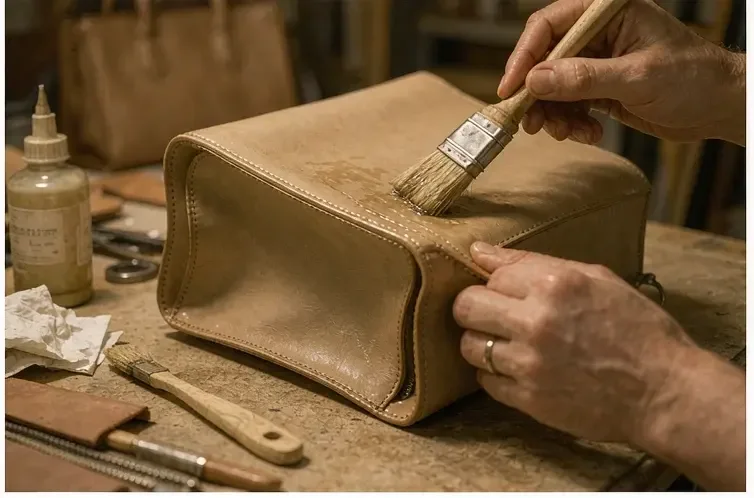
Edge Work on Exotic: Turned, Bound or Painted
There are three ways to finish an exotic edge and the choice is made at sampling, not at finishing. A turned edge folds the shell back on itself and is hand-stitched, which suits a matt or semi-matt shell and a soft silhouette. A bound edge wraps a 12 mm calf binding around the shell, which suits a structured piece and hides the skive. A painted edge is possible on a matt shell but reads as a stripe against a polished one.
| Finish | Suits | Film or wrap | Bench time per piece |
|---|---|---|---|
| Turned and hand-stitched | Matt or semi-matt shell, soft silhouette | No film, 6-8 stitches per inch | 18-25 min |
| Bound in calf | Structured piece, visible skive to hide | 12 mm binding, 0.8 mm | 14-20 min |
| Painted | Matt shell only, low-flex boundary | 0.08-0.12 mm dry, three coats | 10-14 min |
| Left raw and burnished | Ostrich and some lizard builds | No film, burnished with a slicker | 6-9 min |
Read the bench times together and the reason for deciding early is clear. An edge finish chosen at finishing rather than at sampling changes the panel allowance by 3-5 mm, which means the pattern is wrong, which means another sampling round at 12-15 working days on a complex build.
Conditioning, Humidity and Storage Before Cutting
Exotic shells are conditioned before they are cut, and this is a hand operation in the sense that it requires judgement rather than a machine setting. The room is held at 20-22 degrees and 45-55 per cent relative humidity, and the shell is rested flat for 48 hours after delivery before it is laid. A shell cut dry or cold cracks along the tile boundary; one cut while too humid stretches and then shrinks back, opening the seam.
Storage between operations matters equally. Panels are kept flat, interleaved with acid-free tissue, and never folded or stacked under weight. On a gloss finish, handling is done in cotton gloves from the moment the panel is clicked, because a fingerprint on a polished shell cannot be removed and shows under retail lighting as a dull patch.
Documentation, Traceability and the CITES Question
Exotic material arrives with papers, and no panel should be released to the bench before they are checked. CITES Appendix II and Appendix III listings determine whether a re-export document travels with the finished piece, and the tag number on the shell has to reconcile with the document that accompanies it. Without that reconciliation, a finished piece can be held at a border regardless of how well it was made.
Alongside the convention paperwork, hide traceability is evidenced through Leather Working Group tannery audits and the tannery lot is recorded against the order, so a question raised months later can be answered. On the testing side, ISO 3376 covers tensile strength, ISO 11644 covers finish adhesion and ISO 105 covers colour fastness, and an exotic specification should name all three with the minimum agreed in writing.
What Handcrafting Costs on an Exotic Run
The hand operations add bench time, and the bench time is concentrated in three places: laying, skiving and edge work. Laying a matched panel set takes 25-40 minutes against 6-8 for a nested calf set. Skiving by hand adds 6-9 minutes per piece. A turned and hand-stitched edge runs 18-25 minutes against 10-14 for paint. Tightening these from an ordinary specification to the figures above adds roughly USD 4.80 per unit on top of the material difference.
The programme runs through our validated partner factory Quanzhou Yingming Bags, an SGS-validated site with 7 production lines and about 200,000 pcs per month of capacity, holding export experience since 2014. Sampling takes 12-15 working days on an exotic build, bulk occupies 35-50 days, minimums sit at 500 pcs per style and colourway, and shipments leave FOB Xiamen with FOB, CIF and DDP terms available. Inspection is drawn at AQL 2.5 under ISO 2859-1, with a re-work reserve held because a rejected exotic panel cannot be replaced quickly.
Cost an exotic capsule against the shell you have in mind
Send the silhouette, the shell and finish, quantity per colourway and delivery date. You will receive a tile-matching plan, an edge recommendation and a costed bench estimate. Request a quote.
Specifying an Exotic Piece So the Bench Can Repeat It
The specification that makes an exotic run repeatable is short and entirely numeric: tile band per panel position, symmetry tolerance across the centre line, pitch, thread and needle, skive thickness at the turn, edge method, and the gloss level the finish is polished to. Written that way, the second drop matches the first, and a question about quality becomes a question about a figure.
Numbers to write on an exotic tech pack
- Tile band 25-40 mm on the flank and 12-18 mm towards the spine; symmetry within 3 mm across the centre line; pitch 6-8 per inch; thread 0.35 mm waxed linen; needle #7 sharp; skive 0.6-0.7 mm at the turn; binding 12 mm at 0.8 mm or a turned edge; conditioning at 20-22 degrees and 45-55 per cent humidity for 48 hours.
Two clauses close it off. First, a panel rejection rule: any shell with scale loss, a scar crossing a fold line, or a broken tile at the turn is returned to the tannery lot rather than worked around. Second, a reserve: because exotic panels cannot be replaced quickly, the order carries a cutting allowance above the run quantity so a finding at inspection does not stop the programme.
Frequently Asked Questions
Why does handcrafting matter more on exotic leather bags than on calfskin?
Because an exotic shell cannot be corrected. A misplaced hole in a crocodile flank is permanent, the membrane does not close, and the panel cannot be re-sewn. Hand work places each hole deliberately at 6-8 per inch rather than feeding the panel at a machine rate.
What stitch pitch should be used on an exotic hide?
Six to eight per inch, which is 3.18 to 4.23 mm between holes. The wider spacing leaves an unbroken strip of membrane between holes; at 12 per inch the holes begin to perforate the membrane and the seam lifts where the shell flexes.
Why is the thread finer on exotic leather?
At 0.35 mm the waxed linen passes through the hole the awl made without enlarging it. A heavier thread drags against the membrane edge on every pass, and on a shell that cannot be re-punched, that drag becomes a permanent ragged hole.
How is tile symmetry specified?
By band and by tolerance. The flank carries tiles of 25-40 mm and the spine 12-18 mm, one band per panel position, matched left and right within 3 mm across the centre line, with four to six rows drawn before cutting.
Why does an exotic panel set consume so much more hide?
Because the layout follows what the shell offers rather than what the pattern wants. Matching a front panel pair can take two and a half to three and a half times the area the same panel would need in calfskin, and rejected panels cannot be swapped quickly.
Can an exotic edge be painted?
On a matt shell, yes, at 0.08-0.12 mm dry over three coats. Against a polished shell the film reads as a dull stripe along every boundary, so a turned and hand-stitched edge or a 12 mm calf binding is specified instead.
How thin can an exotic panel be skived?
To 0.6-0.7 mm at a turn and 0.9-1.0 mm on a flat. Below about 0.5 mm the knife cuts into the membrane between tiles and the panel fails at the fold; the bevel is always taken from between two tile rows.
What is the cotton scrim backing for?
It stabilises the shell in the direction it is weakest. A 0.3 mm scrim bonded cold with a water-based adhesive adds almost no thickness and stops the panel stretching along the membrane, which is what leaves a seam puckered weeks later.
How should exotic hides be stored before cutting?
Flat, interleaved with acid-free tissue, never folded or stacked under weight, in a room held at 20-22 degrees and 45-55 per cent humidity. The shell rests 48 hours after delivery before it is laid.
What documentation travels with an exotic piece?
CITES documentation where the species is listed in Appendix II or III, with the shell tag reconciled against the document. Alongside it, the tannery lot is recorded and traceability is evidenced through Leather Working Group tannery audits.
How long does an exotic sampling round take?
Twelve to fifteen working days, against six to ten on a standard calf build. The extra time goes into laying and matching the panel set, testing the fold on an offcut, and confirming the edge method before any run panel is cut.
What is the minimum for an exotic programme?
500 pcs per style and colourway, with a cutting allowance held above the run quantity. Because a rejected exotic panel cannot be replaced quickly, the allowance is what keeps an inspection finding from stopping the programme.
People Also Ask
Can exotic leather be sewn by machine at all?
Yes, on linings and interior runs hidden inside the piece. Visible seams, turns and edges are worked by hand because a machine feed cannot read the change in thickness from 0.6 mm at the flank to 1.6 mm at the spine ridge.
Why does an exotic bag cost more than the hide price suggests?
Because of hide consumption and bench time. Matched panels take 2.5-3.5 times the area, laying takes 25-40 minutes, and a turned edge runs 18-25 minutes per piece before any hardware is set.
What is the most common exotic defect?
A seam that puckers weeks after delivery, caused by a panel stretching along the membrane without a scrim backing, or by a shell cut before it had been conditioned for 48 hours.
Should the edge method be decided before sampling?
Yes. Changing it at finishing alters the panel allowance by 3-5 mm, which invalidates the pattern and costs another sampling round of 12-15 working days on a complex build.
How is gloss level specified on an exotic finish?
As a number on the tech pack, agreed against a polished reference at sampling. Gloss level decides whether an edge can be painted, because a film on a polished shell reads as a dull stripe.
Sources and further reading
Every figure on this page is either our own programme data or attributed below. Open the originals before you write them into a specification.
- CITES - Convention on International Trade in Endangered SpeciesCITES The convention whose Appendices determine which exotic shells require documentation and whether a re-export document travels with the finished piece.
- Leather Working GroupLeather Working Group Tannery audit protocol through which hide traceability and the tannery lot are evidenced for exotic shells.
- ISO - International Organization for StandardizationISO Publisher of ISO 3376 for tensile strength, ISO 11644 for finish adhesion, ISO 105 for colour fastness and ISO 2859-1 for the inspection plan.
- SATRA Technology CentreSATRA Independent testing body for leather goods, referenced for abrasion, flex and finish adhesion test methods on exotic shells.