What Makes Handcrafted Luxury Bags Feel Expensive: 68 Minutes Out of 150
What makes a handcrafted luxury bag feel expensive is not one material but five measurable things a hand detects in the first ten seconds: panel gauge, hardware mass, closure pull, edge contour and the balance point of a loaded body. A structured face at 1.4-1.6 mm, a solid brass turn-lock at 28-34 g and a magnetic closure releasing at 1.2-1.6 kgf cost about USD 4.80 more per unit than the substitutes that photograph the same — and none of the five can be added at the end.

Where the Money Goes: 68 Minutes Out of 150
The shortest way to answer what makes a handcrafted piece feel expensive is to price the bench. On a structured body roughly 150 minutes of bench time are spent from clicking to final dress, and the five operations a hand actually detects occupy 68 of them. The lining, zip insertion, interior pocket seams and packing occupy the remaining 82 minutes, all of which make the piece work and none of which make it feel costly. That split is the entire argument: expensiveness is a property of 68 minutes, and it is either bought there or lost there.
- Clicking and grade placement: 10 minutes, and worth 8-11 percentage points of usable hide.
- Skiving and turn preparation: 12 minutes, held to a residual 0.9-1.0 mm at the fold.
- Visible seam work: 18 minutes at 7-8 stitches per inch on heavy gauge.
- Edge finishing: 20 minutes of application and sanding, plus flash time that cannot be worked around.
- Hardware set and final dress: 8 minutes, including a torque check on every screw.
Each of those five responds to a different variable. Gauge responds to the hide; mass responds to the alloy; closure pull responds to the magnet grade; edge contour responds to how many coats are applied and how patiently they are sanded; balance responds to where the reinforcement sits. A buyer who specifies all five in numbers has specified feel, and a buyer who specifies them in adjectives has specified nothing enforceable.
The answer in one line
- Feel is bought in 68 of the 150 minutes spent on a structured body. The other 82 minutes make the piece function; they do not make it feel expensive, and no amount spent on them will.
Panel Gauge: The First Number a Hand Reads
Gauge is the first thing a hand reads because it sets the stiffness of the whole silhouette. A structured face at 1.4-1.6 mm in full-grain calfskin holds its own shape when the bag is set down empty; the same silhouette at 0.9-1.1 mm slumps within a season and reads as a soft body pretending to be a structured one. The number costs nothing to specify and is costly to substitute, which is exactly why it should appear on the tech pack with a tolerance.
- Structured face gauge
- 1.4-1.6 mm, full-grain calfskin, firm temper
- Skived turn allowance
- 0.9-1.0 mm residual across a 10 mm width
- Gusset gauge
- 1.0-1.2 mm, softer temper to let the body flex
- Handle wrap
- Two plies at 0.8 mm each, skived at the join
- Base reinforcement
- 0.8 mm board under the lining, no visible step
- Gauge tolerance at goods-in
- ±0.1 mm on a calliper check at five points
The tolerance is the part that does the work. A specification of 1.4-1.6 mm without a tolerance will drift to 1.2 mm on the second repeat, because 1.2 mm is faster to turn and looks identical under studio lighting. Written as 1.4-1.6 mm with a ±0.1 mm check at five points, the same specification becomes a line item an inspector can fail a carton on.
Hardware Mass, Plating and Sound
Hardware is the second thing a hand reads, and it is read as mass before it is read as colour. A 32 mm turn-lock in solid brass weighs 28-34 g; the same silhouette cast in zinc alloy weighs 11-14 g. The difference is unmistakable the moment a customer lifts the piece by its handle, and it is completely invisible in a photograph, which is precisely why it is the most common silent downgrade in the trade.
Mass
Solid brass at 28-34 g for a 32 mm turn-lock against 11-14 g in zinc alloy. The lighter part passes a visual check and fails the first lift, and it is the substitution most often made without telling the buyer.
Plating
Gold plating at 0.15-0.3 µm over a nickel barrier layer. Below roughly 0.15 µm the colour wears through at the contact points within months and the base metal shows as a grey bloom along the raised edges.
Sound
A solid closure closes with a short, dead sound; a hollow one rings. The difference is the presence or absence of a void in the casting, and it cannot be corrected by polishing after the part is fitted.
Plating thickness deserves a number on the drawing as well. Gold at 0.15-0.3 µm over a nickel barrier gives a lock that still reads warm at the contact points after a season; below that the high points go grey. Salt spray testing at 24 and 48 hours is the standard way to evidence it, and the report is worth requesting before a bulk release rather than after a return.
Closure Feel: Pull, Travel and Release
Closure is where feel becomes measurable rather than impressionistic, because a pull gauge gives a number. A magnetic closure on a structured top-handle should release at 1.2-1.6 kgf: firm enough that the flap does not drift open when the body is set down, light enough that it opens in one motion without the customer bracing the bag against her body. Below about 0.8 kgf the closure feels toy-like; above 2.0 kgf the customer has to fight it.
- Release force: 1.2-1.6 kgf measured on a pull gauge, sampled across the run rather than once.
- Travel: 3-4 mm of movement before the magnet disengages, so the open is felt rather than instantaneous.
- Seating: the magnet must sit flush under the lining with no ridge readable through the face.
- Cycle: 5,000 open-close cycles with no measurable drop in pull, tested before bulk release.
| Property | Number to specify | What happens if it drifts |
|---|---|---|
| Panel gauge | 1.4-1.6 mm, ±0.1 mm | Body slumps and reads as soft pretending to be structured |
| Hardware mass | 28-34 g for a 32 mm lock | First lift feels light; the piece reads hollow |
| Plating thickness | 0.15-0.3 µm gold over nickel | Grey bloom at the raised contact points within months |
| Closure pull | 1.2-1.6 kgf on a pull gauge | Below 0.8 kgf it drifts open; above 2.0 kgf it fights the hand |
| Edge coat build | Three coats, 0.10-0.14 mm wet | A single thick coat cracks at the fold in month two |
| Handle set | ≤3 mm permanent set after 2 kg for 60 seconds | Handle takes a permanent bend and the bag sits crooked |
| Base feet | 3.5-4.0 mm, four points, level | Body rocks on a hard surface and drifts when set down |
Edge Contour and Seam Line: What a Fingertip Detects
Edge is the last of the five, and it is the one a customer tests unconsciously by running a thumb along the fold. Three coats at 0.10-0.14 mm wet, sanded between the second and third, produce a contour that is slightly convex and continuous with the face. One thick coat produces an edge that is proud of the panel, and proud is what a fingertip reads as inexpensive even when the leather underneath is excellent.
- Three coats at 0.10-0.14 mm wet, never one coat at three times the thickness.
- Sanding at 400 then 800 grit between the second and third coat.
- Final contour flush to slightly convex, with no ridge readable at the coat boundaries.
- Pitch held at 7-8 stitches per inch on heavy gauge, counted over 25.4 mm at three points.
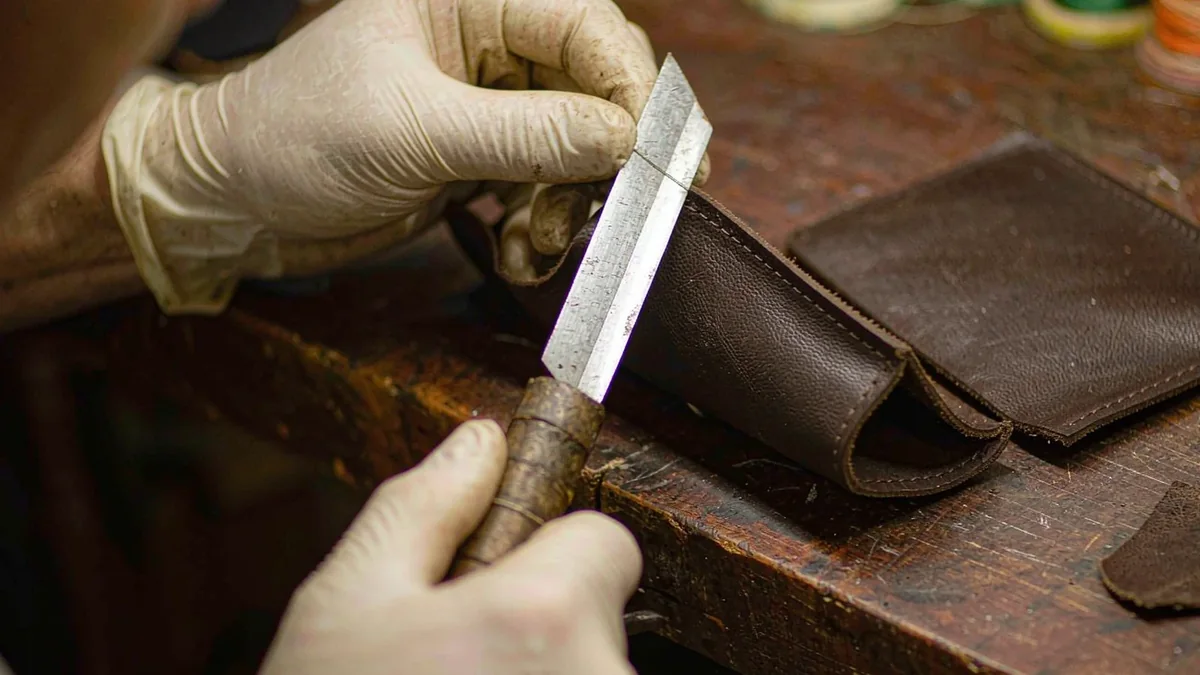
Seam pitch belongs to the same test. On heavy gauge, 7-8 per inch reads deliberate and 11-12 reads hurried, because the holes are closer together than the thickness of the panel can comfortably carry. Counting pitch over 25.4 mm at three points on each seam is a five-second check that catches the most common silent substitution on the bench.
Where the Money Should Not Go
Feel is bought in five places and nowhere else, which means a brief can be deliberately thin everywhere else. Interior pocket bags, dust bags, zip tapes on hidden openings and the underside of a base reinforcement are all read by nobody, and money spent there is money taken away from gauge, hardware and edge. The discipline is to name the five on the drawing and leave the rest to a standard specification.
Ask one question of any cost saving offered: does it change gauge, mass, closure pull, edge build or handle set? If it does, it changes how the piece feels. If it does not, take it.
What Degrades the Feeling Over Six Months
A piece can leave the bench feeling expensive and stop feeling expensive within two seasons, and the four causes are all measurable before despatch. Edge coats applied too thick crack at the fold; plating below 0.15 µm blooms grey at the contact points; magnets below 0.8 kgf lose pull as the lining relaxes; and handles without a set test take a permanent bend. Each has a test, and each test costs less than the return it prevents.
- Edge: flex the fold twenty times at goods-in and look for a hairline along the coat.
- Plating: request the 24-hour salt spray report before bulk release, not after a complaint.
- Closure: re-measure pull at 1.2-1.6 kgf after a 5,000-cycle test.
- Handle: load 2 kg for 60 seconds and confirm no more than 3 mm of permanent set.
How to Specify Feel in a Tech Pack
Feel is specified by replacing every adjective on the drawing with a number and a tolerance. 'Luxury hand feel' is not a specification; '1.4-1.6 mm full-grain calfskin at firm temper, ±0.1 mm at five points' is. The same substitution works across all five properties, and once it is done the drawing becomes enforceable at goods-in rather than a matter of trust between two parties.
- Replace 'heavy hardware' with the part mass in grams and the alloy.
- Replace 'smooth closure' with a release force in kgf and a cycle count.
- Replace 'fine edge finish' with three coats at 0.10-0.14 mm and the sanding grits.
- Replace 'structured body' with the face gauge and the reinforcement specification.
- Replace 'quality stitching' with a pitch counted over 25.4 mm and a thread position.
What the Programme Costs and How Long It Runs
The five properties together add about USD 4.80 per unit in material and bench time against the substituted version, and that is the premium worth defending on a structured body. Our programme runs through our validated partner factory Quanzhou Yingming Bags, an SGS-validated site with 7 production lines and roughly 200,000 pcs per month of capacity, holding export experience since 2014. Sampling takes 6-10 working days, or 12-15 on a complex build; bulk occupies 35-50 days; minimums sit at 500 pcs per style and colourway; and shipments leave FOB Xiamen with FOB, CIF and DDP terms all available. Inspection is drawn at AQL 2.5 under ISO 2859-1, with leather tested against ISO 3376 for tensile strength and ISO 11644 for finish adhesion. See luxury materials for the hide selection behind the first number.
Put the five numbers on your drawing
Send the silhouette, target gauge, hardware direction, quantity per colourway and delivery date. You will receive a costed specification naming each of the five properties with its number and tolerance. Request a quote.
Frequently Asked Questions
What makes a handcrafted luxury bag feel expensive?
Five measurable properties a hand detects in the first ten seconds: panel gauge, hardware mass, closure pull, edge contour and the balance of a loaded body. Together they occupy 68 of the 150 bench minutes on a structured piece and add about USD 4.80 per unit over substitutes that photograph identically.
Why is panel gauge the first thing a hand reads?
Because gauge sets the stiffness of the whole silhouette. A structured face at 1.4-1.6 mm in full-grain calfskin holds its shape when set down empty; the same silhouette at 0.9-1.1 mm slumps within a season and reads as a soft body pretending to be a structured one.
How much should a brass turn-lock weigh?
About 28-34 g for a 32 mm solid brass turn-lock. The same silhouette cast in zinc alloy weighs 11-14 g, passes a visual check completely, and fails the moment a customer lifts the piece by the handle, which is why mass should be specified in grams.
What is the right release force for a magnetic closure?
Between 1.2 and 1.6 kgf measured on a pull gauge. Below roughly 0.8 kgf the flap drifts open when the bag is set down and the closure feels toy-like; above 2.0 kgf the customer has to brace the body to open it, which reads as stiff rather than secure.
How many edge coats should a luxury bag have?
Three coats at 0.10-0.14 mm wet, sanded at 400 then 800 grit between the second and third. One coat at three times the thickness dries proud of the panel, cracks at the fold inside two months, and is read by a thumb as inexpensive regardless of the leather underneath it.
What stitch pitch reads as expensive on heavy leather?
Seven to eight stitches per inch on heavy gauge. Eleven to twelve reads hurried because the holes sit closer together than the panel thickness can comfortably carry. Count the pitch over 25.4 mm at three points on each seam; it is a five-second check at goods-in.
Why does plating thickness matter to how a bag feels?
Plating at 0.15-0.3 µm of gold over a nickel barrier keeps a warm colour at the contact points through a season. Below roughly 0.15 µm the high points wear through and the base metal shows as a grey bloom, which is the most visible sign of a downgrade on an otherwise well-made piece.
How do you test whether a handle will hold its shape?
Load it with 2 kg for 60 seconds and measure permanent set, which should be no more than 3 mm. A handle that takes a permanent bend leaves the bag sitting crooked on a table, and the fault is visible every time the piece is put down in front of a customer.
Where should a brand not spend money on a handbag?
Interior pocket bags, dust bags, hidden zip tapes and the underside of base reinforcement. None of these are read by a customer, and money spent there is taken directly away from gauge, hardware and edge work, which are the three things that actually decide how a piece feels.
How should feel be written into a tech pack?
By replacing every adjective with a number and a tolerance. Write 1.4-1.6 mm full-grain calfskin at firm temper with a ±0.1 mm check at five points rather than 'structured body'. A description can be substituted silently; a measurement with a tolerance cannot be.
What makes a bag stop feeling expensive after six months?
Four measurable causes: edge coats applied too thick crack at the fold, plating below 0.15 µm blooms grey, magnets under 0.8 kgf lose pull as the lining relaxes, and handles without a set test take a permanent bend. Each has a test that costs less than the return it prevents.
How much does the expensive-feeling version cost per unit?
About USD 4.80 more per unit in material and bench time than the substituted version. That covers the heavier gauge, solid brass hardware, a graded magnet, three edge coats and the set-tested handle, and it is the premium most defensible on a structured body.
People Also Ask
Can a bag look expensive in photos but feel inexpensive in the hand?
Yes, constantly. Photographs show silhouette, colour and proportion; they cannot show gauge, hardware mass, closure pull or edge contour. Those four are exactly where silent downgrades are made, which is why they need numbers on the drawing.
What is the most direct way to make a bag feel more expensive?
Raise the panel gauge and the hardware mass together. Moving a structured face from 1.0 mm to 1.4-1.6 mm and a lock from zinc alloy to solid brass changes the first ten seconds of handling more than any other single change.
How do you check feel at goods-in without a laboratory?
Lift the piece by the handle, run a thumb along the edge, open and close the closure five times, and set the body down on a hard surface to see whether it rocks. Four checks, under a minute, and they catch most of what matters.
Does heavier always mean more luxurious?
No. Weight should sit in hardware and gauge, not in reinforcement board and lining. A bag that is heavy in the wrong places feels clumsy; the goal is balance, where the loaded body stands level on its four feet.
How long does it take to develop a bag to this specification?
Sampling runs 6-10 working days, or 12-15 on a complex build, and bulk occupies 35-50 days at 500 pcs per style and colourway. Most of the development time goes into the first sample round, where gauge and hardware are settled.
Sources and further reading
Every figure on this page is either our own programme data or attributed below. Open the originals before you write them into a specification.
- ISO — International Organization for StandardizationISO Publisher of ISO 2859-1 for the AQL 2.5 inspection plan, ISO 3376 for leather tensile strength and ISO 11644 for finish adhesion.
- Leather Working GroupLeather Working Group Tannery audit protocol evidencing hide traceability, the material basis for gauge and temper specifications on premium calfskin.
- SATRA Technology CentreSATRA Independent testing body for leather goods and hardware, referenced for closure cycle, pull force and plating durability test methods.
- European Chemicals AgencyECHA Regulator for REACH, whose Annex XVII restrictions govern the dyes, finishes and metal coatings used on premium leather goods.