From Studio Sketch to Luxury Bag: Three Routes Through the Same Six Stages
How does a studio sketch become a luxury bag? Through six stages — brief, material, pattern and toile, sampling, the freeze, then bulk and packing — and three routes pass through them. The sketch-first route starts from a dimensioned drawing and reaches 75-85% accuracy on the first sample; the reference-first route starts from an existing piece and a change list and reaches 85-95%; the material-first route starts from a reserved hide lot and leaves the geometry open longest. The finished sequence runs 55-75 working days whichever route you take. Below, all three are compared stage by stage, then each stage is opened on its own, and finally the situations each route suits are set out.
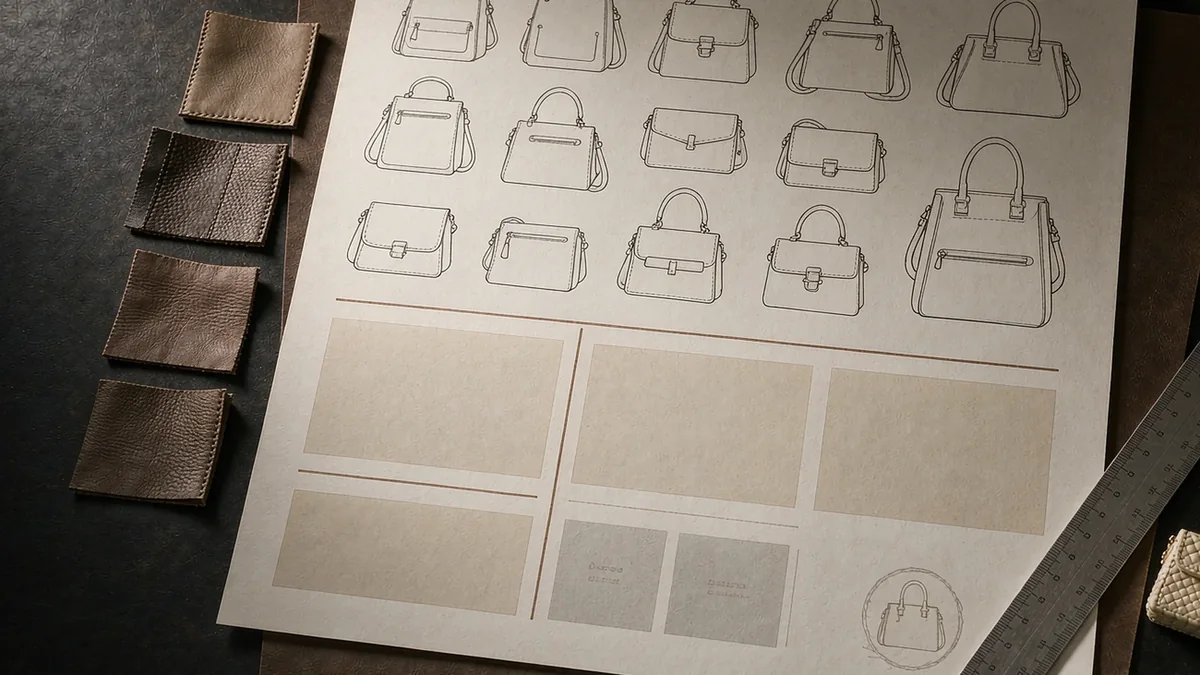
Three Routes Through the Same Six Stages
Every luxury bag passes through the same six stages in the same order. What differs between studios is which of the three routes they take through them, and the route changes where the accuracy comes from and how many rounds are spent finding it.
| Route | What it starts from | First sample accuracy | Rounds to approval |
|---|---|---|---|
| Sketch-first | A dimensioned drawing and a material direction | 75-85% | 2 rounds |
| Reference-first | An existing piece plus a written change list | 85-95% | 1-2 rounds |
| Material-first | A reserved hide lot with the geometry open | 70-85% | 2 rounds |
The numbers are close enough that the choice is rarely about accuracy alone. It is about which unknown you prefer to encounter first: the geometry, the construction, or the behaviour of a particular hide.
Stage 1: The Brief, and How Each Route Writes It
The brief is the one document all three routes need, and they produce it differently. Sketch-first writes it from intention outward; reference-first writes it from an object inward; material-first writes it last, once the hide has spoken.
- Sketch-first states dimensions in millimetres with a working tolerance of ±1.5 mm on panels.
- Reference-first states every intended change against the original, which is the shortest brief to write.
- Material-first reserves the lot first, because yield of 55-65% is a property of that lot and not of the drawing.
- All three then state the same things: thickness, stitch density, hardware and the delivery date.
- A brief covering those items can be answered with a costed figure within two working days.
The reference-first brief is underrated. Naming every change against an existing piece takes an afternoon, and it removes the ambiguity that otherwise costs a whole round of interpretation.
Stage 2: Material, Named as a Lot
At this stage the three routes converge, because a brief reading 'black leather' is not a specification on any of them. All three end up naming a type, a thickness, a finish and a lot, and all three reserve it during the next stage rather than after it.
- Body thickness
- 1.2-1.4 mm for semi-structured work, 1.0-1.2 mm for a soft body
- Lining and interlining
- 0.8-1.0 mm lining, with 0.8 mm interlining behind reinforced panels
- Reservation to arrival
- 15-20 working days on a named European lot
- Yield
- A structured panel set converts 55-65% of purchased hide area
- Traceability
- Leather Working Group audited tanneries evidence the origin for boutiques
The material-first route is the only one that reaches this stage before the others, and it does so deliberately. Starting from a hide that has already arrived removes 15-20 working days from the critical path, at the cost of deciding the shape around whatever that lot will give.
Stage 3: Pattern and the Toile in 10 oz Calico
Pattern work takes 2-3 days on every route, and it is followed by a toile in 10 oz calico, which is where proportion is settled. The calico matters: it has no grain and no stretch, so it reports geometry alone rather than the behaviour of a hide.
- Sketch-first cuts two toiles, because the geometry is the unknown being tested.
- Reference-first cuts one, since the original piece has already answered most proportion questions.
- Material-first cuts one or two, with the panel arrangement governed by the lot's usable area.
- Handle drop is confirmed on the body, with 100 mm a common shoulder target.
- Closure position is tested against where the hand actually reaches, not where the drawing placed it.
Every route ends this stage the same way, with a piece that can be carried, set down and looked at. Two millimetres in the wrong place is visible, and on a toile it costs a marker stroke rather than a six to ten day round.
What the toile also settles, and what no drawing can, is whether the body holds what it was drawn to hold. Contents are loaded into it on the bench and the base depth is adjusted in 8 mm steps until the piece behaves as intended, which is the kind of correction that costs nothing here and a full round later.
- A toile is cut to full size, because scale changes how a proportion reads.
- It is handled and set down, which a drawing cannot be and a render can only pretend to be.
- It is corrected with a marker and shears, in minutes rather than across a sampling window.
- It is then used as the reference the first leather round is measured against.
- Several can be cut in a single day if the silhouette is genuinely undecided.
Stage 4: Sampling Rounds and the Correction List
Sampling takes 6-10 working days on all three routes, extending to 12-15 where the construction is complex or a bespoke closure has to be proved. What separates the routes is not the duration but the content of the correction list.

- Sketch-first corrections are usually dimensional: proportion and handle drop, measured against the brief.
- Reference-first corrections are usually about the changes themselves, revised against the original piece.
- Material-first corrections are usually about behaviour: how that hide folds, skives and takes an edge.
- All three should be written as measured values, for example 92 mm against 100 mm intended.
- Each round costs a pattern revision and a bench build, not merely a courier charge.
The correction list is where a route pays or does not. Written in millimetres with reasons, it becomes instructions; written as impressions, it becomes a conversation, and conversations are the expensive kind of round.
Stage 5: The Freeze and the Counter Sample
The freeze happens on the same condition everywhere: when every measurement falls inside tolerance. It is the moment design stops being negotiable on that style, and it is recorded in a specification and a retained counter sample.
What the freeze records
- Panel dimensions in millimetres with the ±1.5 mm tolerance and the nesting arrangement.
- Material: 1.2-1.4 mm body, 0.8 mm interlining, 0.8-1.0 mm lining, named as a reserved lot.
- Construction: stitch density 8-9 per inch with 0.45 mm braided polyester thread.
- Edge specification: raw, turned, or three coats with 8-10 minutes of flash time between passes.
- Hardware: finish at 0.15-0.3 µm, #5 zip for openings, #3 for pockets, 8 mm base feet.
The counter sample is the piece drawn from that record and kept at the bench, and it is what makes a dispute at inspection resolvable. Without one, an inspector and a bench compare two different memories of the approved piece.
Stage 6: Bulk, Inspection and Packing
Bulk takes 35-50 days from intake on every route, and the differences between routes disappear entirely at this point. What remains is the plan agreed before intake and the discipline of recording what the inspection finds.
- Inspection is drawn at AQL 2.5 under ISO 2859-1, with the sample plan agreed before bulk begins.
- A 500 pcs lot at general inspection level II uses code letter H: 50 units drawn, accept 3, reject 4.
- Corrections found at inspection are re-checked against the counter sample, then packing follows.
- Packing and documents take a further 3-5 days, including any corrections the audit raised.
- FOB Xiamen is the default trade term, with CIF and DDP available on request.
This stage is where the earlier ones are either vindicated or exposed. A shape that was resolved on a toile and frozen on measurement arrives here with nothing left to argue about.
Which Route Suits Which Situation
The three routes are not in competition; each has a situation where it is clearly the right one, and the choice is usually made for you by what you already have in the studio.
Sketch-first
Right when the silhouette is the idea and nothing like it exists yet. Two toiles, two rounds at 6-10 working days, and the shape arrives as drawn. Best for a signature piece.
Reference-first
Right when a shape exists and the work is in the changes. One toile, one to two rounds, and the brief takes an afternoon. Best for a second season or a reissue.
Material-first
Right when an exceptional lot has been secured and the shape should serve it. Reserve early, remove 15-20 working days, and accept that geometry stays open longest.
The routes also differ in which unknown they reveal first, and that is a practical difference rather than a stylistic one. Sketch-first reveals whether the drawing works, reference-first whether the change list works, and material-first whether the hide will do what the shape asks of it. Knowing which unknown you will meet first is the entire value of naming the route.
- Sketch-first: the unknown is geometry, and two toiles usually settle it.
- Reference-first: the unknown is the change list, and one toile usually settles it.
- Material-first: the unknown is behaviour, revealed only when the lot arrives.
- All three reveal it on calico first, which is the whole purpose of the stage.
Most first capsules land on the second route without their designer noticing, because the fastest way to explain a shape is usually to point at something and list what should change about it.
The Six Stages in Working Days
Whichever route is taken, the sequence occupies roughly the same calendar. The route changes how the days are distributed across the early stages, not how many there are in total.
- Brief and material reservation: 15-20 working days on a named lot, overlapping the pattern work.
- Pattern and toile: 2-3 days on the pattern, 1-2 on the toile in 10 oz calico.
- Sampling: 6-10 working days, or 12-15 for structured, framed or complex builds.
- The freeze and the counter sampling 6-10 working days for signature and records.
- Bulk: 35-50 days from intake, with the AQL 2.5 plan agreed beforehand.
- Inspection, packing and documents: 3-5 days, including any corrections found.
That totals 55-75 working days on a standard calendar, which is the figure worth quoting to a retailer. A date quoted to the day has usually been arrived at by quietly spending the buffers.

The programme is delivered through our validated partner factory Quanzhou Yingming Bags, an SGS-validated site with 7 production lines and about 200,000 pcs per month of capacity, holding export experience since 2014. Every style and colourway is committed at MOQ 500 pcs, third-party inspection can be arranged alongside the internal AQL 2.5 audit, and a stock plated trim set at USD 4.80 per bag keeps the hardware line predictable across the sequence.
Start your sketch on the right route
Send a drawing, a reference piece with your change list, or the lot you have secured. You will receive the six stages dated for your route, with the costed answer, within two working days. Request a quote.
Frequently Asked Questions
How does a studio sketch become a luxury bag?
Through six stages in fixed order: the brief, material named as a reserved lot, pattern and a toile in 10 oz calico, sampling rounds, the freeze with a retained counter sample, then bulk at 35-50 days followed by inspection and packing. The order never changes, whichever route is taken.
What are the three routes through the handbag process?
Sketch-first, starting from a dimensioned drawing; reference-first, starting from an existing piece and a change list; and material-first, starting from a reserved hide lot. Each passes through the same six stages and reaches the same total calendar of 55-75 working days, whatever the studio prefers.
Which route gives the most accurate first sample?
Reference-first, at 85-95%, because the original piece has already answered most proportion questions. Sketch-first achieves 75-85% and material-first 70-85%, since each leaves one major variable open for the first sample to reveal, and the variable each leaves open is a different one. Accuracy on the first sample is what decides how many rounds follow it.
How long does the whole sequence take?
Around 55-75 working days on a standard calendar: 15-20 on material reservation, two to three on the pattern, one to two on the toile, 6-10 on sampling, 35-50 on bulk and three to five on inspection and packing. The route changes the distribution of those days, not the total.
Why is a toile cut in 10 oz calico?
Because calico has no grain and no stretch, so it reports geometry alone. A substitute hide would introduce its own hand and thickness, and the proportion question would then be answered through a filter rather than directly, which defeats the purpose of the stage entirely.
How should the material be specified?
By type, thickness and finish, named as a reserved lot. A semi-structured body uses 1.2-1.4 mm panels with 0.8 mm interlining, and a structured panel set converts 55-65% of purchased hide area into usable panels. A colour alone is not a specification on any route.
What happens at the specification freeze?
Every measurement is recorded: panel dimensions to plus or minus 1.5 mm, stitch density 8-9 per inch, the edge specification, hardware finish at 0.15-0.3 microns and zip sizes. A counter sample is drawn from that record and retained, and bulk is built to it.
How many sampling rounds are needed?
Two on the sketch-first and material-first routes and one to two on reference-first. Each round takes 6-10 working days, or 12-15 for structured or complex builds, and each costs a pattern revision and a bench build, which is precisely why the toile matters so much.
What should a correction list contain?
A measured difference and a reason on every line. A note reading handle drop measures 92 mm against 100 mm intended, increase by 8 mm can be executed and checked, whereas the handle feels short can only be interpreted, and interpretation costs a further round.
How is a bulk lot inspected?
At AQL 2.5 under ISO 2859-1 with the plan agreed before intake. A 500 pcs lot at general inspection level II uses code letter H, meaning 50 units are drawn, with acceptance at 3 defects and rejection at 4, and corrections are re-checked against the counter sample.
Should a first capsule use a bespoke closure?
Usually not. A stock plated trim set at USD 4.80 per bag ships on the material calendar, whereas bespoke hardware carries tooling and 30-40 working days, plus 48 hours of salt spray proving, on a track that runs beside the leather rounds rather than inside them.
What is the last thing to decide before starting?
The immovable date. Every other item in the brief can be negotiated, but without that date the calendar can only be built forwards from hope, which is how a sampling window ends up colliding with a launch. Give the arrival date and the rest can be scheduled around it.
People Also Ask
What are the stages of making a luxury handbag?
Six: the brief, material reserved as a named lot, pattern and a toile, sampling rounds, the freeze with a retained counter sample, then bulk followed by inspection and packing. The order does not change between studios.
How long does it take to develop a luxury handbag?
About 55-75 working days from brief to handover. The bulk run takes 35-50 of those days, material reservation 15-20, sampling 6-10, and inspection and packing a further three to five, with buffers held between each of the gates.
What is the best way to start a handbag design?
Whichever gives you the most existing information. Pointing at a reference piece and listing the changes produces the shortest brief and the most accurate first sample of the three routes.
How is a handbag shape tested before the leather is cut?
With a full-size toile in 10 oz calico, which settles proportion, handle drop and closure position in one to two days. Two toiles are often better than one, and both cost less than one unnecessary leather round.
Why is the material lot reserved before the shape is finished?
Because a lot has its own arrival schedule of 15-20 working days. Reserving it early moves that window so it overlaps development rather than sitting in front of it, removing three weeks from the critical path.
Sources and further reading
Every figure on this page is either our own programme data or attributed below. Open the originals before you write them into a specification.
- ISO — International Organization for StandardizationISO Publisher of ISO 2859-1, which sets the code letters and accept and reject numbers for the AQL 2.5 plan applied at inspection.
- Leather Working GroupLeather Working Group Tannery audit protocol, relevant when the lot reserved at stage two has to evidence its origin for boutique distribution.
- ISO Online Browsing PlatformISO Public catalogue used to confirm standard names and scopes, including ISO 105 for colour fastness and ISO 3376 for tensile strength.
- CITES — Convention on International Trade in Endangered SpeciesCITES Appendix listings determine which permit documents a listed skin requires, and those documents must reconcile with the commercial invoice before shipping.
- Sourcing JournalSourcing Journal Coverage of leather supply, material lead times and freight conditions behind the 15-20 day reservation window and the buffers recommended.