Structured Luxury Bag Framing Explained
A structured handbag holds its geometry because of its frame, not because of its leather. Four frame types cover the category: a laminated and blocked board frame, a concealed base plate, a slim metal frame and a moulded shell. The working specification is 1.2-1.4 mm full-grain calfskin laminated to a 0.8 mm reinforcement board, blocked over a heated form, with a frame deflection held under 2 mm at 2 kg. This guide explains framing through a real build, from the drawing that would not stand to the first article that did.
The Brief: A Shape That Refused to Stand
A designer brand came to us with a drawing for a 26 cm top handle bag and a reference sample from another atelier. The reference stood beautifully on a table when it was empty and slumped within an hour of being carried. The brand assumed the leather was wrong. It was not: the leather was a perfectly good full-grain calfskin at 1.3 mm. What was wrong was that the piece had no frame at all, only a stiffened panel doing the job of a skeleton.
That distinction is the whole subject of this guide. Leather is a covering, and a covering cannot hold geometry on its own for long. A frame is what carries the load, defines the corner radius and keeps the closure aligned when the bag is full. Once the brand accepted that, the rebuild took one sampling round instead of the three they had budgeted for, and the shape has been in reorder ever since.
The one-line answer
- Leather is a covering and a frame is a skeleton. If a bag has to hold geometry when it is set down empty, specify a frame: 1.2-1.4 mm full-grain calfskin laminated to a 0.8 mm reinforcement board, blocked over a heated form, with deflection held under 2 mm at a 2 kg load.
Diagnosis: What Was Actually Wrong
We measured the reference sample before changing anything. Body height was 26 cm and width 32 cm, which is a ratio of 0.81 and comfortably inside the balanced band. The handle drop was 10 cm, which is correct for a hand-carried piece. The failure was in the third dimension: with the bag loaded to 2 kg, the front panel deflected 6 mm at the centre line, more than three times what we accept.
- Frame deflection measured at 6 mm under a 2 kg load, against an accepted maximum of 2 mm.
- The base dished when the bag was filled, because there was no concealed base plate under the lining.
- The corner radius varied between units, because there was no acrylic template controlling the cut.
- The closure drifted out of alignment once the panel bowed, which is what the customer actually noticed.
The Four Frame Types Available
Four frame constructions cover almost every structured brief. The choice between them is a choice about how much geometry the shape needs, how much weight the customer will accept, and how many operations the price band can carry. The table below sets out what each one delivers and what it costs in operations.
| Frame type | Construction | Operations added | Best for |
|---|---|---|---|
| Laminated blocked frame | 1.2-1.4 mm calfskin on a 0.8 mm board, blocked over a heated form | Four | Top handle bags that must stand empty |
| Concealed base plate | A shaped plate set under the lining, panel stays soft | One | Day bags that need volume without rigidity |
| Slim metal frame | Brass or steel frame with a hinge and a kiss-lock closure | Three | Evening pieces and minaudieres |
| Moulded shell | A pre-formed shell covered in leather, no lamination step | Two | Repeated shapes with a fixed geometry |
Building the Frame: The Blocking Sequence
Blocking is what turns a laminated flat panel into a permanent three-dimensional shape. The panel is cut oversize, adhesive is applied to the board, the two are married under pressure, and the assembly goes onto a heated form where it is held until the curvature sets. Cooling matters as much as heating: a panel released too early springs back and loses several degrees of curvature.
- Cut the frame panel oversize by 10 mm on every edge, so the trim can be taken after blocking.
- Skive the panel edges to 0.8 mm so the turned edge does not build bulk at the seam.
- Laminate the panel to the 0.8 mm reinforcement board under even pressure, with no trapped air.
- Block the assembly over a heated form and hold it until the curvature is fully set.
- Cool the panel on the form, then trim to the acrylic template and check the corner radius.
- Measure deflection at 2 kg before the gusset is set, because the frame cannot be corrected afterwards.
Choosing the Board and the Leather
Board and leather are specified as a pair. A 0.8 mm reinforcement board under 1.2-1.4 mm full-grain calfskin gives the firmest result in the category and holds a tight corner radius. A 0.6 mm board under the same leather softens the read and lets the panel flex slightly, which suits a semi-structured day bag. Going thinner on either element lets the panel telegraph the board through the grain, which is visible as a faint ridge in raking light.
Board 0.8 mm
The firmest option, paired with 1.2-1.4 mm calfskin, and the standard for a top handle bag that stands empty.
Board 0.6 mm
A softer read with the same leather, suited to a semi-structured day bag that still needs volume.
Leather 1.2-1.4 mm
Full-grain calfskin, thick enough to hide the board and thin enough to turn a tight corner radius.
Base plate
A shaped plate set under the lining, which stops the base dishing when the bag is filled.
The Corner Radius Problem
Corners are where structured bags fail, and they fail for a mechanical reason. Leather has a minimum radius it will turn without compressing, and a board has a minimum radius it will bend without creasing. Below roughly 12 mm at 1.3 mm leather thickness the outer layer compresses into a visible wrinkle that no amount of edge paint will hide. The fix is to specify the radius on the drawing rather than leaving it to the pattern cutter.
- Minimum corner radius
- 12 mm at 1.3 mm full-grain calfskin
- Board thickness
- 0.8 mm firm, 0.6 mm softer
- Frame leather
- 1.2-1.4 mm full-grain calfskin
- Deflection limit
- under 2 mm at 2 kg load
- Template control
- an acrylic template governs every unit in the run
First Article: What Changed and What It Cost
The rebuilt first article kept the drawing almost exactly. The panel became a laminated blocked frame at 1.3 mm leather on a 0.8 mm board, a concealed base plate went under the lining, and the corner radius was fixed at 14 mm with an acrylic template. Deflection fell from 6 mm to 1.4 mm at the same 2 kg load, and the closure stayed aligned with the bag full.
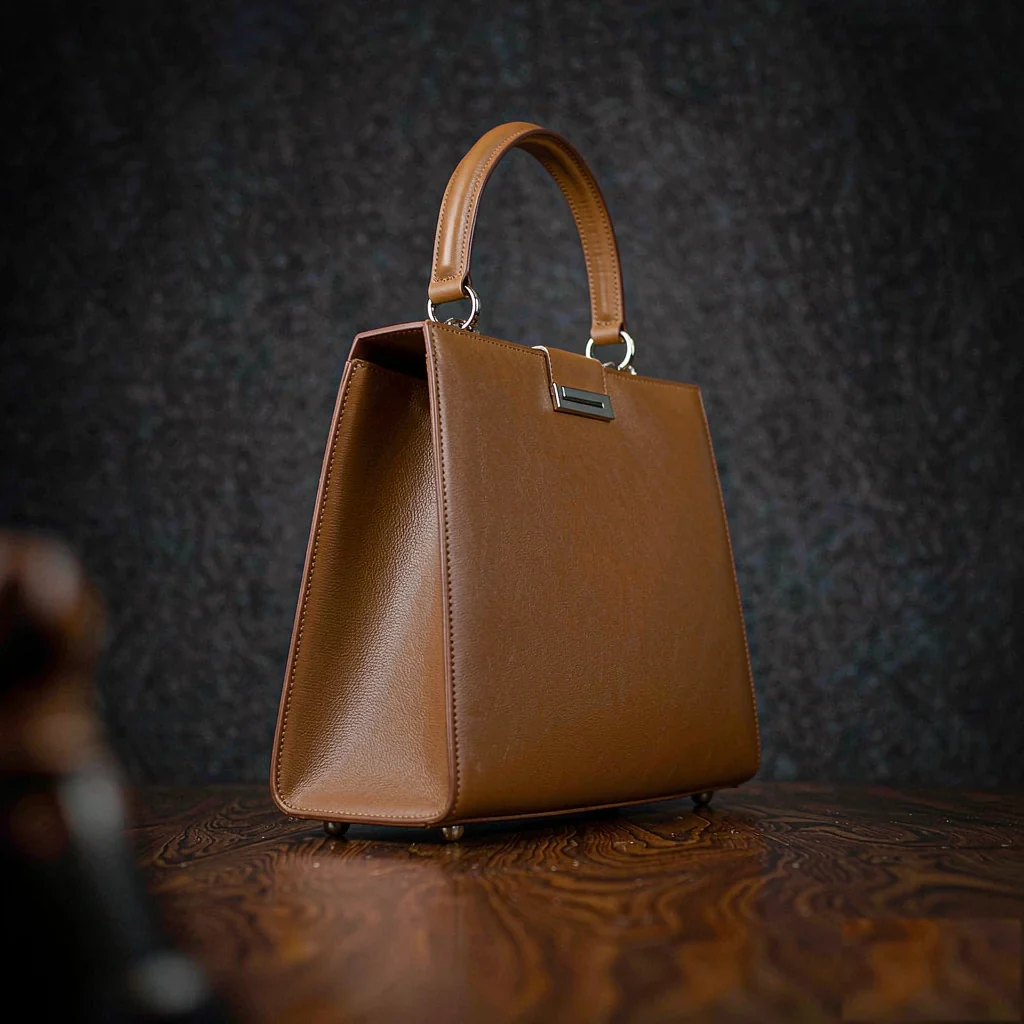
- Deflection fell from 6 mm to 1.4 mm at 2 kg, inside the 2 mm acceptance limit.
- The corner radius was fixed at 14 mm with a template, so every unit matched.
- Four operations were added, which moved the unit into the core rather than the entry band.
- Sampling took 12-15 working days instead of 6-10, and the brand avoided two further rounds.
The Numbers Behind the Rebuild
Framing is measurable at every stage, and the numbers below are the ones we recorded across the rebuild. Each one is a line a brand can put on a tolerance sheet, and each one is checked at AQL 2.5 (ISO 2859-1) on a sample pulled from the cartons.
| Element | Before | After | Acceptance limit |
|---|---|---|---|
| Frame deflection at 2 kg | 6 mm | 1.4 mm | under 2 mm |
| Corner radius | uncontrolled | 14 mm by template | minimum 12 mm |
| Base | dished when filled | concealed base plate | no visible dish |
| Closure alignment | drifted when full | held when full | no visible drift |
| Board telegraphing | visible ridge | none under raking light | none permitted |
Lessons: How to Specify a Frame First Time
Four lessons came out of the build, and all four cost nothing to apply at the drawing stage while costing a full sampling round to apply afterwards. Say whether the bag has to stand empty, because that single sentence decides the frame type. Specify the board thickness in millimetres. Fix the corner radius on the drawing. And agree the deflection limit before sampling rather than after the first article arrives.
- State whether the bag must hold geometry when empty, which decides the frame type.
- Specify the reinforcement board in millimetres, not as firm or soft.
- Fix the corner radius on the drawing, with an acrylic template controlling the run.
- Agree the deflection limit before sampling, and measure it before the gusset is set.
- Add a concealed base plate to any bag taller than 24 cm that will be filled daily.
Sampling and MOQ for a Framed Programme
A framed first article takes 12-15 working days, because the frame has to be blocked, cooled and measured before the gusset can be set. A soft or semi-structured piece takes 6-10 working days. Minimum order quantity is 500 pcs per style / colourway, bulk production runs 35-50 days from an approved sample, and shipments are offered FOB Xiamen. Specified programmes begin at USD 4.80 per unit, with the frame being the largest single cost driver.
Our validated partner factory Quanzhou Yingming Bags has built framed programmes since 2014 on 7 production lines with a monthly output of about 200,000 pcs. Every shipment is audited at AQL 2.5 (ISO 2859-1) against the approved first article, which is why a frozen tolerance sheet is the single most useful document a brand can own.
Request a frame review
Send us a drawing and we will tell you which of the four frame types it needs, with a tolerance sheet and a costed specification. Start your framed programme
Frequently Asked Questions
What makes a handbag structured?
A frame. Structure comes from a reinforcement element inside the panel, not from the thickness of the leather. The working build is 1.2-1.4 mm full-grain calfskin laminated to a 0.8 mm reinforcement board, blocked over a heated form until the curvature is permanent.
What are the four types of bag frame?
A laminated and blocked board frame, a concealed base plate, a slim metal frame and a moulded shell. The laminated frame is the firmest and suits a top handle bag; the base plate adds volume without rigidity; the metal frame suits an evening piece; the shell suits a repeated shape.
Why does my structured bag slump when it is empty?
Because it has a stiffened panel rather than a frame. Leather relaxes under its own weight over hours, and a stiffened panel has nothing to resist that. A laminated and blocked frame holds curvature permanently, and a concealed base plate stops the base dishing when the bag is filled.
How thick should the reinforcement board be?
Zero point eight millimetres for the firmest result, paired with 1.2-1.4 mm full-grain calfskin. A 0.6 mm board softens the read and suits a semi-structured day bag. Below that, the board begins to telegraph through the grain as a faint ridge in raking light.
What is frame blocking?
Blocking is the process of setting a permanent curvature into a laminated panel. The panel is cut oversize, laminated to a board, held on a heated form until the shape sets, then cooled on the form before trimming. Cooling on the form matters as much as heating.
How is frame deflection measured?
The bag is loaded to 2 kg and the change in the centre line of the front panel is read against an unloaded datum. We accept deflection under 2 mm and reject above 2.5 mm. The measurement is taken on a sample pulled from the cartons under AQL 2.5, not on a hand-picked unit.
What is the minimum corner radius for structured leather?
About 12 millimetres at 1.3 mm full-grain calfskin. Below that the outer layer compresses into a visible wrinkle at the corner that no amount of edge paint will hide. We specify 14 mm as standard and control every unit with an acrylic template.
How much does a frame add to the cost of a bag?
A laminated blocked frame adds four operations, a form and an inspection gate, and it is the largest single cost driver on a structured piece. A concealed base plate adds one operation and costs far less. Specified programmes begin at USD 4.80 per unit.
How long does a framed bag take to sample?
Twelve to fifteen working days, because the frame must be blocked, cooled and measured before the gusset can be set. A soft or semi-structured piece takes 6-10 working days. Bulk production then runs 35-50 days from an approved sample, FOB Xiamen.
What is a concealed base plate?
A shaped plate set under the lining at the base of the bag. It stops the base dishing when the bag is filled and adds one operation to the build. It is the least expensive way to give a day bag volume without the rigidity of a full frame.
Can a soft bag be made to stand up?
Partly. A concealed base plate and a reinforcement tape at the stress points will stop the worst of the slump, but a soft body will never hold geometry when empty the way a blocked frame does. If standing empty matters, specify a frame.
What is the minimum order quantity for a framed programme?
Five hundred pieces per style and colourway. A framed programme carries a form and a template setup that is amortised across the run, so the threshold holds for a first capsule and for a reorder. Three colourways of one shape are three qualifying runs.
How do I stop the board showing through the leather?
Specify the leather at 1.2-1.4 mm and the board at 0.8 mm or less, laminate under even pressure with no trapped air, and inspect the finished panel under raking light. Telegraphing shows as a faint ridge along the board edge and is a rejection at the audit.
Should the frame be specified before the leather?
Yes. The frame decides whether the silhouette can be achieved at all, and the leather grade only decides how it looks and ages. Fixing the frame first also fixes the corner radius and the deflection limit, which are the two figures most likely to cause a redraw.
People Also Ask
What is a bag frame made of?
Usually a reinforcement board laminated between the outer leather and the lining, at 0.8 mm for a firm build or 0.6 mm for a softer one. Evening pieces use a slim brass or steel frame with a hinge, and repeated shapes sometimes use a moulded shell.
What is the difference between structured and semi-structured?
A structured bag carries a laminated and blocked frame and holds geometry when empty. A semi-structured bag carries a concealed base plate and reinforcement tape, holds volume but not geometry, and costs one operation instead of four.
Why do structured bags crack at the corners?
Because the corner radius is tighter than the leather and the board can turn. At 1.3 mm full-grain calfskin the practical minimum is about 12 mm. Below that the outer layer compresses into a wrinkle that eventually splits.
How do you make a leather bag hold its shape?
Laminate the panel to a 0.8 mm reinforcement board, block it over a heated form until the curvature is permanent, cool it on the form, then add a concealed base plate and trim to a template. Hold deflection under 2 mm at 2 kg.
Is a framed bag heavier than a soft one?
Marginally. A 0.8 mm board plus a base plate adds weight that most customers read as quality rather than as burden. The bigger difference is in the number of operations, which shows in the cost line rather than on the scale.
Sources and further reading
Every figure on this page is either our own programme data or attributed below. Open the originals before you write them into a specification.
- ISO 2859-1 sampling procedures for inspection by attributesInternational Organization for Standardization The sampling standard behind the AQL 2.5 audit applied to framed programmes.
- Leather Working Group audit protocolsLeather Working Group Referenced for traceability on the full-grain calfskin used in framed builds.
- REACH restricted substances guidanceEuropean Chemicals Agency Used as the chemical baseline for the adhesives used in lamination.
- Business of Fashion industry reportingBusiness of Fashion Used to track how structured silhouettes move between seasons.
A structured bag stands because somebody specified a frame, a board thickness, a corner radius and a deflection limit. None of those four is expensive on paper, and all four are expensive to add after the first article has been blocked, trimmed and measured. The brand in this build spent one sampling round instead of three, and the difference was not a better leather but a better specification written before the first hide was cut.
Send us a drawing and we will tell you which of the four frame types it needs, with a tolerance sheet and a costed specification within one working day. Request a frame review