The Role of Artisans in Luxury Handbag Production: Five Stations, One Cycle
The role of artisans in luxury handbag production is to own the five stations where a decision changes the piece, and to hold them at a 22-minute cycle without losing the tolerance. On a representative run of 1,800 pieces across three colourways, bench judgment is what keeps first-pass rework below 1.2% and gauge spread under 0.08 mm across the run; every other operation on the line is repetition of a setting someone else made.
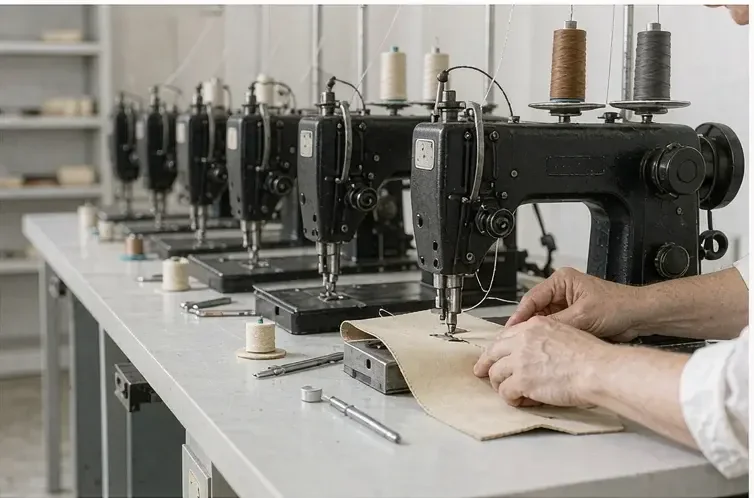
The Case: 1,800 Pieces, Three Colourways, One Bottleneck
Take a representative programme: a European maison releasing 1,800 structured pieces across three colourways for a single season, with 600 pieces per colourway and a delivery window of 35-50 days. The drawing is settled, the hides are booked and the hardware is on order. What decides whether the run lands on time is not the number of benches but the behaviour of five stations, because those five set the cycle time for everything behind them and everything in front of them waits.
- Station one, grade placement and clicking: 10 minutes per body, hides read at 30-45 seconds each.
- Station two, skiving and turn preparation: 12 minutes, residual held at 0.9-1.0 mm.
- Station three, visible seam work: 18 minutes at 7-8 stitches per inch.
- Station four, edge finishing: 20 minutes of work plus flash time that runs in parallel.
- Station five, hardware set and final dress: 8 minutes with a torque check on every screw.
Station four is the bottleneck, and it is the bottleneck for a chemical reason rather than a labour one. Flash time between edge coats is fixed by the coating, so the 20 minutes of application and sanding cannot be compressed by adding hands, and the whole line runs at whatever pace station four sets. Everything a planner does to a run of this shape is really a decision about how to feed station four without starving it.
What the Artisan Actually Owns on the Line
The artisan owns judgment, not throughput. On each of the five stations the work splits into a decision taken by eye or by hand and a repetition executed to a setting, and only the first belongs to the bench. Reading a hide, judging skiving depth, drawing a stitch, testing whether an edge has flashed, and feeling whether a screw has seated — those five are owned. Lining seams, pocket bags and zip insertion are not, and treating them as if they were is the fastest way to make a line both slower and less consistent.
- Cycle per structured body
- 22 minutes at the governing station
- Bodies in progress on a bench
- 6, held as a rolling buffer
- Rework ceiling at first pass
- 1.2% of units, line stopped above 2.5%
- Gauge spread across a 500-piece run
- Under 0.08 mm between lightest and heaviest panel
- Cross-coverage
- Each artisan holds 3 of the 5 stations
- Rotation interval
- Every 90 minutes, to hold attention and consistency
The 22-minute figure is the one to hold on to when a delivery date is discussed. A line at 22 minutes per body runs roughly 27 bodies in a ten-hour day at the governing station, which means 600 pieces in a single colourway takes about 22 working days of bench time before packing. Asking for 600 in twelve days does not make the bench faster; it makes two of the five stations skip a step, and the step skipped is always the one whose absence shows in month two.
Cross-Coverage: Three Stations Out of Five
An artisan who holds three of five stations is worth considerably more than one who holds one, and not only for absence cover. Rotation every 90 minutes is what keeps the tolerance honest: a person who has been drawing the same stitch for six hours stops seeing it, and the gauge spread across a run widens. Rotating across three stations resets the eye, and it is the least costly consistency measure available on a premium line.
One station
Fast on a single operation and blind to its own drift after about four hours. Output looks excellent mid-morning and the gauge spread across a 500-piece run opens past 0.08 mm by the end of the week.
Three stations
Rotation every 90 minutes resets the eye and covers absence without stopping the line. Sign-off on a second station takes about six months, and a third adds a further six.
Five stations
Full coverage, reached at roughly eighteen months. Rare and expensive, and in practice only needed on the smallest runs where one or two benches carry the whole order.
The trade-off is real. Cross-training takes a person off the governing station for six months at a time, which costs throughput in the quarter it happens and returns consistency in every quarter after. Houses that skip it run faster for a season and then spend the following season answering returns about edges that cracked at the fold.
The Rework Ceiling and What It Predicts
First-pass rework is the single best early signal a buyer can ask for, because it moves before anything visible does. A line holding 1.2% or below is a line whose decisions are being taken correctly; a line drifting toward 2.5% is a line that has started compensating somewhere, usually by rushing flash time or by accepting a panel that should have been rejected at clicking. The number is worth asking for weekly rather than at the end.
| Signal | Healthy | What drifting looks like |
|---|---|---|
| First-pass rework | 1.2% of units or below | 2.5% and rising, usually edge or seam related |
| Gauge spread across a run | Under 0.08 mm | 0.15 mm and widening as the week goes on |
| Hide yield against marker | 8-11 points above ungraded | Falling, meaning placement is being rushed |
| Cycle at the governing station | 22 minutes, steady | 18 minutes, achieved by shortening flash |
| Screw torque failures at final dress | Zero across a 500-piece sample | Two or three, which points to a worn driver bit |
How Skill Is Built: Six Months, Then Eighteen
Sign-off is staged rather than granted. Six months on a first station, a further six for a second, and full coverage at roughly eighteen months, with the sequence deliberately ordered so that every operation a trainee touches first is one whose error can be corrected. Preparation and interior seams come first; visible seams, corners and edge work come last, because a mistake on those is a scrapped body rather than a re-worked one.
- Months one to six: preparation, skiving on hidden panels, interior machine seams.
- Months seven to twelve: body seams on non-visible panels, turning, reinforcement placement.
- Months thirteen to eighteen: visible seams, corners, edge finishing and the final read.
- Sign-off is recorded per station per person, not assumed from time served.

Recording matters more than it sounds. A house that can show which person is signed off on which station can answer a quality question in an afternoon; one that cannot will spend a week guessing, and the guess is usually wrong in the direction of blaming the newest person on the line.
Where the Artisan Cannot Be Replaced
Three operations resist substitution regardless of what equipment is available. Grade placement resists it because a hide is not a uniform sheet and no camera yet reads fibre direction and scar depth together as well as a clicker does in 30-45 seconds. Skiving resists it because the error is unrecoverable. Edge readiness resists it because the test is a fingertip, and the penalty for guessing is a coat that lifts in the second month.
Ask which three operations are hand-guided and what the recorded tolerance is on each. A house with the skill answers in a sentence. A house with the vocabulary asks which operations you had in mind.
The other two stations are different in kind. Visible seam work can be mechanised in part, and often should be on long straight runs, but the draw at a corner and the set of a turning cannot; zip insertion and lining are better held to a guide than to an eye. The practical rule is that judgment belongs wherever an error is either unrecoverable or invisible until month two, and repetition belongs everywhere else on the body. A brief that does not make that distinction will be priced as if every operation needs the third year, and a brief that makes it too aggressively will be priced as if none of them do.
What Happens When Volume Doubles
Doubling volume does not double a premium line in the same window, because the governing station is bounded by chemistry and the last two operations are bounded by training. What doubling actually buys is a longer window: two benches over 44 days rather than one bench over 22, with the same 22-minute cycle and the same tolerance. A schedule that assumes otherwise will get its pieces, but it will get them with a wider gauge spread and an edge that fails at the fold.
- Add benches across a longer window, not hours to a shorter one.
- Protect the 90-minute rotation even when the schedule tightens; it is what holds consistency.
- Book hides earlier, because grade placement cannot be rushed without losing yield.
- Hold the 1.2% rework ceiling and stop the line rather than work around a drift.
How to Ask a House About Its Bench
Four questions, asked in writing, separate a house that has the skill from one that has the vocabulary. Which operations are hand-guided and which run to a fixed setting; what tolerance is recorded on skiving depth; what the flash interval is between edge coats and whether it is logged; and how many bodies the governing station completes in a day. A real line answers all four immediately, and the answers come with numbers rather than adjectives. See luxury sampling for how these questions are put to a first sample.
A fifth question is worth adding once the first four have been answered well: what happens to the schedule when a run is reordered at the same specification. A house that has its tolerances recorded will quote a shorter development window on the second drop, because grade placement, skiving depth and flash interval are already on file and do not need to be rediscovered. A house that has to rediscover them will quote the same 6-10 working days again, which is a fair signal that the first run was held together by individuals rather than by a written specification.
Programme Costs and Timing
Our programme runs through our validated partner factory Quanzhou Yingming Bags, an SGS-validated site with 7 production lines and roughly 200,000 pcs per month of capacity, holding export experience since 2014. Sampling takes 6-10 working days, or 12-15 on a complex build; bulk occupies 35-50 days; minimums sit at 500 pcs per style and colourway; and shipments leave FOB Xiamen, with FOB, CIF and DDP terms all available. Inspection is drawn at AQL 2.5 under ISO 2859-1, with leather tested against ISO 3376 for tensile strength and the colour held against ISO 105. The bench sequence behind those numbers is set out on the craftsmanship page.
Ask the four questions before you commit a season
Send the silhouette, volume per colourway, target delivery date and material direction. You will receive a written answer to all four bench questions plus a costed schedule. Request a quote.
Frequently Asked Questions
What is the role of artisans in luxury handbag production?
To own judgment at five stations — grade placement, skiving, visible seam work, edge readiness and final hardware set — and to hold them at a 22-minute cycle without losing tolerance. Everything else on the line is repetition of a setting that someone else has already made.
Why is edge finishing the bottleneck?
Because flash time between coats is fixed by the coating chemistry rather than by how many people are working. Twenty minutes of application and sanding cannot be compressed by adding hands, so the whole line runs at whatever pace the edge station sets.
What cycle time should a premium line hold?
About 22 minutes per structured body at the governing station. That gives roughly 27 bodies in a ten-hour day, which means 600 pieces in a single colourway takes around 22 working days of bench time before packing begins.
Why rotate artisans between stations?
Because attention decays. A person drawing the same stitch for six hours stops seeing it, and the gauge spread across a run widens past 0.08 mm. Rotation every 90 minutes across three stations resets the eye and covers absence without stopping the line.
What is a healthy first-pass rework rate?
Below 1.2% of units. Above 2.5% the line should be stopped for re-briefing, because the drift usually means flash time is being shortened or a panel that should have been rejected at clicking is being accepted.
How long does it take to train an artisan?
About six months to sign-off on a first station, six more for a second, and roughly eighteen months to full coverage of all five. The sequence is deliberately ordered so that every operation a trainee touches first is one whose error can still be corrected.
Which operations can machines not replace?
Three of them: grade placement, because no camera reads fibre direction and scar depth together as well as a clicker does in 30-45 seconds; skiving, because the error is unrecoverable; and edge readiness, because the test is a fingertip.
What happens when a brand doubles its order?
The window lengthens rather than the pace quickening. Two benches over 44 days deliver the same cycle and tolerance as one bench over 22. A schedule that demands the same window at double the volume gets its pieces with a wider gauge spread.
How many bodies should be in progress at once?
About six per bench, held as a rolling buffer. Fewer starves the governing station during flash intervals; more hides defects until the end of the run, when they are found together and rework spikes above the 1.2% ceiling.
What should a buyer ask a house about its bench?
Four questions in writing: which operations are hand-guided, what tolerance is recorded on skiving depth, the flash interval between edge coats and whether it is logged, and how many bodies the governing station completes in a day.
Why is gauge spread a useful signal?
Because it moves before any visible defect does. Under 0.08 mm across a 500-piece run means the bench is holding its tolerance; 0.15 mm and widening as the week progresses means placement and skiving are being rushed to recover time.
How does the programme schedule actually run?
Sampling takes 6-10 working days, or 12-15 on a complex build, and bulk occupies 35-50 days at 500 pcs per style and colourway. Shipments leave FOB Xiamen, and inspection is drawn at AQL 2.5 under ISO 2859-1 with a re-work reserve held.
People Also Ask
Do artisans still matter on a large production run?
Yes, more than on a small one. At 1,800 pieces the cost of a drift at station two is multiplied across the run, so judgment at grade placement and edge readiness is what keeps rework under 1.2%.
What is the difference between an artisan and a machine operator?
The artisan decides; the operator repeats. Five stations need decisions taken by eye or by hand, and lining seams, pocket bags and zip insertion need a constant setting held identically across every unit.
Why can't a delivery date simply be brought forward?
Because the governing station is bounded by flash chemistry and the last two operations by training. Bringing a date forward without lengthening the window means a step is skipped, and the step is always the one that shows in month two.
How is consistency measured on a premium bench?
By gauge spread across the run, held under 0.08 mm, and by pitch counted over 25.4 mm at three points per seam. Both are checked at goods-in without equipment beyond a calliper and a loupe.
Is cross-training worth the throughput it costs?
Yes. It costs about six months of reduced output at the governing station and returns consistency every quarter afterwards, plus absence cover that keeps the line running instead of stopping.
Sources and further reading
Every figure on this page is either our own programme data or attributed below. Open the originals before you write them into a specification.
- ISO — International Organization for StandardizationISO Publisher of ISO 2859-1 for the AQL 2.5 inspection plan, ISO 3376 for leather tensile strength and ISO 105 for colour fastness.
- Leather Working GroupLeather Working Group Tannery audit protocol that evidences hide traceability, the material basis for grade placement at the clicking station.
- SATRA Technology CentreSATRA Independent testing body for leather goods, referenced for seam strength, cycle testing and finish adhesion test methods.
- International Labour OrganizationInternational Labour Organization Source for apprenticeship and skills-development frameworks relevant to structured bench training and staged sign-off.