Reusable Luxury Bag Packaging: How a Keep Box Builds Brand Loyalty
Does reusable packaging actually build loyalty for a fine handbag house? Yes, but only when the carton is specified to survive daily handling rather than a single unboxing: 1200 gsm greyboard, a cloth-reinforced lid hinge proved over 50 open-and-close cycles, a magnetic catch releasing at 1.5-2.5 N, and 3-5 mm of internal clearance so the bagged piece lifts out without a tug. Specified that way, the box stops being packaging and becomes storage, and storage is what keeps a house in the room.
What Reusable Packaging Changes About the Relationship
A fine presentation carton usually has a working life measured in minutes: it is opened once, photographed, and flattened for recycling. A keep box has a working life measured in seasons, and every one of those seasons puts the house name in front of a person who has already bought. The commercial argument is not the cost of the carton; it is the cost of the next acquisition, which is always higher than the cost of keeping the customer already won.
That reframing changes the specification immediately. A one-way carton is optimised for the first forty seconds and can be light everywhere else. A carton intended for a wardrobe shelf has to survive being pulled down by one corner, stacked under scarves, and wiped with a nearly dry cloth, which is a different set of requirements altogether. Decide which object is being bought before the board grade is chosen, because retrofitting durability after the first run means new tooling and a second development window.
The Brief: One Box, Two Lives
Take the case that comes up most often. A European accessories label preparing its sixth collection asks for a presentation carton that will be photographed and then kept. The brief is two lives in one object: forty seconds of theatre followed by two years of storage. Written that way, it forces a decision the team might otherwise have avoided, because the two lives pull in opposite directions on cost and would otherwise be settled by whoever speaks last.
The theatre wants a soft-touch laminate, a deep relief and a ribbon that falls well. Storage wants a wipe-clean interior, corners that do not scuff, and a lid that stays open while both hands are busy. None of these requirements are incompatible, but each costs something, and a brief naming both lives lets those costs be chosen rather than discovered at costing stage with the collection date already fixed.
Choosing the Structure Before the Surface
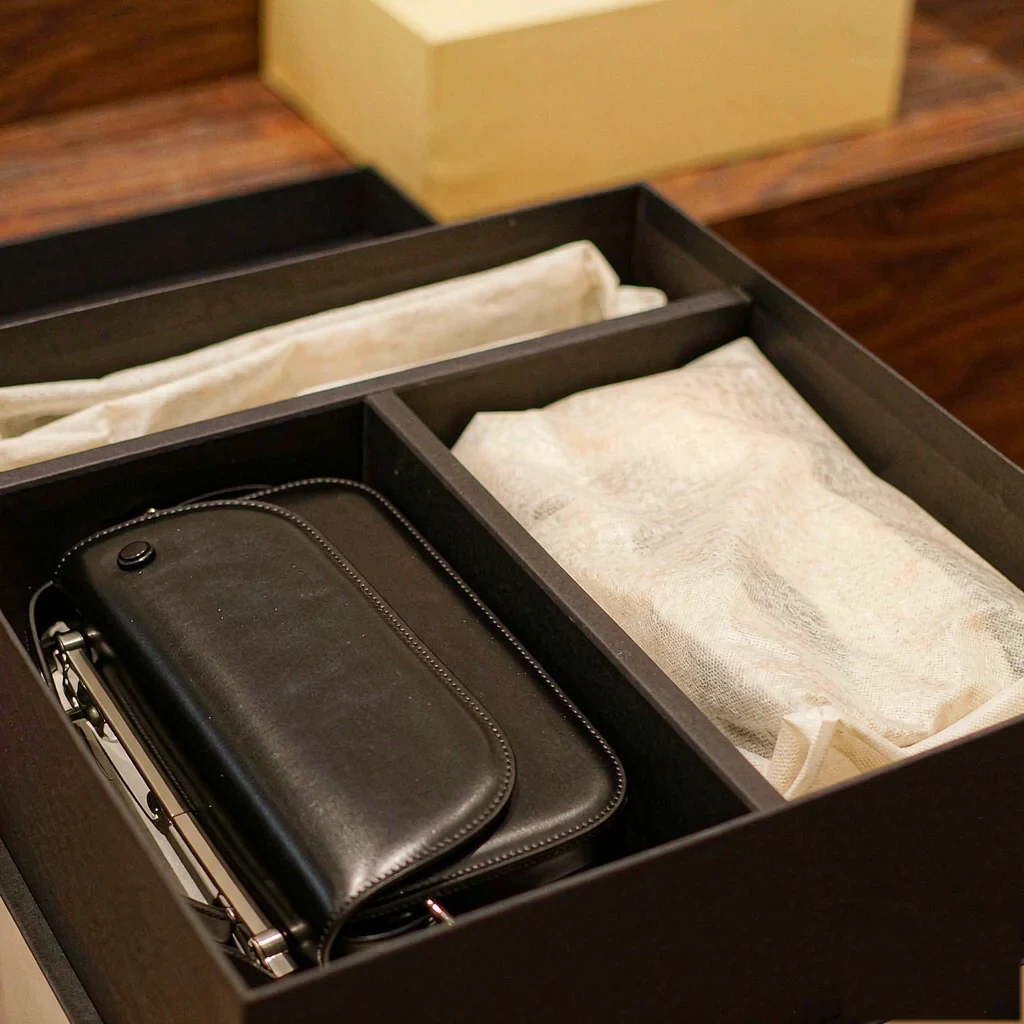
Structure is decided first because it cannot be changed inexpensively later. A rigid base-and-lid carton with a full-depth collar takes wear better than a folding carton, and a shoulder box, where the lid meets the base on a recessed band, hides the gap that opens as a friction fit loosens. A magnetic closure costs more than a friction fit but survives handling that would eventually stretch the alternative beyond recovery.
Three structural choices do most of the work. A collar that carries the lid rather than resting on the base walls. Corners that are reinforced rather than merely folded. A closure that opens with one hand while the other hand holds the piece. Specified together, those three turn a presentation carton into something that behaves like small furniture, which is exactly the comparison a customer makes when deciding what stays on the shelf.
Specifying the Board and the Wrap
Durability begins with the board. A 1200 gsm greyboard with a caliper near 0.6 mm is the working figure for a mid-size keep carton: below that, the base walls bow when the carton is lifted by one corner; above it, the added mass is felt but rarely appreciated. The wrap paper is specified alongside the board rather than after it, because a heavy paper over a light board wrinkles at the corners within weeks of leaving the line.
On the surface, finishes should be chosen for handling rather than for photography. A soft-touch laminate shows every fingerprint and resists cleaning; a matte laminate carrying a fine embossed grain hides both wear and prints and can be wiped with a barely damp cloth. Whatever the finish, decoration must sit at least 5 mm clear of every crease and edge, since the crease is where a kept carton begins to look tired first.
- Board grade
- 1200 gsm greyboard, caliper near 0.6 mm for a mid-size keep carton
- Wrap weight
- 157-200 gsm art paper, specified with the board rather than after it
- Lid hinge
- 60 mm cloth-reinforced hinge along the spine
- Closure release force
- 1.5-2.5 N, opening cleanly with one hand
- Internal clearance
- 3-5 mm around the bagged piece
- Decoration clearance
- At least 5 mm from any crease or edge
- Cycle target
- 50 open-and-close cycles without the lid drifting out of square
How Many Cycles Should a Lid Survive?
Fifty open-and-close cycles is a reasonable release target for a carton expected to live on a shelf for two seasons, and it costs very little to test. Hinge samples are cycled before tooling is released, then again at goods-in on pieces drawn from the middle of the run, because a hinge bonded at the wrong temperature holds for the first ten cycles and then lets go somewhere around the thirtieth.
The test itself belongs on the first-article sheet. Open the lid to ninety degrees, let it return under its own weight, repeat fifty times, then check that the hinge still returns the lid to square and that the cloth has not lifted at either end. A hinge that survives the count but has begun to fray at the ends is a hinge that will fail in the field, and re-specifying the cloth now is far cheaper than re-running the carton later.
Where Reuse Usually Fails First
Four failures account for most of the disappointment on a reuse brief, and none of them concern the print. The hinge lets go where the cloth meets the board. The corners scuff through the wrap to the greyboard beneath. The magnetic catch tears out of a board too light to hold it. The interior lining stains the first time anything spills. Each one is predictable, and each has a check that catches it before the run rather than after.
- Hinge lift at the ends: specify a 60 mm cloth hinge and check adhesion again after cycling.
- Scuffed corners: reinforce rather than fold, and round the corner rather than mitre it.
- Catch pull-out: back the magnet with a denser board patch instead of specifying a stronger magnet.
- Stained lining: use a wipe-clean coated paper rather than an uncoated interior board.
- Lid drifting out of square: hold the collar to size and re-check closure after fifty cycles.
What the Interior Has to Do
An interior that only has to look right for a photograph can be uncoated board. An interior that will hold a dust cover for two years has to be cleanable and physically forgiving. A coated paper around 250 gsm wipes down without marking, resists the faint transfer that a dyed piece can leave on a pale surface, and costs very little more than uncoated stock once the run reaches programme volumes.
Clearance matters as much as material. Keep 3-5 mm around the bagged piece: enough that it lifts out without a tug, not so much that it shifts in transit. A lift ribbon earns more here than it does on a one-way carton, because lifting is how the interior is reached at all, and a ribbon that pulls cleanly through fifty uses is genuinely part of the durability story rather than decoration.
Marking and Dating Without Looking Marks Down
Exterior mark
Small and low on the face. A kept carton is furniture, and a large mark reads as advertising.
Collection reference
Debossed inside the lid rather than printed on the face, so it cannot rub away.
Care note
Held to the same adhesion requirement as any printed panel so it survives a wipe.
Material statement
Board and paper carry FSC chain-of-custody; state it once, on the inside.
The instinct is to put more marking on a carton that will be kept. The correct move is usually the opposite. A kept carton lives in a bedroom or a dressing room, and anything that reads as advertising gets turned face down or pushed to the back of the shelf. Keep the main mark small and low on the front face and carry the practical information, the collection reference, the care note and the material statement, on the inside.
Placement rules that hold up across sizes: the main mark no taller than 25 mm on a mid-size lid; the reference debossed rather than printed so it cannot rub off in use; the care note held to the same adhesion standard applied to any decorated surface. A care card tucked loosely inside a carton is read once and kept far less reliably than a note pressed permanently into the lid.
What Reuse Costs, and Where the Money Sits
A keep carton costs more per unit than a one-way carton, but the increase is concentrated in three places rather than spread evenly. The board upgrade is the smallest part and scales linearly with sheet size. The cloth hinge and the magnetic catch are paid once per unit and are modest. The largest variable by far is the reject rate on the hinge bond, which is why the cycling test is worth running rather than assuming.
| Cost line | Effect on unit cost | Worth paying for when |
|---|---|---|
| Board upgrade to 1200 gsm | Small, linear with sheet size | Always on a reuse brief |
| Cloth-reinforced hinge | Small per unit; jig tooling once | The lid will be opened often |
| Magnetic closure | Moderate, set by pull force and backing | One-handed opening matters |
| Coated interior paper | Small; replaces uncoated stock | The interior will be wiped |
| Hinge cycling test | Negligible; avoids the largest reject source | Always, on the first article |
| Corner reinforcement | Small tooling, small material addition | Cartons are stacked or moved often |
A presentation pack built along these lines lands near USD 4.80 per unit at programme volumes, which sits comfortably inside the landed cost of most fine handbag programmes. The comparison worth making is not against a plain carton but against the cost of winning the replacement purchase the house hopes to delay. Measured that way, the upgrade almost always pays, and it pays twice if the carton is still on the shelf a year later.
Measuring Whether the Carton Is Actually Kept
Reuse is a claim until it is measured, and it can be measured inexpensively with three signals. How often the carton appears in customer photographs sent months after purchase. How often replacement dust covers and care cards are requested. Whether the collection reference pressed into the lid is quoted correctly in service enquiries. Taken together, these say plainly whether the carton is still standing in the room.
Read them on a six-month lag rather than weekly. Launch month always shows a spike in photographs, because that is when the unboxing happens; the interesting number is month five. If the carton is still visible then, the specification is doing its job, and any further spend should go towards durability, cleaner closure action and better interior rather than towards more surface decoration.
On a keep brief, spend on the hinge, the corners and the closure before spending on print. A kept carton that has gone tired on the shelf is worse for the house than a plain carton nobody remembers.
How a Reuse Brief Runs Through Development
Our programme runs through our validated partner factory Quanzhou Yingming Bags, an SGS-validated site with 7 production lines and roughly 200,000 pcs per month of capacity, holding export experience since 2014. Sampling takes 6-10 working days, or 12-15 where a cloth hinge and a magnetic closure have to be tooled together; bulk occupies 35-50 days; and minimums sit at 500 pcs per style and colourway before shipment leaves FOB Xiamen.
Presentation packaging is inspected on the same plan as the piece itself: a sample drawn at AQL 2.5 under ISO 2859-1 and read against the approved first article rather than against a written description. The full presentation specification is set out on luxury packaging, the development and tooling sequence is described on luxury sampling, and the inspection plan itself is explained on luxury quality control.
Write the reuse brief before the board is ordered
Send the carton size, the target cycle count, the closure preference and the quantity per colourway. You will receive a keep-carton specification naming board grade, hinge build, closure force, interior material and the inspection point. Request a quote.
Frequently Asked Questions
What makes packaging reusable rather than merely recyclable?
Reusable packaging is built to survive repeated handling, while recyclable packaging is built to be processed once. A recyclable carton can be light, folded and Printed flat. A reusable carton needs a rigid board, a reinforced hinge, corners that resist scuffing and a closure proved over fifty cycles.
How many times should the lid of a keep carton open cleanly?
Fifty open-and-close cycles is the practical target for a carton expected to live two seasons on a shelf. Open to ninety degrees, let the lid return, repeat fifty times, then check that the lid still sits square and the cloth has not lifted at either end.
What board weight suits a carton that is meant to be kept?
About 1200 gsm greyboard with a caliper near 0.6 mm for a mid-size keep carton. Lighter board bows when the carton is lifted by one corner, and heavier board adds mass that is felt but rarely appreciated by the person carrying it home.
Why does the hinge fail before anything else on a reused carton?
Because it takes every movement the carton will ever see. The failure is usually not the cloth itself but the bond where the cloth meets the board, and it is caused by adhesive applied below the temperature window and showing only after twenty or thirty cycles.
How much clearance should there be around the bagged piece?
Between 3 and 5 mm. Enough for the dust-covered piece to lift out without a tug, and tight enough that it does not shift in transit. Check this with the actual dust cover rather than with the piece alone, since the cover adds bulk at the corners.
Should the closure be magnetic or a friction fit?
Magnetic for a reuse brief. A friction fit relies on compression in the board, which relaxes over time and leaves the lid sitting proud. A magnetic catch holds within the same tolerance for years, provided the board behind it is backed with a denser patch.
Can a keep carton still carry foil decoration?
It can, with two conditions. Decoration sits at least 5 mm clear of every crease so it does not crack on the first opening, and adhesion is proved at 4B under ASTM D3359 so it survives being wiped rather than lifting at the corners.
How is a magnetic catch kept from tearing out of the board?
Back it with a denser board patch rather than specifying a stronger magnet. Pull force beyond about 2.5 N makes one-handed opening awkward, and that discomfort is what makes people stop closing the lid properly, which wears the hinge faster.
What interior material survives being wiped down repeatedly?
A coated paper around 250 gsm. It wipes clean without marking, resists colour transfer from a dyed piece resting against it, and costs very little more than uncoated stock once the run reaches 500 pcs per colourway or more.
How much more does reusable packaging cost per unit?
The board upgrade and the coated interior add a small amount, the hinge and the closure add a modest amount, and neither dominates. The real variable is the reject rate on the hinge bond, which is why cycling fifty pieces before release protects the unit cost more than any material saving.
How is a reusable carton inspected at goods-in?
On the same plan applied to the piece itself: a sample drawn at AQL 2.5 under ISO 2859-1 and compared against the approved first article. The extra checks specific to reuse are hinge condition after cycling, corner scuff resistance and closure release force.
What is the minimum quantity for a bespoke keep carton?
500 pcs per style and colourway, because bespoke size, board and tooling cannot be amortised below that. Sample cartons take 6-10 working days, rising to 12-15 where a cloth hinge and a magnetic closure need to be tooled together.
People Also Ask
Is a reusable carton worth the extra unit cost?
Usually yes, when it is judged against the cost of winning a replacement purchase rather than against the price of a plain carton. Board and closures add modest cost; new customer acquisition costs far more.
Where should the brand mark go on a keep carton?
Small and low on the front face, no taller than about 25 mm on a mid-size lid. Anything larger reads as advertising and gets turned face down, which defeats the purpose of keeping it.
Why do corners scuff first on a carton kept in use?
Corners take every knock and every pull off a shelf. Reinforced, rounded corners outperform folded mitred ones, because the wrap is not stretched thin across a hard turn and the greyboard stays covered.
Can an existing carton be upgraded for reuse without new tooling?
Sometimes. A coated interior paper and a backed closure can often be added within existing tooling, but a cloth hinge and a collar almost always need new tooling and a fresh 6-10 working day window.
How often should the hinge be re-tested during a long run?
On the first article, then again on pieces drawn from the middle and the end of the run. Bond quality moves with adhesive temperature, so a hinge that passes in the morning can fail by the afternoon.
Sources and further reading
Every figure on this page is either our own programme data or attributed below. Open the originals before you write them into a specification.
- ISO - International Organization for StandardizationISO Publisher of ISO 2859-1, the attribute sampling plan under which presentation packaging is drawn at AQL 2.5.
- ASTM International standardsASTM International Publisher of ASTM D3359, the cross-hatch tape test used to score decoration adhesion on a 0B to 5B scale.
- Forest Stewardship CouncilFSC Chain-of-custody scheme covering the greyboard and wrap paper used in rigid presentation cartons.
- SGS - Inspection and verificationSGS Third-party validation and goods-in inspection body referenced for site validation and pre-shipment checks.