Quilted Luxury Bag Stitching Techniques
Quilting is not decoration on a luxury handbag; it is a structural method that bonds a face leather, a wadding and a lining into one composite panel. Five patterns dominate the category: diamond, chevron, channel, mattress and trapunto, and each one differs in stitch spacing, wadding thickness and how much it lets the panel drape. The working specification across all five is 8-9 stitches per inch with a 0.45 mm bonded nylon thread over 2-3 mm of wadding. This guide compares the five patterns on the numbers a designer brand has to sign off, and shows where each one belongs inside a collection.
What Quilting Actually Does to a Luxury Bag
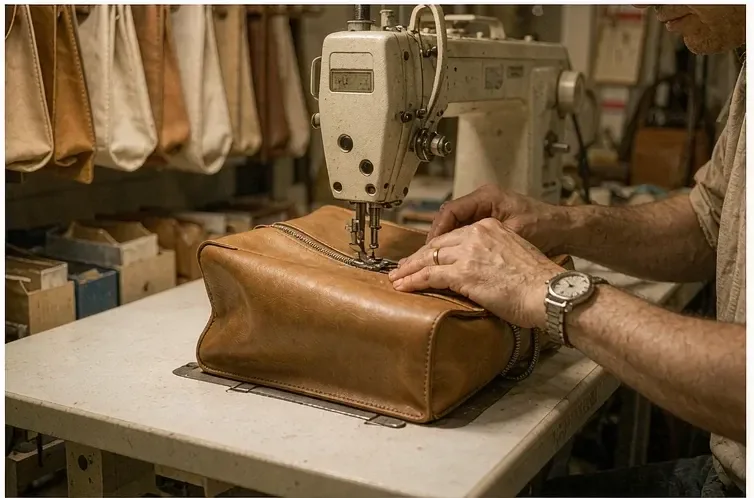
Quilting turns three layers into one. A face leather of 0.9-1.1 mm, a wadding of 2-3 mm and a lining of 0.6-0.8 mm are stitched together so the panel behaves as a composite rather than as three materials moving independently. That composite is stiffer than any of its individual layers, which is why a quilted panel holds a curve that a flat panel cannot, and why the stitch line is a structural seam rather than a drawn motif.
The trade-off is drape. Every additional stitch line removes flexibility, so a densely quilted panel resists the corner radius and a densely quilted gusset fights the frame. The specification question is therefore not which pattern looks best on a sketch, but how much stiffness the silhouette needs at each panel and how far the leather is being asked to bend. A panel that is too stiff for its frame will crack at the turn within a season.
The one-line specification
- Specify a quilted panel by four numbers: pattern and stitch spacing in millimetres, stitch density in stitches per inch, wadding thickness in millimetres, and thread diameter in millimetres. Those four figures determine drape, finished weight and how the panel ages, and they are the four lines we audit before a shipment is released.
The Five Core Quilt Patterns Compared
The table below compares the five patterns on the specifications that matter at sampling: geometry, stitch spacing, wadding, drape and where each one belongs in a collection. Read it as a selection matrix rather than as a style library, because the same pattern behaves differently on a shoulder panel and on a structured frame.
| Pattern | Geometry and spacing | Wadding | Drape | Best silhouette |
|---|---|---|---|---|
| Diamond | Lattice at 45 or 60 degrees, 18-25 mm spacing | 2 mm | Medium | Top handle and shoulder bags |
| Chevron | Parallel zig-zag at 18 mm spacing | 2 mm | Medium-soft | Flap and shoulder silhouettes |
| Channel | Parallel lines at 12-15 mm spacing | 3 mm | Firm | Structured top handle bags |
| Mattress | Tacked points at 25-40 mm spacing | 2-3 mm | Soft | Soft hobo and slouch shapes |
| Trapunto | Corded channel at 20-30 mm spacing | 3 mm | Firm and sculpted | Evening bags and minaudieres |
Stitch Density: Why 8-9 SPI Is the Working Band
Stitch density controls both appearance and tear resistance. Below 8 stitches per inch the stitch line opens under load and the wadding migrates towards the lowest point of the panel; above 9 stitches per inch the needle perforations weaken the leather and the line begins to look mechanical rather than hand-guided. We hold 8-9 stitches per inch across every quilt pattern, with a tolerance of plus or minus 0.5 SPI, verified by counting ten inches of seam on the first article rather than by eye.
- Counting method: ten inches of seam are counted on the first article and recorded on the specification sheet.
- Tolerance: plus or minus 0.5 stitches per inch, with a hard reject below 7.5 or above 9.5.
- Back-tack: every quilt line is back-tacked at both ends so the line cannot unravel from the panel edge.
- Consistency: one operator and one machine setting complete a full panel, because re-setting mid-panel changes the line.
Thread, Needle and Wadding: The Three Inputs
Thread
A 0.45 mm bonded nylon in Tex 40, colour-matched to the face leather under D65 lighting, with a break load above 4 kg.
Needle
A size 18 leather point needle, changed every 8 working hours so a dull point does not burnish the stitch hole.
Wadding
2 mm for a supple panel and 3 mm for a sculpted one, specified at 80 gsm so weight stays predictable across a run.
Face leather
0.9-1.1 mm full-grain calfskin, because a thinner face shows the wadding edge and a thicker one resists the turn.
Those three inputs are specified together, never separately. A change in wadding thickness changes the stitch line depth, which changes needle penetration, which changes thread tension. Any one of the three moved on its own produces a panel that passes a dimensional audit and still looks wrong beside the reference sample.
Diamond vs Chevron: Which Pattern Suits Which Silhouette
Diamond is the most forgiving pattern to look at and the most demanding to run. A 45 degree lattice reads as classic and a 60 degree lattice reads as sharper and more contemporary, but both require the stitch lines to meet at an intersection point that must fall inside a 1 mm window across the entire panel, which is what makes the operation slow. Chevron is faster, reads as directional, and suits a flap or a shoulder silhouette where the panel is seen at an angle rather than head-on.
- Diamond at 45 degrees: classic read, widest pattern matching requirement, slowest to run.
- Diamond at 60 degrees: sharper and more contemporary, carrying the same tolerance burden as the 45 degree lattice.
- Chevron at 18 mm: directional, faster to run, best on a flap or a shoulder panel.
- Point tolerance: every lattice intersection must fall inside a 1 mm window across the panel.
Channel and Trapunto: Volume Without Weight
Channel quilting runs parallel lines at 12-15 mm spacing over 3 mm of wadding, which produces the firmest flat panel in the category and is the standard choice for a structured top handle bag that has to hold a blocked frame. Trapunto takes the same geometry and inserts a cord into selected channels, raising them above the surface. It is the heaviest of the five in labour and the lightest in material, because the volume comes from the cord rather than from additional wadding.
Pattern Matching Across Panels and Gussets
The failure point of a quilted bag is rarely the panel itself; it is the junction. A diamond lattice that meets a gusset at an unplanned angle reads as a mistake even when every stitch is technically correct. We plan the panel so the lattice closes symmetrically about the vertical centre line, and we specify the gusset as a plain or channel-quilted element rather than as an attempted continuation of the lattice.
- Centre-line symmetry
- Lattice closes symmetrically about the vertical centre line
- Gusset treatment
- Plain or channel-quilted, never an attempted lattice continuation
- Flap alignment
- Flap lattice aligns with the body lattice within 1 mm
- Handle tab
- Cut on the straight grain so the quilt line does not skew
- Panel tolerance
- Stitch spacing held to plus or minus 1 mm across the panel
How a Quilted Panel Ages
A quilted panel is judged twice: on the day it is approved and after a season of use. The failure modes are predictable. Wadding migrates towards the lowest point of the panel when stitch density is too low, the lattice relaxes where the panel meets a strap anchor, and the face leather develops a shadow along the stitch line where the needle has perforated it too densely. All three are specification problems rather than material problems, and all three are prevented at the sampling stage.
- Wadding migration: prevented by holding 8-9 stitches per inch and by tacking the wadding before the line is run.
- Lattice relaxation: prevented by reinforcing the panel behind every strap anchor and behind every handle tab.
- Stitch-line shadow: prevented by keeping density below 9.5 SPI and by matching the thread colour to the grain.
- Corner cracking: prevented by specifying a corner radius that the chosen wadding thickness can actually turn.
Tolerance Table for Quilted Panels
Every quilted panel is audited on the lines below, measured on a sample pulled from the cartons under AQL 2.5 (ISO 2859-1) rather than on a hand-picked first article.
| Element | Specification | Tolerance | Failure threshold |
|---|---|---|---|
| Face leather | 0.9-1.1 mm full-grain calfskin | plus or minus 0.1 mm | Below 0.8 mm or above 1.2 mm |
| Wadding | 2 mm or 3 mm by pattern | plus or minus 0.2 mm | Visible wadding edge at the seam |
| Stitch density | 8-9 stitches per inch | plus or minus 0.5 SPI | Below 7.5 or above 9.5 SPI |
| Stitch spacing | 12-40 mm by pattern | plus or minus 1 mm | Drift above 2 mm across a panel |
| Lattice point | Intersection inside a 1 mm window | 1 mm window | Any point outside the window |
| Thread | 0.45 mm bonded nylon, Tex 40 | plus or minus 0.02 mm | Break load below 4 kg |
| Needle | Size 18 leather point | Changed every 8 hours | Burnished or torn stitch holes |
| Back-tack | Both ends of every quilt line | Mandatory | Any line without a back-tack |
Sampling, MOQ and Cost Notes
A quilted first article takes 6-10 working days from a confirmed tech pack, while diamond and trapunto, which carry the heaviest pattern matching burden, take 12-15 working days. Minimum order quantity is 500 pcs per style / colourway and bulk production runs 35-50 days from an approved sample, offered FOB Xiamen. Our validated partner factory Quanzhou Yingming Bags has run quilted programmes since 2014 on 7 production lines with a monthly output of about 200,000 pcs, and specified programmes begin at USD 4.80 per unit.
Request a quilt specification review
Send us a sketch and a target hand feel and we will return a pattern recommendation, a tolerance sheet and a costed specification within one working day. Start your quilted programme
Frequently Asked Questions
What is the best stitch density for a quilted luxury bag?
We hold 8-9 stitches per inch across every quilt pattern, with a tolerance of plus or minus 0.5 SPI. Below 8 the stitch line opens under load and the wadding migrates; above 9 the needle perforations weaken the leather and the line looks mechanical. The figure is verified by counting ten inches of seam on the first article.
How thick should the wadding be under quilting?
Two millimetres for a supple panel and three millimetres for a sculpted one, specified at 80 gsm so the finished weight stays predictable. Thicker wadding produces more loft but resists the turn at a corner radius, which is why channel and trapunto panels are paired with a blocked frame rather than with a soft body.
Which quilt pattern is the most demanding to produce?
Diamond, because every lattice intersection must fall inside a 1 mm window across the whole panel, and trapunto, because the cord is inserted by hand into selected channels. Both take 12-15 working days at sampling rather than 6-10, and both should be reserved for silhouettes where the panel is seen head-on.
Can quilting be used on a structured top handle bag?
Yes, and channel quilting is the usual choice. Run at 12-15 mm spacing over 3 mm of wadding it produces the firmest flat panel in the category, which supports a blocked frame instead of fighting it. Diamond can also be used on a structured body, but it should be planned to close symmetrically about the centre line.
How do you stop a quilted panel from puckering?
Puckering comes from uneven feed, so the panel is stitched in one direction by one operator at one machine setting. The face leather is held at 0.9-1.1 mm, the wadding is tacked before the line is run, and the needle is changed every 8 working hours. A dull point burnishes the hole and drags the grain.
What thread is used for quilting leather?
A 0.45 mm bonded nylon in Tex 40, colour-matched to the face leather under D65 lighting rather than to a screen image, with a break load above 4 kg. A bonded finish matters because an unbonded thread frays at the needle and produces a fuzzy line after a season of use.
How do you match a quilt pattern across a flap and a body?
The flap lattice is aligned with the body lattice within 1 mm, and both are planned from the same centre line on the tech pack. Gussets are specified as plain or channel-quilted rather than as an attempted continuation of the lattice, because a lattice meeting a gusset at an unplanned angle reads as an error.
What is the difference between channel and trapunto quilting?
Channel runs parallel stitch lines at 12-15 mm spacing over 3 mm of wadding and stays flat. Trapunto uses the same geometry but inserts a cord into selected channels, raising them above the surface. Trapunto is heavier in labour and lighter in material, because its volume comes from the cord rather than from extra wadding.
How long does a quilted sample take?
A first article takes 6-10 working days from a confirmed tech pack for chevron, channel and mattress patterns. Diamond and trapunto take 12-15 working days because of the pattern matching burden. Bulk production then runs 35-50 days from an approved sample, and shipments are offered FOB Xiamen.
What is the minimum order quantity for a quilted programme?
Minimum order quantity is 500 pcs per style / colourway. Quilted panels carry a pattern planning and setup cost that is amortised across the run, so the threshold is the same for a first capsule and for a repeat. A brand ordering four colourways of one quilted silhouette places four qualifying runs.
Does quilting add weight to a handbag?
Yes, and it should be budgeted deliberately. Wadding at 80 gsm plus a lining adds measurable weight to every panel, which is why trapunto is specified when a sculpted look is wanted without additional wadding. The cord provides the volume, so the panel gains presence without gaining material.
How is a quilted panel inspected before shipment?
Panels are audited at AQL 2.5 (ISO 2859-1) on a sample pulled from the cartons. Inspectors measure face thickness, wadding thickness, stitch spacing and lattice intersections, then check the back-tack at both ends of every line and inspect the stitch holes for burnishing under a 10x loupe.
How do you stop wadding from migrating inside a quilted panel?
Migration happens when stitch density is too low for the wadding weight, so the fill creeps towards the lowest point of the panel. We hold 8-9 stitches per inch, tack the wadding before the line is run, and specify 80 gsm so the fill stays predictable. Migration shows as a flat patch at the base of the bag.
Can a quilted panel be corrected after it has been made?
A single broken stitch line can be re-run without opening the panel, but migrated wadding cannot be corrected once the composite is closed. That is why the sampling round exists: the panel is opened, measured and re-specified before bulk, and the approved sample becomes the physical standard for the run.
People Also Ask
What is diamond quilting on a luxury handbag?
Diamond quilting is a lattice of stitch lines set at 45 or 60 degrees with 18-25 mm spacing over 2 mm of wadding. It is the most recognisable quilt pattern in the category and the most demanding to run, because every lattice intersection must fall inside a 1 mm window across the panel.
Why does quilting make leather stiffer?
Quilting bonds three layers into one composite: a 0.9-1.1 mm face leather, 2-3 mm of wadding and a 0.6-0.8 mm lining. That composite is stiffer than any single layer, so it holds a curve a flat panel cannot, at the cost of drape.
What does SPI mean in leather stitching?
SPI means stitches per inch, the standard measure of stitch density. Luxury quilted panels run at 8-9 SPI with a tolerance of plus or minus 0.5. Lower density opens under load; higher density perforates the leather and reads as mechanical rather than hand-guided.
Is trapunto quilting suitable for a structured silhouette?
Yes. Trapunto inserts a cord into selected channels at 20-30 mm spacing over 3 mm of wadding, producing a raised sculpted surface that pairs well with a blocked frame. It is the heaviest pattern in labour and the lightest in material of the five.
How do you specify a quilted panel on a tech pack?
Give four numbers: the pattern and stitch spacing in millimetres, the stitch density in stitches per inch, the wadding thickness in millimetres and the thread diameter in millimetres. Add the lattice intersection tolerance and the centre-line rule, and the panel can be sampled without a correction round.
Sources and further reading
Every figure on this page is either our own programme data or attributed below. Open the originals before you write them into a specification.
- ISO 2859-1 sampling procedures for inspection by attributesInternational Organization for Standardization The sampling standard referenced by the AQL 2.5 audit applied to quilted panels.
- Leather Working Group audit protocolsLeather Working Group Referenced for face leather traceability on full-grain calfskin programmes.
- REACH restricted substances guidanceEuropean Chemicals Agency Used as the chemical baseline for wadding, adhesive and thread finishes.
- ISO 11644 leather adhesion and finish flexibility testsInternational Organization for Standardization Referenced when a quilted face leather is assessed for finish flexibility.
A quilted panel is specified with four numbers, not with an adjective. Give us the pattern, the spacing, the wadding and the thread and the sample arrives right the first time; give us a photograph and the programme spends its calendar in correction rounds.
Send a sketch, a target hand feel and a target price band and we will return a pattern recommendation, a tolerance sheet and a costed specification within one working day. Request a quilt specification review