Ostrich vs Crocodile Exotic Leather Handbags: Which Exotic Belongs in Your Line
Ostrich vs crocodile exotic leather handbags: which one belongs in a line? Choose ostrich when the design wants a soft, clothing-like hand and a surface that reads as texture rather than scale; choose crocodile when the design wants architecture, gloss and a centre panel that behaves like a tile field. Ostrich yields a wide quill panel and finishes around 0.9-1.1 mm; crocodile gives a belly of 20-26 scale rows and finishes around 1.0-1.3 mm. Both carry CITES documentation. This guide answers the choice as six questions in the order buyers actually ask them.
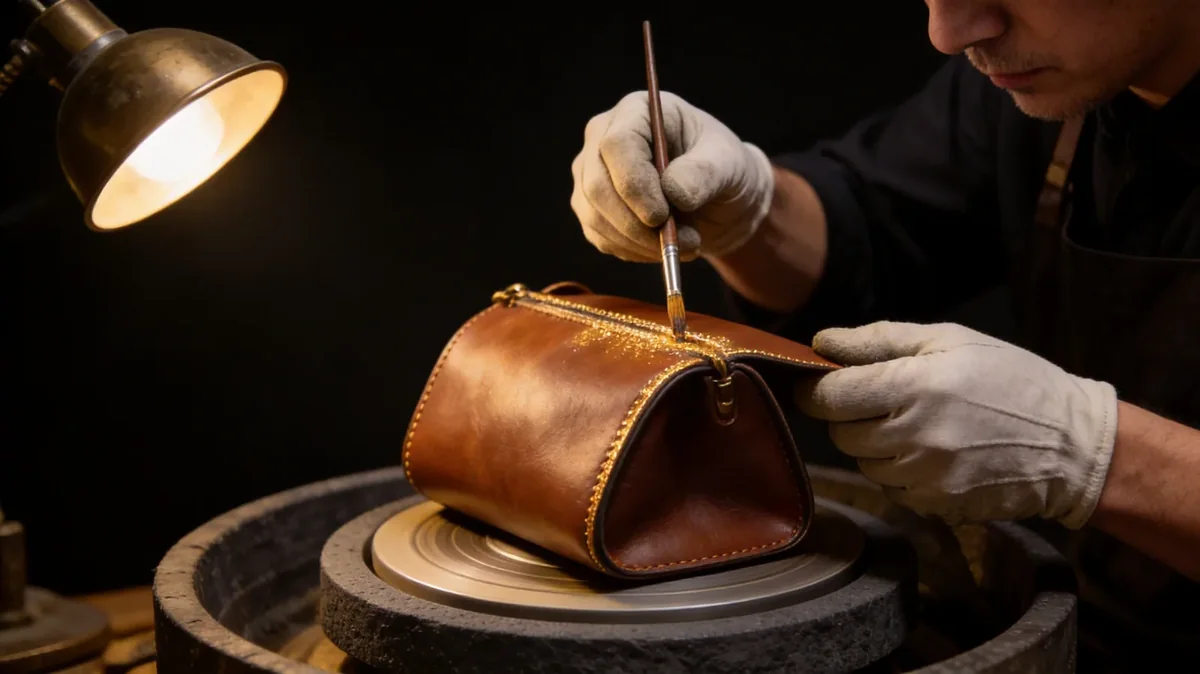
Question One: What Does Each Skin Look Like on a Finished Body?
Ostrich is identified by the quill field: raised bumps across the centre of the skin where the feathers were removed, surrounded by a smoother area that runs down the flanks. The pattern is organic, never repeats, and reads best on a large uninterrupted panel. Crocodile is identified by belly tiles: rectangular scales arranged in regular rows, with the small round scales of the flank used for gussets, straps and trim.
The two surfaces photograph very differently. Ostrich absorbs light and looks matte, soft and slightly rustic even in a formal shape. Crocodile reflects light, holds a high gloss and makes even a simple body look architectural. A house building a quiet, understated range usually lands on ostrich; a house building a statement range usually lands on crocodile.
Question Two: Where Does the Skin Come From and What Paperwork Follows It?
Both species are regulated under CITES, and the paperwork travels with the skin rather than with the bag. Crocodilians appear in Appendix I or Appendix II depending on species and population; farmed programmes operate under registered sources with export permits. Ostrich from registered ranching programmes is also controlled, and in some markets the listing differs, so the permit route has to be confirmed per origin before a booking is made.
For a brand the practical consequences are fixed. Each skin arrives with a tag or documentation set; finished bodies may need re-export documentation when they cross a border again; and a delivery without complete paperwork cannot be sold on in most jurisdictions. Confirm the route at sampling, not at the shipping window, because a permit is the one item that no amount of bench skill can accelerate.
- CITES listing
- Crocodilians in Appendix I or II by species and population; ostrich regulated by origin
- Origin requirement
- Registered ranching or captive-breeding programme with a traceable source
- Document set
- Export permit or re-export certificate accompanying the skin or the finished body
- Tag integrity
- Tag or documentation reference retained through cutting and recorded per body
- Market rule
- US states and EU member states apply their own additional restrictions on top of CITES
Question Three: How Much Usable Panel Does One Skin Actually Give?
This is where the cost difference is really created. Ostrich gives a wide centre panel of quills, roughly the shape of a rounded diamond, with usable flank either side; the quill area is the valuable part and every seam that crosses it spends money. Crocodile gives a narrower belly of tiles in regular rows, plus flanks; the belly is the valuable part and its width sets the widest panel the body can carry.
| Factor | Ostrich | Crocodile |
|---|---|---|
| Signature area | Centre quill field | Belly tile rows, typically 20-26 |
| Finished substance | 0.9-1.1 mm | 1.0-1.3 mm after finishing |
| Hand | Soft, draping, clothing-like | Firm, structural, holds a flat plane |
| Light behaviour | Matte, absorbs light | Gloss, reflects light |
| Panel planning | One large panel, minimal seaming | Belly centred, flanks for gusset and strap |
| Typical failure | Quill flattened by pressure in packing | Tile lift at a fold if the finish is too hard |
Plan the panel layout before the design is frozen. On ostrich, move seams to the flank and keep the quill field whole. On crocodile, centre the belly on the front panel and let the tile rows run symmetrically, because buyers read symmetry in the tile count before they read anything else on the body.
Question Four: How Does Each Skin Behave Under the Needle and the Burnisher?
Ostrich is softer and more forgiving at the needle; it takes a stitch at 8-9 per inch with 0.45 mm thread and closes over the line. Crocodile is firmer and denser, and a needle entering between tiles behaves differently from one entering a tile, so stitch placement has to respect the scale row. Both are finished with a three-coat edge, but the edge on a scaled skin has to be built thinner to avoid a visible ridge along the arris.
Ostrich at the bench
Soft hand, takes a fold well, burnishes to a soft sheen. Quills flatten permanently under sustained pressure, so packing has to keep weight off the panel.
Crocodile at the bench
Dense and structural, holds a flat plane without interlining. Tiles lift at a tight fold if the finish is too hard, so fold radius is a design constraint.
Ostrich finishing
Light top coat keeps the quill definition. Heavy finishing fills the valleys between quills and flattens the visual depth that the skin is bought for.
Crocodile finishing
Gloss is built by polishing rather than by coating thickness. A thick coat cracks along the tile joints and is the most common cause of a rejected exotic delivery.
Thread and needle choice also differs. Ostrich accepts a 0.45 mm braided polyester at 8-9 stitches per inch and closes around it, which keeps the stitch line discreet against an already busy surface. Crocodile benefits from the same thread but a marginally lower density at the tile joints, because crowding perforations along one row weakens the line between scales. Both should be sampled on the actual skin rather than on calf, because the bench feel of a scaled surface is not transferable.
Question Five: What Does the Finished Body Cost and Why?
On either skin the programme terms do not change: MOQ 500 pcs per style and colourway, sampling at 6-10 working days and 12-15 for a complex construction, bulk at 35-50 days on FOB Xiamen terms, inspected to AQL 2.5 under ISO 2859-1, at a base reference unit of USD 4.80 before the material is applied. What changes is the material line and the yield behind it, and on exotic skins the material line dominates the cost sheet.
Ostrich is usually the less expensive of the two per usable panel, because a single skin gives a larger area and the flank is genuinely usable. Crocodile is usually the more expensive, because the belly is narrow, the tile count constrains panel width, and matching a pair of bodies for symmetry consumes additional skins. A pair-matched crocodile programme can consume material at a rate that surprises a first-time buyer.
Where the money goes
- Material, not labour, is the dominant line on an exotic body.
- Yield is set by the layout: whole quill field or centred belly, never a compromise of both.
- Pair matching on crocodile multiplies the skin count and should be quoted as its own line.
- Permit handling and documentation add time rather than cost, but the time is calendar time.
- Rejected exotic panels cannot be re-cut, so inspection happens before cutting, not after.
Colour behaves differently too. Ostrich takes dye into the quill field unevenly by nature, so a shaded or hand-antiqued finish flatters it and a flat, uniform colourway fights it. Crocodile accepts a flat gloss and reads as deeper at the tile joints, which is why a single-colour crocodile body still looks dimensional. Sampling the intended colourway on the intended skin is the only way to know which of the two a palette actually suits.
Question Six: Which Skin Suits Which Client Promise?
Ostrich suits a promise built on softness, rarity and restraint: a quiet body that rewards touch and photographs as texture. Crocodile suits a promise built on presence, precision and permanence: a body that reads as an object and justifies a high price tag on the shelf. Both are legitimate; the mistake is choosing crocodile for a slouched shape or ostrich for a rigid one.
- Choose ostrich for slouch, gathered panels, soft shoulder bodies and a matte palette.
- Choose crocodile for structured bodies, flat front panels, gloss and symmetrical tile work.
- Choose ostrich where the client will carry the bag daily and wants it to relax.
- Choose crocodile where the bag is an occasion object and must hold its shape indefinitely.
- Either skin should be sampled in the actual colourway, because finish level changes the hand.
Holding an Exotic Programme Steady Across Seasons
An exotic body that works is usually repeated, and repetition is where programmes drift. Keep a retained body from the first season, re-measure the sealed reference before booking the second, and ask the tannery for notice before any reformulation of the finish system. Also re-confirm the documentation route, because listings and national restrictions change, and a route that was straightforward three seasons ago may no longer be.
How the Programme Runs on an Exotic Skin
Exotic programmes run on the same clock as any other once the material is in hand. Sampling is 6-10 working days for a standard construction and 12-15 for a complex one; bulk is 35-50 days; inspection is AQL 2.5 under ISO 2859-1, and at this material value a pre-production inspection before cutting is worth more than a final inspection after packing. Capacity runs across 7 production lines at about 200,000 pcs per month with export experience since 2014, delivered through our validated partner factory Quanzhou Yingming Bags.
One operational point deserves its own line: exotic panels are inspected and approved before a blade touches them. Once a belly or a quill field is cut, there is no recovery. Set the approval gate at material stage, record the documentation reference against each body, and treat the skin count as a fixed asset rather than a consumable.
Planning an ostrich or crocodile body?
Send the silhouette, the target panel width and the colourway. We will return a yield estimate, a CITES route note and a sampling plan in days. Request a quotation
Frequently Asked Questions
Which exotic skin is more expensive for a handbag line?
Crocodile, in most programmes. The belly is narrow, the tile rows constrain panel width, and pair matching across a centre seam consumes additional skins. Ostrich gives a wider usable field and genuinely usable flank, so the material cost per finished body is usually lower even before the difference in skin price is counted.
Do ostrich and crocodile both require CITES permits?
Yes. Crocodilians are listed in Appendix I or Appendix II depending on species and population; ostrich is regulated by origin and listing. The permit or re-export certificate travels with the skin and, in most markets, with the finished body when it crosses a border again. Confirm the route per origin at sampling rather than at the shipping window.
What is the usable panel width on a crocodile belly?
It is narrower than most first-time plans assume, which is why the panel width of the design has to follow the skin rather than the reverse. The belly carries typically 20-26 tile rows down its length. Design the front panel to that width, use flank scales for gussets and straps, and let the tile rows run symmetrically.
How thick should an ostrich panel be finished at?
Around 0.9-1.1 mm for a body panel. Thinner risks the quill field showing the interlining beneath it; thicker wastes the softness that the skin is chosen for. Specify the band with a permitted variation and seal a reference, because ostrich substance varies more across a skin than calf does.
Can ostrich be used on a structured body?
It can, but the structure has to come from the interlining rather than from the skin. Ostrich at 0.9-1.1 mm will not hold a self-standing corner on its own. Use a 0.8 mm non-woven on the main panels and keep the quill field whole, because the structure is invisible and the quill pattern is the reason the skin was bought.
What causes crocodile tiles to lift on a finished bag?
A fold radius tighter than the finish can tolerate, or a top coat applied too thickly. Tiles lift along the joint where the skin bends hardest, usually at the gusset turn. Set a minimum fold radius in the specification and build gloss by polishing rather than by coating thickness, which is the standard bench discipline for scaled skins.
Is pair matching possible on exotic skins?
Yes, and it is expected on crocodile, where symmetry across the centre seam is read as quality. It costs material, because matching consumes additional skins to find two bellies of comparable tile count and scale size. Quote pair matching as its own line rather than absorbing it into the unit price.
How are exotic panels inspected before cutting?
Panels are laid out, viewed under a D65-equivalent light source and checked against the sealed reference for colour, finish level and surface damage. Defects are classified as critical, major and minor, counted against the AQL 2.5 sample size under ISO 2859-1. Approval happens at this stage because a cut exotic panel cannot be recovered.
What is the minimum order for an exotic leather body?
MOQ is 500 pcs per style and colourway, the same as any other programme. Exotic material is booked against that number, and because skins are bought whole rather than by the metre, a reduction below the MOQ does not reduce the material cost proportionally. Plan the colourway count carefully before booking.
How long does an exotic sampling round take?
Sampling is 6-10 working days for a standard construction and 12-15 working days for a complex one, measured from approved material in hand. The permit and material route is separate and runs on calendar time, so the critical path on an exotic programme is usually documentation, not the bench. Bulk then runs 35-50 days on FOB Xiamen terms.
Does gloss on crocodile crack over time?
It can, if the gloss was built with coating thickness rather than by polishing. A thick coat is brittle and cracks along the tile joints, particularly at a fold. A polished finish ages into a deeper sheen instead. Ask how the gloss was achieved and test at the gusset turn rather than on a flat swatch.
Is ostrich a farmed or wild-sourced skin?
Commercial ostrich leather comes from registered ranching programmes, and the source has to be traceable for documentation to be issued. Wild-sourced material is not a practical route for a branded programme. Ask for the origin and the programme reference at the same time as you ask for the price, because they travel together.
Which exotic skin ages better over ten years?
Crocodile holds its architecture; ostrich relaxes and deepens in colour. Neither fails if the finish was built correctly. The honest answer is to match the skin to the promise: a body sold as an heirloom object belongs in crocodile, and a body sold as a soft companion belongs in ostrich.
Can exotic leather be combined with calfskin on one body?
Yes, and it is common for cost and structural reasons. Exotic appears on the front panel or flap; calfskin at 1.2-1.4 mm takes the gusset, base and handle. Specify the seam where the two substances meet, because the edge build and the interlining change across it and the transition has to be drawn rather than improvised.
People Also Ask
What is the difference between ostrich and crocodile leather?
Ostrich shows a raised quill field and a soft, matte hand at 0.9-1.1 mm. Crocodile shows regular belly tile rows, usually 20-26, with a firm hand and high gloss at 1.0-1.3 mm.
Which exotic leather is better for a first collection?
Ostrich, if the shape is soft, because the usable panel is wider and the layout is more forgiving. Crocodile suits a structured launch body but costs more per unit through yield and pair matching.
Why is crocodile so much more expensive?
The belly is narrow, tile rows limit panel width, and symmetry across a seam consumes extra skins. Material dominates the cost sheet, so yield drives price far more than labour does.
Can exotic leather bags be shipped internationally?
Yes, with documentation. CITES export or re-export papers travel with the skin and usually with the finished body, and individual US states and EU markets add their own restrictions on top.
How should an exotic panel be approved before cutting?
Lay the panels out, view under a D65-equivalent light source against a sealed reference, and classify defects as critical, major or minor under AQL 2.5. Approval must happen before the blade, since a cut panel cannot be recovered.
Sources and further reading
Every figure on this page is either our own programme data or attributed below. Open the originals before you write them into a specification.
- CITES — Convention on International Trade in Endangered SpeciesCITES The convention that governs the permits and re-export certificates required for ostrich and crocodilian skins and the finished bodies made from them.
- CITES Appendices I, II and IIICITES The listing reference used to confirm which appendix a species and population falls under before a booking is made.
- Leather Working Group — environmental audit protocolLeather Working Group The audit framework a tannery is assessed against, relevant to the traceability claims made for exotic skins.
- ISO — international standardsISO Publisher of ISO 2859-1, the sampling standard behind the AQL 2.5 inspection applied to exotic panels and finished bodies.