Luxury Shoulder Bag Hardware Considerations
Hardware on a shoulder bag is load-bearing, not decorative. Seven decisions govern it: base metal, plating thickness, D-ring and slider size, anchor reinforcement, cycle testing, corrosion testing and how the specification is written. The working standard is brass or zamak plated to 0.15-0.3 micrometres, verified by a 24 h neutral salt-spray test, with every closure cycled 5,000 times under load. This guide answers the hardware questions in the order a brand asks them.
What Does Hardware Do on a Shoulder Bag?
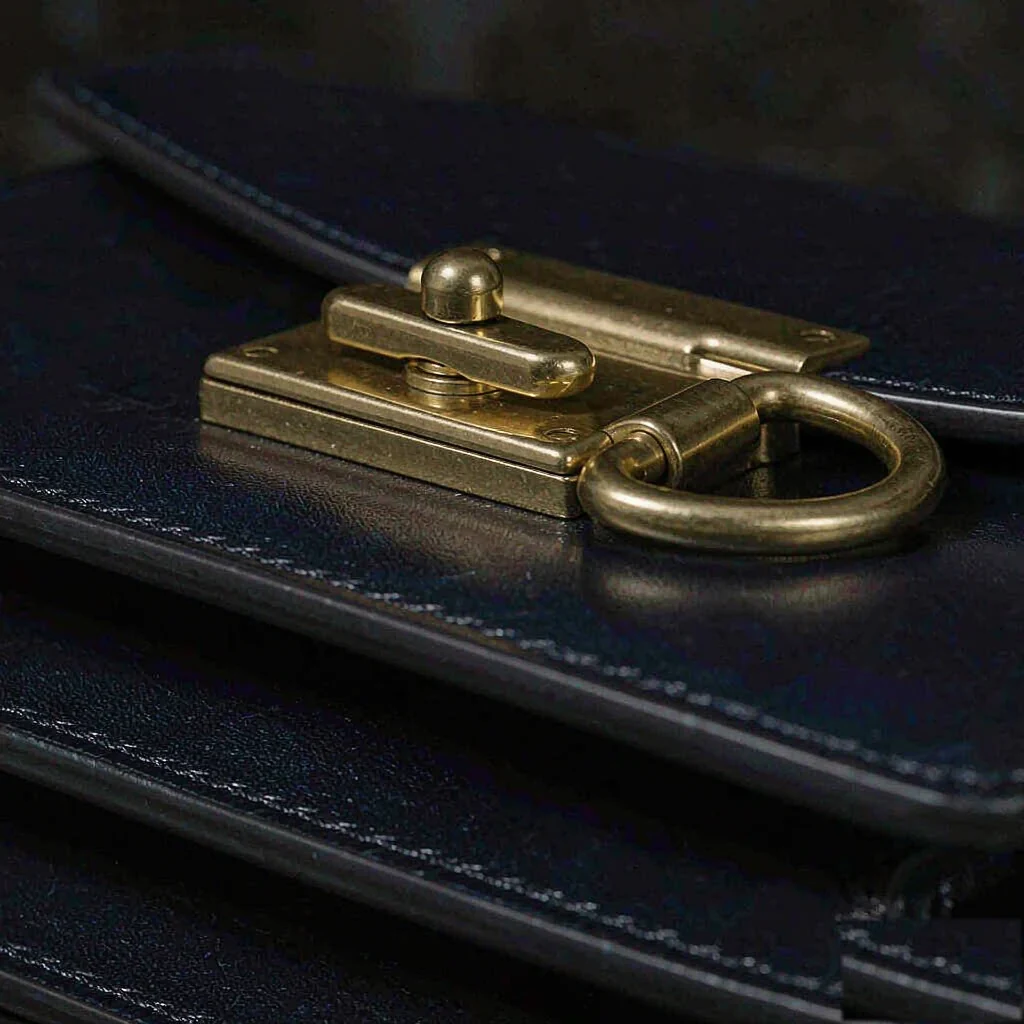
On a shoulder bag, hardware carries weight. A shoulder strap at a 25-30 cm drop transfers the entire load of a filled bag through two D-rings, into two anchors, and into the frame or panel of the bag. Every one of those elements is a load path, and the weakest point in that path decides how long the bag lasts. This is why shoulder hardware is specified differently from decorative hardware on an evening piece.
The practical consequence is that shoulder hardware is over-specified rather than matched to the look. A D-ring that would be generous on a small evening piece is only adequate on a shoulder bag, because a filled day bag can weigh 1.5-2 kg and that weight swings with every step the wearer takes. The strap anchor is the single most stressed point on the whole bag, and it is the point at which a specification written for looks rather than for load will eventually fail.
The one-line answer
- Specify shoulder hardware as a load path: brass or zamak plated to 0.15-0.3 micrometres, a D-ring sized to the strap at 20-25 mm, an anchor closed at 8-9 stitches per inch over a reinforcement plate, a 5,000-cycle function test and a 24 h salt-spray corrosion test.
Which Base Metal Should You Specify?
Two base metals cover the category. Brass is the choice for anything load-bearing: D-rings, strap ends, clasps and turn-locks, because it takes a fine casting, holds a thread and resists fatigue. Zamak is the choice for decorative plates, feet and logo details, because it casts inexpensively and takes plating smoothly, but it is more brittle and should never carry the strap load on its own.
Brass
Used for D-rings, strap ends, clasps and turn-locks. It takes a fine casting, holds a thread and resists fatigue.
Zamak
Used for decorative plates, feet and logo details. It casts cleanly and plates smoothly, but it is more brittle.
Stainless steel
Used when a piece needs maximum corrosion resistance, and plated or left bare depending on the finish.
What to avoid
Any load-bearing component that has been cast too thin at the gate, which is where a D-ring opens under load.
How Thick Should the Plating Be?
We specify 0.15-0.3 micrometres and verify it by X-ray fluorescence on the first article of every run. Below 0.15 the plating fails a 24 h neutral salt-spray test and the piece starts to mark clothing within a season. Above 0.3 the surface reads as glassy, loses the depth of a properly finished metal and can flake at the edges of a casting. Resort and coastal assortments sit at the top of the band and are tested for 48 h.
- Standard specification: 0.15-0.3 micrometres, verified on the first article of each run.
- Corrosion test: 24 h neutral salt spray as standard, extended to 48 h for resort assortments.
- Colour match: matched to a physical standard under D65 lighting rather than to a screen image.
- Edge condition: inspected at the casting gate, where thin plating is most likely to flake.
What Size D-Ring and Slider Does a Shoulder Strap Need?
The D-ring is sized to the strap, not to the look. A 20-25 mm shoulder strap needs a D-ring with an internal clearance of at least 22 mm so the strap sits flat rather than bunching, and the wire of the ring is specified at 3 mm so it does not deform under load. A slider on an adjustable strap needs the same clearance plus a tooth that grips without cutting into the leather.
- Strap width
- 20-25 mm for a shoulder strap
- D-ring internal clearance
- at least 22 mm, sized to the strap
- D-ring wire
- 3 mm, so the ring does not deform under load
- Slider
- matched clearance, with a tooth that grips without cutting
- Adjustment
- five holes at 25 mm pitch on an adjustable strap
How Is a Strap Anchor Loaded and Reinforced?
The anchor is where shoulder bags fail. A strap end is folded over the D-ring, closed with a 0.45 mm bonded nylon thread at 8-9 stitches per inch, and backed with a hidden reinforcement plate that spreads the load into the panel. Without the plate the stitch line is the only thing holding the bag, and a stitch line through leather will creep under a swinging load.
- Reinforcement tape is applied to the panel at the anchor position before the strap is fitted.
- The strap end is folded over the D-ring with a 12 mm return, so the leather doubles at the stress point.
- The return is closed at 8-9 stitches per inch with a 0.45 mm bonded nylon thread.
- A hidden reinforcement plate is set behind the anchor and closed into the same seam.
- The finished anchor is pull-tested at 25 kg and inspected for stitch creep before the bag is released.
How Do You Test Shoulder Bag Hardware?
Hardware is tested on four axes, and all four are recorded on the specification sheet. Plating thickness is measured by X-ray fluorescence. Corrosion is tested by neutral salt spray, 24 h as standard and 48 h for resort assortments. Function is tested by 5,000 open-and-close cycles with the bag loaded. And the anchor is tested by a 25 kg static pull held for one minute.
| Test | Method | Pass condition | What it catches |
|---|---|---|---|
| Plating thickness | X-ray fluorescence on the first article | 0.15-0.3 micrometres | Thin plating that will mark clothing |
| Corrosion | 24 h neutral salt spray, 48 h for resort | No base metal showing | Plating that fails in humid markets |
| Function | 5,000 open and close cycles loaded | Alignment unchanged | Closures that drift under use |
| Anchor pull | 25 kg static pull held for one minute | No stitch creep | Anchors that will fail in service |
| Colour | Matched to a standard under D65 lighting | No visible drift | Batch to batch colour drift |
What Are the Four Failure Modes?
Four failure modes account for almost every hardware complaint we see, and each one is a specification failure rather than a material one. A D-ring opens because the wire was too thin for the load. Plating marks clothing because it was specified below 0.15 micrometres. A closure drifts because it was never cycle tested. And an anchor creeps because the reinforcement plate was omitted.
- D-ring opens: the wire was under 3 mm for the load the bag actually carries.
- Plating marks: specified below 0.15 micrometres, or tested for 24 h where 48 h was needed.
- Closure drifts: the closure was approved on an empty bag and never cycled under load.
- Anchor creeps: the hidden reinforcement plate was omitted to save one operation.
How Does Hardware Affect the Price Band?
Hardware is the second largest cost driver on a shoulder bag after the frame. Cast brass costs multiples of stamped zamak, plating thickness moves the figure again, and a cycle-tested closure adds a testing operation to every run. Specified programmes begin at USD 4.80 per unit, and a shoulder bag with full brass hardware and a reinforced anchor sits above the entry band.
- Base metal: cast brass costs multiples of stamped zamak.
- Plating thickness: moving from 0.15 to 0.3 micrometres adds measurable cost per component.
- Testing: a cycle test and a salt-spray test add an operation to every first article.
- Family: one metal and one finish across the line reduces the number of setups required.
What Should Be Written Into the Specification?
Six lines cover shoulder bag hardware, and all six are answerable before sampling begins. Write the base metal for each component, the plating thickness, the salt-spray duration, the cycle-test count, the D-ring clearance and the anchor construction. A specification that names all six will pass the first audit; one that names three will spend a round discovering the other three.
- Base metal
- Brass for load-bearing, zamak for decorative
- Plating
- 0.15-0.3 micrometres, verified by X-ray fluorescence
- Salt spray
- 24 h standard, 48 h for resort assortments
- Cycle test
- 5,000 open and close cycles with the bag loaded
- D-ring
- 22 mm internal clearance, 3 mm wire
- Anchor
- 8-9 SPI over a hidden reinforcement plate, pull tested at 25 kg
How Hardware Is Matched to the Leather
Hardware is matched to leather under D65 lighting against a physical standard, never against a screen image, because screens render metal depth and grain differently and a colour approved on a display will not match the component that arrives. Warm leathers pair with a warm brass tone and cool leathers with a palladium or gunmetal tone, and the pairing is recorded on the specification sheet so a reorder two seasons later matches.
- Match under D65 lighting against a physical standard, not a screen reference.
- Warm leathers take a warm brass tone, cool leathers a palladium or gunmetal tone.
- Record the pairing on the sheet so a reorder matches without a new approval round.
- Inspect the finish at the casting gate, where plating is thinnest and most likely to differ.
Sampling, MOQ and Lead Times
A shoulder bag first article takes 6-10 working days from a confirmed tech pack, and 12-15 working days when the piece carries a blocked frame or a custom cast closure, because the tooling for a custom casting is made before the sample is built. Minimum order quantity is 500 pcs per style / colourway, bulk production runs 35-50 days from an approved sample, and shipments are offered FOB Xiamen.
Our validated partner factory Quanzhou Yingming Bags has run hardware-led programmes since 2014 on 7 production lines with a monthly output of about 200,000 pcs. Every shipment is audited at AQL 2.5 (ISO 2859-1) on a sample pulled from the cartons, and every closure on that sample is cycled before the carton is released.
Request a hardware specification review
Send us your shoulder bag drawing and we will return a hardware schedule, a test plan and a costed specification. Start your hardware programme
Frequently Asked Questions
What metal is best for shoulder bag hardware?
Brass for anything load-bearing, because it takes a fine casting, holds a thread and resists fatigue. Zamak is the choice for decorative plates, feet and logo details, where it casts cleanly and plates smoothly but is not asked to carry the strap load.
How thick should plating be on bag hardware?
We specify 0.15-0.3 micrometres and verify it by X-ray fluorescence on the first article of every run. Below 0.15 the plating fails a 24 h neutral salt-spray test and begins to mark clothing within a season; above 0.3 the surface reads as glassy and can flake at the gate.
What size D-ring does a shoulder strap need?
A D-ring with an internal clearance of at least 22 mm for a 20-25 mm strap, and a 3 mm wire so the ring does not deform under load. Under-sized rings make the strap bunch at the anchor, which looks wrong and wears the leather at one point.
How is a shoulder strap anchor reinforced?
Reinforcement tape is applied to the panel, the strap end is folded over the D-ring with a 12 mm return, the return is closed at 8-9 stitches per inch with a 0.45 mm bonded nylon thread, and a hidden plate is closed into the same seam behind the anchor.
How many cycles should a bag closure be tested for?
Five thousand open-and-close cycles with the bag loaded to its specified weight. A closure approved on an empty bag will pass and then drift in service, which is why the load condition is written into the test rather than implied.
What is a salt-spray test and why does it matter?
A neutral salt-spray test exposes plated hardware to a controlled corrosive atmosphere for a fixed duration, 24 h as standard and 48 h for resort and coastal assortments. It catches plating that will mark clothing or show base metal in a humid market within one season.
Why does plated hardware mark clothing?
Because the plating is too thin or the casting is porous at the gate, so the base metal migrates to the surface. Both are specification problems: plating below 0.15 micrometres, or a casting that was never inspected at the gate before plating.
How much weight should a strap anchor hold?
We pull-test the finished anchor at 25 kg held for one minute and inspect for stitch creep. A filled day bag weighs 1.5-2 kg, so a 25 kg static test gives a wide margin for the dynamic load of a bag swinging with every step.
Should all hardware in a collection share one finish?
Yes. One base metal and one finish across feet, closures, strap ends and zip pullers is the fastest way to make a line read as one house, and it reduces the number of plating setups a run requires. A mismatched zip puller is noticed even when the customer cannot say why.
How long does custom hardware take to tool?
A custom cast closure adds tooling time before the sample is built, which is why a first article with custom hardware takes 12-15 working days rather than 6-10. The tooling is amortised across the run, and the minimum order quantity of 500 pcs per style applies.
What is the minimum order quantity for a hardware-led programme?
Five hundred pieces per style and colourway. Custom castings and plating setups are amortised across the run, so the threshold holds for a first capsule and for a reorder. Three colourways of one shoulder bag are three qualifying runs.
How is hardware audited before a shipment goes out?
A sample is pulled from the cartons and audited at AQL 2.5 (ISO 2859-1). Every closure on that sample is cycled, every zip is run, plating thickness is verified against the first article, and the anchors are inspected for stitch creep under a 10x loupe.
Can zamak be used on a shoulder strap anchor?
Not on its own. Zamak is more brittle than brass and should not carry the strap load, so the anchor hardware on a shoulder bag is specified in brass while zamak is reserved for decorative plates, feet and logo details elsewhere on the bag.
What is the difference between plated and solid brass hardware?
Solid brass needs no plating and develops its own patina, but it is heavier and costs more per component. Plated brass or zamak gives a controlled, repeatable finish across a run, which is why most luxury programmes plate to 0.15-0.3 micrometres instead.
People Also Ask
What hardware does a shoulder bag need?
Two D-rings or strap ends, a closure, a slider if the strap adjusts, feet on the base and a zip on any interior pocket. On a shoulder bag all of these except the feet are load-bearing and are specified in brass rather than zamak.
How do you stop bag hardware from tarnishing?
Specify plating at 0.15-0.3 micrometres and verify it by X-ray fluorescence, then test at 24 h neutral salt spray, extended to 48 h for resort assortments. Tarnishing is almost always a thickness problem rather than a metal problem.
What is the strongest metal for bag hardware?
Brass for cast components that carry load, and stainless steel where maximum corrosion resistance is needed. Zamak is perfectly good for decorative plates and feet, but it is more brittle and should not carry the strap load on its own.
Why does my bag strap keep slipping?
Because the slider does not grip. An adjustable strap needs a slider with the same internal clearance as the strap and a tooth that bites without cutting the leather, plus five adjustment holes at 25 mm pitch so the fit can be set properly.
How is bag hardware attached to leather?
Through an anchor: reinforcement tape on the panel, a 12 mm return folded over the fitting, closed at 8-9 stitches per inch with a 0.45 mm bonded nylon thread, and a hidden plate set behind the anchor to spread the load into the panel.
Sources and further reading
Every figure on this page is either our own programme data or attributed below. Open the originals before you write them into a specification.
- ISO 2859-1 sampling procedures for inspection by attributesInternational Organization for Standardization The sampling standard behind the AQL 2.5 hardware audit.
- REACH restricted substances guidanceEuropean Chemicals Agency Used as the chemical baseline for plating baths and metal finishes.
- Proposition 65 listed substancesCalifornia Office of Environmental Health Hazard Assessment Checked for nickel and lead content before hardware is approved for the California market.
- Leather Working Group audit protocolsLeather Working Group Referenced for traceability on the leather used at the strap anchor.
Shoulder bag hardware is a load path, and a load path is only as good as its weakest element. Specify the metal, the plating thickness, the ring clearance, the anchor construction and the four tests, and the bag will carry its weight for years instead of failing at the one point nobody specified.
Send us a shoulder bag drawing and we will return a hardware schedule, a test plan and a costed specification within one working day. Request a hardware specification review