The Luxury Handbag OEM Sample Approval Process: Three Rounds, Five Measurements and One Sealed Reference
How many sample rounds does a handbag programme need before a style is cleared for bulk? Three: a prototype built in 6-10 working days, a confirmation sample rebuilt after your comments are folded in, and a sealed shipment sample held as the bulk reference. Every round is judged against the same written numbers rather than an impression — 8-9 stitches per inch, edge paint built in three coats to 0.35-0.45 mm, hardware plated to 0.15-0.3 µm — and nothing advances until a signed sheet says so. MOQ stays at 500 pcs per style and colourway, and bulk opens 35-50 days after that signature.
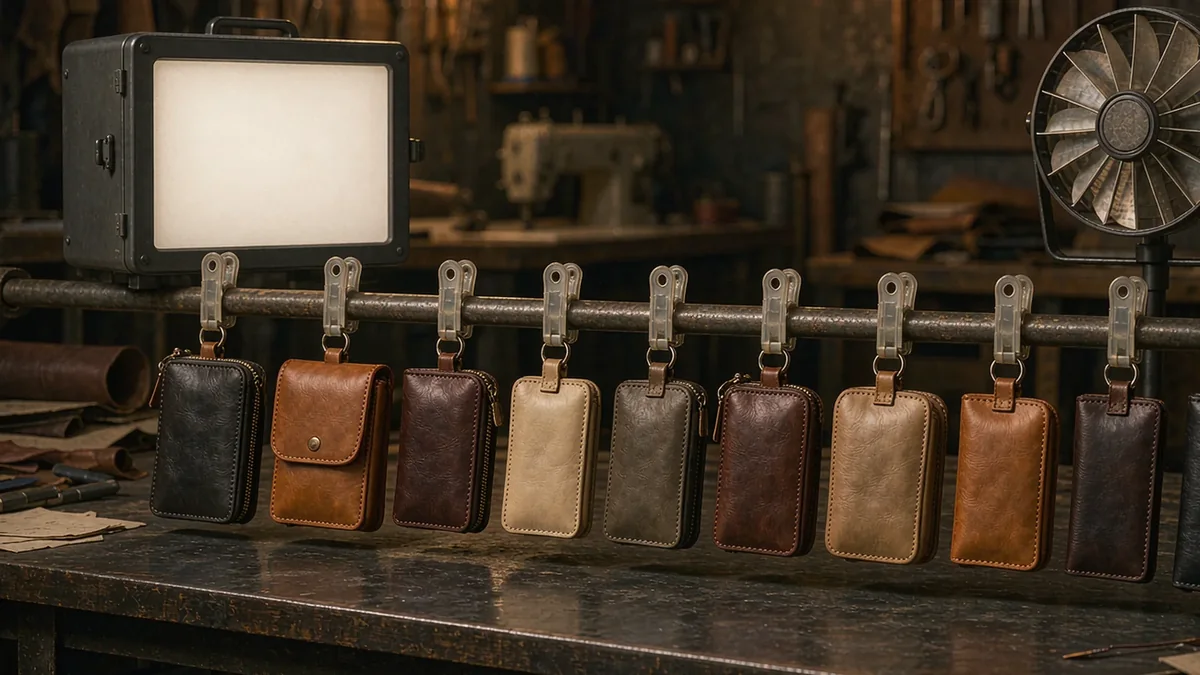
Where the 6-10 Working Days Actually Go
A sampling round is not one continuous stretch of bench time. It is four gates in sequence: pack lock, material pull, bench build, and written review. The 6-10 working day figure covers the build and the internal review only, and it assumes your pack arrives complete and the hides are already in the storeroom. A structured body with a framed top handle or a hand-turned edge pushes the same round to 12-15 working days, because the bench has to wait on a fixture or a curing interval. Knowing which gate you are actually waiting on is the most useful question you can ask on day three.
- Gate 1 · pack lock and pattern check
- Day 0-1, drawings and tolerances confirmed in writing
- Gate 2 · material pull and clicker cutting
- Day 1-3, panels cut from the named lot
Read the gate map as a living document rather than a promise. If the material pull slips because a hide lot was rejected on shade, the whole round slips with it, and that rejection is the correct outcome, not a delay worth arguing about. A lot that fails at the pull costs three days; the same lot discovered at bulk costs the run.
What a Prototype Is Allowed to Get Wrong
The first prototype exists to prove geometry, not finish. Expect shape, volume and handle drop to be right. Expect edge paint, stitch tension and hardware seating to be provisional, because those three are set in the second round once the geometry stops moving. Brands that reject a first prototype on finish are effectively restarting the clock on work that was never meant to be final yet, and they usually pay for it twice.
- Silhouette and volume: within 2 mm of the pack on all three axes, measured on a flat surface.
- Handle drop: within 3 mm of spec, measured under a 500 g load rather than empty.
- Panel alignment at the gusset join: no visible drift along the seam line.
- Stitch density: 8-9 stitches per inch, counted over a 25 mm gauge at three positions.
- Hardware function: a turn-lock cycled 200 times without scoring the receiving plate.
Anything outside those five items is a note for round two, not a rejection. Write the note against a measurement rather than an impression. The handle feels short is not actionable; handle drop is 14 mm against a 17 mm spec is, and it will be corrected in one pass instead of two.
The 24-Hour Comment Rule and Why Round Two Slips
Round two starts the clock again, and the most common cause of a slipped round two is not the bench at all. It is a comment sheet arriving in five fragments across four days, each one reopening a decision the previous note had closed. Consolidate every observation into a single sheet inside 24 hours of receiving the prototype, ordered by priority, with one owner and one date on it.
What belongs on the comment sheet
- Every note paired with a number: a measurement, a tolerance, or a photograph with a scale reference.
- A priority column, because a shape change and a shade nitpick cannot carry the same weight.
- One named decision-maker, so the bench never receives two contradictory instructions.
- An explicit list of what is already approved, which prevents accidental re-opening at round three.
A consolidated sheet also protects you commercially. When a round two comes back with an uncorrected item, a dated sheet is the difference between a correction made at the house's cost and one charged back to you. Fragmented notes destroy that record. One sheet, one date, one owner, and the argument disappears.
Five Measurements That Decide Approval
Approval should never be a matter of taste. It should be five numbers on a sheet, each with a stated gauge, a stated position and a stated tolerance. When those five are written into the pack before sampling opens, the approval conversation becomes arithmetic and the sampling round stops being a negotiation.
| Measurement | Target | Gauge and method |
|---|---|---|
| Stitch density | 8-9 stitches per inch | Counted over a 25 mm gauge at three positions per panel |
| Edge paint build | 3 coats, 0.35-0.45 mm total | Dial gauge taken 24 h after the final cure |
| Hardware plating | 0.15-0.3 µm | X-ray fluorescence read on a flat, non-contact surface |
| Full-grain calfskin thickness | 1.2-1.4 mm | Dial gauge at five points across the panel |
| Colour match to approved swatch | Delta E at or below 1.5 | Spectrophotometer under D65 in a light booth |
The Delta E figure under D65 is worth insisting on. A sample that matches under showroom tungsten and misses under daylight produces retail returns that cannot be charged back to anybody. One booth, one light source, one number, recorded on the sheet.
Material Variables That Move the Clock
Hide is the variable nobody fully controls. A full-grain calfskin lot can vary by 0.1 mm across a single skin, and a shade difference of Delta E 0.8 between two lots is both normal and acceptable. Exotics are slower again: species listed in CITES Appendix II or III require permit documents before the skin can be cut, and that paperwork sits outside the sampling clock entirely. Where your capsule uses a listed skin, open the permit step before the pack, not after the prototype.
- Full-grain calfskin at 1.2-1.4 mm: usually in the storeroom, pulled the same day.
- Cross-hatch or saffiano-embossed calf: 1-2 extra days if a new emboss plate is required.
- Listed exotic panel: permit lead time runs on an authority calendar outside the sampling window.
- Dyed-to-match lot: 7-10 days for a lab dip, then around 3 days for the strike-off.
- GRS-certified recycled lining: generally held in stock, but certificate copies travel with the parcel.
None of those numbers are negotiable by goodwill. They are properties of a material and an authority, and the only real lever is sequencing: name the lot early, book the permit early, and the sampling window stays intact.
Hardware, Plating and the Three-Coat Edge Rule
Hardware is where a luxury programme is won or lost, and it is the slowest line item to correct once a round has closed. A custom turn-lock needs a tooling decision before it needs a finish decision: zamak or brass, die-cast or sand-cast, and whether the logo is struck or etched. Plating in the 0.15-0.3 µm band is what survives a 24-hour neutral salt spray exposure without bloom; below roughly 0.15 µm the bloom appears inside a single season on the shelf.
Edge paint is the other slow item, and the one most often under-specified. Three coats, each sanded back and cured, gives a total build of 0.35-0.45 mm with no ridge where the fold turns. Two coats looks acceptable on the bench and fails at the corner within weeks of handling. Ask for the coat count in writing: it costs nothing to specify and it is the least costly quality question in the entire programme.
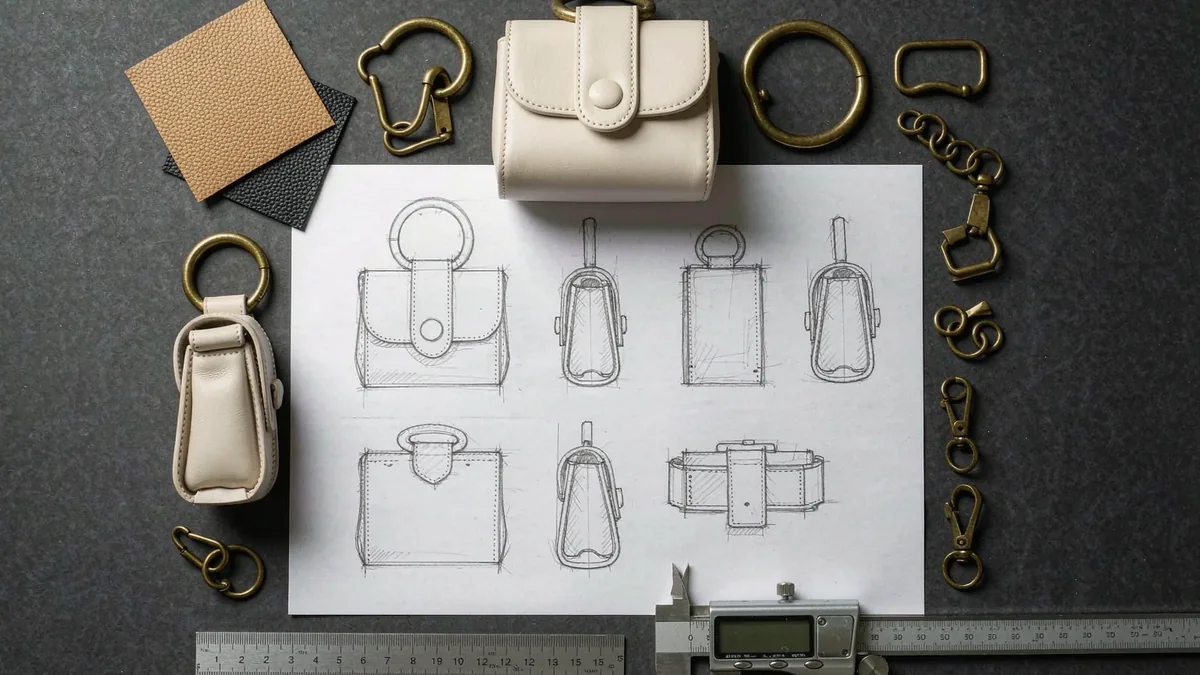
A leather decision can be revised inside a round; a tooling decision usually cannot. Prove the closure on the bench, then commit the panel, and the second round has one variable instead of two.
Where Extra Rounds Come From
Most programmes that run to a fourth round can name the reason, and it is almost never the bench. It is a decision taken after the round closed. Knowing the four usual sources lets you buy them out in advance, either by sequencing the decision earlier or by accepting a slightly wider tolerance at the pack stage.
Silhouette change after round one
A volume or handle-drop change reopens pattern, toile and panel cutting at once. Decide geometry first and finish second; the reverse order costs a full round every time.
Hardware substitution mid-programme
Swapping a stock closure for a bespoke one adds a proving step plus tooling, which is a calendar item rather than a bench item and rarely fits inside 6-10 days.
Shade re-match against a new reference
If the reference swatch changes after approval, the lab dip restarts. Keep the original approved swatch, stored away from light, as the single reference for the life of the style.
Interior re-specification
Changing lining, pocket count or the reinforcement behind a strap affects yield and panel area, so the outer shell often has to be re-cut even when the outside looks unchanged.
Each of those four is legitimate. The point is not to forbid them but to price them in days before they happen, so a fourth round is a scheduled event rather than a surprise that lands during a launch window.
Documentation That Must Arrive With Every Sample
A sample without paperwork is a photograph with a handle. The parcel is worth very little if nothing in it can be referenced six weeks later, when bulk is on the line and the question is what exactly was approved.
- A measurement sheet with the five numbers filled in as values, not as tick boxes.
- A material declaration naming hide origin, tannery and finish, with the lot reference.
- A hardware plating report giving the micron reading and the salt spray exposure used.
- Two photographic sets: one studio, one hand-held under daylight, both with a scale reference.
- Courier and documentation handling, quoted from USD 4.80 per sample parcel.
- A dated revision log stating plainly what changed since the previous round.
The revision log is the item most often skipped and the one that matters most at bulk. Without it, a disputed detail becomes two memories arguing across a time zone; with it, the dispute resolves in one email.
Accept, Revise or Re-Quote
Three outcomes are available at the end of any round, and confusing them is expensive. Accepting is a signature against the five numbers. Revising is a new round with a written list. Re-quoting is what happens when the revision changes cost, not merely construction.
| Situation | Correct decision | What it costs you |
|---|---|---|
| All five numbers inside tolerance | Accept and seal the sample | Nothing beyond the round itself |
| One or two numbers outside, geometry unchanged | Revise with a dated written list | One further round, typically 4-7 days |
| Geometry, material or hardware re-specified | Re-quote before re-sampling | A fresh quotation plus a fresh round |
| Approved but shade drifting against a new lot | Hold and re-match before bulk | A lab dip cycle, 7-10 days |
Re-quoting is the outcome brands avoid because it feels like starting over. It is not. It is the honest recognition that a specification change is a commercial change, and it is far cheaper to discover at sample stage than at intake.
From Approved Sample to Bulk, With AQL 2.5 as the Bridge
The sealed shipment sample is the reference against which bulk is judged, and it should be sealed by both sides rather than filed by one. Bulk opens 35-50 days after approval on FOB Xiamen terms, and inspection is drawn at AQL 2.5 under ISO 2859-1 at general inspection level II. On a 500 pcs lot the plan uses code letter H: 50 units drawn, accept 3, reject 4. Third-party inspection can be added alongside the internal audit where a retailer requires it.
The programme runs across 7 production lines at about 200,000 pcs per month, and has held export experience since 2014 through our validated partner factory Quanzhou Yingming Bags, an SGS-validated site. Those figures matter to a sampling round for one reason only: a bench that is not fighting for capacity can return a corrected round on the day it said it would.
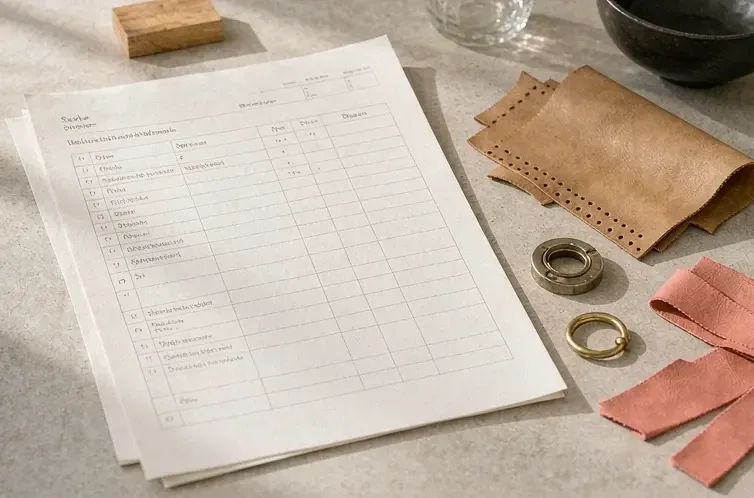
Sample Logistics and the Paper Trail
Samples travel, and travel is where reference material is quietly lost. Send one reference to yourself and keep one at the bench; photograph the sealed sample from six angles before it goes anywhere, since a courier claim is easier to make with images than with adjectives. Where a capsule spans several colourways, seal one reference per colourway rather than one per style, because shade is a lot property and not a style property.
Finally, set the approval deadline before the first parcel ships. A round with no deadline absorbs every competing priority in the studio, and a sealed sample that arrives late is worth less than an imperfect one that arrived on time and let bulk open.
Put your sampling round on a dated sheet
Send your drawings, target dimensions and the five numbers you want held to tolerance. You will receive a gate map with dates, the measurement sheet template, and the documentation list that travels with every parcel. Request a quote.
Frequently Asked Questions
How many sample rounds does a handbag programme usually need?
Three is the working answer: a prototype to prove geometry, a confirmation sample rebuilt after your written comments, and a sealed shipment sample kept as the bulk reference. Programmes that reach a fourth round usually do so because a specification decision was taken after a round had already closed rather than before it opened.
How long does one sample round take?
Six to ten working days for a standard build, split across pack lock, material pull, bench build and written review. Complex constructions, bespoke closures and listed skins take 12-15 working days, mostly because the bench waits on a fixture, a permit or a curing interval rather than on labour.
What is the difference between a prototype and a confirmation sample?
The prototype proves shape, volume and handle drop, with finish deliberately provisional. The confirmation sample is rebuilt with every written correction folded in and with finish set: edge paint in three coats, stitch tension locked, hardware seated and plated. Only the confirmation sample is a candidate for sealing.
Should I approve a sample from photographs?
Only for interim colour or hardware direction, never for final approval. Photographs cannot show edge build, stitch density or plating thickness, and a screen shifts shade. Final approval needs the physical piece, the measurement sheet and a light booth reading under D65, at a Delta E at or below 1.5 against the sealed swatch.
What stitch count should I specify for a luxury handbag?
Eight to nine stitches per inch is the usual specification for a luxury body, counted over a 25 mm gauge at three positions per panel. Lower counts read as casual and can open at the seam under load; higher counts perforate the leather and weaken the very edge they are meant to hold.
How is edge paint thickness measured and why does it matter?
With a dial gauge 24 hours after the final cure, reading a total build of 0.35-0.45 mm across three coats. Each coat is sanded back before the next is applied. Two coats look acceptable on the bench but tend to crack at the fold within weeks of handling.
What plating thickness should I ask for on hardware?
Ask for 0.15-0.3 µm measured by X-ray fluorescence on a flat surface, and pair it with a 24-hour neutral salt spray exposure. Below roughly 0.15 µm, bloom appears within a season on the shelf, and a closure that blooms is the single most common cause of a returned luxury piece.
Do I really need a sealed shipment sample?
Yes, and it should be sealed by both sides rather than filed by one. It is the physical reference against which bulk is judged at AQL 2.5, and without it any dispute about finish, shade or hardware becomes two opinions rather than one comparison against an agreed object.
What happens if the hide lot does not match the approved shade?
The lot is held and re-matched rather than cut. A lab dip cycle takes 7-10 days plus around 3 days for the strike-off, and the approved swatch stays the reference. Cutting a drifting lot is the expensive option, because shade deviation only becomes visible once units are on a shelf together.
How does sampling connect to the 500 pcs minimum?
MOQ 500 pcs per style and colourway applies to bulk and is fixed throughout development, so sampling does not reduce it. Where a colourway is genuinely uncertain, sample it and then decide, rather than committing to a colourway at intake and discovering the yield or shade problem during the run.
Can exotic panels be sampled before permits are issued?
No. Skins listed in CITES Appendix II or III require permit documents before cutting, and the issuing authority works to its own timetable. Open the permit step before the pack is finalised, and expect that lead time to sit outside the 6-10 working days of sampling window entirely.
What does AQL 2.5 mean for an approved sample?
It is the plan under which bulk is drawn against that sample: AQL 2.5 under ISO 2859-1 at general inspection level II. On a 500 pcs lot that means code letter H, 50 units drawn, accept 3, reject 4. Third-party inspection can be arranged alongside the internal audit.
Who pays for sample revisions?
A revision correcting something outside the agreed specification is normally corrected at the house's cost; a revision arising from a brand-side specification change is normally chargeable. A dated comment sheet is what decides which of the two applies, which is why one consolidated sheet matters more than it appears to.
How do I stop sample rounds from slipping?
Consolidate every comment into a single sheet inside 24 hours, pair each note with a measurement, name one decision-maker, and set the approval deadline before the first parcel ships. Most slipped rounds are caused by fragmented approvals rather than by anything happening on the bench.
People Also Ask
What is a confirmation sample in handbag production?
The second built sample, rebuilt after the brand's written corrections, with finish set rather than provisional. It is the round that becomes the sealed reference for bulk if the five agreed measurements sit inside tolerance.
Why do sample rounds slip?
Usually because comments arrive in fragments across several days, reopening decisions already closed. Material lot rejection and permit waiting also slip rounds, but those are calendar items rather than approval failures.
How thick should edge paint be on a luxury bag?
A total build of 0.35-0.45 mm across three coats, each sanded back and cured before the next. Measured with a dial gauge 24 hours after the final cure so the reading is not taken on paint that is still shrinking.
What is the minimum order for a bespoke handbag programme?
500 pcs per style and colourway, applied consistently through development and bulk. Sampling does not lower the figure, though it lets you defer a colourway decision until you have seen the piece in the hand.
How long does bulk take after sample approval?
35-50 days from the signed approval, on FOB Xiamen terms. The range reflects how much hand work the style carries and how much correction the inspection stage absorbs at the end of the run.
Sources and further reading
Every figure on this page is either our own programme data or attributed below. Open the originals before you write them into a specification.
- ISO — International Organization for StandardizationISO Publisher of ISO 2859-1, which defines the AQL 2.5 sampling plans, code letters and accept and reject numbers used to judge bulk against a sealed sample.
- CITES Appendices I, II and IIICITES The listing that determines which skins require permit documents before cutting, and therefore which materials sit outside the sampling clock.
- Leather Working GroupLeather Working Group Tannery audit protocol referenced when a hide lot is named, which affects shade consistency between lots matched to an approved swatch.
- REACH legislation (European Chemicals Agency)ECHA Annex XVII restrictions apply to substances in finished leather and hardware, and a material declaration is checked against them at sampling.