Luxury Handbag Hang Tags and Labels: A Working Glossary for Brand Teams
What is the difference between a hang tag and a label on a fine handbag? A hang tag is external, removable and carries the marketing voice: typically 600-800 gsm cotton board, 50 by 90 mm, pierced with a 4 mm eyelet and hung on a 90 mm cord. A label is sewn or bonded inside and carries the permanent record: fibre composition, origin and batch reference read at 6 pt minimum. Both share one rule — anything printed on a face smaller than a card has to be specified by legibility, not by appearance.

Hang Tag Versus Label: What Each One Does
The two are often specified together and behave completely differently. A hang tag hangs on the exterior, is removed within minutes of purchase, and carries whatever the house wants to say: the mark, the collection name, the material story. A label lives inside the piece for its whole working life and carries what regulation and aftercare demand rather than what marketing would prefer.
That difference drives every downstream choice. Because a tag is removed, it can use finishes that would not survive wear: deep deboss, heavy foil coverage, soft uncoated paper. Because a label stays, it has to resist abrasion, perspiration and cleaning, and it has to stay legible after years in contact with lining fabric rather than weeks in contact with air.
Choosing a Substrate: Board, Cotton Paper or Coated Stock
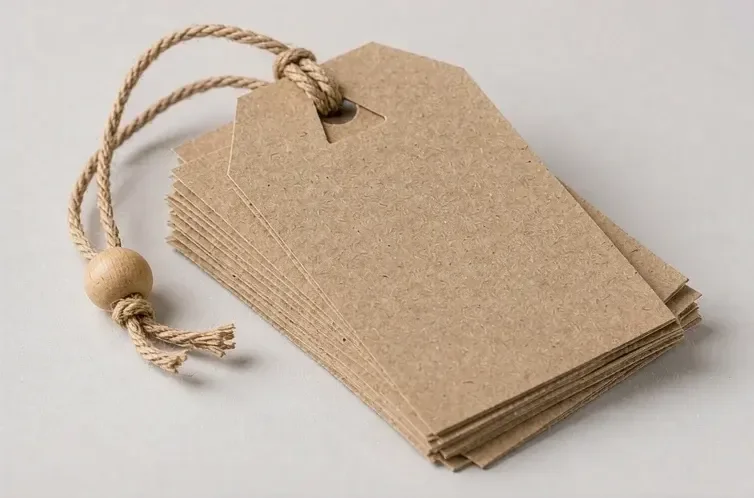
Tag substrate sets how the piece feels before it is read. Cotton board in the 600-800 gsm range is the working choice for a tag that has to stand away from the handle rather than curl against it; below 600 gsm the tag bends along the cord. Uncoated cotton paper around 350 gsm suits a softer, quieter presentation, and a coated stock suits houses that want photography rather than touch.
Labels follow different rules because they are worn rather than read once. A woven satin reads beautifully and outlasts the piece, but it only holds fine detail above about 20 denier thread and struggles with very small type. A printed satin or a coated polyester holds 6 pt type cleanly and is the safer option wherever composition text has to be read by somebody other than the owner.
Sizing: What Fits Without Overwhelming the Piece
Scale is the most common mistake on a first collection. A tag that flatters a large tote swamps a small shoulder piece, and the usual consequence is a second tag size specified halfway through the run at extra tooling cost. As a working guide, 50 by 90 mm suits a mid-size piece, 40 by 70 mm suits anything carried under the arm, and nothing larger than 65 by 110 mm should go on any silhouette.
Proportion is judged at arm's length, not in the hand. Hold the tag against the piece from a metre away: if the tag reads before the silhouette does, it is too large. The other reliable check is movement, since a tag that swings freely against hardware will mark both itself and the fitting it rests against.
- Tag board weight
- 600-800 gsm cotton board; below 600 gsm curls on the cord
- Tag size
- 50 x 90 mm mid-size; 40 x 70 mm small; 65 x 110 mm maximum
- Eyelet
- Brass, 4 mm internal diameter, 4 mm barrel length
- Cord length
- 90-110 mm of 1.5 mm waxed cotton, tied not crimped
- Label width
- 15 mm satin for composition text at 6 pt minimum
- Minimum type size
- 6 pt printed, 9 pt debossed without foil
- Colour tolerance
- Delta E 2.0 against the signed reference
Comparing Attachment Methods
How a tag hangs decides how long it survives the shop floor. Four methods cover almost every programme, and the differences are practical rather than aesthetic: how quickly the tag can be applied at packing, whether it can be removed without tools, and whether it leaves a mark on the handle it was attached to.
| Method | Best for | Watch out for |
|---|---|---|
| Waxed cotton cord looped through the eyelet | Most programmes; ties and unties cleanly | Cord twist on very light tags |
| Ball chain or brass chain | Hardware-led collections | Marking against delicate fittings |
| Safety pin through the label sheath | Soft pieces with no visible handle ring | Snagging a loose woven lining |
| Moulded collar around a handle | High-volume retail handling | Reading as mass retail rather than boutique |
Type Size and Legibility on a Small Face
Everything printed on a tag is read closer than anything printed elsewhere in the pack, which tempts teams to reduce type below its usable floor. Six point is that floor for printed text on a coated face and nine point for debossed text carrying no foil. Below those figures, letters lose counters and stroke separation once the board compresses, regardless of how clean the artwork looked on screen.
Three adjustments recover legibility without increasing the tag. Raise contrast rather than size, since pale foil on pale board disappears first. Increase tracking slightly, because tight setting turns to mud under compression. And separate the hierarchy: one message per face, with the practical detail moved to the reverse where the customer will look once they have read the front. Reverse faces also carry faults more gracefully, because a slight registration drift on the reverse is far less likely to be noticed than the same drift sitting beside the principal mark.
Print Methods Compared
| Method | What it gives | Where it belongs |
|---|---|---|
| Letterpress | Deep bite into cotton board, no colour needed | A house that wants the mark found rather than read |
| Foil stamp | High contrast, reads at distance and in photography | The principal face of the tag |
| Blind deboss | Quiet relief, no added material | Secondary detail and care references |
| Offset litho | Full colour, tight registration, low unit cost | Reverse faces carrying long copy |
| Digital toner | Variable data and batchcodes without plates | Short runs and multi-language versions |
Combining two methods is where a tag begins to look considered rather than produced. A blind deboss front with an offset reverse is the most common pairing in fine programmes, because it puts the texture where the hand goes and the information where the eye goes. Pairing foil with letterpress is riskier: both fight for the same register, and drift between them is visible at reading distance.
Codes, Batch References and Traceability
Machine-readable marking has moved onto the tag rather than the box, because that is where the customer naturally looks. Print a two-dimensional code at a minimum module size of 0.5 mm with a quiet zone of four modules around it, and place it on a flat area clear of the eyelet. Anything smaller, and a phone held at a natural distance will fail to resolve it.
Batch references should be readable by people as well as machines. Every piece leaves with a reference tying it to its dye lot, its hardware batch and the week it was finished, and that record is what lets a service query be answered in minutes rather than weeks. Keep the reference off the principal face; its audience is the atelier, not the customer.
Care Information and What Regulation Requires
Composition labelling is not a matter of house style. Textile components placed on the European market must declare their fibre composition under Regulation (EU) 1007/2011, and the declaration has to use recognised fibre names in the language of the market. Where a lining, strap or dust cover is textile, that obligation follows the piece rather than the material, and it is the reason labels exist at all.
The practical consequence for a fine programme is that label artwork has to be checked against the regulation before it is tooled, not after. A missing percentage, a trade name where a generic fibre name is required, or a composition missing from a multi-language label are all reasons a shipment can be held, and none of them can be corrected once the label is woven.
Where Tags and Labels Fail First
Four faults account for most rejects, and each has a check that belongs on the first-article sheet. Run them before the run rather than after, because every one of them is invisible in a single sample and obvious across five hundred.
- Foil lift at the eyelet: tape test under ASTM D3359, scored 4B minimum, checked after punching rather than before.
- Eyelet pull-through: specify a 4 mm barrel on board above 600 gsm and test a pull later rather than sooner.
- Rub-off on printed labels: assess against the ISO 105 series for colour fastness before the woven order is placed.
- Curl on the cord: raise board weight rather than adding a laminate, which makes the curl worse over time.
- Illegible composition text: check at 6 pt under the light the customer will use, not under bench light.
Holding Colour Across a Whole Set
A tag set is rarely one colour. The board, the foils, the cord, the eyelet and the label ground all have to agree, and they are supplied by different presses working in different media. The only reliable way to hold them together is a single signed reference card carrying every element of the set, distributed before bulk rather than after disagreement.
Read that card under two lights and re-issue it annually, because paper yellows, dyed cord fades and brass tarnishes between seasons. Where the set is reordered twelve months later, comparing against the original card rather than a retained sample is what keeps the sixth reorder identical to the first.
A tag fails when it cannot be read, not when the typeface disappoints. Specify minimum pt size, contrast and clearance, and the artwork argument disappears before it starts.
How Tags and Labels Are Inspected
Tags and labels are inspected on the same plan applied to everything else in the programme: a sample drawn at AQL 2.5 under ISO 2859-1 and read against the approved first article. The checks specific to this part of the pack are print rub on the label stock, eyelet security after a pull test, colour agreement at delta E 2.0, and legibility of composition text read unaided.
Three faults are classified critical rather than major, because none can be corrected once packed: incorrect composition text, an eyelet that pulls through under its own weight, and a code that will not resolve. A house that finds these at goods-in loses the giving-in date; a house that finds them at the boutique loses considerably more.
Programme Figures and How a Tag Set Runs
Our programme runs through our validated partner factory Quanzhou Yingming Bags, an SGS-validated site with 7 production lines and roughly 200,000 pcs per month of capacity, holding export experience since 2014. Sample tags and labels take 6-10 working days, or 12-15 where a woven label carries fine composition text; bulk occupies 35-50 days; and minimums sit at 500 pcs per style and colourway leaving FOB Xiamen.
A considered tag and label set adds little to unit cost while carrying most of the visible authority of the pack, and it sits inside the same presentation specification detailed on luxury packaging. The material statements printed on it connect directly to the luxury materials definitions, and the sampling sequence behind it is set out on luxury sampling.
Specify the legibility before the artwork is frozen
Send the tag size, board preference, attachment method and the composition text with its market. You will receive a tag and label specification naming substrate, type floor, eyelet build and inspection points. Request a quote.
Frequently Asked Questions
What is the difference between a hang tag and a label?
A hang tag is exterior, removable and carries the marketing voice. A label is sewn or bonded inside and carries the permanent record: composition, origin and batch reference. Because the tag is removed, it can take finishes that would not survive wear; the label cannot.
How heavy should the tag board be?
Between 600 and 800 gsm cotton board for a tag that must stand away from the handle. Below 600 gsm the tag curls along the cord within days of sitting on a rail. Uncoated cotton paper near 350 gsm suits a quieter, softer presentation.
What size tag suits a mid-size piece?
About 50 by 90 mm. Anything carried under the arm takes 40 by 70 mm, and no silhouette should carry larger than 65 by 110 mm. Judge the proportion at arm's length; if the tag reads before the silhouette, it is too big.
What eyelet specification should be used?
A brass eyelet at 4 mm internal diameter with a 4 mm barrel on board above 600 gsm. The barrel length matters as much as the diameter, since a short barrel pulls through a thick board once the tag has been swung around a rack.
How long should the cord be?
Between 90 and 110 mm of 1.5 mm waxed cotton, tied rather than crimped. Shorter makes attachment awkward at packing, longer lets the tag swing into contact with neighbouring hardware and mark both surfaces.
What is the smallest type that can be read on a label?
Six point for printed text on a coated face and nine point where the text is debossed with no foil. Below those floors, letters lose their counters and stroke separation once the board compresses under the die.
Which label material performs best inside a piece?
Woven satin for longevity, printed satin or coated polyester for legibility. Woven holds up beautifully but struggles below about 20 denier thread with fine detail; printed stock holds 6 pt composition text cleanly for years.
What does EU law require of composition labelling?
Regulation (EU) 1007/2011 requires textile products to declare their fibre composition using recognised fibre names in the language of the market. Check label artwork against the regulation before tooling, because a missing percentage cannot be fixed once woven.
How should a two-dimensional code be printed?
At a minimum module size of 0.5 mm with a quiet zone of four modules, placed on a flat area clear of the eyelet. Very small codes are the most common reason a customer's phone fails to resolve a perfectly printed tag.
Which print method suits a principal tag face?
Foil stamping works best where the tag must read in photography; blind deboss suits a house that prefers discovery over announcement; letterpress gives deep bite on cotton board with no colour added at all.
How is print rub tested on labels?
Against the ISO 105 series for colour fastness, run before the woven or printed order is placed rather than after delivery. A label that has already been applied to hundreds of pieces cannot economically be corrected.
What minimum applies to a bespoke tag and label set?
500 pcs per style and colourway. Sample tags take 6-10 working days, rising to 12-15 where a woven label carries fine composition text that has to be proved legible rather than merely printable.
People Also Ask
Should the batch reference appear on the front of the tag?
No. Its audience is the atelier and the service desk, not the customer. Place it on the reverse or near the eyelet where it stays available without competing with the mark.
Can foil be used alongside a deboss on the same tag?
Yes, as registered foil emboss held within about 0.2 mm. Combining foil with letterpress is riskier, because both methods fight for the same register and the drift shows at reading distance.
Why do tags curl once they are hanging?
Usually board that is too light rather than humidity. Raising the weight above 600 gsm corrects it; adding a laminate tends to make the curl worse by putting tension on one face only.
Are multi-language labels worth the complication?
Where the piece ships across several markets, yes, and digital toner makes them practical by removing plate cost. The risk is omitted text, so proof each language separately rather than the set.
How much does a tag add to the unit cost?
Very little relative to its effect. Board, cord and eyelet are small lines even at high specification, and they leave the pack looking considered for a few cents of printed surface.
Sources and further reading
Every figure on this page is either our own programme data or attributed below. Open the originals before you write them into a specification.
- EUR-Lex access to European Union lawEUR-Lex Hosts Regulation (EU) 1007/2011 on textile fibre composition and labelling requirements for the European market.
- ISO - International Organization for StandardizationISO Publisher of ISO 2859-1 for attribute sampling and the ISO 105 series covering colour fastness of printed label stock.
- ASTM International standardsASTM International Publisher of ASTM D3359, the cross-hatch tape test used to score foil adhesion on a 0B to 5B scale.
- GS1 global standardsGS1 Sets the barcode and two-dimensional code specifications that govern how reliably a printed code resolves.