Luxury Handbag Edge Stitching and Piping: Six Questions Answered in Order
Luxury handbag edge stitching and piping are two different operations that are often confused: edge stitching runs a single line 3.0-3.5 mm from the finished edge, while piping inserts a cord of 1.5-2.0 mm inside a seam so that a welt of 2.5-3.5 mm stands proud of it. Both are specified at 8-9 stitches per inch, and both are mitred at 45 degrees at a corner with the cord butted rather than overlapped.
What Is Piping on a Handbag?
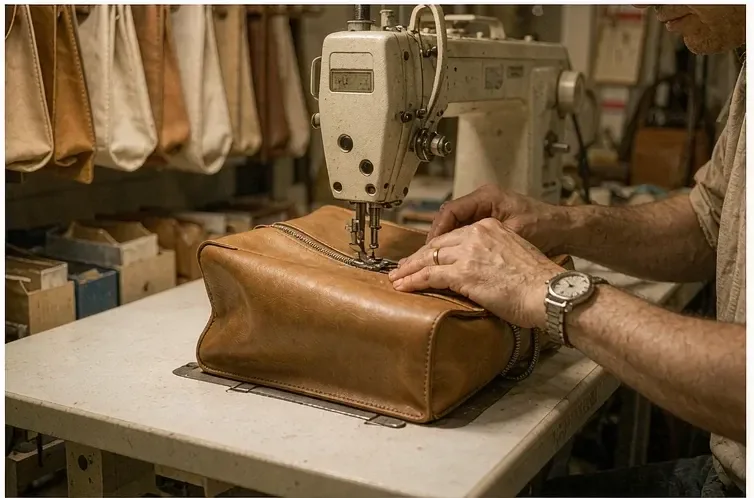
Piping is a cord wrapped in a strip of leather or fabric and inserted into a seam so that a narrow raised line stands proud of the join. It does two jobs at once: it stiffens the seam against the flexing that would otherwise crease it, and it gives the edge of the panel a defined line that reads as deliberate. On a structured body the cord is 1.5-2.0 mm and the visible welt is 2.5-3.5 mm, which is narrow enough to read as a line rather than as a band.
- Cord diameter
- 1.5-2.0 mm, cotton or leather-filled
- Visible welt width
- 2.5-3.5 mm, consistent along the seam
- Tape width before folding
- 12-15 mm, cut on the straight grain
- Pitch along the piping
- 8-9 stitches per inch
- Seam allowance under the piping
- 8 mm, trimmed after insertion
- Corner treatment
- Mitred at 45 degrees, cord butted
What Is Edge Stitching, and How Is It Different?
Edge stitching is a single line run parallel to a finished edge, with no cord and no added material. Its job is to hold the turn flat and to give the eye a line to follow, and on a structured body it runs 3.0-3.5 mm from the edge. Piping adds material into the seam; edge stitching does not. That is the whole difference, and it decides which one a drawing should call for: piping where the seam needs stiffening, edge stitching where it only needs holding.
The two are sometimes combined, and the combination is where most specifications go wrong. An edge stitch run at 3.0 mm alongside a piping welt of 3.0 mm leaves no gap between them, so the two lines read as one thick seam. If both are wanted, the edge stitch should sit at least 4 mm outside the welt, which usually means moving one of them rather than squeezing both into the same 3 mm.
How Thick Should the Cord Be?
Between 1.5 and 2.0 mm for a structured body, and the choice inside that range depends on the gauge of the panel it sits against. A cord of 1.5 mm suits a face at 1.0-1.2 mm; a cord of 2.0 mm suits a face at 1.4-1.6 mm. Matching the cord to the gauge is what keeps the welt proportional, and a cord that is too thick for its panel produces a bulge on the face that no amount of pressing will remove.
| Face gauge | Cord diameter | Welt width | Where used |
|---|---|---|---|
| 0.9-1.1 mm | 1.2-1.5 mm | 2.0-2.5 mm | Soft bodies and gussets |
| 1.0-1.2 mm | 1.5 mm | 2.5-3.0 mm | Gusset-to-face seams |
| 1.2-1.4 mm | 1.8 mm | 3.0-3.5 mm | Base seams and structured panels |
| 1.4-1.6 mm | 2.0 mm | 3.5 mm | Handles and loaded joins |
| Exotic skins | 1.2 mm maximum | 2.0-2.5 mm | Where the scale pattern must stay readable |
Exotic skins are the exception and worth naming separately, because the instinct is to pipe them the same way as calfskin and the result is wrong. A cord above 1.2 mm on a scaled skin lifts the scales at the seam and breaks the pattern across the join, which is visible from across a room. On exotic work the welt should stay at 2.0-2.5 mm or the piping should be omitted altogether in favour of a plain edge stitch.
How Wide Should the Welt Show?
Between 2.5 and 3.5 mm, held consistent along the whole length of the seam. Consistency is the harder requirement and the one that fails: a welt that varies between 2.5 mm and 4.0 mm along a seam reads as careless even where every stitch is correct. The cause is usually the tape being cut off-grain or folded unevenly rather than any fault in the stitching itself.
Too narrow
Under 2.5 mm the welt disappears into the seam and the piping does no stiffening work at all. It is also the first sign that the tape was folded short, which means the cord is only partially wrapped.
Correct
2.5-3.5 mm, constant along the seam, with the cord fully wrapped and the stitch line running close to the cord rather than across it. The seam stiffens and the edge reads as a deliberate line.
Too wide
Above 4 mm the piping becomes a band rather than a line, narrows the visible face of the panel and adds bulk at every corner, where four thicknesses of tape already meet.
How Far from the Edge Should the Stitch Run?
An edge stitch runs 3.0-3.5 mm from the finished edge, and the distance should be written on the drawing rather than left to the operator. Closer than 3.0 mm and the stitch risks breaking out through the edge on a skived panel; further than 4.0 mm and the turn it is meant to hold begins to lift between stitches. The window is narrow, and a guide set once at the start of a run is what holds it.
- 3.0-3.5 mm from the finished edge, held by a guide rather than by eye.
- 8-9 stitches per inch, counted over 25.4 mm at three points.
- Thread tension set so the stitch sits 0.1-0.2 mm below the surface.
- A guide set once at the start of the run and checked every twenty pieces.
What Happens at a Corner?
A corner is where both operations are won or lost. Piping is mitred at 45 degrees with the cord butted rather than overlapped: butting keeps the welt at a constant width through the turn, while overlapping doubles the cord thickness at exactly the point where the least material is wanted. Edge stitching is either mitred to match or, more commonly, stopped and restarted with three back-stitches on each side of the corner.
Measure the welt width 10 mm before the corner, at the corner, and 10 mm after. If the three figures differ by more than 0.5 mm, the cord was overlapped rather than butted.
The second corner question is whether the piping should run around it at all. On a tight radius below about 15 mm, piping will not turn without gathering, and the honest answer is to stop it short and finish with a plain seam. A drawing that calls for continuous piping around a tight corner guarantees a gathered welt at every one of them, and the gathering is what a customer sees rather than the piping.
There is a third option at a corner that is worth knowing because it solves the problem rather than avoiding it: a continuous welt with the tape cut on the bias. Bias-cut tape stretches around a radius instead of gathering at it, which is the same principle a tailor uses on a curved hem. It costs more in material, because a bias strip yields less from the same skin, and it needs a slightly narrower welt at 2.0-2.5 mm. Where a silhouette has four tight corners and the piping has to be continuous, it is usually the better answer than either forcing a straight-grain tape around or stopping short.
Which Materials Suit Piping and Which Do Not?
Calfskin takes piping well at any of the combinations above. Suede takes it but shows the cord's pressure line against the nap, so a lighter cord is used. Exotic skins take it only at 1.2 mm and below. Patent and heavily corrected grains are the difficult cases: the coating is less extensible than the fibre beneath it, so a cord pressed into the seam can crack the finish along the welt within a season.
What Fails and How to Read It
Four failures cover most of what goes wrong, and each points at a specific decision rather than at the operation generally. A welt that varies in width was folded off-grain. A welt that gathers at a radius was asked to turn tighter than it can. An edge stitch that breaks out through the edge was set closer than 3.0 mm on a skived panel. And a stitch line that wanders was run by eye rather than against a guide. Reading which one it is tells you what to correct.
A fifth failure belongs on the list because it is the one most often accepted at approval and most often raised later: a stitch line that crosses the welt rather than running alongside it. Under load the welt rolls slightly, and a stitch crossing it is lifted with it, so the line that looked straight on the bench reads as a series of shallow scallops within a season. The check is simple — sight along the seam at a low angle and confirm every stitch lands on the same side of the cord.
Both operations in one line
- Piping stiffens a seam and needs a cord matched to the gauge; edge stitching holds a turn and needs a guide. Write the distance and the pitch, or neither will be consistent.
How to Specify Both on a Drawing
Piping is specified as cord diameter, welt width, tape width and pitch: 1.8 mm cord showing a 3.0 mm welt, folded from 12-15 mm tape, at 8-9 stitches per inch, mitred at 45 degrees with the cord butted. Edge stitching is specified as distance from the finished edge and pitch: 3.0-3.5 mm at 8-9 per inch, held by a guide. Written that way both become inspectable, and an inspector with a rule can settle either in under a minute.
Programme Figures
Our programme runs through our validated partner factory Quanzhou Yingming Bags, an SGS-validated site with 7 production lines and roughly 200,000 pcs per month of capacity, holding export experience since 2014. Sampling takes 6-10 working days, or 12-15 on a complex build; bulk occupies 35-50 days; minimums sit at 500 pcs per style and colourway; and shipments leave FOB Xiamen with FOB, CIF and DDP terms all available. Inspection is drawn at AQL 2.5 under ISO 2859-1, with leather tested against ISO 3376 for tensile strength. Material direction is covered on luxury materials.
Have piping and edge stitching specified in numbers
Send the silhouette, gauge, hardware direction, quantity per colourway and delivery date. You will receive a specification naming cord, welt, distance and pitch. Request a quote.
Frequently Asked Questions
What is piping on a luxury handbag?
A cord wrapped in a strip of leather or fabric and inserted into a seam so a narrow raised welt stands proud of the join. It stiffens the seam against flexing and gives the panel edge a defined line. On a structured body the cord is 1.5-2.0 mm and the welt 2.5-3.5 mm.
What is the difference between piping and edge stitching?
Piping adds material into the seam; edge stitching does not. Edge stitching is a single line run 3.0-3.5 mm from a finished edge to hold the turn flat. Piping stiffens, edge stitching holds, and a drawing should call for one or the other on that basis.
How thick should piping cord be?
Between 1.5 and 2.0 mm, matched to the face gauge: 1.5 mm against a panel of 1.0-1.2 mm and 2.0 mm against one of 1.4-1.6 mm. A cord too thick for its panel produces a bulge on the face that pressing will not remove.
How wide should a piping welt be?
Between 2.5 and 3.5 mm, held constant along the whole seam. Under 2.5 mm the welt does no stiffening work; above 4 mm it becomes a band, narrows the visible face and adds bulk at every corner.
How far from the edge should an edge stitch run?
Between 3.0 and 3.5 mm from the finished edge, held by a guide rather than by eye. Closer than 3.0 mm risks breaking out through the edge on a skived panel; further than 4.0 mm lets the turn lift between stitches.
How is piping handled at a corner?
Mitred at 45 degrees with the cord butted rather than overlapped. Overlapping doubles the cord thickness exactly where the least material is wanted, and it shows as a welt that widens through the turn by more than 0.5 mm.
Should piping run around a tight corner?
Not below a radius of about 15 mm. Piping will not turn tighter than that without gathering, and the gathering is what a customer sees. The honest specification is to stop the piping short and finish with a plain seam.
Which materials do not suit piping?
Patent and heavily corrected grains, because the coating is less extensible than the fibre beneath it and a pressed cord can crack the finish along the welt. Exotic skins take a cord of 1.2 mm at most, or none at all.
What pitch is used on piping and edge stitching?
Eight to nine stitches per inch on both, counted over 25.4 mm at three points along the seam. Thread tension is set so the stitch sits 0.1-0.2 mm below the surface rather than standing proud of it.
What causes a welt to vary in width?
Usually a tape cut off-grain or folded unevenly rather than any fault in the stitching. Measuring the welt 10 mm before a corner, at the corner and 10 mm after will show it: more than 0.5 mm of variation means the cord was overlapped rather than butted.
How should piping be written on a drawing?
As cord diameter, welt width, tape width and pitch together: 1.8 mm cord showing a 3.0 mm welt, folded from 12-15 mm tape, at 8-9 stitches per inch, mitred at 45 degrees with the cord butted. That is inspectable with a rule.
How long does sampling and bulk take?
Sampling takes 6-10 working days, or 12-15 on a complex build, and bulk occupies 35-50 days at 500 pcs per style and colourway. Shipments leave FOB Xiamen, with FOB, CIF and DDP terms all available.
People Also Ask
Is piping stronger than a plain seam?
It is stiffer rather than stronger. The cord resists the flexing that creases a seam, which is why it appears on base seams and structured panels rather than on load-bearing joins.
Can piping and edge stitching be used together?
Yes, but the edge stitch needs at least 4 mm of clearance outside the welt. Run at 3.0 mm beside a 3.0 mm welt, the two lines read as one thick seam instead of two deliberate ones.
Why does piping gather at a corner?
Because the radius is tighter than the cord can turn. Below about 15 mm the honest answer is to stop the piping short rather than to force it around and accept the gathering.
How do you check piping at goods-in?
Measure the welt at three points along the seam and at the corner, count the pitch over 25.4 mm, and confirm the stitch runs close to the cord rather than across it. Under a minute with a rule.
Does piping add much cost?
It adds material and one operation, and the cost is modest against the seam strength it protects. The larger cost is at corners, where each mitre is cut and set individually rather than run continuously.
Sources and further reading
Every figure on this page is either our own programme data or attributed below. Open the originals before you write them into a specification.
- ISO — International Organization for StandardizationISO Publisher of ISO 2859-1 for the AQL 2.5 inspection plan and ISO 3376 for leather tensile strength.
- SATRA Technology CentreSATRA Independent testing body for leather goods, referenced for seam strength, stitch pitch and flex test methods.
- Leather Working GroupLeather Working Group Tannery audit protocol evidencing hide traceability behind the skins used for piping tape.
- CITES — Convention on International Trade in Endangered SpeciesCITES Permit authority governing the exotic skins for which piping cord is restricted to 1.2 mm or omitted.