Luxury Bag Gift Box Inserts: Materials, Fit and Decision Rules
What is a gift box insert, and how does it differ from a divider? An insert is any structure inside the carton that locates, protects or presents the piece: a flocked foam block, a velvet tray, a moulded pulp cradle or a board divider. Three rules decide between them — nothing touches metal hardware, keeping 4 mm clearance; any board in direct contact sits at pH 6.5 to 7.5; and fit stays within 0.5 mm of the drawing, because an insert either holds the piece still or it does nothing at all.
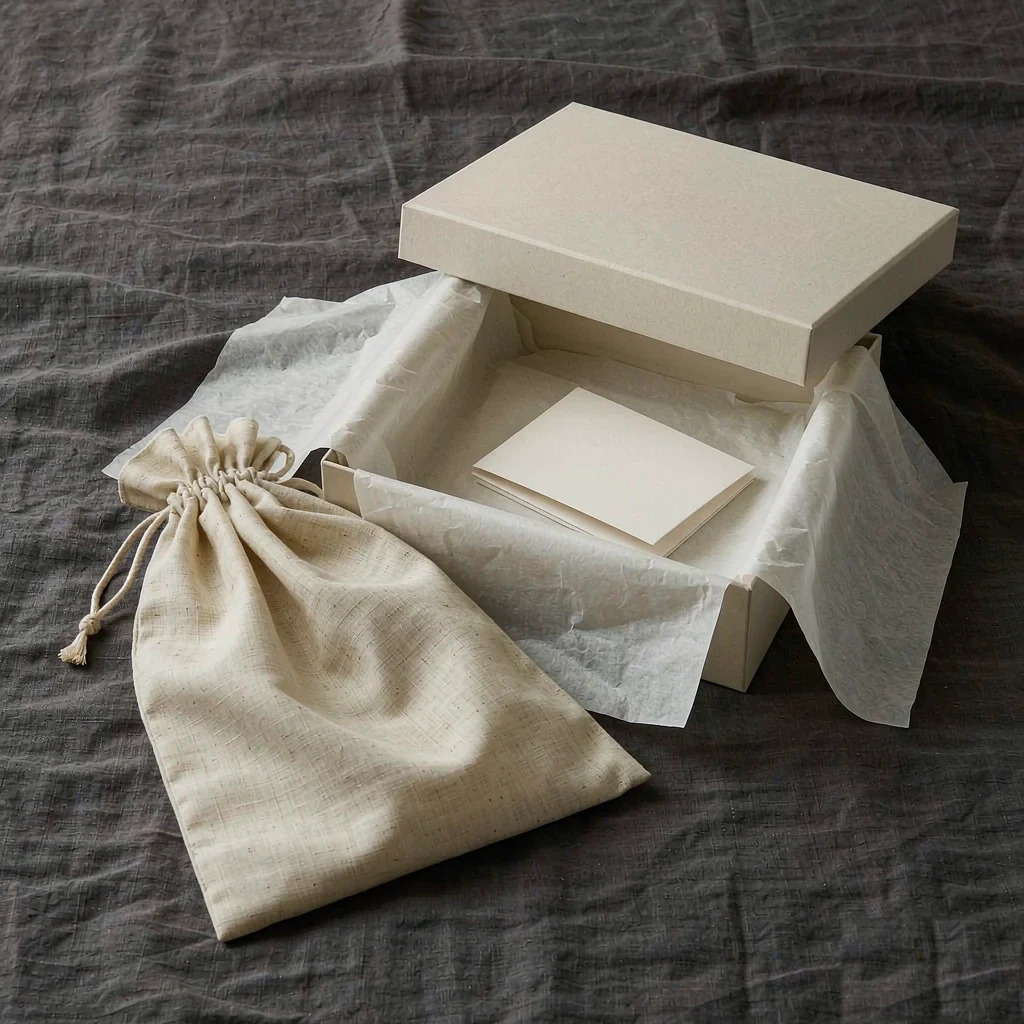
What Counts as an Insert?
The word covers anything added to the inside of a carton that the piece does not wear. That includes an obvious cradle moulded to take the silhouette, a simple board divider keeping a dust cover away from a strap, and a scattering of tissue used to raise the piece to the lip of the carton. Each does the same job by a different means: it stops movement, and it sets how the piece is first seen.
What none of them may do is alter the piece. An insert is in contact with leather, hardware and lining for weeks or months, and every material choice has to be made on that basis. This is the distinction most specifications miss, and it is why a well-reviewed insert can still be the reason a piece arrives with a permanent mark.
Decision One: Does Anything Touch the Piece?
Start here, because it eliminates half the candidates immediately. If anything rests against unprotected hardware, the specification is wrong. Metal feet, a turn-lock, a hanging zip pull or a chain strap will all mark or be marked by contact, and they are the parts most often forgotten when a cradle is drawn around the silhouette.
The rule is simple and worth writing on the drawing: keep 4 mm of clearance around every metal component, and at least 2 mm around any leather surface that will rest under its own weight. Where an insert has to reach under the piece to lift it, it should contact the base panel only, never the corners, handles or feet, and never a strap lying along the base.
Decision Two: Cushion or Present?
The second question is what the insert is for. A transit cradle exists to survive being thrown around and is usually hidden beneath something decorative. A presentation tray exists to be looked at and is the first thing the customer sees after the lid comes off. Very few programmes honestly need both, and trying to satisfy both is the commonest reason an insert costs twice what it should.
Decide by route. A carton shipped direct to a customer needs the cradle. A carton handed across a boutique counter needs the tray. A carton shipped to a distribution centre and then to a customer needs a cradle inside a carton that has been drawn to look right without one, which is usually better resolved at the carton than at the insert.
Comparing Insert Materials
| Material | What it does | Where it fits |
|---|---|---|
| Flocked ethylene-vinyl acetate foam | Locates precisely, cushions shock | Direct shipment, structured silhouettes |
| Velvet-faced board tray | Presents beautifully, low cushioning | Counter handover, camera-facing sets |
| Moulded pulp cradle | Absorbs impact, single material | Programmes with recovery targets |
| Board divider or frame | Separates components, no cushioning | Multiple pieces in one carton |
| Tissue and paper fill | Raises the piece, fills voids | Soft silhouettes, short holding times |
Flocked Foam and Velvet Trays in Detail
Flocked ethylene-vinyl acetate foam is the most capable insert material and the least forgiving to specify. Density around 60-80 kg per cubic metre suits a fine handbag: softer does not recover after compression and harder transmits rather than absorbs shock. Thickness runs 2-5 mm at the contact face, and tolerance across the cradle should stay within 0.5 mm.
The flock itself deserves attention, because it is the part the customer touches. A short nylon pile rubs cleanly and recovers, while a long rayon pile flattens under vertical storage and leaves permanent shadows. Whichever is specified, ask for rub results before bulk: 500 dry rubs without visible pile loss is a reasonable floor for anything the customer will handle more than once.
Moulded Pulp and Board Dividers
Moulded pulp has shed its reputation and is now the honest answer wherever a programme carries a recovery target. It absorbs impact well, it presses into a form closer to the silhouette than any folded board, and it is a single material, which matters enormously when the customer is deciding what can be recycled and what has to be separated.
Board dividers solve a different problem: several components in one carton. They are the simplest way to stop a strap crossing a panel or a dust cover being crushed under a card. Specify them at 400-600 gsm with all edges covered, since a raw board edge is the part that scuffs whatever it rests against over a long storage period.
- Hardware clearance
- 4 mm around every metal component
- Contact clearance
- 2 mm minimum around loaded leather surfaces
- Foam density
- 60-80 kg per cubic metre for fine pieces
- Foam thickness
- 2-5 mm at the contact face, within 0.5 mm tolerance
- Flock rub resistance
- 500 dry rubs without visible pile loss
- Contact board pH
- 6.5-7.5, lignin-free and acid-free
- Dimensional tolerance
- ±0.5 mm across the insert drawing
Tissue, Paper Fill and Void Creation
Tissue is not filler in a fine programme; it is a tool. Used correctly it raises the piece to the lip of the carton so the customer sees the silhouette rather than looking down into a well, and it separates the handle from the panel beneath. Used as void filler it collapses, shifts, and eventually looks accidental.
Where a genuine void has to be filled, fill it deliberately. A folded paper block sized to the void holds its shape and can be removed cleanly, whereas loose fill migrates and ends up inside the piece rather than around it. The acid-free rule applies here too: paper resting against pale leather for months has to be lignin-free.

Tolerances: How Tight Should the Fit Be?
Fit is measured on the piece it was drawn for, not on a drawing dimension. A useful working target is contact without pressure: the insert should touch the base panel firmly enough to stop movement, and should release the piece when it is lifted straight up without any feeling of suction or grab. Anything tighter makes the customer pull, and pulling is how handles get stretched.
Two measurements make this test repeatable. Total movement when the closed carton is tilted thirty degrees should be under 2 mm. And extraction force, measured straight up with a scale, should sit below about 3 N for a piece with handles. Both cost almost nothing to check and both catch the same mistakes that visual inspection always misses. Run them again on cartons that have already completed a simulated transit cycle, because compression moves both figures and the difference between fresh and settled is exactly what a customer eventually meets.
Colour Safety and Contact Bleed
Colour moves both ways. A dark component can bleed into a pale insert and a dyed insert can bleed into pale leather, and the second is the one that ends in a returned piece. Every dyed material going inside a carton should be assessed for colour fastness against the ISO 105 series before bulk, and unlined dark flock against pale lining is the combination most worth testing.
Moisture makes bleed worse, so test under damp conditions rather than dry ones. A carton standing in a humid warehouse during a summer transit can reach conditions that accelerate transfer considerably, and a combination that passes on the bench can fail after ten days in a container. Test at elevated humidity and read after twenty-four hours rather than immediately.
Recovery, Separation and Single-Material Sets
Customers increasingly judge a pack by what they have to do with it afterwards. An insert bonded from three materials — foam, flock and adhesive — has to be separated by hand before anything can be recycled, and most people will not bother. A single-material insert, such as moulded pulp or uncoated board, can go straight into the paper stream and reads as considered rather than merely compliant.
Where foam is genuinely required, specify it without a bonded decorative facing so that the foam and the carton can be separated cleanly, and note the separation instruction on the care card rather than leaving the customer to decide. That one line converts an unwelcome task into an explained one, and it is the sort of detail that separates a pack people remember well from one they remember badly. Sets combining two materials should still be separable with no tool, since anything requiring scissors will be put in the bin whole.
How Inserts Behave in Long Storage
Most inserts are designed for a journey lasting days and then stored for months, which is a much longer test than they are drawn for. Three things happen over that time. Foam takes a permanent set where the piece rests. Adhesives holding a facing begin to release at the edges. And paper-based materials absorb moisture from whatever environment they are stored in.
Plan for it rather than discovering it. Rotate stock every six months so no carton carries load in the same place indefinitely, and specify a storage environment below 65 percent relative humidity. Where a collection may be held for a year or more before release, ask for accelerated ageing results on the insert material before committing, because a set that looks perfect at six weeks can look tired at nine months.
Direct shipment needs a cradle; counter handover needs a tray. Trying to satisfy both at once is the usual reason an insert costs double and still does neither job properly.
What Inserts Cost and Where the Money Sits
Insert cost divides into tooling and unit. Moulded pulp carries the highest tooling and the lowest unit cost, which suits a long programme with a settled silhouette. Flocked foam carries moderate tooling and a moderate unit cost, and suits programmes expected to run across several collections. Board dividers carry almost no tooling and a small unit cost.
The hidden line is reject rate, which behaves differently for each material. Flocked foam rejects for dimensional drift and visible seams; moulded pulp rejects for edge breakage; board dividers reject for crushed corners in transit. Whichever is specified, agreeing the acceptable rate in writing before tooling protects the unit cost better than negotiating it afterwards, and it removes the argument about who pays for the many pieces sitting just outside tolerance.
Programme Figures and Insert Development
Our programme runs through our validated partner factory Quanzhou Yingming Bags, an SGS-validated site with 7 production lines and roughly 200,000 pcs per month of capacity, holding export experience since 2014. Sample inserts take 6-10 working days, or 12-15 where a foam cradle has to be cut to a new silhouette; bulk occupies 35-50 days; and minimums sit at 500 pcs per style and colourway leaving FOB Xiamen.
Inserts are inspected on the same plan applied to every part of the presentation pack: a sample drawn at AQL 2.5 under ISO 2859-1 and read against an approved first article rather than a drawing alone. The surrounding specification sits on luxury packaging, the material definitions behind it on luxury materials, and the 6-10 working day development window on luxury sampling.
Have the insert decided before the carton is drawn
Send the silhouette, the route to market and the components that share the carton. You will receive an insert specification naming material, clearances, tolerance and colour-safety test. Request a quote.
Frequently Asked Questions
What is the difference between an insert and a divider?
An insert locates or presents the piece, usually by being shaped around it. A divider separates components inside the same carton and does not locate anything. Insert choice depends on the shipping route; divider choice depends only on what else shares the carton.
How much clearance should an insert leave around hardware?
Four millimetres around every metal component, including feet, turn-locks, hanging zip pulls and chain straps. These are the parts forgotten most often when a cradle is drawn around a silhouette, and they are the parts that mark.
What foam density suits a fine handbag cradle?
Around 60-80 kg per cubic metre. Below that the foam does not recover after compression and the piece begins to sit lower each time the carton is opened. Above that, shock transmits to the piece rather than being absorbed by the insert.
How thick should the foam contact face be?
Between 2 and 5 millimetres, held within 0.5 mm tolerance across the drawing. Thinner reaches its compression limit quickly; thicker adds bulk to the carton without improving protection, and it makes extraction more awkward for the customer.
Why must contact board be acid-free?
Because acid migrates into leather and lining over months of contact, leaving permanent discolouration on pale pieces. Board contacting pale leather should be lignin-free, acid-free and sitting between pH 6.5 and 7.5 with nothing else permitted.
How tight should the piece sit inside the carton?
Contact without pressure. The piece should not move when the closed carton is tilted thirty degrees beyond about 2 mm, yet should lift straight out below roughly 3 N of extraction force. Anything tighter makes the customer pull on the handles.
Is moulded pulp suitable for fine presentation?
Yes, and increasingly preferred. It absorbs impact well, presses closer to the silhouette than folded board, and arrives as a single material, which means the customer can put it straight into the paper stream rather than separating layers.
How is colour transfer risk assessed on inserts?
Against the ISO 105 series for colour fastness, tested damp rather than dry and read after twenty-four hours. Communication usually shows up only under elevated humidity, which is exactly what a summer container transit provides.
What flock specification lasts longest?
A short nylon pile. It rubs cleanly, recovers well after pressure and resists vertical storage. A long rayon pile flattens under stack and leaves permanent shadows where the piece has rested, which reads as damage even though nothing is broken.
Should loose fill be used in a fine carton?
Rarely. Loose fill migrates and ends up inside the piece rather than around it. Where a void genuinely has to be filled, use a folded paper block sized to the space, which holds its shape and can be removed cleanly.
How does an insert affect the unit cost?
Board dividers add least, flocked foam sits in the middle, and moulded pulp carries the highest tooling against the lowest unit price. The line that dominates in practice is reject rate, so agreeing the acceptable rate before tooling matters more than the material price itself.
How are inserts inspected at goods-in?
On the standard plan: a sample drawn at AQL 2.5 under ISO 2859-1, compared with an approved first article. The checks specific to inserts are dimensional tolerance, edge breakage, pile condition after rub and clearance around hardware.
People Also Ask
Can one insert work for several silhouettes?
Sometimes, with a generic flat base and removable blocks, though the fit will always be looser than a dedicated cradle. Dedicated tooling earns its cost once a silhouette has run for more than a single collection.
Should the insert be visible under the lid?
For counter handover, yes, since that is the first thing the customer sees. For direct shipment the cradle can be concealed beneath tissue, which allows plainer materials and a lower unit cost.
Why do inserts crush at the corners?
Because board edges are raw and take the load of a stacked pallet. Covering or rolling the edge spreads that load and removes most corner complaints without changing the material specification.
Is paper fill acceptable against pale leather?
Only if it is lignin-free and acid-free. Standard kraft carries lignin and will discolour pale hides over long contact, particularly in damp conditions where transfer accelerates.
How long does inset sampling take?
Sample inserts take 6-10 working days, rising to 12-15 where a foam cradle has to be cut to an entirely new silhouette and proved against the real piece rather than against a drawing.
Sources and further reading
Every figure on this page is either our own programme data or attributed below. Open the originals before you write them into a specification.
- ISO - International Organization for StandardizationISO Publisher of ISO 2859-1 for attribute sampling and the ISO 105 series covering colour fastness of materials contacting leather.
- ASTM International standardsASTM International Publisher of ASTM D3575 covering flexible cellular materials, referenced for foam density and compression behaviour.
- Forest Stewardship CouncilFSC Chain-of-custody scheme covering moulded pulp and board used for single-material inserts.
- SGS - Inspection and verificationSGS Third-party validation and goods-in inspection body referenced for site validation and pre-shipment checks.