How Much Does a Handbag Maison Programme Cost: Nine Cost Lines and the Variables That Move Them
How much does a handbag maison programme cost? A structured calfskin style ordered at our MOQ of 500 pcs per style and colourway usually lands between USD 26 and USD 68 per unit on FOB Xiamen terms, once leather, hardware, bench time, tooling, compliance testing and packing are counted together. The range is wide because the leather line alone commonly carries 45-55% of unit cost, and cutting yield on a full-grain hide can swing that line by a fifth. Below is the cost sheet as nine checkable lines, followed by the variables that move it further than quantity does.
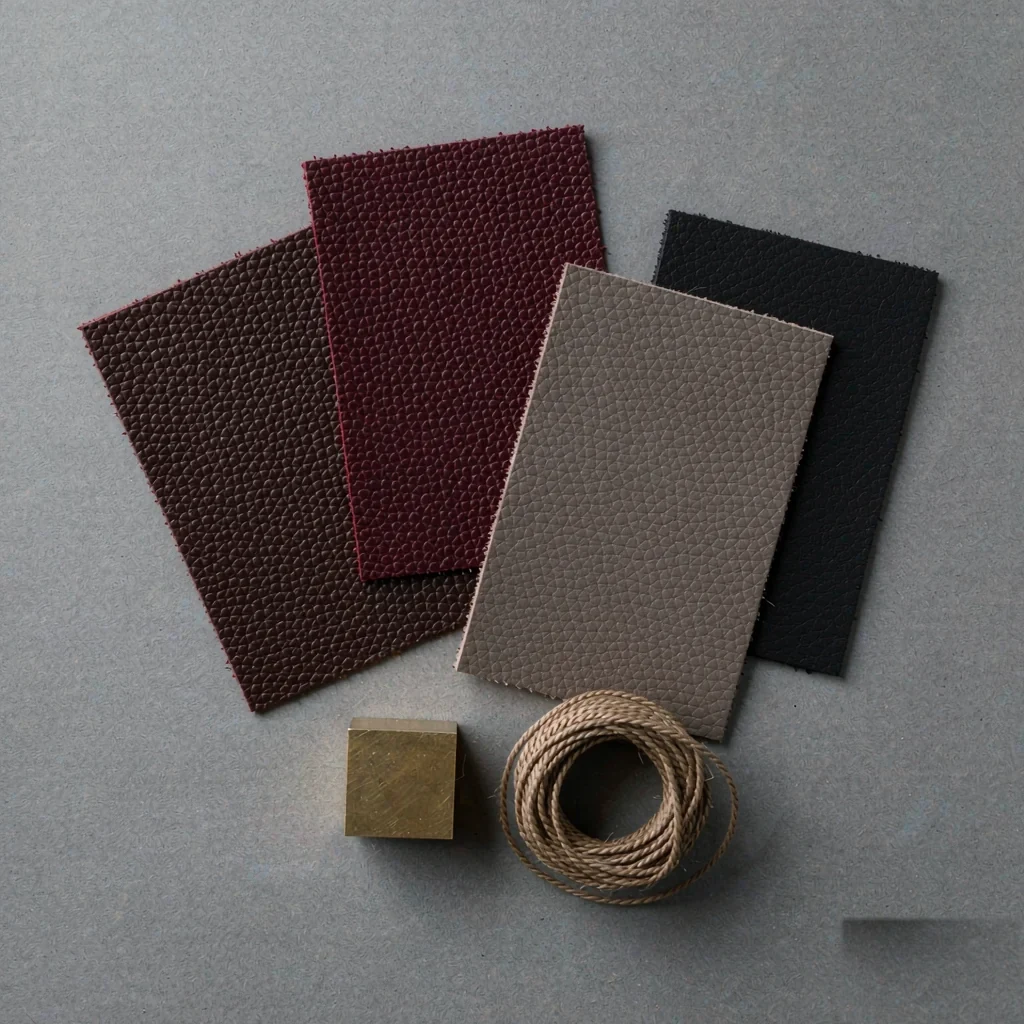
The Nine Cost Lines Behind One Unit Price
A handbag maison programme is quoted on nine lines rather than one number: development and sampling, leather, hardware, linings and reinforcement, bench time, tooling, compliance testing, packing, and freight. Anyone who asks for the nine lines separately can compare two programmes honestly, because the single number always hides a different set of assumptions.
| Line | What it covers | How it behaves | What to request |
|---|---|---|---|
| Development and sampling | Pattern research, first sample, one corrected round | Charged per style, sometimes credited against bulk | Ask whether the fee is credited |
| Leather and exotic skins | Hides, lot reservation, yield losses | Largest single line; moves with grade and season | Have the tannery and grade named |
| Hardware | Locks, feet, rings, closures, mechanisms | Proven parts are predictable; bespoke ones add tooling | Ask for plating thickness in microns |
| Linings and reinforcement | Lining cloth, interlining, bonding film | Small line, large effect on how shape is held | Ask for interlining weight in gsm |
| Bench time | Cutting, skiving, assembly, edge work | Scales with stitch density and hand operations | Ask how many steps are hand-finished |
| Tooling | Dies, embossing plates, bespoke moulds | One-off cost amortised across the run | Ask who owns it and for how long |
| Compliance testing | REACH, Prop 65, CPSIA by destination | Priced per material lot, not per shipment | Name every destination before costing |
| Packing | Dust bag, box, tissue, export carton | Unit cost that also drives freight volume | Ask for carton count and dimensions |
| Freight and terms | Haulage, port handling, ocean freight | Sits outside the unit price on FOB Xiamen | Fix the trade term at quotation |
Read this way, the first question changes. Instead of asking whether a figure is good, you ask which line is heavy and why, and that question has an answer a bench can act on. The handbag maison programme page shows where each line falls.
Line 1 — What You Pay Before Anything Is Cut
Development is charged per style and normally covers two rounds inside a 6-10 working days of sampling window, with complex constructions running to 12-15 working days; a third round is quoted separately at USD 60-120 per style and adds 3-4 working days. Always ask whether the development fee is credited against the bulk order once placed.
- Ask whether development fees are credited against the bulk invoice, since the same figure means very different things.
- Confirm how many correction rounds sit inside the quoted window, because extra rounds are billed and add days.
- Send dimensioned sketches rather than mood imagery, as undefined geometry adds research days that are billed.
- Fix the hardware direction before the first sample, since a mechanism swap re-opens the pattern and the cost.
Line 2 — Leather: The Line That Sets Every Other One
Leather carries 45-55% of unit cost before packing on most structured handbags, because hides are bought whole and priced by area rather than by panel. That single fact explains why two visually identical bags quote differently: the nesting plan, not the drawing, usually holds the gap.
- Body leather thickness
- 1.2-1.4 mm full-grain calfskin, split tolerance ±0.1 mm
- Cutting yield, 28 cm body panel set
- 62-70% depending on nesting and grain direction
- Usable area recorded per hide
- 45-52 sq ft graded usable, logged against the lot
- Tannery audit reference
- Leather Working Group audited tanneries recorded in the pack
Grain direction and thickness tolerance are what an auditor notices later. One direction across every panel keeps a bag from twisting after a month on a shoulder, and it costs a little more at cutting while saving considerably more in returns.
Line 3 — Hardware: Plating Thickness Is the Variable
Hardware cost is set less by shape than by finish: a proven brass turn-lock plated with 0.15-0.3 µm of gold over a palladium underlayer is predictable in both price and lead time, whereas a bespoke mechanism adds tooling, a proving step and two to three weeks.
- Ask for plating thickness in microns and the neutral salt spray hours tested, commonly 24 h or 48 h.
- Ask whether the base is brass or zinc alloy, since brass takes plating better and costs more per gram.
- Keep one hardware family across the capsule, because shared plating runs cut component lead time.
- Specify zip size in the pack, as a #5 metal zip reads very differently from a #3 coil.
Line 4 — Linings, Interlining and Reinforcement
Lining, interlining and reinforcement are the smallest monetary line and the largest behavioural one: a 240 gsm non-woven interlining at 0.8 mm is what lets a flap hold its line, and removing it saves cents while costing the silhouette its authority.
The setting that matters most is skiving. Turned edges are thinned to 0.6-0.8 mm so the fold lies flat under the paint, and the first-off piece is checked with a dial gauge rather than trusted by eye.
- State interlining weight in grams per square metre so panels can be costed and reproduced.
- Reinforce behind every hardware point, since a plate through plain lining tears early.
- Choose lining coatings for the destination climate, as some fail in sustained humidity.
Line 5 — Bench Time: Paying for Hand Operations
Bench time is costed per operation rather than per hour, so construction decisions taken at concept stage appear directly on the unit line: stitch density of 8-9 per inch rather than 6, three coats of edge paint at 12-15 µm each rather than two heavier ones, hand-burnished edging rather than machine creasing.
Thread matters too. Bonded nylon near 0.45 mm diameter runs cleanly at high stitch density and resists abrasion at base corners, where most bags fail first, while finer thread tolerates fewer stitches per inch.
- Ask which operations are hand-finished, then price removing them once before the choice is accidental.
- Stitch density above 8 per inch lengthens assembly and should be specified with the outcome in mind.
- Turned edges cost more than bound or raw edges and are the clearest visual signal of that difference.
- Structured bodies need extra setting time and jig work, which belongs in the cost rather than in the margin.
Line 6 — Tooling: Never Amortised Over One Order
Tooling covers the objects that carry your identity into production: cutting dies, embossing or debossing plates, and the mould itself when a lock is developed for you. The useful question is never the amount but how many units it is spread across.
Ownership and storage belong in the development agreement. Ask who holds the dies and plates, how long they are kept after a season, and what happens if the programme moves. These are settled far more easily before machining than after.
Where a bespoke lock earns its development cost, plan the proving step inside the sampling window. A mechanism that has not been cycled on the bench tends to be redesigned during bulk, the most expensive place imaginable to redesign anything.
Line 7 — Compliance: What Each Destination Adds
Compliance is priced per material lot and set by destination: REACH obligations under Annex XVII for the European Union, California Prop 65 assessment and CPSIA documentation for the United States, and EU Regulation 1007/2011 on fibre composition labelling.
- European Union programmes screen leather, metal and textile components against REACH Annex XVII.
- United States programmes add Prop 65 assessment plus CPSIA where applicable, notably for metal parts.
- Colour fastness is usually checked under the ISO 105 series and coating adhesion under ISO 11644.
- Exotic skins needing CITES documents should be declared here, since permits are not on the production calendar.
A report belongs to the lot it was drawn from, so re-selecting hides means fresh paperwork: allow USD 120-260 per lot and per destination, and remember that a second colourway on the same material still wants its own entry.
Laboratories keep their own timetables, which sit outside the production window. Booking when the lot is named rather than when cartons are ready is the least costly compliance decision available to a founder.
Lines 8 and 9 — Packing, Freight and the Landed Number
The number your accountant sees is the unit cost plus packing plus freight plus duty, and only the first is quoted by default. On FOB Xiamen the unit price covers goods to the port, after which freight, insurance and destination charges are yours.
Packing belongs to both halves, being simultaneously a unit cost and a freight driver. Rigid boxes, heavier board gauge or a carton count chosen for convenience rather than pallet efficiency each raise the landed figure without appearing in the unit quote.
- Request export carton count, dimensions and gross weight, because these determine your freight quotation.
- Specify dust bags and boxes at concept stage, as their lead times sit outside the 35-50 day bulk window.
- Fix the trade term at quotation, since moving from FOB to CIF or DDP later re-prices the shipment.
- Ask for a landed estimate alongside the unit cost so internal margin maths stays realistic.
- Ask how many export cartons sit on a pallet, since 36 cartons per pallet is a different freight quotation from 24.
One Silhouette Priced at Three Specifications
The cleanest way to read a quote is to hold the silhouette constant and vary only the specification. The three configurations below describe the same structured body at MOQ 500 pcs per colourway, differing in leather grade, hardware and hand-finishing.
The studio standard
Corrected-grain calfskin, stock brass hardware, machine creasing with two edge coats, folding carton. Indicative USD 26-34 per unit on FOB Xiamen terms.
The boutique edition
Full-grain calfskin from an LWG-audited tannery, upgraded plating thickness, hand-burnished edges with three coats, rigid box. Indicative USD 38-52 per unit.
The collector edition
Single full-grain lot with a bespoke debossed plate, custom lock proven on the bench, hand-set linings, presentation packing. Indicative USD 56-68 plus tooling.
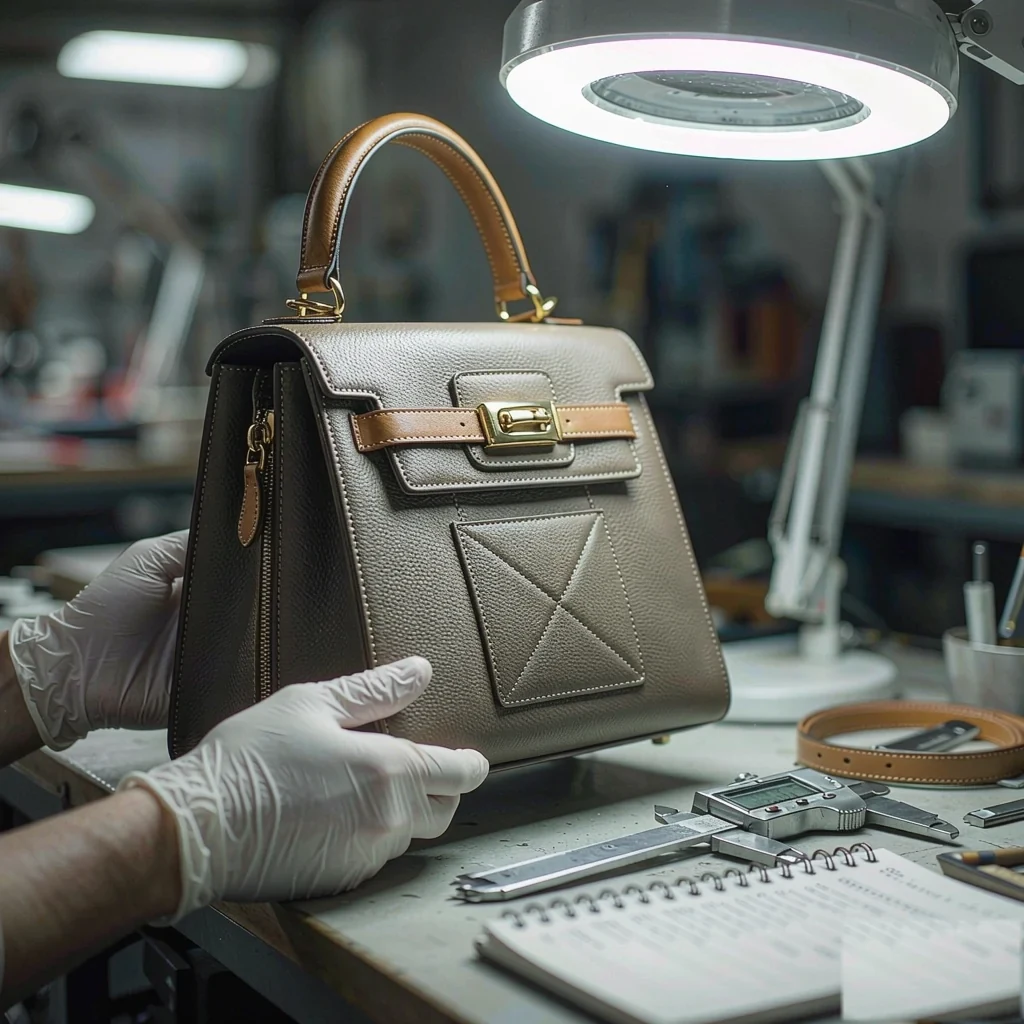
Seven Variables That Move Unit Price More Than Quantity
Quantity is the variable founders negotiate hardest and the one that moves least: hide yield, tannery grade, plating thickness, hand-operation count, colourway count, compliance scope and packing weight all shift unit cost further.
Variables worth asking about before you negotiate
- Hide yield often shifts material cost further than a modest increase in order size.
- Named lots from audited tanneries cost more per metre and far less in re-selection.
- Moving from 0.15 µm to 0.3 µm changes both the component price and its corrosion life.
- Every hand-finished step adds labour and adds a place for inspection to find variation.
- MOQ applies per style and per colourway, so added colour multiplies committed quantity.
- Each new destination market can require its own report against its own lot.
- Carton efficiency is a freight decision dressed up as a design one.
Read in that order, the conversation becomes honest. Rather than pressing for a reduction against an unspecified build, you choose which two or three variables to adjust, and the cost moves by a known amount for reasons everyone can see.
The Cost Checklist to Bring to Your First Quote Call
A first quote call produces usable costing in proportion to what arrives before it: the technical pack or dimensioned sketches, quantity per colourway, destination markets, target landed cost, and the date the capsule must reach a shelf.
- Send dimensioned sketches so panel yield can be estimated before anything is priced.
- State quantity per style and per colourway separately, since MOQ applies to each combination.
- Name every destination up front so the compliance line reflects what will actually ship.
- Give a target landed figure alongside the target unit figure.
- Request the nine lines individually, with the variables assumed behind each.
The programme operates across 7 production lines with about 200,000 pcs per month of capacity and has held export experience since 2014, executed through our validated partner factory Quanzhou Yingming Bags, an SGS-validated site. Inspection runs at AQL 2.5 under ISO 2859-1, with third-party audit available in addition.
Get the nine lines for your capsule
Send your pack, quantity per colourway and destination markets. You will receive all nine cost lines separated and a landed estimate within two working days. Request a quote.
Frequently Asked Questions
How much does a handbag maison programme cost per unit?
A structured calfskin style ordered at MOQ 500 pcs per style and colourway generally falls between USD 26 and USD 68 per unit on FOB Xiamen terms. The floor assumes corrected-grain leather, stock hardware and folding cartons; the ceiling assumes a single full-grain lot, custom debossing, a bespoke lock and presentation packing, with tooling charged separately.
What exactly does the development fee cover?
It covers pattern research, a first sample and one corrected round within 6-10 working days, or 12-15 for complex constructions. Further rounds are quoted separately. Some programmes credit the fee against the bulk invoice once the order is placed, so confirm that before you compare it against a unit cost.
Why does leather dominate the cost of a luxury handbag?
Because hides are purchased whole and priced by area rather than by panel, so cutting yield decides how many a run consumes. On a 28 cm structured body yield commonly sits between 62% and 70%, and every lost point is paid for in additional hides rather than in extra minutes of labour.
How much does hardware add to the unit price?
Shape matters less than finish and alloy. A proven brass component with 0.15-0.3 µm plating over a palladium underlayer is predictable in cost and lead time, while a bespoke mechanism adds mould tooling, a proving step on the bench and roughly two to three weeks to development.
Is tooling a one-off charge?
Yes, tooling is charged once for cutting dies, embossing plates and custom lock moulds. The useful question is what it amortises against, because one plate spread across 500 pieces and the same plate reused over several seasons produce very different unit economics. Confirm in writing who holds the plates and how long they are stored after a season ends.
How does increasing my order quantity change the unit cost?
Volume helps, though usually less than founders expect, because the largest lines scale nearly linearly. Moving from 500 to 1,000 pieces may improve tooling amortisation and material pricing, while hide area and bench operations per bag stay broadly unchanged. Ask which line actually improves, since the gain usually sits in tooling and sampling fees, not in the leather bill.
What does MOQ 500 per style and colourway mean in practice?
The minimum applies to each combination, so four styles in one colourway equals 2,000 pieces and the same four across two colourways equals 4,000. Most first capsules launch a single colourway and add colour once the silhouette has proven itself at retail. Development and tooling are quoted per style, so each added style carries its own entry.
Which compliance tests do buyers usually pay for?
European Union destinations typically require REACH Annex XVII screening, while United States programmes add California Prop 65 assessment and CPSIA documentation where applicable. Colour fastness is usually checked under the ISO 105 series, coating adhesion under ISO 11644, and tensile behaviour referenced to ISO 3376.
Is packaging included in the quoted unit price?
Basic packing usually is, while presentation elements such as rigid boxes, cotton dust bags and printed care cards are quoted separately and lead their own schedule. Always request carton count, dimensions and gross weight, because those three figures drive the freight quotation as directly as unit weight does.
What does FOB Xiamen actually mean for my total cost?
On FOB Xiamen the unit price covers goods to the port of loading, after which ocean freight, insurance and destination charges belong to you. CIF and DDP can be arranged, but the term should be fixed at quotation, since changing it later re-prices the shipment rather than merely adding a line.
When does the unit price become final?
At the spec freeze, when the approval sample is signed and the hide lot is named, because the leather line is then held against a real material rather than a description. Anything quoted before that point is an intention, and re-selecting a lot re-opens both costing and testing.
Can I reduce the unit cost without changing the design?
Yes, usually through specification rather than silhouette: adjusting interlining weight, moving from turned edging to a bound finish, lowering stitch density within an acceptable range, or keeping one hardware family across the capsule. Each change is measurable and none alters the drawing customers recognise. Take one step at a time and re-cost, because two changes together hide which one actually worked.
People Also Ask
What are the nine cost lines in a handbag programme quote?
Development and sampling, leather, hardware, linings and reinforcement, bench time, tooling, compliance testing, packing, and freight. Programmes differ in how they group these lines, but a quote that cannot be separated on request is hard to compare against another.
Why is leather the largest share of unit cost?
Hides are bought whole and priced by area, and cutting yield decides how many are needed. A modest drop in yield on a long run is absorbed through additional hides, which costs far more than additional minutes of labour.
How does MOQ affect the price per bag?
MOQ of 500 pcs applies per style and per colourway, so adding colour multiplies committed units. Tooling amortisation improves with volume, but material area and bench operations per bag stay broadly constant.
What costs come after the quoted unit price?
Presentation packing, ocean freight on FOB terms, insurance, import duty and destination handling. Request a landed estimate alongside the unit cost so internal margin maths reflects reality from the first season onward.
What unplanned costs should a new bag brand expect?
Extra sampling rounds beyond the first two, tooling for bespoke hardware, repeat compliance reports after any material change, presentation packing lead time, and freight movement between quotation and booking. Each is predictable and none is unusual.
Sources and further reading
Every figure on this page is either our own programme data or attributed below. Open the originals before you write them into a specification.
- ISO — International Organization for StandardizationISO Publisher of ISO 2859-1 for AQL sampling inspection, the ISO 105 series for colour fastness, ISO 11644 for coating adhesion and ISO 3376 for leather tensile behaviour.
- Leather Working GroupLeather Working Group Tannery environmental audit protocol referenced when costing specifies leather from audited tanneries and records the audit in the technical pack.
- European Chemicals AgencyECHA Authority for REACH obligations, including the Annex XVII restrictions that set substance screening scope for European Union destinations.
- U.S. Consumer Product Safety CommissionU.S. Consumer Product Safety Commission Administrator of CPSIA requirements, including lead limits applied to metal components alongside California Prop 65 on United States programmes.
- Sourcing JournalSourcing Journal Trade reporting on material cost movements, hide pricing and freight conditions that shape the indicative ranges quoted here.