How to Mix Luxury Bag Silhouettes in a Collection
A luxury collection works when the silhouettes inside it differ on purpose rather than by accident. Seven rules govern the mix: one carry method per occasion, a size ladder rather than a size crowd, one material language, one hardware family, a fixed price band architecture, one repeated signature detail and room left for the following season. This guide gives the seven rules as a working checklist, then shows how to audit a collection against them before a single sample is cut.
Why a Collection Mix Fails
Most collection problems are not design problems; they are assortment problems. A line of five bags that all carry the same way competes with itself, because a customer who buys one has no reason to buy another. A line of five bags in five different leathers reads as five brands. And a line with no size ladder leaves the customer nothing to trade up into, which is where the second sale usually comes from.
The fix is to make each silhouette earn its place by answering a different question. One bag answers how the customer carries a laptop, one answers what she carries to dinner, one answers what she carries at the weekend. When each piece answers a different question, the collection reads as a wardrobe rather than as a catalogue, and the customer buys across it rather than choosing within it.
The one-line test
- Give every silhouette in the line a one-sentence job. If two sentences are the same, one of the two bags has no reason to exist. A working capsule of three usually reads: a structured day piece, a shoulder or crossbody piece and an evening piece, all sharing one material and one hardware language.
The Silhouette Mix Checklist
Run this checklist before the tech packs are released, and run it again whenever a silhouette is added to the line. Every line is answerable from a specification sheet, and any line that cannot be answered is a gap the sampling round will find for you at greater cost, usually after a frame has already been blocked and a set of templates has already been cut.
- Does every silhouette answer a different carrying occasion?
- Is there a size ladder, with at least 4 cm of body height between steps?
- Do all pieces share one leather family and one lining weight?
- Do all pieces share one hardware family and one plating finish?
- Is the price band architecture fixed, with no two pieces at the same price?
- Is there one signature detail repeated across the line?
- Is there room left for one addition next season?
Rule 1: One Carry Method per Occasion
Carry method is the cleanest way to separate two bags that look similar. A top handle piece at a 9-11 cm drop is a day or business bag; the same body on a 25-30 cm shoulder strap is an evening to day crossover; a 50-60 cm crossbody strap turns it into a weekend piece. Three carrying occasions, three drops, one body language, and no internal competition.
Top handle
A 9-11 cm drop carried in the hand, or 13-15 cm in the crook of the arm. Reads as business or occasion.
Shoulder
A 25-30 cm drop on a 20-25 mm strap. Reads as day to evening, and leaves one hand free.
Crossbody
A 50-60 cm drop on a 12-15 mm strap. Reads as weekend, and leaves both hands free.
Evening
A 9-11 cm drop on a slim frame piece with a 6 cm gusset. Reads as jewellery rather than capacity.
Rule 2: Build a Size Ladder, Not a Size Crowd
A size ladder gives the customer somewhere to go. Three body heights with at least 4 cm between them read as a family: 18 cm for an evening piece, 24 cm for a day bag and 30 cm for a city or business piece. Three sizes 2 cm apart read as indecision. The ladder also makes commercial sense, because the middle step is where the volume sits and the top step is where the margin sits.
- 18 cm: the evening and occasion step, usually with a 6 cm gusset.
- 24 cm: the day bag step, and the one that carries the volume.
- 30 cm: the city and business step, and the one that carries the margin.
- Keep at least 4 cm between steps so the ladder reads as deliberate.
Rule 3: One Material Language Across the Line
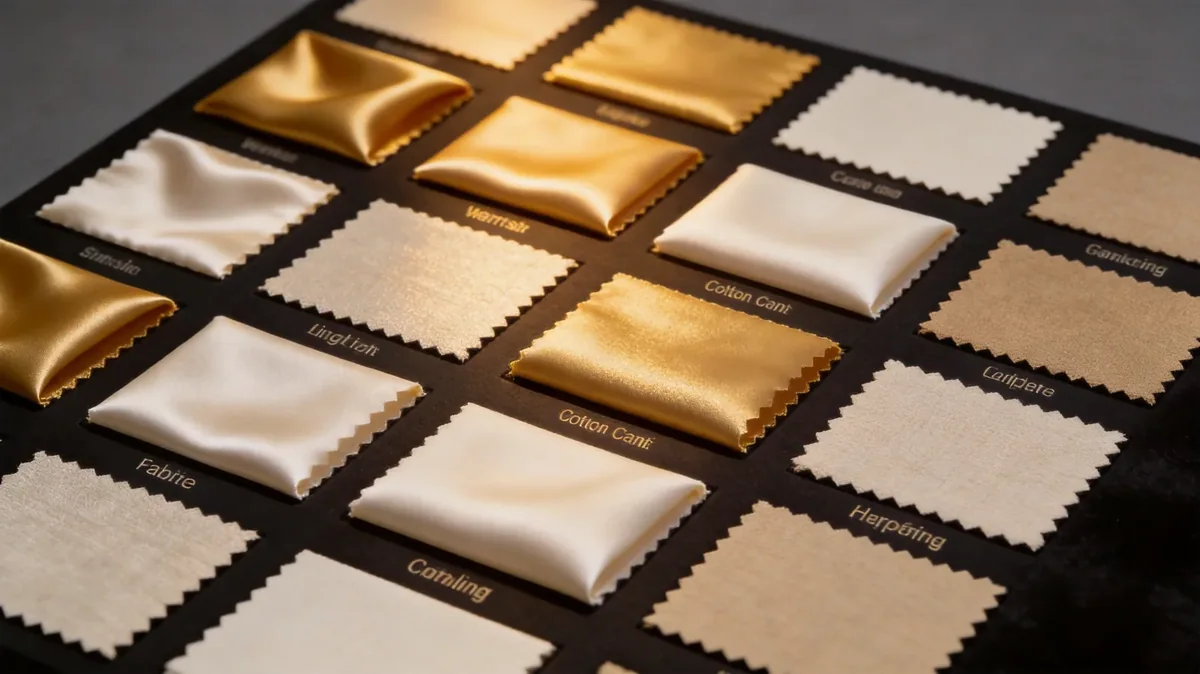
A collection reads as one house when the material language is constant. Choose one leather family and stay inside it: full-grain calfskin at 1.2-1.4 mm across the structured pieces, and lambskin at 0.8-1.0 mm only where drape is the point. Keep the lining weight constant as well, at 0.8-1.0 mm split suede or a 120 gsm jacquard, so the interior feels like the same hand from piece to piece.
- Structured pieces
- 1.2-1.4 mm full-grain calfskin on a 0.8 mm board
- Soft and quilted pieces
- 0.9-1.1 mm calfskin face, or lambskin at 0.8-1.0 mm
- Lining
- 0.8-1.0 mm split suede, or 120 gsm jacquard
- Edge
- 3 coats across every piece in the line
- Stitch density
- 8-9 stitches per inch, held constant
Rule 4: One Hardware Family
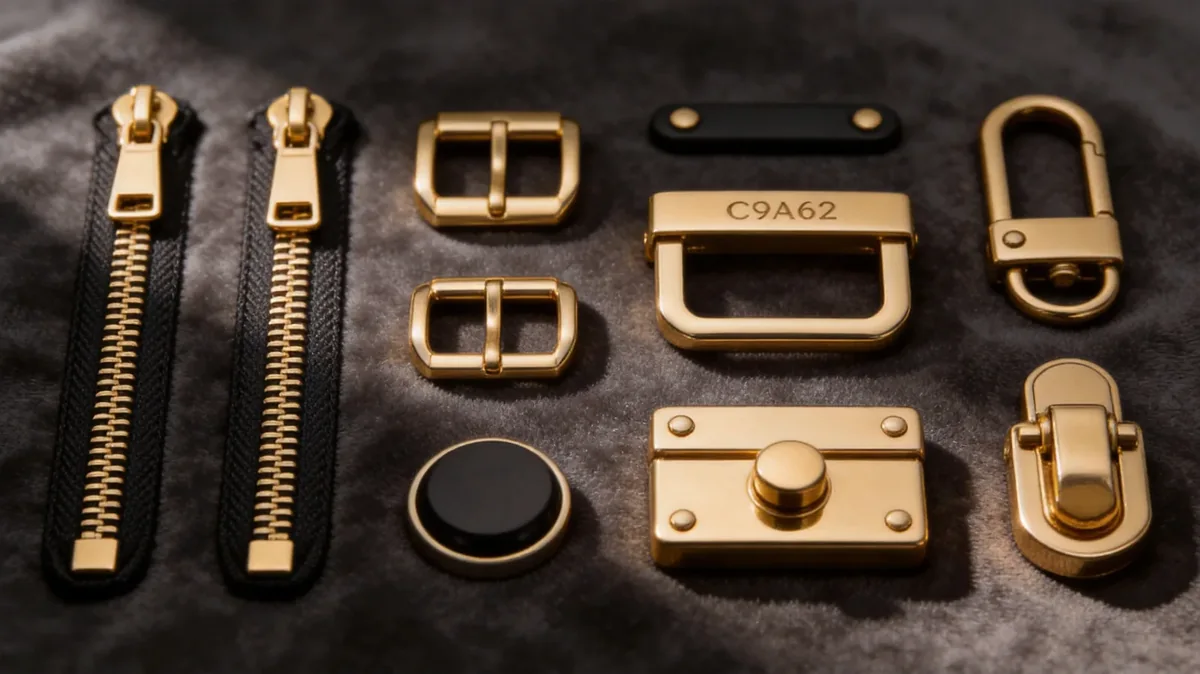
Hardware is the fastest way to make a line read as one house, and the fastest way to break it. Choose one base metal and one finish and apply them everywhere: brass plated to 0.15-0.3 micrometres in a warm tone, or zamak in a cool tone, but not both. Feet, closures, strap ends and zip pullers should all come from the same family, because a mismatched zip puller is the kind of detail a customer notices without knowing why.
- One base metal: brass for load-bearing closures, zamak for decorative plates and feet.
- One finish and tone, held across feet, closures, strap ends and pullers.
- One plating thickness, verified at 0.15-0.3 micrometres on every first article.
- One salt-spray duration, 24 h as standard and 48 h for resort assortments.
Rule 5: Fix the Price Band Architecture
No two pieces in a collection should sit at the same price, because the customer will then choose on looks alone and the brand loses the trade-up path. Set three steps and place one silhouette in each: an entry piece from USD 4.80 with a soft body and zamak hardware, a core piece with a concealed base plate and brass hardware, and a prestige piece with a blocked frame and a hand-set lining.
| Band | Construction | Silhouette | Position in the line |
|---|---|---|---|
| Entry | Soft body, zamak hardware, corrected grain leather | Small shoulder or crossbody | The first purchase, from USD 4.80 |
| Core | Concealed base plate, brass hardware, full-grain calfskin | Semi-structured day bag | The volume step, and the repeat order |
| Prestige | Blocked frame, cast brass closure, hand-set lining | Top handle satchel or evening piece | The margin step, and the press piece |
Rule 6: Repeat One Signature Detail
A signature detail is what makes a collection recognisable in a photograph where the logo is not visible. It should be a construction detail rather than a printed one: a specific turn-lock shape, a 12 mm bar-tack at every pocket end, a three-coat edge in a contrasting tone, or a handle anchor closed at 8-9 stitches per inch with a visible reinforcement plate. Repeated across every piece, that detail becomes the house mark.
- A closure shape used across the line, cast in one metal and one finish.
- A 12 mm bar-tack at every pocket end, in a thread matched to the shell.
- A three-coat edge in either a matching or a deliberately contrasting tone.
- A visible handle anchor, closed at 8-9 stitches per inch over a reinforcement plate.
Rule 7: Leave Space for the Next Season
A collection that uses every idea it has cannot grow, and a line that fills every carrying occasion in its first season has nowhere to go but back over its own ground. Leave one carrying occasion and one size step open, so next season has somewhere to go without cannibalising what already sells. The cleanest way to do this is to launch three silhouettes where four would fit, and to hold the fourth back deliberately, specified and costed but not yet sampled, so the decision to add it later is a commercial one rather than a design scramble.
Auditing a Mix Before Sampling
Before the tech packs go out, put every silhouette in the line on one sheet and check it against the seven rules. The audit takes an hour and it is the highest-value hour in the whole programme, because every problem found here costs nothing to fix and every problem found at the first article costs a full sampling round, a new frame form or a new set of templates. Run it again when a piece is added, because a line grows one silhouette at a time and each addition changes what the other pieces are for.
| Check | Question | Pass condition |
|---|---|---|
| Occasion | Does each piece answer a different carrying occasion? | No two sentences are the same |
| Ladder | Is there at least 4 cm between size steps? | Three steps minimum |
| Material | Do all pieces share one leather family? | One grade and one thickness band |
| Hardware | Do all pieces share one metal and finish? | One family across the line |
| Price | Is each piece in a different band? | No two at the same price |
| Signature | Is one construction detail repeated? | Visible on every piece |
| Headroom | Is one occasion left open? | Room for one addition |
Sampling and MOQ for a Mixed Capsule
Each silhouette in the line is sampled on its own clock. A soft or semi-structured piece takes 6-10 working days from a confirmed tech pack, and a piece with a blocked frame, a hand-set closure or a mixed-media panel takes 12-15 working days. Minimum order quantity is 500 pcs per style / colourway, so a three-piece capsule is three qualifying runs, and bulk production runs 35-50 days from an approved sample.
Our validated partner factory Quanzhou Yingming Bags has built capsule programmes since 2014 on 7 production lines with a monthly output of about 200,000 pcs. Every shipment is offered FOB Xiamen and audited at AQL 2.5 (ISO 2859-1) against the approved first article, so a line that shares one tolerance architecture audits faster and reorders more cleanly.
Request a collection mix review
Send us your line plan and we will return a mix audit, a shared tolerance architecture and a costed specification for each piece. Start your capsule programme
Frequently Asked Questions
How many silhouettes should a luxury collection have?
Three for a first capsule: a structured day piece, a shoulder or crossbody piece and an evening piece. That set covers the carrying occasions a customer has, shares one material and hardware language, and leaves room for a fourth piece next season without cannibalising what already sells.
How do I stop two bags in a collection competing?
Give each one a different job. If two silhouettes answer the same carrying occasion at the same size, one of them has no reason to exist. Separate them by carry method, by size step or by price band, and the customer buys across the line instead of choosing inside it.
What is a size ladder in a bag collection?
Three or more body heights with at least 4 cm between them, such as 18 cm, 24 cm and 30 cm. The middle step carries the sales volume and the top step carries the margin. Sizes only 2 cm apart read as indecision rather than as a ladder.
Should all bags in a line use the same leather?
They should share one leather family. Full-grain calfskin at 1.2-1.4 mm across the structured pieces, and lambskin at 0.8-1.0 mm only where drape is the point. A line in five different leathers reads as five brands rather than as one house.
How important is a shared hardware family?
Very. One base metal and one finish across feet, closures, strap ends and zip pullers is the fastest way to make a line read as one house. A mismatched zip puller is the kind of detail a customer notices without being able to say why.
What price steps should a collection use?
Three: an entry piece with a soft body and zamak hardware from USD 4.80, a core piece with a concealed base plate and brass hardware, and a prestige piece with a blocked frame and a hand-set lining. No two pieces should sit at the same price.
What makes a good signature detail?
A construction detail rather than a printed one. A specific cast closure shape, a 12 mm bar-tack at every pocket end, a three-coat edge in a contrasting tone, or a visible handle anchor closed at 8-9 stitches per inch. Repeated everywhere, it becomes the house mark.
How much size difference reads as a real step?
Four centimetres of body height. Anything less reads as a variation rather than as a step, and the customer cannot tell which one she is meant to buy. Eighteen, 24 and 30 cm is a ladder that reads clearly in a photograph and on a shelf.
Should an evening piece be in every collection?
Almost always, because it is the margin step and the press piece. An evening piece has a 6 cm gusset, a 9-11 cm drop and a frame closure, so it shares the line's hardware and leather language while costing far less in material than a large structured bag.
How long does it take to sample a three-piece capsule?
Each piece runs on its own clock: 6-10 working days for a soft or semi-structured body and 12-15 working days for a blocked frame. Sampled in parallel, a three-piece capsule reaches first articles inside three weeks, and bulk runs 35-50 days from approval.
What is the minimum order quantity for a capsule?
Five hundred pieces per style and colourway, so a three-piece capsule in one colourway is three qualifying runs. The threshold covers the frame tooling, the hardware setup and the pattern planning for each silhouette in the line.
How do I keep a collection consistent across seasons?
Freeze the shared architecture rather than the drawings. Keep one leather family, one hardware family, one stitch density and one edge specification as a standing tolerance sheet, and let the silhouettes change inside it. The line then reads as one house indefinitely.
What is the most common mistake in a first collection?
Launching five silhouettes that all carry the same way. The line competes with itself, no piece has a clear job, and the customer chooses one and stops. Three pieces on three different carrying occasions outsell five pieces on one.
Can one body be sold in more than one way?
Yes, and it is the most efficient move in a line plan. One body with a fixed handle and a removable shoulder strap sells as a day bag and as an evening piece, and it shares one frame tooling cost across two price steps.
People Also Ask
How do you build a handbag collection?
Give each silhouette a different carrying occasion, build a size ladder with at least 4 cm between steps, keep one leather and one hardware family across the line, place each piece in a different price band, and repeat one construction detail everywhere.
What is a capsule collection in luxury bags?
A small, tightly edited set, usually three silhouettes that share one material and hardware language and cover three carrying occasions. It is the most efficient way for a new brand to launch without multiplying tooling and setup cost.
How do you price a bag collection?
In three steps. Entry from USD 4.80 with a soft body and zamak hardware, core with a concealed base plate and brass hardware, prestige with a blocked frame and a hand-set lining. No two pieces should sit at the same price.
Should a bag line use one or several leathers?
One leather family. Full-grain calfskin at 1.2-1.4 mm carries the structured pieces, and lambskin at 0.8-1.0 mm appears only where drape is the point. Several unrelated leathers make a line read as several brands.
How many sizes should one bag shape come in?
Three, separated by at least 4 cm of body height. Eighteen centimetres for evening, 24 for day and 30 for city or business reads as a deliberate ladder and gives the customer somewhere to trade up into.
Sources and further reading
Every figure on this page is either our own programme data or attributed below. Open the originals before you write them into a specification.
- Business of Fashion industry reportingBusiness of Fashion Used to track how luxury houses structure capsule assortments and price ladders.
- WWD accessories and handbag coverageWWD Referenced for how capsule collections are merchandised across a season.
- ISO 2859-1 sampling procedures for inspection by attributesInternational Organization for Standardization The sampling standard behind the AQL 2.5 audit applied to each piece in a line.
- Leather Working Group audit protocolsLeather Working Group Referenced for traceability across the single leather family used in a collection.
A luxury collection reads as one house when its silhouettes differ on purpose. Give every piece a job, keep the material and hardware language constant, and leave one opening for next season, so the line grows rather than repeats itself.
Send us a line plan and a target price architecture and we will return a mix audit, a shared tolerance sheet and a costed specification for each piece within one working day. Request a collection mix review