How Luxury Packaging Protects Bags in Transit: A Four-Layer Specification
How does luxury packaging protect bags in transit? It protects them by giving four layers four separate jobs: a cotton dust bag that stops abrasion, a rigid box that carries the compression load, void fill that holds an 8-12 mm gap so no load reaches the leather, and an ECT 32 shipper carton that absorbs the drop. Specify all four as numbers rather than as materials and the layers stop competing with each other.
The Order of Decisions Behind a Transit Specification
Transit protection is decided in a fixed order, and writing the specification in that same order is what stops the four layers from fighting one another. The outer shipper comes first, because its board rating decides how much of a warehouse stack the presentation box inside is ever asked to carry. Void fill comes second, because it decides whether any of that load reaches the leather at all. The rigid box comes third and the dust bag last, because a dust bag exists to stop abrasion and nothing it does should ever be relied on for structure.
Why Transit Damage Is a Specification Gap, Not a Courier Event
Transit damage is rarely a shipping accident; it is a specification gap that the shipping network exposes. A carton never given an edge crush rating will crush in a six-week stack. A box with 20 mm of clearance will let the piece travel and bruise its own corners. A dust bag cut from paper-based non-woven will hold the moisture the leather releases against the surface for an entire container crossing.
The practical test is straightforward. Write every layer as a number, then ask which number was missing when a carton came back damaged. In our experience the missing figure is nearly always the same one: internal clearance, written as a gap rather than as a tolerance, so the piece is free to move by whatever the packer happened to leave on the day.
The Ten-Point Transit Checklist
This is the list we work through before a packaging specification is released to a run. Each line carries one reason, and the reason is written down so a brand can argue with the number rather than simply accept it. Read it in order; the last three lines are the ones most often skipped when a despatch date is close.
- Rate the shipper board at ECT 32 minimum, because stacking strength is a board property and not a tape property.
- Set internal clearance at 8-12 mm on every face, so the carton takes the load and the leather never does.
- Specify greyboard at 1200 gsm below a 300 mm longest edge and 1500 gsm above it, because a long lid bows.
- Wrap every metal part before the dust bag goes on; a bare turn-lock prints its outline into a flap at 40 °C.
- Choose cotton flannel for the dust bag rather than paper-based non-woven, which holds moisture at the surface.
- Load silica gel at 2 g per cubic foot of carton volume, calculated per pallet rather than per carton.
- Hold carton moisture between 8% and 12% at despatch; above 14% board loses about a third of its strength.
- Seal with 48 mm BOPP and hot-melt adhesive, because 24 mm tape peels on the first corner impact.
- Drop test at 76 cm over ten drops after conditioning at 23 °C and 50% relative humidity.
- Photograph the first packed pallet and keep it with the despatch record; it settles most freight claims.
Layer One: What the Dust Bag Actually Prevents
The dust bag does one job: it stops abrasion. A handbag travelling inside a rigid box still moves, and every movement rubs the surface against whatever it touches. Cotton flannel gives a soft, low-friction interface that also breathes, letting the moisture the leather releases pass out to the desiccant rather than sitting against the finish.
Two details decide whether it works. The bag must close without stretching across the hardware, because tension at the closure is what transfers load into the strap and handle. And it must genuinely breathe: a coated or laminated dust bag turns the assembly into a sealed pouch, which is the fastest route to a bloom on a vegetable-tanned panel.
Layer Two: Board Weight and the Rigid Presentation Box
A rigid box carries the compression load of a stack of its own kind, and very little else. Specify it by board weight and by lid fit rather than by appearance: 1200 gsm greyboard gives about 1.5 mm, 1500 gsm gives about 2.0 mm, and the step matters once the longest edge passes roughly 300 mm.
- Board grade
- 1200 gsm below a 300 mm longest edge, 1500 gsm above
- Board thickness
- About 1.5 mm and 2.0 mm respectively
- Wrap paper
- 128-157 gsm art paper, matte laminated
- Lid fit
- Shoulder fit, 1.0-1.5 mm of resistance felt on withdrawal
- Ribbon pull
- Grosgrain, 15-25 mm, anchored under the tray
- Unit reference
- About USD 4.80 for a 2.0 mm board box with a foil crest
Lid fit is the specification most often left to the packer, and it causes the most repeat damage. A lid that lifts freely lets dust in and lets the box deform at the corners; a lid so tight it has to be forced will crush the shoulder on the second opening. The test is a number: 1.0-1.5 mm of resistance on withdrawal, checked on the first article and then on five pieces from the middle of the run.
Layer Three: Internal Clearance and Void Fill
Internal clearance is the layer that does the real work, and it is almost never specified as a tolerance. Held at 8-12 mm on every face, the carton wall deflects under load and the presentation box never sees it. At 20 mm the box accelerates inside the carton and arrives with four bruised corners. The gap between a clean arrival and a claim is usually that one number.
- Moulded pulp trays: dimensionally stable and recyclable, best above roughly 2,000 pcs.
- E-flute corrugate pads: cuttable, and the right choice for a first collection.
- Expanded polyethylene: the highest protection per millimetre, but hard to place in a recycling stream.
- Acid-free tissue: a filler, never a structural element; it compresses and then stops working.
- Never rely on the dust bag to fill the gap; it compacts within the first day.
Layer Four: Rating the Outer Shipper
The shipper is the only layer bought against a mechanical test result, and it should be specified that way. Edge crush test, measured under TAPPI T 811 and reported as ECT 32 or ECT 44, predicts how a box resists stacking far better than a burst rating or a printed grade name. Pair it with a ply count, because 5-ply at ECT 32 is a materially different box from 3-ply at the same figure.
| Shipper element | Specified value | Why it is specified |
|---|---|---|
| Board grade | 5-ply, ECT 32 minimum | Predicts stacking strength over a 6-week hold |
| Internal clearance | 8-12 mm on every face | Load reaches the carton, never the leather |
| Carton moisture | 8-12% at despatch | Above 14% board loses about a third of its strength |
| Sealing tape | 48 mm BOPP, hot-melt | 24 mm tape peels off on the first corner impact |
| Drop test | 76 cm, 10 drops, ISTA 1A | One face, one corner, three edges, repeated |
| Pallet height | Column stack, 5 high | Keeps the four vertical corners aligned and sharing load |
Drop, Compression and Vibration: The Three Tests That Matter
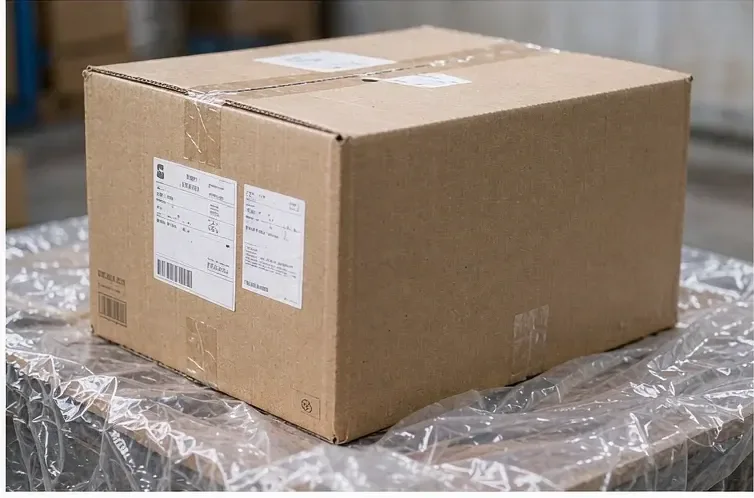
Three tests cover almost every transit mode, and each runs on the packed carton rather than on the contents. Drop testing under ISTA 1A applies 76 cm over ten drops to a carton up to 9.5 kg. Compression testing under ASTM D642 measures the load a carton takes before the walls buckle. Vibration testing reproduces the low-frequency input of a truck bed, which is what loosens fixings rather than breaking boards.
- Drop test the first packed carton of every new box size, not the first of the season.
- Condition cartons at 23 °C and 50% relative humidity before testing, or the figures will not repeat.
- Compression test after conditioning too, because moisture moves that number more than grade does.
- Vibration matters most for hardware; a fixing that survives the drop can still arrive loose.
- Photograph the failure rather than the pass; the failure names the layer to change.
Moisture, Heat and the Six-Week Container
Sea freight is the harshest environment a presentation box will ever meet, and it is the one most specifications ignore. A container crossing the equator holds around 40 °C and 90% relative humidity by day and drops sharply at night, so water condenses on the inside roof and runs down onto the top cartons. The trade calls it container rain, and it causes more carton staining than any handling fault.

Container rain
Condensation forms on the inside roof of the container when the night temperature drops and runs down onto the top cartons. A polythene liner over each pallet, sealed at the top rather than the base, is the reliable defence.
Desiccant loading
Silica gel is loaded at roughly 2 g per cubic foot of carton volume, calculated per pallet rather than per carton. It is spent once it has absorbed about a third of its own weight.
Adhesive creep
Hot-melt adhesive softens above roughly 50 °C. Cartons stacked against a container wall through a Gulf summer often open at the seam while the board itself is still sound.
Where Transit Specifications Are Usually Wrong
Four mistakes account for most of the transit damage we are asked to review, and every one of them is a specification error rather than a packing error. Each is listed with the line that prevents it, because the correction is always a number rather than an instruction to take more care.
- Clearance written as a gap rather than as an 8-12 mm tolerance, leaving the piece free to travel.
- Board bought on a printed grade name rather than on an ECT figure measured under TAPPI T 811.
- Dust bags chosen for colour rather than for breathability, sealing moisture against the leather.
- Hardware shipped unwrapped, so metal prints its outline into the panel within days at 40 °C.
Specify internal clearance as 8-12 mm on every face, held by void fill, and rate the shipper board at ECT 32. Those two figures remove the large majority of corner and crush claims without changing the box design at all.
Writing Transit Requirements Into the Packaging Spec
Transit requirements belong on the packaging drawing, alongside board grade and print specification, not in an email to the despatch team. Write them as a short block: shipper board 5-ply at ECT 32; internal clearance 8-12 mm on all faces held by void fill; drop tested at 76 cm over ten drops after conditioning; hardware wrapped before the dust bag; desiccant at 2 g per cubic foot.
Transit protection in one line
- Four layers, each with one job and one number: dust bag against abrasion, rigid box at 1200-1500 gsm, void fill holding 8-12 mm, shipper board at ECT 32.
Programme Figures and How Packaging Fits Them
Our programme runs through our validated partner factory Quanzhou Yingming Bags, an SGS-validated site with 7 production lines and roughly 200,000 pcs per month of capacity, holding export experience since 2014. Sampling takes 6-10 working days, or 12-15 on a complex build; bulk occupies 35-50 days; minimums sit at 500 pcs per style and colourway; and shipments leave FOB Xiamen with FOB, CIF and DDP terms all available.
Packaging is specified alongside the bag so the two arrive together rather than in two shipments. Inspection of both is drawn at AQL 2.5 under ISO 2859-1 and set out on the luxury quality control page; presentation, inserts and despatch are covered on luxury packaging.
Have transit protection specified before the run starts
Send the silhouette, hardware direction, quantity per colourway, delivery date and freight mode. You will receive a packaging specification naming board grade, clearance, test method and desiccant loading. Request a quote.
Frequently Asked Questions
How does luxury packaging protect bags in transit?
It separates the job into four layers. A dust bag stops abrasion, a rigid presentation box carries the compression load, void fill holds an 8-12 mm gap so no load reaches the leather, and an ECT 32 shipper carton absorbs the drop. Specify all four as numbers rather than as materials and the layers stop competing.
What drop test height should a bag shipper carton be tested to?
ISTA 1A sets 76 cm for a loaded carton up to 9.5 kg, applied over ten drops covering one face, one corner and three edges, then repeated. Condition the cartons at 23 °C and 50% relative humidity first, because dry board behaves very differently from board that has taken up moisture.
What board weight should a rigid presentation box use?
About 1200 gsm greyboard for a box under 300 mm on its longest edge, rising to 1500 gsm above that, giving roughly 1.5 mm and 2.0 mm of thickness. The reason is span: a long lid on thin board bows under its own weight long before anything is stacked on top of it.
How much clearance should sit between the presentation box and the carton?
Between 8 and 12 mm on every face, held by void fill rather than left to chance. Too little and the carton load passes straight through into the box; too much and the box travels inside the carton and bruises its own corners. The range is a tolerance to hold.
Should a dust bag be cotton or non-woven?
Cotton flannel, because it breathes. A paper-based non-woven traps the moisture the leather releases and holds it against the surface for six weeks in a container, which is how a bloom appears on a piece that was perfect at despatch. Cotton lets the same moisture reach the desiccant.
How much silica gel does a carton need?
Roughly 2 g per cubic foot of carton volume, calculated per pallet rather than per carton, and placed where air can reach it. Desiccant is spent once it has absorbed about a third of its own weight, so a container crossing the equator in summer needs more than the nominal figure.
What does ECT 32 mean on a shipper carton?
It is the edge crush test result, 32 pounds per inch, measured under TAPPI T 811 and used to predict how well a box resists stacking. Construction matters as much as the printed grade: a 5-ply sheet at ECT 32 will hold a six-week warehouse stack where a 3-ply sheet at the same rating will not.
Why do corners crush first on a stacked carton?
Because the four vertical corners carry most of the load in a column stack, and board loses strength fastest where it has been folded. Once one corner gives, the load shifts onto the neighbouring carton and the failure walks along the pallet. Corner posts and a column pattern stop the transfer.
How should hardware be protected inside the presentation box?
Wrap every metal part before the dust bag goes on, and check that no metal rests against leather. A turn-lock left bare will print its outline into a calfskin flap within a week at 40 °C, and the mark cannot be lifted afterwards. Acid-free tissue between the strap and the body does the rest.
What conditioning is required before a drop test?
Condition the cartons at 23 °C and 50% relative humidity under ISO 2233, then test. Board stored dry is brittle and fails at lower heights; board that has taken up moisture above about 14% loses roughly a third of its stacking strength. Testing unconditioned gives a number nobody can reproduce.
Can a rigid presentation box be shipped on its own?
No. A rigid box is designed to present, not to survive a parcel network. It needs a corrugated shipper rated for the weight, with 8-12 mm of clearance on every face and corner protection. The box takes the compression load from a stack of its own kind; the carton takes everything else.
What are the minimums and lead times for a custom presentation box?
Minimums sit at 500 pcs per style and colourway, matched to the bag run so the two arrive together. Sampling takes 6-10 working days, or 12-15 on a complex build with foil and a shaped insert, and bulk occupies 35-50 days. Shipments leave FOB Xiamen, with FOB, CIF and DDP terms all available.
People Also Ask
Why does transit damage show up first as corner wear?
Because a box travels inside its carton and meets it at the corners. The four corners take the first impact and the leather underneath takes the load, which is why an 8-12 mm held clearance prevents most of it.
How high should cartons of bags be stacked in a warehouse?
Five high is a workable ceiling for a column stack of handbag cartons at ECT 32. Beyond that the bottom carton carries enough load to creep, and board loses strength the longer it is held under compression.
Does vacuum packing protect leather in transit?
It protects against moisture but introduces a new fault: compression set. A structured body held under vacuum for six weeks can lose the shape it was blocked to, and the crease often does not fully recover.
What tape width seals a shipper carton properly?
48 mm BOPP with hot-melt adhesive. Narrower tape concentrates the peel force on a smaller area and lifts on the first corner impact, which is the most common reason a sealed carton arrives open at one end.
Should pallets of bag cartons be strapped as well as wrapped?
Yes. Stretch wrap holds the pallet together; strapping carries the load. Without straps the wrap stretches over a long crossing and the top layers begin to shift, which is how corner crushing starts.
Sources and further reading
Every figure on this page is either our own programme data or attributed below. Open the originals before you write them into a specification.
- International Safe Transit AssociationISTA Publisher of the ISTA 1A and 3A test sequences, including the 76 cm drop height applied to loaded cartons up to 9.5 kg.
- ASTM International standardsASTM International Source of ASTM D5276 for drop testing loaded containers and ASTM D642 for compressive resistance of shipping containers.
- ISO - International Organization for StandardizationISO Publisher of ISO 2233 on conditioning of packages for testing, referenced for 23 °C and 50% relative humidity, and ISO 2859-1 for AQL 2.5.
- Forest Stewardship CouncilFSC Chain-of-custody scheme for the paper and board used in rigid presentation boxes and outer shippers.