How Luxury Leather Handbags Are Inspected: Four Passes, Nine Checks and the Yield Number Behind Every Quote
How are luxury leather handbags inspected? In four passes: hide selection before cutting, shade and grain matching at the cutting table, checks at the bench during assembly, and a final random sample at AQL 2.5 under ISO 2859-1. On a 500-piece run the final pass draws 50 pieces with an accept number of 3 and a reject number of 4, and critical faults — a closure that will not fasten, a sharp edge, a needle left in the construction — are held at zero regardless. Each piece is turned and examined at about 30 cm for surface faults and roughly 1 m for silhouette.

The Four Passes, and What Each One Costs
Leather is inspected in four passes, not one: selection before cutting, matching at the cutting table, checks at the bench, and a final lot count — and each pass catches faults the pass after it can no longer fix.
The costs move in one direction only. A hide rejected at selection costs the price of the hide. The same fault found at the bench costs the cutting, the skiving and the assembly labour already spent on it. Found in a finished lot, it costs the finished piece, the re-inspection and several weeks of the calendar.
That is the whole argument for inspecting early. Catching a fault at pass one costs a small fraction of catching it at pass four, and the only pass most brands insist on is the last one — the one where every hour already spent on the piece is unrecoverable.
| Pass | When | What is examined | Cost of a catch |
|---|---|---|---|
| 1. Hide selection | Before cutting | Grain, scars, loose areas, substance | The hide only |
| 2. Cutting and matching | At spreading and cutting | Shade, grain direction, panel placement | Cutting and skiving already spent |
| 3. Bench checks | During assembly | Skiving thickness, edge finish, stitch tension | Assembly labour on the piece |
| 4. Final lot inspection | After packing | The nine checks, at AQL 2.5 | The finished piece and the delivery window |
One number governs the material cost of everything downstream: a full-grain bovine hide typically yields 55-65 percent usable cutting area once scars, branding marks and the belly are set aside. Quoting a price without that yield figure is quoting a number that will not survive the season.
Pass One: Hide Selection and the Yield Number
Selection is the pass where leather is judged as a material rather than as a part: grain character, substance, temper and the natural marks that will or will not be acceptable on a finished panel.
An inspector sorts a hide into zones. The butt carries the tightest grain and takes a finish most evenly; the shoulder is sound but looser; the belly is loose and stretchy; and a neck wrinkle is permanent and will not press out. Which zone a panel is cut from is a design decision recorded on the specification, not a choice left to whoever reaches the hide first.
- Butt: tightest grain, highest cutting value, the default for a structured front panel.
- Shoulder: sound but looser, workable on a gusset or a base where load is lower.
- Belly: loose and stretchy, used for linings, facings and hidden reinforcement.
- Neck and flank: natural wrinkles that will not press out and are cut around.
On a structured bag of roughly 30 by 22 by 11 cm, a programme commonly consumes 4-5 hides per 100 finished pieces once nesting and rejection are counted. That ratio is what turns a price per square foot into a price per bag, and it is the line most often missing from a quotation.
Pass Two: Shade, Grain and the Sealed Reference
Shade is where most leather disputes are born, because it is a sensory judgement made under whatever light happens to be available at the time.
The fix is a sealed reference and a stated light. A counter sample approved at the development stage is sealed and retained; it is opened for comparison and for nothing else. The comparison happens in a light booth at D65, and the accepted departure from the reference is recorded as a grey scale rating rather than as an opinion.
- Light source for comparison
- D65, the daylight standard used across the leather trade
- Grey scale rating required
- 4 or better under ISO 105-A02 for a visual shade comparison
- Instrumental alternative
- Colour difference recorded as delta E, with 1.0 a common working limit for matched panels
- Reference retained
- The sealed counter sample approved at development, opened only for comparison
- Viewing distance for grain
- Around 30 cm, with the piece turned rather than laid flat
Two panels that match in the booth can still disagree on the finished piece, because a shade that reads correctly on a flat panel reads differently once the panel is turned, folded and burnished. Matching is therefore verified on the assembled piece as well as on the cutting table.
Pass Three: In-Process Checks at the Bench
Three operations account for most of the leather faults that reach final inspection: skiving, edge finishing and stitch tension.
Skiving thins the leather where panels overlap so the join does not bulk. Skived too thin, the fold splits under load; skived too little, the join reads as a ridge under the hand. A working tolerance on a skived edge is around 0.6-0.8 mm, and it is checked by gauge rather than by eye.
Edge finishing is the most visible hand operation on the piece and the one a customer notices first. Four coats, sanded between each, is a common specification on a premium edge; three rushed coats produces a ridge that cracks at a fold inside a season.
Stitch tension is judged on the finished seam. Too loose and the seam grins when the bag is loaded; too tight and the leather puckers along the line. Between 7 and 9 stitches per 2.5 cm is a common range for a visible seam on a structured bag, and the number belongs in the specification rather than in a machinist's judgement.
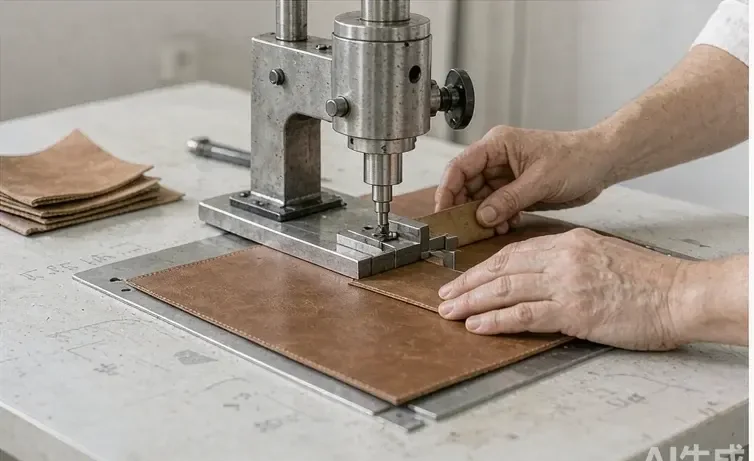
Finish Testing: Rub, Light and Water
Finish is tested on the panel before it is tested on the piece, and three tests do most of the work: rub fastness, light fastness and water response.
Rub fastness under ISO 11644 is assessed dry, wet and with an artificial perspiration solution, and the change is recorded on the grey scale. A rating of 4 after 500 dry rubs is a reasonable working expectation for a premium semi-aniline finish; a pigment finish will generally rate higher and a pure aniline lower, which is a trade-off rather than a defect.
Light fastness under ISO 105-B02 is reported on the blue wool scale, where a rating of 4 is a common expectation for a fashion shade. A deep saturated colour on an aniline base will often sit lower, which is one of the reasons a colour that looks perfect on a cutting sample behaves differently on a shop floor in strong light.
- Rub fastness: ISO 11644, dry, wet and perspiration, recorded on the grey scale.
- Light fastness: ISO 105-B02, reported on the blue wool scale.
- Water response: observed on the finished panel, not on a swatch, because a finish behaves differently on a curved surface.
- Flexing endurance: ISO 5402, for a finish expected to survive repeated folding in use.
Pass Four: Final Lot Inspection at AQL 2.5
The final pass is a statistical count, not an examination of every piece: inspectors draw a random sample from finished, packed goods and accept or reject the lot against numbers agreed in advance.
On a 500-piece lot at General Inspection Level II under ISO 2859-1, the sample is 50 pieces, the accept number is 3 and the reject number is 4. Critical faults are held at zero, so one closure that will not fasten rejects the lot whatever the agreed AQL for major faults says.
The sample must be drawn at random. A sample handed over by anyone with an interest in the outcome carries no statistical meaning at all, and a presented sample is the most common way a final inspection is quietly defeated.
The Nine Checks Every Finished Bag Passes
These nine are the practical core of a leather inspection. Written into the plan as a defect library, they remove most of the discretion from the count.
| # | Check | Method | Class if failed |
|---|---|---|---|
| 1 | Grain and scars | Turned at 30 cm against the sealed reference | Major |
| 2 | Shade match | D65 booth, grey scale 4 or better | Major |
| 3 | Hand and temper | Compared against the approval sample by feel | Major |
| 4 | Skived edges | Gauge against the stated tolerance | Minor |
| 5 | Edge finish | Four coats, sanded, no ridge or crack | Major |
| 6 | Stitch line | 7-9 per 2.5 cm, no skipped or grinning seam | Major |
| 7 | Symmetry | Handle and panel alignment within 2 mm | Major |
| 8 | Interior and lining | Examined under a lamp, no adhesive residue | Minor |
| 9 | Odour | Detected at arm's length after airing | Major |
Each check needs two things to be enforceable: a method anyone can repeat and a class that decides whether the fault counts. Nine checks without those two columns are nine arguments, and they will be had at the worst possible moment — with a shipment waiting.
Hand Feel, Odour and the Tests No Camera Can Take
Three properties decide whether a leather bag feels expensive, and none of them can be verified from a photograph: temper, hand and smell.
Temper
Judged by feel against the approval sample. A piece can match for shade and grain and still feel wrong; temper is the property a customer registers in the first second of picking the bag up, and it is the one nobody photographs.
Hand
The finish under the palm: waxy, dry, oily or powdery. It is set by the finish recipe and the milling, and it drifts when either is shortened to save time on the bench.
Smell
Assessed at arm's length after the piece has aired. A persistent smell is a material fault rather than a packing fault, and it is answered at the tannery, not at the bench.
Because these are sensory, they need a protocol like any other check: a named reference, a named distance, and a named interval after airing. Without those three, the most subjective check on the list becomes the least defensible one.
What a Failed Lot Costs, Line by Line
A rejected lot is not a rounding error, and the arithmetic is worth setting out before the clause is signed.
Reworking one closure on a returned piece costs around USD 4.80 in parts and bench time before any freight is counted. A lot that has to be re-presented costs the rework, the re-inspection and the calendar: on a 35-50 day bulk programme a re-present commonly takes three to four weeks, and a delivery window does not move to accommodate it.
The comparison most people make is the wrong one. A price concession argued after shipment feels cheaper than an inspection agreed before it, and it is not — the concession buys the same faults arriving in the next lot as well, and it buys them at a time when nothing can be reworked.
On our programme, export experience runs since 2014 across 7 production lines with about 200,000 pcs per month of capacity, delivered through our validated partner factory Quanzhou Yingming Bags, an SGS-validated site, and inspection at AQL 2.5 is agreed in writing before bulk begins.
Writing the Leather Clause Before Bulk Starts
A leather clause is seven lines long and takes about an hour to agree: yield, shade method, finish tests, the nine checks, the AQL, who counts and what happens on rejection.
The seven lines to agree
- Yield and substance: usable cutting area and thickness in millimetres, with a tolerance.
- Shade: D65 comparison, grey scale 4 or better, or a delta E limit recorded in writing.
- Finish: rub, light and water responses stated as the tests they must pass.
- Checks: the nine, each with a method and a class attached.
- AQL: 2.5 for major faults, looser for minor, zero for critical.
- Counter: named in advance — in-house, third-party or joint at the bench.
- Rejection: rework and re-present, or a documented concession, agreed before it is needed.
Against that clause, the rest of the programme is unchanged: MOQ 500 pcs per style and colourway, sampling in 6-10 working days and 12-15 for complex constructions, bulk in 35-50 days, and handover on FOB Xiamen terms.
Two documents sit beside the clause and are not the same thing as it: a material declaration from the tannery for chemical restrictions, and a packing specification for presentation. Neither is answered by counting faults in a sample, and a programme that relies on the sample for both will eventually be surprised.
Agree the leather clause before the hides are cut
Send us the style, the quantity and the markets and we will return the yield assumption, the nine checks and the inspection clause, in writing, before cutting begins. Request a quote.
Frequently Asked Questions
How are luxury leather handbags inspected?
In four passes: hide selection before cutting, shade and grain matching at the cutting table, checks at the bench during assembly, and a final random sample at AQL 2.5 under ISO 2859-1. The earlier passes catch faults the later ones can no longer fix, and each pass costs more to fail than the one before it.
What is a good usable yield from a full-grain hide?
Usually 55-65 percent once scars, branding marks and the belly are set aside, with the remainder going to facings, linings and hidden reinforcement or lost. Yield is the number that turns a price per hide into a price per bag, so it belongs in the clause rather than in an assumption.
Which part of a hide is best for a structured panel?
The butt, which carries the tightest grain and takes a finish most evenly. The shoulder is sound but looser and suits a gusset or a base; the belly is loose and stretchy and is used for linings and hidden reinforcement. Neck wrinkles are permanent and are cut around rather than pressed out.
How is leather shade checked?
Against a sealed counter sample in a light booth at D65, with the accepted departure recorded as a grey scale rating of 4 or better under ISO 105-A02. An instrumental reading of delta E can stand beside it, with 1.0 a common working limit for panels that must match on the finished piece.
What is ISO 11644?
The rub fastness test for leather: a felt pad is rubbed over the finish dry, wet and with an artificial perspiration solution, and the change is assessed on the grey scale. A rating of 4 after 500 dry rubs is a reasonable expectation for a premium semi-aniline finish.
How many stitches should a leather seam have?
Between 7 and 9 per 2.5 cm is a common range for a visible seam on a structured bag, and the figure belongs in the specification rather than in a machinist's judgement. Too few stitches and the seam grins under load; too many and the leather is perforated along the line.
What thickness should a skived edge be?
Around 0.6-0.8 mm on a panel that will be folded or turned, checked by gauge rather than by eye. Skived too thin, the fold splits under load; skived too little, the join reads as a ridge. The tolerance is one line in the clause and it removes an argument that otherwise recurs every season.
How is edge finishing specified?
By the number of coats and by what happens between them: four coats, sanded between each, is a common specification on a premium edge. Three rushed coats produces a ridge that cracks at a fold within a season, and the difference is invisible in a photograph and obvious in the hand.
What are the nine checks on a finished leather bag?
Grain and scars, shade match, hand and temper, skived edges, edge finish, stitch line, symmetry, interior and lining, and odour. Each one needs a method attached — a distance, a light, a gauge or a reference — or it is an opinion rather than a check, and opinions are where disputes start.
Why does the inspection sample have to be drawn at random?
Because the arithmetic of ISO 2859-1 only holds if every piece had an equal chance of being drawn. A sample selected by anyone with an interest in the outcome carries no statistical meaning at all, and a presented sample is the most common way a final inspection is quietly defeated.
What does leather inspection not cover?
Chemical compliance, durability over time, packing and consistency between lots. The first is answered by a declaration from the tannery, the second by cycling and load testing, the third by a packing specification, and the fourth by a fresh plan and a fresh reference for every delivery.
What happens when a lot fails inspection?
The clause agreed beforehand decides: rework and re-present, or a documented concession. Reworking one closure on a returned piece costs around USD 4.80 in parts and bench time before freight, and a re-present on a 35-50 day programme commonly costs three to four weeks of the calendar.
People Also Ask
What is the first pass in leather inspection?
Hide selection, before any cutting begins. Grain, scars, loose areas and substance are judged on the whole hide and the usable yield is recorded. It is the least costly pass to fail, because the only thing lost at that point is the hide itself.
Why must leather shade be checked under D65?
Because a colour that matches under warm shop lighting can read differently under daylight, and most returns are made under daylight. The booth removes the variable and the sealed reference removes the opinion.
Can natural marks be accepted on a premium bag?
Yes, if the specification says so. A healed scar or a natural grain break is a character mark on a full-grain hide, and it is either designed in or rejected at selection. What cannot be accepted is an unstated one discovered after the piece is finished.
How long does leather inspection take?
Around 3-6 minutes per structured piece at final inspection, against well under a minute for a flat garment, because every closure is cycled and the piece is turned rather than laid flat. A 50-piece sample therefore occupies several hours, not an afternoon.
Does AQL 2.5 apply to leather faults?
It applies to the count of faults in the sample, whatever they are. Leather faults such as shade departure, scarring and grain mismatch are classified first — critical, major or minor — and the class then decides whether they count against the AQL at all.
Sources and further reading
Every figure on this page is either our own programme data or attributed below. Open the originals before you write them into a specification.
- ISO — International Organization for StandardizationISO Publisher of ISO 2859-1 sampling, ISO 11644 rub fastness, ISO 105-A02 grey scale and ISO 105-B02 light fastness.
- Leather Working GroupLeather Working Group Tannery audit protocol behind the material declarations that sit alongside, rather than inside, a final inspection.
- SATRASATRA Technology Centre Independent testing body for leather and footwear, and a reference for physical test method practice in the leather trade.
- Sourcing JournalSourcing Journal Reporting on inspection practice, material yields and quality disputes across the accessories trade.
- FashionUnitedFashionUnited Industry data on rework, returns and the commercial consequences of rejected lots in leather goods.