How a Luxury Handbag OEM Manages Exotic Skins: Permits, Cutting Rules and Finish Standards
Exotic skin handbags are documents before they are leather. A crocodile, alligator, ostrich or python programme can only start once three things are approved together: the CITES document chain, the skin grade, and the cutting plan. At our atelier the permit file is opened before any skin is booked, because re-export paperwork takes 4-6 weeks and no cutting room can win that time back. Grading then fixes the layout: centre-front panels come from the belly, scales are tiled to match within 1.5 mm across the seam, and usable yield is planned at 1.6-2.2 sq ft per belly panel. Finish is held to ISO 11644 adhesion of 4 N per 10 mm, then released under AQL 2.5 inspection.
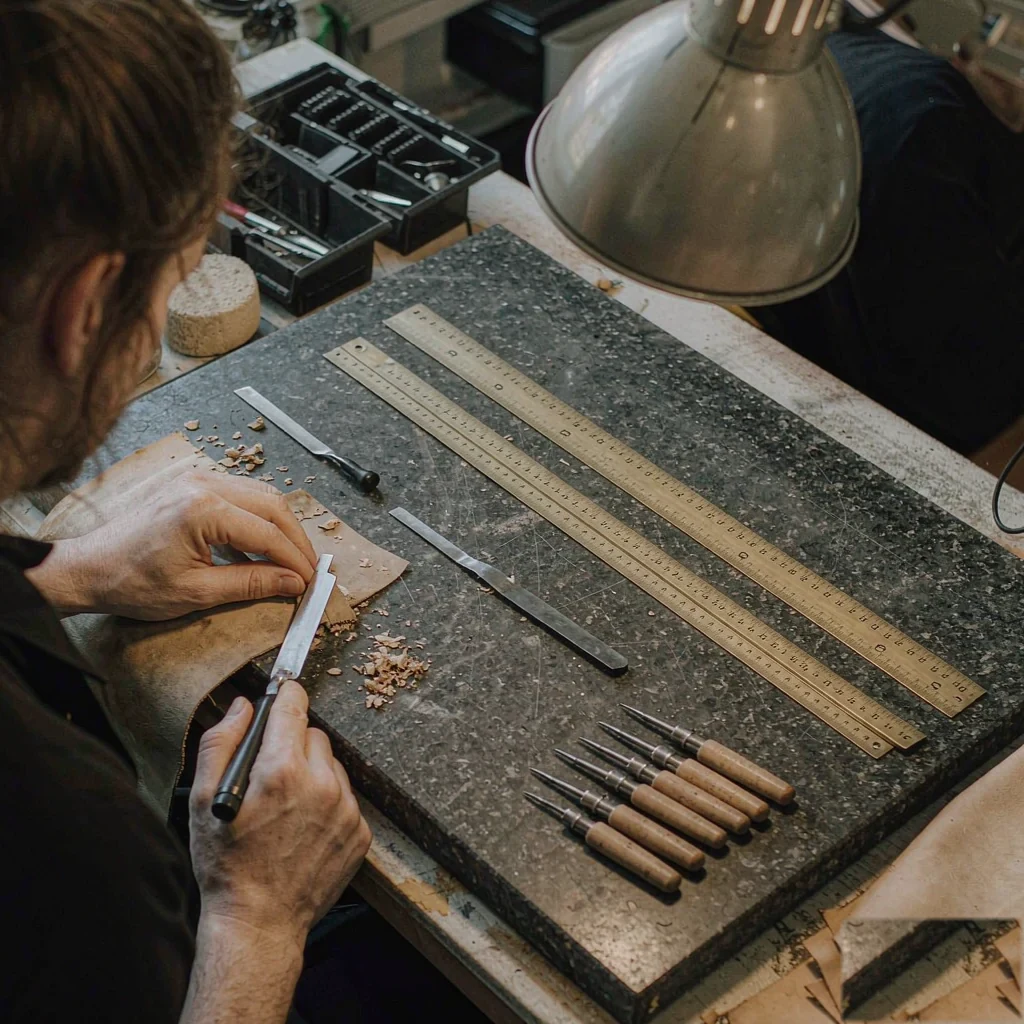
What Counts as an Exotic Skin in a Luxury Programme
An exotic skin in a luxury handbag programme is any hide that travels with international trade documentation attached, not simply any unusual texture. That definition matters because it decides who signs the file. Crocodilians, pythons and monitor lizards sit on CITES Appendix I, II or III depending on species and country of origin, and every shipment needs the matching permit. Ostrich is treated differently: it is farmed under national veterinary control in most producing countries rather than being held to a CITES quota, but the tannery still issues a traceability record that our team files alongside the cutting ticket.
The practical consequence is that a skin choice is a legal choice long before it is a colour choice. A brand that asks for Nile crocodile from one country may be buying an Appendix II ranching specimen with a quota, while the same species sourced across a border is Appendix I and needs both export and import permits before the crate moves. Our intake team therefore asks for species, country of origin and appendage type in the first email, not the third. Without those three answers, no quotation is realistic, because the document path can change the landed cost and the calendar by weeks.
- Crocodilians: Nile crocodile (Crocodylus niloticus), Siamese crocodile (C. siamensis) and saltwater crocodile (C. porosus) carry different appendix listings by country, so the origin certificate governs the file.
- American alligator (Alligator mississippiensis) is generally traded under Appendix II with ranch or harvest state oversight and a United States export permit issued by the Fish and Wildlife Service.
- Reticulated python (Python reticulatus) is listed on Appendix II and is usually bought as tanned skins with a quota reference from the country of export.
- Monitor lizards (Varanus spp.) include Appendix I species that should be treated as non-runnable for commercial handbag work unless the paperwork is already in hand.
- Ostrich is normally sourced as farmed leather with veterinary and tannery traceability records rather than CITES permits, which shortens the document path considerably.
The Permit File Opens Before the Leather Is Booked
Open the permit file before you book the leather, because the documents move slower than the cutting room ever will. In practice this means the CITES re-export permit, the origin certificate and the tannery traceability record are requested in the same week as the first tech pack draft, while the specimen is still being graded at the tannery. Our experience across exotic programmes is that permit issuance alone runs 4-6 weeks, and any brand that orders the skins first and asks about documents afterwards loses that window twice: once waiting for the paperwork, and again if the permit is refused and the skins have to be re-sourced.
Document order that never changes
- Species and country of origin are confirmed first, then the CITES export or re-export permit is requested, then the tannery traceability record is matched to the permit number, and only then is the skin released to the cutting room. Reverse that order and the crate sits in customs while the production calendar slips, which is the single most common cause of a missed exotic launch date.
Skin Grading: Tiling, Symmetry and Centre Lines
Skin grading decides layout, and layout decides how many bags a crate actually yields. A crocodile hide is not a uniform sheet: the square tiles of the belly are the most valuable area, the flank tiles become irregular and the hornback ridge is usually reserved for frames, handles or a back panel. Buyers who plan a layout on average hide size routinely over-estimate output, because the centre rows that a top-handle bag needs are a minority of the skin. The honest planning number is usable belly area, not total skin area.
Once the grade is fixed, layout is drawn around the centre line of the bag. For a structured top-handle silhouette, our pattern team reserves the two cleanest tile rows either side of the belly centre and mirrors them across the front seam, holding the match within 1.5 mm. That tolerance is what separates a bag that reads as symmetrical on a shelf from one that reads as two different skins sewn together. It also consumes a further share of the skin, which is why we quote a falling yield range rather than a single figure, and why the landing price of an exotic piece is negotiated after grading rather than before it.
| Skin area | Typical use | Planning yield | Note for the brand |
|---|---|---|---|
| Belly, centre rows | Front panel, flap, top of the frame | 1.6-2.2 sq ft usable per panel | This is the area that gates how many bags the crate can yield. |
| Belly, outer rows | Gussets, back panel, strap faces | 1.1-1.5 sq ft usable | Reads slightly coarser; fine on the sides of a structured bag. |
| Flank | Interior facings, strap linings, small leather goods | 0.8-1.2 sq ft usable | Irregular tile edges; needs a skiving plan before it is cut. |
| Hornback ridge | Handle tops, frame caps, trim | 0.4-0.7 sq ft usable | Very hard-wearing but stiff; needs a skilled hand at the bench. |
| Tail and offcuts | Zip pulls, tabs, hangtags | Under 0.3 sq ft | Useful for presentation accessories and for sampling. |
| Rejects | Returned to the tannery credit note | 0 | Scarred or damaged goods are logged, photographed and sent back. |
Cutting Rules That Protect Yield and Pattern Match
Cut an exotic panel once, because there is no second attempt. Unlike calfskin, a graded crocodile or ostrich panel cannot be re-cut from a fresh area of the same hide if the first attempt is wrong; the tile pattern will not line up and the piece is finished as waste. For that reason our cutting room works from a drawn layout that is approved on paper by the brand before any blade touches the skin, and every panel is cut with a template that has been checked against that same drawing.
- Approve the layout drawing in writing before cutting, including the position of the centre line on every panel.
- Cut with the grain of the tiles running the same direction on the front, flap and back of the bag so the light catches all three surfaces alike.
- Keep the mirror pair from adjacent tile rows; a pair taken from non-adjacent rows will differ in scale size and will be visible at arm's length.
- Skive all joins to 0.7-0.9 mm before bonding; exotic skins are thicker at the tile edges and a full-thickness join leaves a ridge under the lining.
- Log every offcut on the cutting ticket so trim pieces for handles, tabs and zip pulls are found from the same crate instead of being bought later.
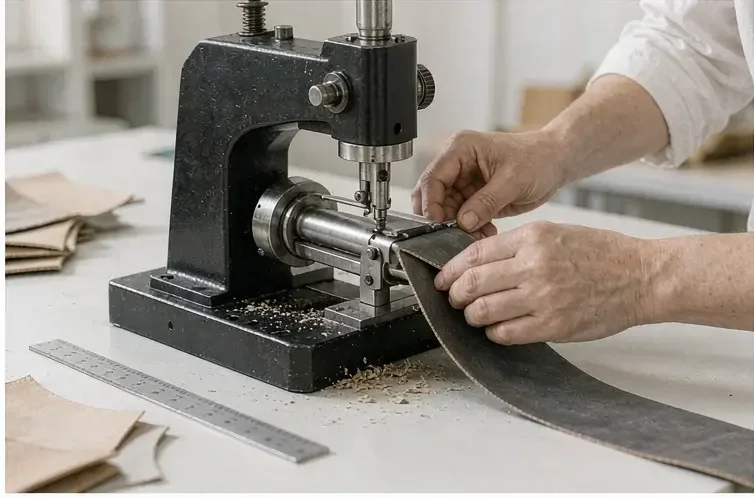
Finishing, Backing and Edge Discipline
Exotic skins fail at the edges and at the finish, not in the middle of the panel. A crocodile tile surface is extremely hard-wearing, but the finish that gives it gloss is a coating, and a coating can lift. Our finish specification is therefore written around ISO 11644, the standard for finish adhesion on leather, with an acceptance of 4 N per 10 mm; anything under that is returned to the tannery rather than being pushed into bulk. Tensile strength is checked to ISO 3376 at 12 N/mm², which is the number that tells you whether a thin-skived join will hold under load.
Backing before skiving
Exotic skins are backed with a 0.4 mm woven interlining before they are skived, so the tile edge has something to sit on instead of a thin, brittle glue line.
Three coats on the edge
Edge paint is applied in 3 coats with sanding between each, finishing at 0.9 mm total edge thickness so the edge reads as a single line rather than a stack.
Storage at stable humidity
Finished pieces rest at 45-55% relative humidity and 18-22 degrees Celsius, because dry air lifts a gloss finish and cracks the membrane between tiles.
Hardware, Adhesives and Lining Choices
Hardware and adhesive choice change how an exotic bag ages, and the wrong pairing shows up as a stain that cannot be removed. Brass turn-locks and feet are lacquer-sealed on exotic work, because raw brass against a gloss finish leaves a green transfer line within a season; the plating specification we hold is 0.15-0.3 micrometres of protective lacquer over 0.2 micrometres of palladium. Adhesive is a water-based contact cement rather than a solvent-based one, selected both for REACH Annex XVII compliance and because solvent carriers can bloom through a polished tile surface.
- Finish adhesion
- 4 N per 10 mm, ISO 11644
- Tensile strength
- 12 N/mm2, ISO 3376
- Skiving thickness at joins
- 0.7-0.9 mm
- Edge finish
- 3 coats, final 0.9 mm
- Hardware plating
- 0.2 micrometres palladium plus 0.15-0.3 micrometres lacquer
- Storage conditions
- 45-55% relative humidity, 18-22 degrees Celsius
- Inspection level
- AQL 2.5, ISO 2859-1
The 9-Point Exotic Skin Intake Checklist
- Confirm species, country of origin and appendage type in writing before any costing is done.
- Request the CITES export or re-export permit and confirm the expected issuance window of 4-6 weeks.
- Match the tannery traceability record to the permit number and file both against the purchase order.
- Grade the crate into belly centre, belly outer, flank, hornback and offcut before quoting a yield.
- Approve the layout drawing with the centre line marked on every structural panel.
- Confirm that the mirror pair for a front panel comes from adjacent tile rows.
- Verify finish adhesion to ISO 11644 and tensile to ISO 3376 on a cut sample, not on a swatch card.
- Fix the hardware plating and adhesive system, then run a 24-hour contact test against the finished surface.
- Book the third-party inspection at AQL 2.5 before packing, and require the document pack to travel with the cartons.
Documents You Should Receive With Every Shipment
A luxury exotic shipment is incomplete without its paper trail, because the documents are what let your own customs broker, your retail partners and your e-commerce compliance team move the goods afterwards. Our standard handover at packing is a single PDF pack that mirrors the carton labels, so a buyer in Europe can clear goods under Council Regulation (EC) No 338/97 conditions and a buyer in the United States can satisfy Fish and Wildlife Service requirements without going back to us for a second email.
- CITES re-export or export permit, scanned and matched to the carton list.
- Tannery traceability record with the permit number recorded on it.
- Inspection report at AQL 2.5 with the inspector's name and the sampling plan used.
- Leather test summary covering ISO 11644 adhesion, ISO 3376 tensile and ISO 105 colour fastness.
- Packing list with the carton number, the style number and the colourway reference on every sheet.
Where Exotic Skins Sit in the Sampling Window
Exotic sampling takes longer than calfskin sampling, and the calendar should be built around that from the first meeting. A standard development sample runs 6-10 working days; an exotic piece with a graded layout, a mirror pair and a hand-glazed edge runs 12-15 working days, and that clock only starts after the specimen and the permit reference are both in the building. Bulk then follows in 35-50 days, and the crate is planned against a 500 pcs per style and colourway minimum that is set by how many graded panels a reasonable skin purchase can cover.
Add the 4-6 week permit window to the 12-15 working day sampling window before you promise a launch date. Brands that count only the bench time routinely land two months late on their first exotic season.
Planning an exotic skin drop?
Send the species, the silhouette and the target season. We will confirm the document path, the graded yield and the sampling window before you commit to a purchase. Reach the programme team at contact-quote.
Frequently Asked Questions
Which exotic skins can a luxury handbag programme actually run?
Crocodilians, pythons and most monitor lizards are the practical commercial group, and each is governed by its CITES appendix listing and country of origin. Ostrich runs under farm and tannery traceability rather than a CITES quota, which makes it the fastest document path. Appendix I species should be treated as non-runnable unless the permits are already issued.
How long does CITES paperwork take for a crocodile handbag order?
Plan 4-6 weeks for re-export permit issuance, and request it before the skins are booked rather than after. If a permit is refused, the crate has to be re-sourced, which adds the same window again. Building the permit window into the calendar at the first meeting is the least costly insurance available on an exotic launch.
Why is usable yield quoted as a range instead of one number?
Because a crocodile hide is not uniform. The clean square tiles of the belly centre are a minority of the skin, and a front panel needs those tiles. Grading sorts the crate into centre, outer, flank and hornback, and only after that is a real yield known, so a single average figure would be misleading.
What tolerance should a mirror-matched crocodile front panel meet?
We hold scale alignment to within 1.5 mm across the centre-front seam and take the mirror pair from adjacent tile rows. Pairs cut from non-adjacent rows differ in scale size, and that difference is visible at arm's length on a shop floor. The tolerance is written into the approved layout drawing before any cutting begins.
How thick should exotic joins be skived?
Skive to 0.7-0.9 mm before bonding. Exotic skins are thicker at the tile edges than between them, and a full-thickness join leaves a ridge that prints through the lining and the outer surface. Backing with a 0.4 mm woven interlining first gives the skived edge something to sit on.
Which standards cover exotic leather finish and strength?
Finish adhesion is measured to ISO 11644, with our acceptance at 4 N per 10 mm, and tensile strength to ISO 3376 at 12 N/mm2. Colour fastness is checked to ISO 105. These are run on a cut sample from the actual crate, not on a swatch card, because the finish can behave differently across a graded hide.
Do exotic handbags need different hardware than calfskin ones?
Yes. Raw brass transfers onto a gloss finish, so exotic work uses lacquer-sealed hardware: 0.2 micrometres of palladium under 0.15-0.3 micrometres of protective lacquer. Adhesive is water-based contact cement rather than solvent-based, both for REACH Annex XVII compliance and to avoid solvent bloom under a polished tile surface.
How much longer does exotic sampling take than calfskin sampling?
A standard development sample runs 6-10 working days. An exotic piece with a graded layout, a mirror pair and a hand-glazed edge runs 12-15 working days, and the clock starts only when the specimen and the permit reference are both in the building. Bulk follows in 35-50 days.
What is the minimum order for an exotic skin style?
The minimum is 500 pcs per style and colourway, set by how many graded panels a reasonable skin purchase can cover. Because usable belly area is limited, the minimum is reached per colourway rather than across a mixed run, so a two-colour exotic drop is planned as two separate bookings.
What documents should arrive with an exotic handbag shipment?
The pack should contain the CITES re-export or export permit, the tannery traceability record carrying the permit number, the AQL 2.5 inspection report, a leather test summary covering ISO 11644 and ISO 3376, and a packing list with carton, style and colourway references. It should travel as one PDF matched to the carton labels.
Can an exotic panel be re-cut if the first attempt is wrong?
No. A graded exotic panel cannot be re-cut from a fresh area of the same hide because the tile pattern will not line up, and the piece ends as waste. That is why the layout drawing is approved in writing by the brand before the first blade touches the skin.
How should finished exotic bags be stored?
Store at 45-55% relative humidity and 18-22 degrees Celsius. Dry air lifts a gloss finish and cracks the membrane between tiles; damp air risks mould in the backing. Warehouses in very dry winter climates should be humidified for exotic stock. Keep pieces away from direct light, which fades a gloss finish faster than it fades a matte one.
People Also Ask
Is crocodile leather legal to use in handbags?
Yes, when the specimen is traded with the correct CITES permits for its species and country of origin. Ranching operations supply most commercial crocodilian skins under Appendix II. The brand's obligation is to hold the document chain and to pass it on with each shipment.
Why is crocodile leather so expensive?
Usable area is the constraint. Only the square tiles of the belly centre suit a front panel, and that is a minority of the hide, so the cost is spread across a small yield. Grading, mirror matching and hand glazing add bench time on top.
What is the difference between alligator and crocodile leather?
Alligator has a smoother, more uniform tile pattern and lacks the small sensory pits visible on crocodile scales. Alligator hides are also generally smaller, so a single panel layout is harder to achieve on a large structured silhouette.
How do I check a CITES permit is genuine?
Match the permit number to the tannery traceability record and to the packing list, and confirm the species, country of origin and specimen count. Your customs broker can validate the document against the issuing authority before the crate is collected.
Do exotic bags need special care in retail storage?
Yes. Keep them at 45-55% relative humidity, away from direct light and heat, and never hang a structured exotic piece by its handles. Gloss finishes mark under sustained pressure, so store with tissue support.
Sources and further reading
Every figure on this page is either our own programme data or attributed below. Open the originals before you write them into a specification.
- CITES Appendices I, II and IIICITES Secretariat The listing that decides which species, populations and countries can be traded and under which permit.
- Leather Working GroupLeather Working Group Leather sourcing and tannery environmental audit protocol referenced for exotic and bovine tanneries.
- U.S. Fish and Wildlife ServiceUnited States Fish and Wildlife Service Issues United States export permits under the Endangered Species Act for alligator and other listed species.
- EUR-Lex access to European Union lawEUR-Lex Source for Council Regulation (EC) No 338/97 on the protection of species of wild fauna and flora.