How Designer Handbag Production Preserves Craft: Nine Operations, Kept Alive on the Bench
How does designer handbag production preserve craft? By keeping nine named operations on the bench rather than designing them out: lot selection, grain direction, hand clicking, skiving to 8-10 mm at 45 degrees, interlining at 0.8 mm, turning, stitching at 8-9 per inch, three-coat edge finishing and a final read against the approved reference. Each is specified in writing before sampling, which is what allows a technique to survive repetition.

A Paris Maison and a Discontinued Frame Bag
A Paris maison arrived with a frame bag discontinued two decades earlier and a single question: could the hand-turned edge on the original be held across 500 pieces without the seam creeping? The archive piece was available, the pattern had been lost, and the technique existed only in the hands of two artisans.
The answer turned out to depend less on skill than on specification. The turned edge could be held, but only if four things were written down first: the skiving bevel at 45 degrees across 8-10 mm, the interlining at 0.8 mm on the gusset, the turning allowance at 3-4 mm, and the relaxation period before edge work began.
That is the pattern in most craft recovery work. The technique is rarely the constraint; the constraint is that nobody recorded the numbers that made it repeatable. Once they were on paper, the run behaved. The first sample came back with the turn holding and the seam flat, and the second round corrected two items: the turning allowance was trimmed from 5 mm to 4 mm, and the interlining was extended across the full base rather than stopping short of the gusset. Two rounds, twelve working days, and the piece was signed — which is the point. The craft survived repetition because it had first been written down as numbers, and the reorder two seasons later matched without a new development cycle.
The Nine Operations That Carry the Craft
Nine operations carry most of what a customer recognises as craft in a designer handbag. Each one can be specified, timed and inspected, which is what distinguishes a technique from a description of one.
| Operation | What is specified | Where it is checked |
|---|---|---|
| Lot selection | Tannery, lot reference, thickness, finish | Material intake before cutting |
| Grain direction | Arrow marked on every panel of the marker | Cutting inspection |
| Hand clicking | Panel placement clear of scars on visible faces | Cutting bench |
| Skiving | 8-10 mm width at 45 degrees, to ±0.15 mm | Preparation bench |
| Interlining | 0.8 mm on base and every handle join, bonded before assembly | Preparation bench |
| Turning | Turning allowance 3-4 mm, shaped wet | Assembly bench |
| Stitching | 8-9 per inch, bonded nylon #69 on body seams | Assembly bench and final inspection |
| Edge finishing | Three coats at 0.08-0.12 mm wet, 8-10 min flash | Edge finishing bench |
| Final read | Against the approved reference, AQL 2.5, ISO 2859-1 | Final inspection and archive set |
Naming them also settles the order in which they can be changed. Lot selection and grade placement are fixed early and rarely revisited; skiving, stitching and edge work are the three that get discussed when a calendar tightens, and only the first of those can be altered without the customer noticing.
The value of naming them is that each becomes inspectable. A lot can be verified, a bevel can be measured, a stitch count can be taken, and a coat thickness can be recorded. Unnamed, all four are a matter of opinion.
The other value is that the list shows where the minutes go. Of roughly 2.5 hours of bench time on a structured body, the majority sits in the last four operations, which is exactly where a volume programme looks first when it needs to save time.
Skiving and the 45 Degree Bevel
Skiving thins the edge of a panel so two thicknesses meet without a step, and it is hand-guided work. On a designer body the specification is an 8-10 mm width at a 45 degree bevel, held to ±0.15 mm, applied to every edge that will be folded, turned or joined.
- A consistent bevel is what makes a turned edge lie flat rather than ripple after a week.
- Skiving to ±0.15 mm is the tolerance that separates an atelier seam from a volume seam.
- Every skived edge is a discrete operation, counted before assembly even begins.
- Skiving is also where a hide can be lost: too deep a cut and the panel is scrap.
For the Paris frame bag this was the operation that decided the outcome. The original had been skived narrow and deep; the reproduction was specified wider and shallower, which held the turn without thinning the panel at the fold.
Turning, Relaxation and the Shape That Holds
Turning is the slowest step on the bench and the one that decides whether a structured body still stands after a month. The panel is folded and shaped while the material is receptive, then left to relax before any edge work begins. The specification is a 3-4 mm turning allowance and four to six hours of relaxation, and both are recorded rather than left to the discretion of whoever is on the bench that morning.
- Turning allowance
- 3-4 mm beyond the finished seam line
- Relaxation period
- 4-6 hours after turning, before edge finishing
- Interlining
- 0.8 mm on the base and at every handle join
- Grain direction
- Fixed and marked before the marker is nested
- Marker efficiency
- 78-84% on a structured panel set
The allowance and the relaxation period are both unglamorous and both load-bearing. Turning too tight a radius across a 1.2-1.4 mm shell will not fail on the bench; it will fail in the third week of use, when the fold begins to open under the handle load.
Shortening the relaxation period is a common request and a consistent mistake. Edge coats applied to a panel that has not finished moving will crack along the fold, usually in the second month, which is long after the invoice was paid.
Stitch Density: Why 8-9 Per Inch Is the Standard
Stitch density at 8-9 per inch is the designer standard, and it is slower to sew than the 6-7 per inch used on casual goods. The difference is roughly a third more needle entries per seam, each one hand-guided, which is where the additional minutes come from. The thread choice matters as much as the count: bonded nylon #69 gives a body seam the tensile margin it needs where the gusset takes the load, while #46 keeps interior work from bulking at the fold. Specifying both in the brief prevents the commonest substitution on a simplified run, which is a single thread size used throughout to keep the bench moving.
- Finer stitching closes a seam more tightly, which helps a structured body hold its line.
- Bonded nylon #69 is the usual body thread; #46 is used on interior work.
- A saddle seam draws roughly 25 metres of thread per metre of finished seam.
- Stitch density is taken at assembly and again at final inspection, not assumed.
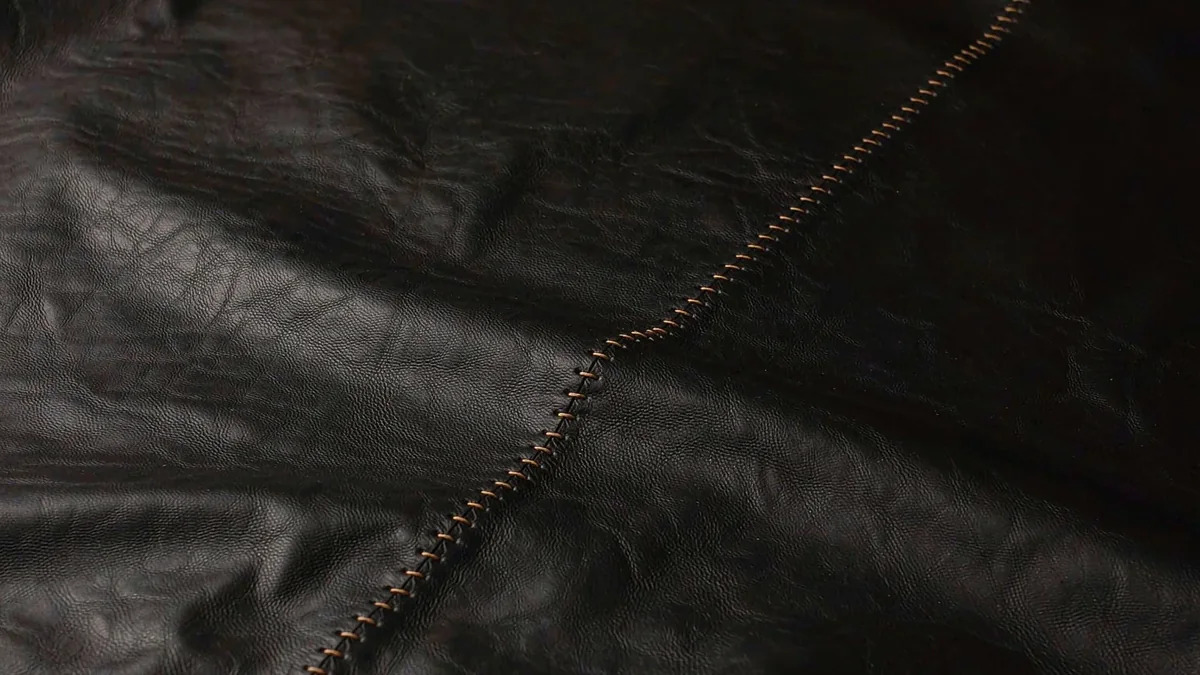
The measurable consequence is that stitch density sits inside the labour line alongside three-coat edge finishing, which together decide most of what the bench costs on a structured body.
Three-Coat Edges and the Flash Time Nobody Shortens
Edge finishing in three thin coats at 0.08-0.12 mm wet, with 8-10 minutes of flash time between passes, is a finish statement with three operations attached. One thick coat looks acceptable at despatch and fails earlier, because the solvent trapped beneath the surface continues to move.
- Three thin coats outperform one thick coat on both appearance and durability.
- Flash time is chemical rather than discretionary; it cannot be compressed by adding hands.
- Edge work is 6-9 working days of the bulk sequence on a structured body.
- An edge specification changed after approval is a change repeated several hundred times.
This is the operation most often trimmed when a calendar slips, and it is the one whose failure is slowest to appear. A bag that leaves with an under-cured edge looks correct for six weeks.
Burnishing and the Final Read on the Bench
Burnishing closes a raw edge by friction, worked with a wood slicker until the fibres lie down and the surface takes a low sheen. It is used where the design wants the edge visible rather than painted, and it is judged by hand rather than by gauge, which is precisely why it should be specified rather than left open.
The final read is the last operation and the only one that is entirely comparative. The piece is placed against the approved reference and examined under the same light: panel alignment, seam line, edge build-up, hardware setting and handle drop. Anything that differs is corrected on the bench rather than explained in a note.
The inspection that follows is drawn at AQL 2.5 under ISO 2859-1, with a re-work reserve held so a finding is corrected rather than airfreighted. Together, the final read and the audit are what make a technique repeatable at 500 pieces rather than only at one.
What Scales and What Does Not
Not every operation scales equally, and knowing which is which is what makes the difference between a considered simplification and a loss of character.
Scales well
Lot selection, grain direction and grade placement. These are decisions made once per lot and repeated identically, so a longer run costs no more per piece to get right.
Scales with care
Skiving and stitching. Both are hand-guided, so a longer run means more artisans holding the same tolerance rather than a faster bench.
Does not scale
Three-coat edge finishing and burnishing. Flash time is chemical and burnishing is judged by hand, so neither can be compressed without changing the result.
The practical guidance follows directly: simplify the pattern before the finish. Reducing panel count saves minutes without touching the operations a customer actually notices.
Keeping the Record: How a Technique Survives a Reorder
A technique survives repetition when it is recorded as numbers rather than described as intentions. The approved sample is the physical reference; the record beside it is what makes the second run match the first.
- Lot reference, tannery and thickness, kept with the compliance reports.
- Skiving width and bevel, with the tolerance actually held at assembly.
- Stitch density and thread size, checked at assembly and final inspection.
- Edge specification: number of coats, wet thickness and flash time.
- Handle drop measured under a 200 g load, recorded with the archive set.
The distinction is worth holding on to, because the two savings look identical on a costing sheet. One removes minutes nobody perceives; the other removes minutes a customer's hand finds within seconds of picking the piece up.
A useful test before simplifying anything is to ask what a customer touches first. The edge, the handle and the closure are the first three; the panel layout is not on that list. Reducing panel count is therefore usually the safest saving available, and trimming the edge specification usually the least safe, even though costing conversations routinely present the two as equivalent.
The programme runs through our validated partner factory Quanzhou Yingming Bags, an SGS-validated site with 7 production lines and about 200,000 pcs per month of capacity, holding export experience since 2014. Sampling takes 6-10 working days, or 12-15 on a complex build, bulk occupies 35-50 days, and inspection is drawn at AQL 2.5 under ISO 2859-1, with third-party inspection available alongside the internal audit.
Specify the craft you want kept
Send the drawings, your material direction, quantity per colourway and delivery date. You will receive a costed specification listing the nine operations and the tolerances held on each. Request a quote.
Frequently Asked Questions
How does designer handbag production preserve craft?
By keeping nine named operations on the bench and specifying each in writing before sampling: lot selection, grain direction, clicking, skiving, interlining, turning, stitching, edge finishing and the final read against the approved reference. Naming them is what makes each one inspectable rather than a matter of opinion.
Why does recording numbers matter more than describing techniques?
Because numbers can be verified and descriptions cannot. A bevel at 45 degrees across 8-10 mm held to ±0.15 mm can be measured on any piece; a described feel cannot be checked, and it drifts as soon as the artisan changes. A bevel can be measured on any piece; a described hand feel cannot be checked at all.
What is skiving and why is it specified?
Skiving thins a panel edge so two thicknesses meet without a step. On designer work it runs 8-10 mm wide at a 45 degree bevel, held to ±0.15 mm, and it is what makes a turned edge lie flat rather than ripple. Skiving is also where a hide can be lost: one cut too deep and the panel is scrap.
Why is stitch density set at 8-9 per inch?
It closes a seam tightly enough to help a structured body hold its line. It is roughly a third more needle entries than the 6-7 per inch used on casual goods, each hand-guided, which is where the extra minutes come from. It is roughly a third more needle entries than casual goods, each one hand-guided.
How long should a turned panel relax before edge work?
Four to six hours. Edge coats applied to a panel that has not finished moving will crack along the fold, typically in the second month, which is long after despatch and long after anyone is looking. Edge coats applied before the panel settles will crack along the fold in month two.
Why three edge coats rather than one?
Three thin coats at 0.08-0.12 mm wet cure properly, because each pass can release solvent. One thick coat looks acceptable at despatch and fails earlier, since trapped solvent continues to move beneath a surface that has already skinned over. Three thin coats cure properly; one thick coat traps solvent beneath a skinned surface.
Can flash time between edge coats be shortened?
No. It is chemical rather than discretionary, so adding hands does not compress it. This is why edge finishing is 6-9 working days of the bulk sequence and why a slipped calendar tends to land here first. Adding hands does not compress it, which is why a slipped calendar lands here first.
What is burnishing and when is it used?
Burnishing closes a raw edge by friction, worked with a wood slicker until the fibres lie down and the surface takes a low sheen. It is chosen where the design wants the edge visible rather than painted. It is chosen where the design wants the edge visible rather than painted over.
What happens at the final read on the bench?
The piece is placed against the approved reference and examined under the same light for panel alignment, seam line, edge build-up, hardware setting and handle drop. Anything that differs is corrected on the bench rather than explained in a note. Anything that differs is corrected on the bench rather than explained away in a note.
How is quality held across a full run?
By inspecting against the approved reference at AQL 2.5 under ISO 2859-1 and holding a re-work reserve, so a defect finding is corrected on the bench rather than by airfreighting a partial shipment. Together they decide most of what the bench costs on a structured body.
Which operations scale and which do not?
Lot selection, grain direction and grade placement scale well, because they are decided once per lot. Skiving and stitching scale with care. Three-coat edge finishing and burnishing do not scale at all. Panel count, reinforcement placement and hardware choice are structural rather than tactile, so changing them costs a customer nothing.
What belongs in the record kept with the archive set?
Lot reference, tannery, thickness, skiving width and bevel with the tolerance held, stitch density and thread size, edge specification with coat count and flash time, and the handle drop measured under a 200 g load. One page per style is a small discipline with an outsized return at reorder.
People Also Ask
What does craft actually mean in handbag terms?
A set of named, inspectable operations — skiving, turning, stitching density, edge finishing — rather than an impression of quality, and each one can be specified and measured. Each can be inspected rather than merely admired, which is what keeps a technique alive.
Why is edge finishing so often the first thing cut?
Because its failure is slow. An under-cured edge looks correct at despatch and for weeks afterwards, so compressing it feels free until the coats crack in month two or three.
How long does hand turning take?
It is the slowest step on the bench, and it needs a 3-4 mm allowance plus 4-6 hours of relaxation before edge finishing begins, so it cannot be rushed without consequence.
Does a longer run reduce the craft content?
Not automatically. Lot selection and grade placement are decided once per lot, but edge finishing and burnishing remain hand operations regardless of run length. Presenting the two as equivalent is the commonest error in a costing conversation.
What is the most reliable way to keep a technique alive?
Record it as numbers — bevel angle, stitch count, coat thickness, flash time — and keep them with the approved sample and archive set for the next run. Keeping the numbers beside the approved sample is what makes repetition possible.
Sources and further reading
Every figure on this page is either our own programme data or attributed below. Open the originals before you write them into a specification.
- ISO — International Organization for StandardizationISO Publisher of ISO 2859-1 for the AQL 2.5 inspection plan, plus ISO 105 for colour fastness, ISO 3376 for tensile strength and ISO 11644 for finish adhesion.
- Leather Working GroupLeather Working Group Tannery audit protocol used to evidence hide traceability, which underpins lot selection and grade placement on a designer programme.
- CITES — Convention on International Trade in Endangered SpeciesCITES The convention whose Appendices determine which exotic shells require documentation before a piece can be despatched.
- OEKO-TEXOEKO-TEX Independent testing system referenced for restricted substance screening on linings, interlinings and finished leather goods.