Designer Handbag Production Checklist Before Sampling: Fourteen Decisions in the Order You Have to Make Them
What belongs in a designer handbag production checklist before sampling? Fourteen items, worked in a fixed order: silhouette and size set, shell leather and thickness, lining and reinforcement, hardware and finish, edge specification, stitch density, tolerances, quantity per colourway, destination markets, colour reference, presentation, inspection level, trade term and delivery date. Three of those items can reverse an earlier decision, which is why the order matters more than the contents. A pack sent complete returns a costed specification and a sampling plan inside 6-10 working days.
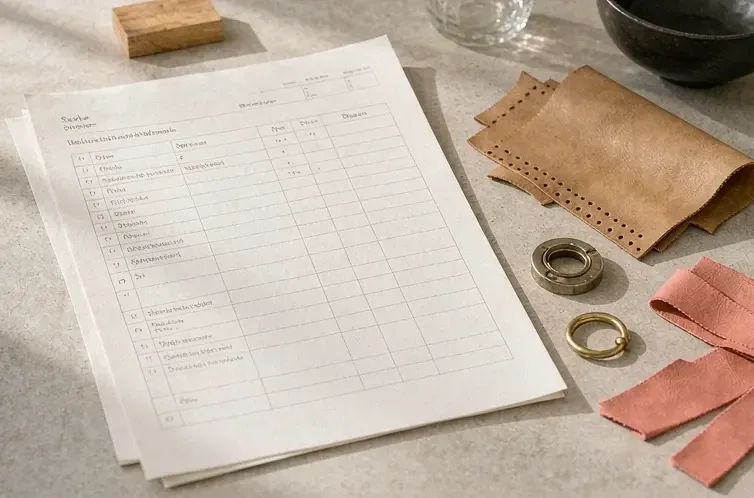
The Order of Decisions Before Sampling
Work the checklist in this order, because three items on it can send you back to an earlier one. A pack that starts with quantity tends to be re-costed twice; a pack that starts with the silhouette usually holds. The sequence exists to make the expensive discoveries happen while they still cost nothing.
- Silhouette and size set: a structured body pulls the shell towards 1.2-1.4 mm, a soft body allows 0.8-1.0 mm.
- Shell leather and thickness, which can reverse decision one if the material will not hold the shape.
- Lining, interlining and load paths, since reinforcement governs whether the body stands after a month.
- Hardware and finish: stock or bespoke, because the answer moves the calendar by roughly 30-40 working days.
- Edge specification: raw, turned, or painted in three coats, each a different number of operations.
- Stitch density and thread: 8-9 per inch is the designer standard and slower than the 6-7 used on casual goods.
- Tolerances you will actually hold, because they become the inspection reference for the whole run.
- Quantity per colourway, destination markets, colour reference, presentation, inspection level, trade term and date.
The two groups behave differently under pressure. The first seven items are design decisions that become progressively more expensive to change; the last seven are commercial inputs that can be recalculated in an afternoon. Packs that spend their effort on the second group discover the first one at sampling, when it costs a round.
The three that reverse an earlier decision are material, market and hardware. Material can force a silhouette change; market can force a material change through testing; bespoke hardware can force an edge change, because a lock has to be set before the edge is closed.
Everything after the seventh item is a consequence rather than a choice. Quantity follows from the size set, markets follow from where the label sells, and the date follows from the calendar the first seven decisions create.
Decision One: Silhouette and Size Set
Decide the silhouette and how many sizes it carries before anything else, because the size set governs the tooling outlay and the development share. One size at MOQ 500 pcs carries the full development cost; two sizes share a pattern and divide it, but each needs its own die set and grading.
- Structured bodies need 1.2-1.4 mm shell leather and internal reinforcement to hold their shape.
- Soft bodies work at 0.8-1.0 mm and cost less in both material area and assembly minutes.
- A second size changes panel area by roughly 8% and adds a graded pattern to the development line.
- Decide the size set at the brief: changing it after tooling is the most expensive revision available.
For a first collection, one size is usually the honest answer. The second size is a second 500-pcs commitment, and it is better funded from the sell-through of the first.
Decision Two: Shell Leather and Thickness
Name the shell leather, its finish and its thickness, and confirm the lot before the first sample is built. This is the single decision that most often reverses an earlier one: a leather that will not hold a structured shape below 1.2 mm will send the silhouette back to the drawing, weeks after it was settled.
- Structured body
- 1.2-1.4 mm full-grain calfskin, with 0.8 mm interlining on load-bearing panels
- Soft body
- 0.8-1.0 mm, where the shape is meant to relax rather than stand
- Lining
- 0.8-1.0 mm, chosen for abrasion resistance at the opening and base
- Colour reference
- Physical swatch plus a Pantone code; lab dip 7-10 working days
- Custom colour
- Strike-off at 14-21 working days after lab dip approval
- Hides per colourway
- Three, below which the balance is drawn from a second dyelot
The marker efficiency of 78-84% applies to a structured panel set once grain direction is fixed. That figure, not the price per hide, is what decides the material line — which is why the lot has to be named rather than described.
Decision Three: Lining, Interlining and Load Paths
Reinforcement is what keeps a structured body standing after a month of use, and it is specified in the brief rather than chosen on the bench. Base, handle joins and the opening carry the load; everything else carries the shape.
- Interlining at 0.8 mm on the base and at every handle join, bonded before assembly.
- Lining at 0.8-1.0 mm, selected for abrasion resistance where the hand enters the bag.
- Load paths traced from handle to base, because a handle joined to the body alone will pull.
- Reinforcement counted as operations: each bonded panel is bench time before sewing starts.
This is also the decision most often reverse-engineered from a reference piece. If the bag you are copying stands up empty, something inside it is doing the work, and that something has to be named in the specification.
Decision Four: Hardware and Finish
State the hardware as stock or bespoke, name the finish, and note the plating thickness. The stock-versus-bespoke answer alone moves the calendar by roughly 30-40 working days, because a bespoke closure carries tooling and a proving step that stock brass does not.
- Plating on brass runs 0.15-0.3 µm for gold tones; thinner films show wear first at contact points.
- Salt spray proving runs 24 hours for stock finishes and 48 hours for bespoke developments.
- Zip specification belongs in the brief: #5 metal for main openings, #3 for interior pockets.
- Base feet are set four per body, and each is a discrete setting operation on the bench.
- A plated brass trim set is quoted at USD 4.80 per bag as the published reference figure.
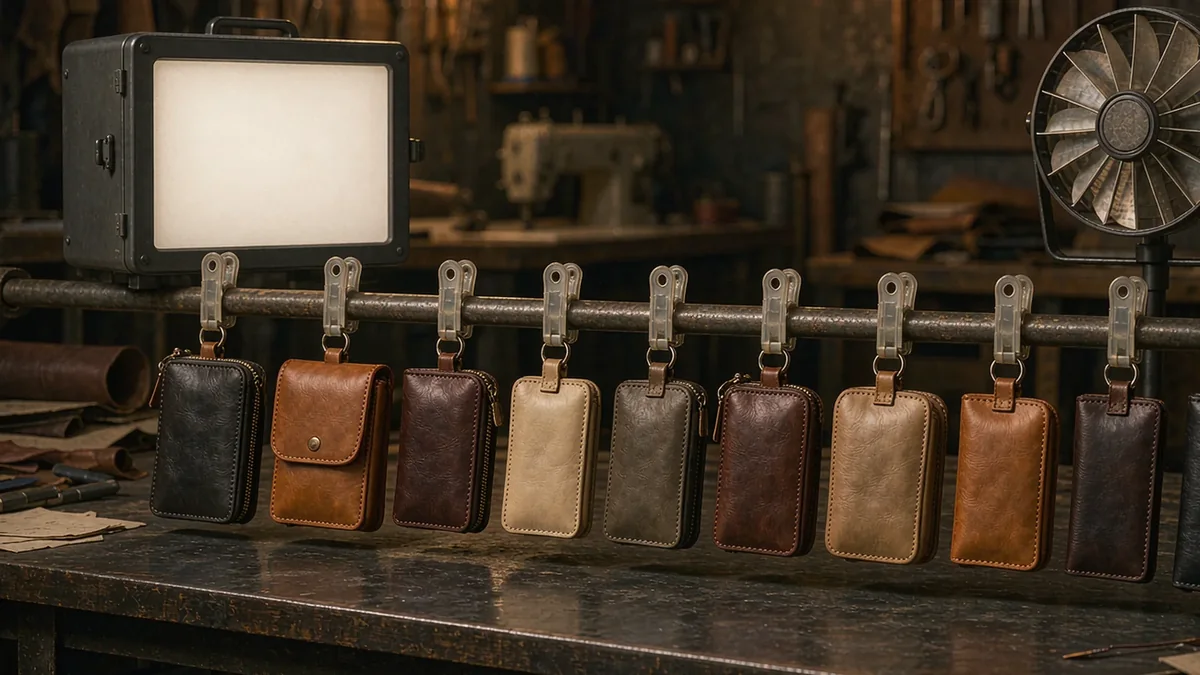
The usual guidance holds: keep the closure stock and spend the difference on the body. A distinctive silhouette in excellent leather reads as more considered than a distinctive lock on an ordinary one, and it reaches the line sooner.
Where a bespoke closure is genuinely part of the design, build the calendar around it rather than around the bag. Tooling and proving run 30-40 working days, which is longer than sampling and bulk planning combined, and it is the one item that cannot be compressed once started.
Decision Five: Edge Specification and Stitch Density
Two operations decide most of the labour line, and both are chosen in the studio. Stitch density at 8-9 per inch is the designer standard and is slower to sew than the 6-7 per inch used on casual goods. Edge finishing in three coats, at 0.08-0.12 mm wet with 8-10 minutes of flash time between passes, is a finish statement with three operations attached.
- A raw edge is a legitimate design choice and removes an entire operation from the run.
- A turned edge holds shape best and is the slowest step on the bench.
- Edge paint in three thin coats outperforms one thick coat, and flash time is chemical rather than discretionary.
- Thread is specified by size: bonded nylon #69 on body seams, #46 on interior work.
Raw edge
The cut edge is left visible, sometimes burnished by friction. It removes an entire operation from the run and suits a soft, relaxed body where a clean cut reads as deliberate.
Turned edge
The panel is folded and shaped before closing, giving the strongest line on a structured body. It is the slowest step on the bench and needs a 3-4 mm allowance.
Three-coat painted edge
Three thin coats at 0.08-0.12 mm wet with 8-10 minutes of flash time between passes. It is the finish statement most customers recognise, and the one most often trimmed under pressure.
A caution worth repeating: an edge specification changed after approval is a change repeated several hundred times. It belongs on the correction list from round one, not in a note with the bulk order.
Decision Six: The Tolerances You Will Actually Hold
Recorded tolerances are worth more than recorded intentions. A tolerance that was held at inspection is a specification; a tighter figure that nobody measured is a wish, and it will not survive contact with a reorder.
| Dimension | Tolerance held | Where it is checked |
|---|---|---|
| Panel dimensions | ±1.5 mm | Cutting inspection against the graded pattern |
| Handle drop | ±3 mm under a 200 g load | Fit sample and pre-production piece |
| Skiving width | 8-10 mm at a 45 degree bevel, ±0.15 mm | Preparation bench before assembly |
| Stitch density | 8-9 per inch | Assembly bench and final inspection |
| Edge build-up | Three coats at 0.08-0.12 mm wet | Edge finishing bench |
| Unit weight | ±5% | Pre-packing check before freight quotation |
These six figures are what make a second season cheaper. They are also what the inspection is drawn against, which means they should be agreed at sampling rather than discovered at the audit.
The Fourteen-Item Checklist to Work Through
The checklist below compresses the six decisions into fourteen working items. Complete it before requesting a quotation and the returned figure usually holds.
- Silhouette confirmed, with the number of sizes and the panel count for each.
- Shell leather named, with thickness stated between 0.8 mm and 1.4 mm as appropriate.
- Lining and interlining specified, including every reinforced panel.
- Load paths traced from handle to base and marked on the pattern.
- Hardware stated as stock or bespoke, with finish and plating thickness.
- Zip specification recorded: #5 for main openings, #3 for interiors.
- Edge specification recorded as raw, turned, or painted in three coats.
- Stitch density agreed at 8-9 per inch, with thread size noted.
- Tolerances recorded for panels, handle drop and unit weight.
- Quantity confirmed per style and per colourway against the 500-pcs minimum.
- Destination markets listed, since testing and documentation follow the market.
- Colour reference supplied as a physical swatch with a Pantone code.
- Presentation specified: rigid box, dust bag, care card and carton packing.
- Trade term fixed at FOB Xiamen, CIF or DDP before the figure is compared.
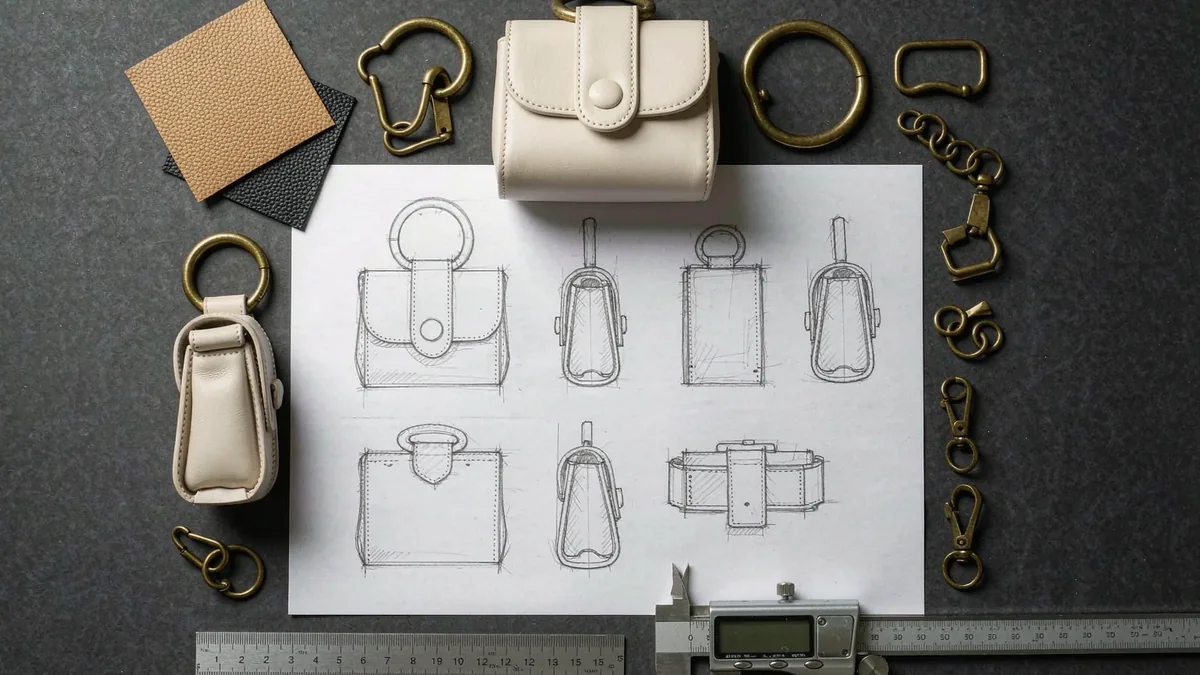
Items one to eight decide the piece; items nine to fourteen decide the figure. Most re-costings happen because a label sent the second group and assumed the first could be settled later.
What to Send With the Pack
A checklist is only useful once it travels with the drawings. Four accompaniments decide whether the bench can quote from the pack or has to come back with questions, and each question costs a round trip of roughly two working days.
- A six-view tech pack with around eighteen numbered callouts covering dimensions, hardware and finishes.
- A physical material reference, or the named lot, rather than a description of the intended hand feel.
- A dimensioned reference piece where one exists, with every intended departure noted on the sheet.
- The delivery date, so the quote arrives as a calendar rather than as a figure without one.
Two habits make the pack easier to read. Mark grain direction on every panel of the marker, and note where the load travels from handle to base. Both are decisions the bench would otherwise have to make for you, and both are cheaper made in the studio.
The programme runs through our validated partner factory Quanzhou Yingming Bags, an SGS-validated site with 7 production lines and about 200,000 pcs per month of capacity, holding export experience since 2014. Sampling runs 6-10 working days, or 12-15 on a complex build, bulk occupies 35-50 days, and inspection is drawn at AQL 2.5 under ISO 2859-1, with third-party inspection available alongside the internal audit.
Send your pack for a costed plan
Send the tech pack, your material reference, the quantity per colourway and the delivery date. You will receive a costed specification and a sampling plan within two working days. Request a quote.
Frequently Asked Questions
What should be settled before requesting a handbag sample?
Fourteen items, worked in order: silhouette and size set, shell leather and thickness, lining and reinforcement, hardware and finish, edge specification, stitch density, tolerances, quantity per colourway, markets, colour reference, presentation, inspection level, trade term and date. Work it top to bottom, because the last seven items are consequences of the first seven.
Why does the order of decisions matter so much?
Because three items can reverse an earlier one. Material can force a silhouette change, market can force a material change through testing requirements, and bespoke hardware can force an edge change, since a lock is set before an edge is closed. Starting with quantity tends to produce two quotations rather than one that holds.
How does the size set affect the costing?
One size at MOQ 500 pcs carries the entire development cost. Two sizes share a pattern and divide it, but each needs its own die set and grading, and each size changes panel area by roughly 8%. It governs the tooling spend and the development share, so it belongs in the brief.
What thickness should the shell leather be?
1.2-1.4 mm full-grain calfskin for a body meant to hold its shape, with 0.8 mm interlining on load-bearing panels. A soft body works at 0.8-1.0 mm and costs less in both material area and assembly minutes. State the thickness as a number, because a described hand feel cannot be cut.
Why must the lot be named before sampling?
Because a second dyelot produces a visible colour break. Naming the lot fixes the marker efficiency, usually 78-84% on a structured panel set, and lets the material line be costed rather than estimated. Naming the lot fixes the marker efficiency before a single hide is cut.
What does reinforcement contribute to a handbag?
It keeps a structured body standing after a month of use. Interlining at 0.8 mm goes on the base and at every handle join, bonded before assembly, and each bonded panel counts as a bench operation. It is what keeps a structured body standing after a month of daily use.
Which hardware decision moves the calendar most?
Stock versus bespoke. Stock brass ships on the material calendar; a bespoke closure adds roughly 30-40 working days of tooling and proving, plus 48 hours of salt spray on the finished plating. Stock brass ships on the material calendar; bespoke adds tooling and proving of its own.
What stitch density is standard for designer work?
8-9 stitches per inch, sewn on hand-guided machines. It is materially slower than the 6-7 per inch used on casual goods, and together with three-coat edge finishing it decides most of the labour line. Finer stitching is slower to sew than the six to seven per inch used on casual goods.
How should tolerances be recorded?
Record what was held rather than what was drawn. Panels at ±1.5 mm, handle drop at ±3 mm under a 200 g load, stitch density at 8-9 per inch, and unit weight within ±5% before freight is quoted. Record what was held at inspection rather than what was drawn on the sheet.
What belongs in a six-view tech pack?
Around eighteen numbered callouts covering overall dimensions, panel dimensions, handle drop, hardware positions and finishes, edge specification and stitch density. Descriptions of intended hand feel do not substitute for any of them. Two colourways on a shared shell can often be split inside the five-hundred-piece total.
How does the colour reference affect the calendar?
A physical swatch with a Pantone code allows a lab dip in 7-10 working days. A colour outside the seasonal range then needs a strike-off at 14-21 working days before bulk can be booked. Each market adds a line of testing and documentation rather than a rounding.
What happens after the pack is sent?
A costed specification and a sampling plan come back, usually within two working days. Sampling then takes 6-10 working days, or 12-15 on a complex build, followed by 35-50 days of bulk and inspection at AQL 2.5. A swatch with a Pantone code allows a lab dip in seven to ten working days.
People Also Ask
Why start with the silhouette rather than the quantity?
Because the silhouette decides the size set, the panel count and the tooling spend, and material can send it back for revision. Quantity is a consequence of those decisions, not an input to them.
What is the most common gap in a first tech pack?
Reinforcement. A reference bag that stands up empty has interlining doing the work, and if the specification does not name it, the sample will not stand and the cause will look mysterious.
How much detail is enough on hardware?
State stock or bespoke, the finish, and the plating thickness at 0.15-0.3 µm, then confirm proving at 24 hours of salt spray for stock or 48 for bespoke.
Should tolerances be tight or realistic?
Realistic. A tolerance of ±1.5 mm that is actually held is a specification; a tighter figure nobody measures becomes an argument at inspection rather than a standard. A tolerance actually held is a standard; one merely drawn is an argument waiting to happen.
What is the fastest way to get a usable quotation?
Send the fourteen items complete. Packs that leave the silhouette, material or hardware open are quoted on assumptions and re-costed once the decisions are made. Open questions get quoted on assumptions and re-costed once the decisions arrive.
Sources and further reading
Every figure on this page is either our own programme data or attributed below. Open the originals before you write them into a specification.
- ISO — International Organization for StandardizationISO Publisher of ISO 2859-1 for the AQL 2.5 inspection plan, plus ISO 105, ISO 3376 and ISO 11644 for material acceptance.
- Leather Working GroupLeather Working Group Tannery audit protocol referenced when naming a lot for traceability, which fixes the material line before sampling.
- ECHA — European Chemicals AgencyEuropean Chemicals Agency Administrator of REACH Annex XVII, whose restrictions can reverse a material decision once the destination market is named.
- OEKO-TEXOEKO-TEX Independent textile and leather testing system referenced for restricted substance screening on linings and interlinings.