Designer Handbag Production Sample Rounds Explained: What Counts as a Round and How Many You Need
How many sample rounds does a designer handbag need? Two for a standard build and three for a complex one, and each round takes 6-10 working days, extending to 12-15 where the construction involves a bespoke closure or a structured body. A round is not a sample: it is a complete cycle of building, measuring against the brief, writing a correction list and rebuilding. That distinction matters, because most capsules lose calendar not to the rounds they planned but to the half-rounds in between, where changes are made without the measurements that justified them. Below, six questions move through the sequence in order, from what a round contains to how to spend two of them well.
What Counts as One Sample Round?
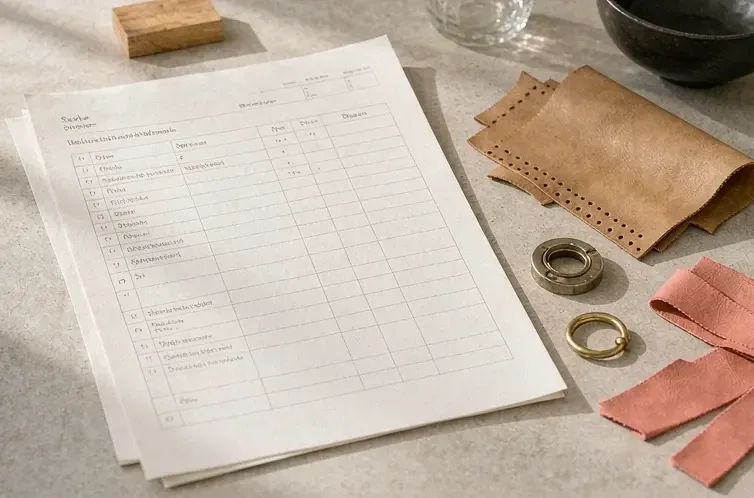
One sample round is a complete cycle, not a parcel. It contains four steps: building the piece, measuring it against the brief, writing a correction list with reasons, and rebuilding with those corrections recorded. Skipping any of the four produces a parcel rather than a round, and parcels are what stretch a six-day window into a month.
- Standard build
- 6-10 working days from pattern release to corrected sample
- Complex build
- 12-15 working days, including hardware proving and structured bodies
- Toile in 10 oz calico
- 1-2 days, and it is the least costly round available to a designer
- Working tolerance
- ±1.5 mm on cut panels, which is what the correction list measures against
- Records
- Each round is measured and written up, so a correction can be traced to a reason
The measurement step is the one designers skip, and skipping it is expensive. Without a written comparison against the brief, a second sample changes several things at once and nobody can say which change produced the improvement.
Why Does the First Sample Usually Feel Wrong?
Because proportion reads differently in three dimensions than on paper, and because a drawing carries no thickness. A body drawn at 280 mm wide looks one way as a line and slightly another as a 1.2-1.4 mm panel set with 0.8 mm interlining behind it.
- Thickness is absent from a drawing and present in a bag, changing how volume reads.
- Handle drop reads shorter once the body has weight in it, typically around 100 mm for a shoulder bag.
- Stitch density at 8-9 per inch draws the eye differently than the 6-7 per inch used on a sketch.
- A closure drawn closed sits differently once the leather has body and the lock has thickness.
- Colour on a swatch card is not colour on a curved panel under showroom light.
None of these are errors, and that is the useful reframe. The first sample is not a failed bag; it is the first object in the project that exists in three dimensions, and it is the only one that can tell you whether the drawing was right.
How Many Rounds Should a Designer Plan For?
Two for a standard build and three for a complex one, plus a toile beforehand in both cases. The toile is not counted as a round because it is made in 10 oz calico rather than the named leather, and it resolves proportion before a hide is cut.
| Route | Sequence | Elapsed working days |
|---|---|---|
| Standard, two rounds | Toile, sample, corrections, approved sample | 9-14 days including the toile |
| Complex, three rounds | Toile, sample, lock proving, two corrected samples | 18-25 days including proving |
| Re-order on a frozen pattern | Counter sample for the record only | 6-10 days, one round |
| Bespoke closure development | Toile, sample, tooling, proving sample, approval | 30-45 days on the hardware track |
The fourth row is the one that catches people out. Bespoke hardware runs on its own track, so a closure development sits beside the leather rounds rather than inside them, which is why a bespoke capsule can spend three weeks on locks while the body is already approved.
What Actually Belongs on a Correction List?
A correction list should carry a measured difference and a reason for every line. 'The handle feels short' is an impression; 'handle drop measures 92 mm against a specified 100 mm, increase by 8 mm' is a correction, and it can be executed, checked and recorded.
- State the measured value and the intended value, in millimetres, for every dimensional change.
- Separate what you want changed from what you want discussed, and mark the second kind clearly.
- Limit each round to the changes the bench can execute without disturbing an already-approved element.
- Record every correction, so the approved sample and the eventual bulk share one specification.
- Confirm the hardware and trim separately, since a trim set at USD 4.80 per bag is booked per order.
The third item is the discipline that saves rounds. Changes cascade: moving a handle changes the reinforcement under it, which changes the panel, which can change the yield of 55-65% on that lot.
When Is the Right Moment to Freeze the Specification?
Freeze after the round where every measurement falls inside tolerance, and not before. Freezing early is the most common cause of a bulk run that differs from the approved sample, because the freeze is what bulk is built to.
- Freeze when dimensions are inside ±1.5 mm on panels and the handle drop is confirmed.
- Freeze the material lot at the same moment, since yield is a property of that lot.
- Freeze the trim and hardware list, including zip sizes of #5 for openings and #3 for pockets.
- Freeze the edge specification: raw, turned, or three coats with 8-10 minutes of flash time.
- Freeze nothing before the closure has been proved, including 48 hours of salt spray on bespoke work.
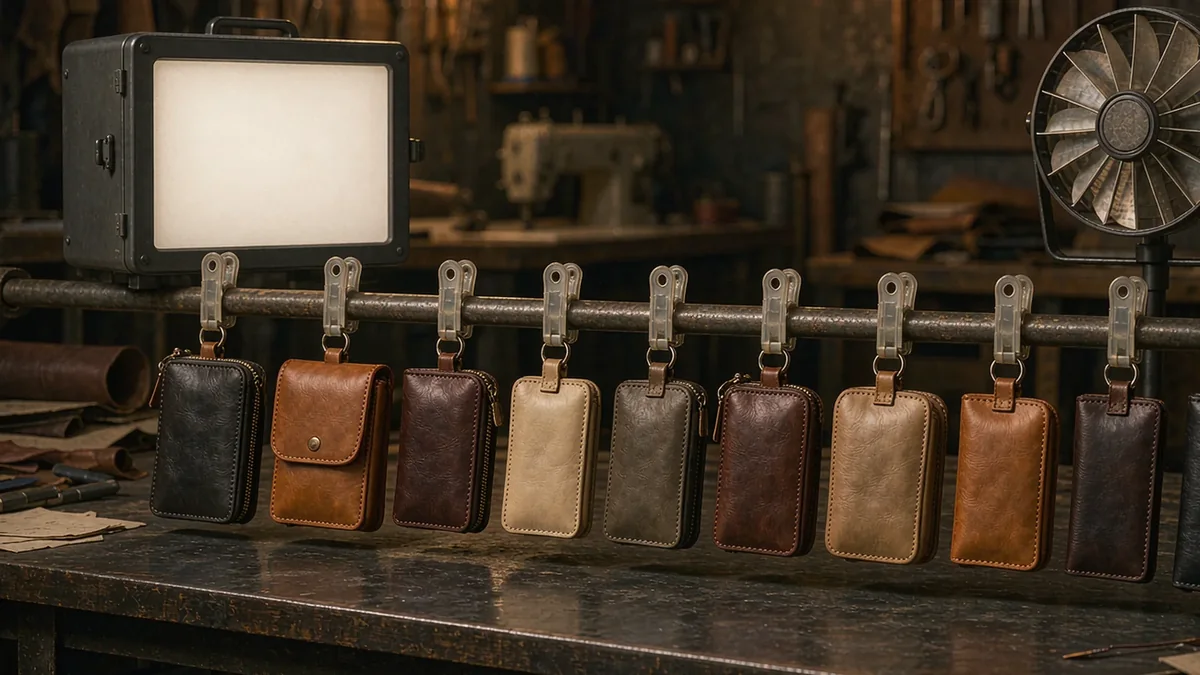
A freeze is not the end of design; it is the moment design stops being negotiable on that style. Anything discovered afterwards belongs in the next capsule, which is a far cheaper place for it to land.
The Toile: The Round That Costs Almost Nothing
A toile in 10 oz calico solves proportion, handle drop and closure placement in one to two days, and it does so before any leather is committed. It is the highest-return step in the whole sequence and the one most often skipped for looking unglamorous.
What a toile resolves, inexpensively
- Proportion: whether the body reads as intended at full size rather than at sketch scale.
- Handle drop: 100 mm on a shoulder body, tested on the arm and not on paper.
- Closure placement: whether the lock sits where the hand reaches, not where the drawing put it.
- Volume: whether the intended contents fit, which a drawing can only assert.
- Panel logic: whether the seam sequence the designer imagined can actually be assembled.
Two toiles are often better than one. The first tests proportion and the second confirms the corrections, and together they still cost less than one unnecessary leather round.
There is also a reason a toile is cut in 10 oz calico rather than a substitute leather. Calico has no grain and no stretch, so it reports geometry alone; a substitute hide would introduce its own hand and thickness, and the proportion question would be answered through a filter.
- A toile is cut to full size, because scale changes how a proportion reads.
- It is handled, carried and set down, which no drawing can be.
- It is corrected with a marker and a pair of shears, in minutes rather than days.
- It is then used as the reference the first leather round is measured against.
- Several toiles can be cut in a single day if the silhouette is genuinely undecided.
From Approval to Bulk: The Round Nobody Counts
Between approval and bulk sits a step most calendars omit: the counter sample. It is the piece drawn from the frozen specification and kept as the reference bulk is measured against, and it is what makes a dispute at inspection resolvable.
- The counter sample is measured to the frozen specification and retained at the bench.
- Bulk is drawn at AQL 2.5 under ISO 2859-1, with the sample plan agreed before intake.
- A 500 pcs lot at general inspection level II uses code letter H: 50 units drawn, accept 3, reject 4.
- Corrections found at inspection are re-checked against the counter sample, not against memory.
- Bulk then takes 35-50 days from intake, and packing and documents a further 3-5 days.
Skipping the counter sample is why inspection arguments happen. Without a retained reference measured to the freeze, an inspector and a bench are comparing two different memories of the approved piece.
Making Two Rounds Enough
Two rounds are enough when the brief was complete, the toile was taken seriously and the corrections were measured. Where any of those three is missing, the sequence simply continues, and each additional round costs a pattern revision and a bench build rather than a courier charge.
Standard capsule
Toile, then two leather rounds at 6-10 working days each, approval, counter sample, then bulk at 35-50 days. Reserve the lot during the toile to overlap the 15-20 day material window.
Structured or framed body
Toile, then three rounds at 12-15 working days. Structured bodies need reinforcement and turning, and turning is the slowest operation on the bench, so it earns its own round.
Bespoke closure development
Run the hardware track beside the leather: tooling, proving at 48 hours of salt spray, then a final approval sample. Add 30-40 working days to the calendar before quoting a date.
The overlap advice in the first card is worth repeating, because it is the only saving that costs nothing. Reserving the named lot while the toile is being cut puts the 15-20 day material window in parallel with development instead of in front of it.
What to Send Before the First Round
The first round starts on the day the material and the pattern are both available, so send the brief with the lot named. Everything that arrives later becomes waiting between rounds rather than work inside them.
- Drawings with dimensions in millimetres and a working tolerance of ±1.5 mm.
- The material direction, 1.2-1.4 mm for structured work, named as a reserved lot.
- The hardware list: stock or bespoke, finish at 0.15-0.3 µm, zip sizes and base feet.
- Construction notes: stitch density 8-9 per inch, edge specification and reinforcement.
- Quantity per colourway at MOQ 500 pcs, and the date the goods must arrive.
The programme is delivered through our validated partner factory Quanzhou Yingming Bags, an SGS-validated site with 7 production lines and about 200,000 pcs per month of capacity, holding export experience since 2014. Third-party inspection can be arranged alongside the internal AQL 2.5 audit, and handover is on FOB Xiamen terms.
Plan your sampling rounds before you start them
Send your drawings, material direction and the date you are working towards. You will receive the round sequence, the working days each step holds and the reserve plan for the lot, within two working days. Request a quote.
Frequently Asked Questions
What counts as one sample round in handbag development?
One complete cycle of four steps: building the piece, measuring it against the brief, writing a correction list with reasons, and rebuilding with those corrections recorded. Skipping any step produces a parcel rather than a round, and parcels are what turn a six-day window into a month.
How many sample rounds does a designer handbag need?
Two for a standard build and three for a complex one, with a toile in 10 oz calico beforehand in both cases. The toile is not counted as a leather round, because it is cut in calico and resolves proportion before any hide is committed to the shape.
How long does each sample round take?
6-10 working days for a standard build from pattern release to corrected sample, and 12-15 working days where the construction is complex. A structured or framed body and any bespoke closure fall into the longer window, since both need proving before a panel is cut.
Why does the first sample often feel wrong?
Because a drawing carries no thickness. A body drawn at 280 mm wide reads differently as a 1.2-1.4 mm panel set with 0.8 mm interlining behind it, and handle drop reads shorter once the body has weight in it. None of that is error; it is three dimensions.
What belongs on a sample correction list?
A measured difference and a reason on every line. A note reading handle drop measures 92 mm against a specified 100 mm, increase by 8 mm can be executed and checked, whereas the handle feels short can only be interpreted and reinterpreted, which costs a further round.
When should the specification be frozen?
After the round in which every measurement falls inside the working tolerance of plus or minus 1.5 mm on panels and the handle drop is confirmed. Freeze the material lot, trim list, stitch density of 8-9 per inch and the edge specification at the same moment.
What is a counter sample and why is one kept?
After the round in which every measurement falls inside the working tolerance of plus or minus 1.5 mm on panels and the handle drop is confirmed. Freeze the material lot, trim list, stitch density of 8-9 per inch and the edge specification at the same moment, because bulk is built to that record.
How does bespoke hardware change the round sequence?
It is the piece drawn from the frozen specification and retained at the bench as the reference bulk is measured against. Without it, an inspector and a bench compare two different memories of the approved sample, which is how inspection arguments begin and how corrections lose their traceability.
What reduces the number of rounds most effectively?
It runs on a separate track alongside the leather rounds. Tooling, a proving sample and 48 hours of salt spray testing add 30-40 working days, so a capsule can spend three weeks on locks while the body itself is already approved and waiting. Planning the two tracks together is the only way to quote a date.
How is a bulk lot inspected after approval?
At AQL 2.5 under ISO 2859-1, with the sample plan agreed before bulk intake. A 500 pcs lot at general inspection level II uses code letter H, meaning 50 units are drawn, with acceptance at 3 defects and rejection at 4. Agreeing the plan early changes the arithmetic at the end of the run, and third-party inspection can be added alongside it.
Can the material reservation overlap with sampling?
At AQL 2.5 under ISO 2859-1, with the sample plan agreed before bulk intake. A 500 pcs lot at general inspection level II uses code letter H, meaning 50 units are drawn, with acceptance at 3 defects and rejection at 4. Agreeing the plan early changes the arithmetic at the end of the run.
What happens if a change is needed after the freeze?
It belongs in the next capsule. Changes after the freeze cascade into reinforcement, panel geometry and the yield of 55-65% on that lot, so the honest answer is usually to carry the idea forward. A change that looks like eight millimetres often carries a four-figure consequence once the lot is cut.
People Also Ask
What is a handbag sample round?
A full cycle of building a piece, measuring it against the brief, writing corrections with reasons and rebuilding. A posted sample without the measurement and the written list is a parcel, not a round.
How many rounds do most designer capsules use?
Two for a standard build plus a toile, and three plus a toile for a structured or framed body. The count rises mainly where a bespoke closure or complex reinforcement is involved.
What is a toile in handbag development?
A full-size test piece cut in 10 oz calico instead of the named leather. It resolves proportion, handle drop, closure placement and volume in one to two days before any hide is cut.
Why do sample rounds take six to ten days?
Because the window covers a first build, measurement against the brief, a written correction list and one corrected round. It is not a single attempt at the bag, which is why it cannot honestly be quoted as three days.
When should a designer stop making changes to a sample?
When every measurement is inside the working tolerance of ±1.5 mm on panels, the handle drop is confirmed and the closure has been proved. That is the freeze, and bulk is built to it.
Sources and further reading
Every figure on this page is either our own programme data or attributed below. Open the originals before you write them into a specification.
- ISO — International Organization for StandardizationISO Publisher of ISO 2859-1, which sets the code letters and accept and reject numbers used in the AQL 2.5 plan applied after the freeze.
- Leather Working GroupLeather Working Group Tannery audit protocol, relevant when the lots reserved ahead of the sampling rounds need their origin evidenced for the brand.
- ISO Online Browsing PlatformISO Public catalogue used to confirm standard names and scopes, including the ISO 105 series for colour fastness testing.
- FashionUnitedFashionUnited Reporting on European fashion calendars and trade show timing, useful when planning which round must be finished before a launch.
- Sourcing JournalSourcing Journal Coverage of material lead times and hardware supply conditions that shape the separate track bespoke closures run on.