How to Choose Leather for Luxury Handbag Lines: The Buyer's Checklist from Hide to Finished Panel
How do you choose leather for luxury handbag lines? Work the decision as a checklist in a fixed order, starting from the silhouette and ending at the tannery record: substance and where it is measured, the cut of the hide the panels come from, temper, finish, colour behaviour under three light sources, restricted-substance compliance, realistic yield, and lot traceability. A swatch answers only the temper and colour checks. On a structured body the figures usually land at 1.2-1.4 mm substance, 8-9 stitches per inch and finish adhesion of 3 N/10 mm; everything else follows the shape.
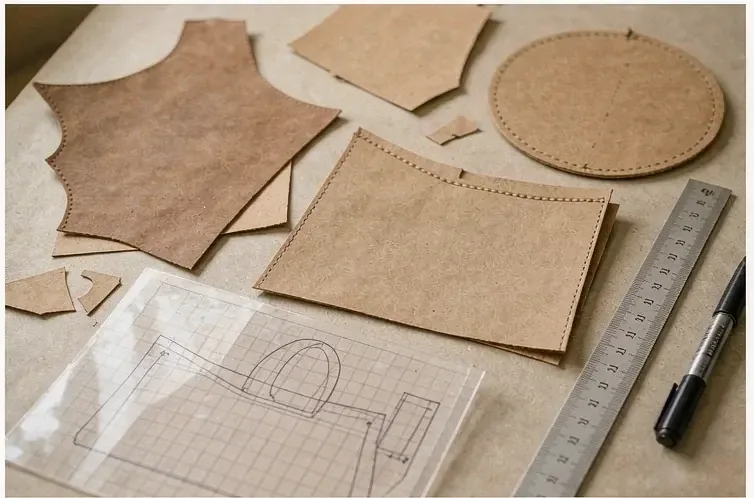
Start With the Silhouette, Not the Swatch
Choosing leather for a luxury handbag line starts with the silhouette, because substance, temper and finish are consequences of the shape the body has to hold rather than preferences to be matched against a colour card. Decide first whether the bag is structured, semi-structured or slouchy, and most of the specification writes itself from there.
A structured body needs a material with enough body to hold a corner unaided, which usually means a substance of 1.2-1.4 mm, a firm temper and a 0.8 mm reinforcement behind the panels. A slouchy body wants close to the opposite: 0.9-1.1 mm, a soft temper, and as little internal structure as the shape will tolerate.
- Structured: 1.2-1.4 mm, firm temper, full reinforcement at 0.8 mm, holds a corner without help.
- Semi-structured: 1.0-1.2 mm, medium temper, reinforcement at the base and gussets only.
- Slouchy: 0.9-1.1 mm, soft temper, minimal reinforcement, relies on the drape of the material.
- Evening and minaudière: 0.8-1.0 mm over a rigid frame, where the frame carries the load rather than the leather.
Check One: Substance and Where It Is Measured
Substance is the single figure most often quoted and least often defined. Ask where on the hide it was measured, because a hide is not a uniform sheet: the bend is dense and thick, the belly is thin and stretchy, and the shoulder sits between the two with visible growth marks.
The figure to insist on is a range with a tolerance rather than a single number. On a structured body, 1.2-1.4 mm measured at the bend, held to plus or minus 0.1 mm across the hide and between hides in the same lot. A single figure with no location attached describes a marketing sheet rather than a specification.
Check Two: Which Cut of the Hide the Panels Come From
Two hides of the same tannage and colour behave differently once cut, because the zone the panel comes from governs fibre density as much as the tannage does. Specify which zone feeds which panel and the pattern becomes predictable instead of negotiable.
| Zone | Character | Substance | Where it belongs |
|---|---|---|---|
| Bend | Densest fibre, minimal stretch | 1.2-1.4 mm | Handles, gussets, base, load-bearing panels |
| Shoulder | Looser fibre, growth marks | 1.1-1.3 mm | Body panels away from load |
| Belly | Thin, stretch of 8-10% | 0.9-1.1 mm | Linings, hidden panels, facings |
| Neck | Coarse irregular grain | 1.3-1.6 mm | Small components, trim, patches |
The third row is where problems begin. A belly panel cut into a load-bearing gusset stretches in service and the shape is gone within one season, while the same panel is entirely adequate as a facing or a lining. Matching zone to function is a pattern decision made at the drawing stage, not a tannery decision.
Check Three: Temper and Hand
Temper describes how the material resists being bent, and it is the figure that decides whether a bag still looks crisp after a month or looks collapsed. The practical bench test is a strip of 20 x 5 cm folded grain-out around a 10 mm mandrel and released: it should recover within five seconds and retain no crease.
Milling changes temper as much as tannage does. Dry milling for 6-8 hours softens the hand and raises the grain on a full-grain hide; over-milling flattens the grain and produces a boardy surface that no amount of finishing will bring back. Ask how long, and at what drum speed.
A hide that arrives too firm can be softened in the drum. A hide that arrives too thin cannot be thickened, which is why substance is checked before temper and why the substance tolerance is written into the booking rather than left to the grader.
Check Four: Finish and What It Withstands
The finish is the layer the customer touches and the layer that fails first, so it is judged on measured performance rather than on appearance. Two figures carry most of the decision: how well the finish adheres to the substrate, and how it behaves under rubbing.
Adhesion is tested to ISO 11644 and should sit at 3 N/10 mm or better; below 2 N/10 mm the finish lifts at folds and at the painted edge within a season. Rubbing is tested to ISO 11640 at 500 cycles dry and 250 cycles wet, read on the grey scale at 4/5 dry and 4 wet or better.
| Finish | Look | Performance | Best for |
|---|---|---|---|
| Aniline | Natural, no pigment | Marks readily; highest hand | Low-volume lines, slouchy bodies |
| Semi-aniline | Light pigment plus topcoat | Balanced; adhesion 3 N/10 mm | Most structured lines |
| Pigmented | Full coverage | Highest rubbing figures | Travel and everyday pieces |
| Pull-up or waxed | Colour moves under pressure | Develops patina | Heritage shapes |
| Suede split | Nap of 0.3-0.5 mm | Lower rubbing, grey scale 3/4 | Soft bodies, trim, linings |
The last row is a genuine trade-off rather than a defect. A nap surface cannot reach the rubbing figures a smooth finish does, so choosing suede means accepting grey scale 3/4 and designing the panel so the nap is never the load-bearing surface.
Check Five: Colour, Light and Metamerism
Colour is approved under one light source and worn under three, so the specification has to name the illuminants as well as the tolerance. Work to a reference swatch cut in half, one half kept by the house and one by the brand, and to a measured figure rather than to a description in words.
The working figures are a colour difference of 1.0 or less in CIEDE2000 terms against the approved reference measured at D65 and 10 degrees, and 1.5 or less from hide to hide within one run. The metamerism index across D65, TL84 and illuminant A should stay below 0.5, otherwise two panels that match in the studio visibly disagree in a shop window.
Check Six: Compliance Before Aesthetics
Compliance is not a document review at the end of development; it is a filter applied before a swatch is approved, because a shade that fails REACH Annex XVII is not a shade at all. Ask for test reports by lot rather than by season, and ask for the standard and the limit beside each result.
- Chromium(VI) under ISO 17075-1, below 3 mg/kg, the figure most retailers quote first.
- Formaldehyde under ISO 17226-1, at the limit agreed for the destination market.
- Azo dyes under REACH Annex XVII entry 43, at 30 mg/kg for listed aromatic amines.
- Nickel release under EN 1811 where metal sits against skin, at 0.5 micrograms per square centimetre per week.
- Fibre composition under EU Regulation 1007/2011 where the lining is declared on the label.
- California Prop 65 and CPSIA where the destination is the United States.
The first item is the one worth chasing hardest. Chromium(VI) is generally not present when the hide leaves the tannery; it can form later under heat and humidity, which is why the test is run on finished leather and repeated by lot instead of being assumed from a certificate issued a year earlier.
Check Seven: Yield, Grading and What the Figure Means
Yield is quoted as units per hide and it is meaningless without three qualifiers attached: the grade of the hide, the size of the body, and whether the panels are matched. A figure quoted without them describes maximum economy, which is not how a luxury piece is actually cut.
- Hide size
- 45-50 sq ft for a full bovine hide used on bag work
- Usable cutting area
- 70-80% after defects and marks are graded out
- Grade
- A, B or C by usable area, agreed in writing before the hides are booked
- Yield
- 4.2-4.8 units per hide on a 28 cm structured body with matched panels
- Matching
- Panels laid so grain direction and shade run consistently across the body
- Re-cut allowance
- 3-5% of hides held back against cutting faults
Check Eight: Tannery Records and Lot Traceability
The final check is documentary: can this hide be traced back to the tannery, the lot and the date, with the record still in existence two years later. Traceability is what turns a colour query into a solved problem rather than into an argument about who approved what.
Ask for a tannery audited under the Leather Working Group protocol with a current rather than a historic rating, a lot number recorded against every panel allocation, and a retained reference piece stored with the record. Ten years of retention is the working figure, because anything shorter fails the moment a retailer asks about a piece sold three seasons ago.
How the Check Feeds Sampling and Bulk
A leather specification is only useful if it is written before sampling starts, because each of the eight checks becomes a line on the sample report and then a line on the inspection plan. Approve the numbers on the sample and the bulk run has something measurable to be judged against.
Sampling
6-10 working days for a standard body and 12-15 where the construction is complex. A leather change inside an approved sample restarts the clock rather than extending it, because the new material has to be proven rather than merely substituted.
Bulk
35-50 days from material reservation, quoted on FOB Xiamen terms. The window moves with the leather: a reserved lot runs at the short end of the range, an undyed or unbooked one at the long end.
Inspection
AQL 2.5 under ISO 2859-1, agreed before intake. On a 500 pcs lot at general inspection level II the plan uses code letter H: 50 units drawn, accept 3, reject 4, with the result recorded against the run.
Correction
A rejected panel costs about USD 4.80 per unit in parts and bench time before freight is counted. That figure is why colour and substance are settled on the sample, and not discovered three weeks into a bulk run.
Our programme works to MOQ 500 pcs per style and colourway, runs across 7 production lines with about 200,000 pcs per month of capacity, and has carried export experience since 2014. Delivery runs through our validated partner factory Quanzhou Yingming Bags, an SGS-validated site, with third-party inspection available where the brand prefers it.
The Eight Checks Written as One Specification
Put the eight checks on one page and the specification stops being a conversation. Each line carries the figure, the tolerance and the way it is verified, which is what makes the document quotable to a retailer as well as usable on the bench.
| Check | Figure to write down | How it is verified |
|---|---|---|
| Substance | 1.2-1.4 mm at the bend, plus or minus 0.1 mm | Dial gauge on the hide before cutting |
| Zone | Bend for load, shoulder for body, belly for facing | Marked on the pattern pieces |
| Temper | Recovers within 5 seconds off a 10 mm mandrel | Bench test on a 20 x 5 cm strip |
| Finish | Adhesion 3 N/10 mm, rubbing grey scale 4/5 dry | ISO 11644 and ISO 11640 reports |
| Colour | Difference of 1.0 or less, metamerism index below 0.5 | Spectrophotometer at three illuminants |
| Compliance | Chromium(VI) below 3 mg/kg and market limits | ISO 17075-1 report by lot |
| Yield | 4.2-4.8 units per hide with matched panels | Cutting record on the first run |
| Traceability | Lot number and retained reference, held ten years | Allocation record against the run |
Questions to Ask Before You Approve a Swatch
Six questions asked at swatch stage settle most of what follows, and each one is designed so that a house with real material discipline answers with a figure rather than with an adjective.
Six questions before the swatch is signed off
- Where on the hide was that substance measured, and what is the tolerance across the lot?
- Which zone of the hide will the handles, the gussets and the body panels be cut from?
- What is the finish adhesion figure, and which standard was it tested under?
- What colour difference do you work to, at which illuminants, against which reference?
- Is the chromium(VI) report for this lot or for last season?
- What is the realistic yield per hide with panels matched on this body?
Bring us the silhouette and we will return the specification
Tell us the shape, the quantity and the destination market. We will come back with the eight checks written as figures, the likely tannery route and the realistic yield per hide, within two working days. Request a quote.
Frequently Asked Questions
What is the first thing to decide when choosing leather for a handbag line?
The silhouette. Substance, temper and finish are all consequences of the shape the body has to hold, so a structured, semi-structured or slouchy decision writes most of the specification before a single swatch is looked at. Starting from the swatch is the most common order error.
What substance should a structured luxury handbag use?
Usually 1.2-1.4 mm measured at the bend of the hide, held to plus or minus 0.1 mm across the hide and between hides in the same lot. Below about 1.1 mm the body needs heavy reinforcement to hold a corner, and heavy reinforcement adds weight and stiffness the shape did not ask for.
Why does the cut of the hide matter so much?
Because fibre density varies by zone. The bend is dense and stable, the belly is thin with a stretch of 8-10%, and the shoulder carries growth marks. A belly panel in a load-bearing gusset will stretch in service and lose the shape within one season, while the same panel makes a perfectly good facing.
How is temper checked on the bench?
Fold a strip of 20 x 5 cm grain-out around a 10 mm mandrel and release it. It should recover within five seconds and retain no crease. Milling alters temper substantially, with dry milling for 6-8 hours softening the hand, so ask how long and at what drum speed.
What finish adhesion figure should I ask for?
Three newtons per 10 mm or better, tested to ISO 11644. Below 2 N/10 mm the finish will lift at folds and at the painted edge within a season, and no repair at that stage is invisible. Ask for the report by lot rather than a general statement about the tannage.
What colour tolerance is realistic for a luxury run?
A colour difference of 1.0 or less in CIEDE2000 terms against the approved reference measured at D65 and 10 degrees, and 1.5 or less from hide to hide within one run. The metamerism index across D65, TL84 and illuminant A should stay below 0.5, so panels do not disagree under shop lighting.
Which compliance tests matter most for leather?
Chromium(VI) under ISO 17075-1 at below 3 mg/kg is the one most retailers quote first, followed by formaldehyde under ISO 17226-1 and azo dyes under REACH Annex XVII entry 43 at 30 mg/kg. Add EN 1811 for nickel release and California Prop 65 for the United States.
How many units does one hide produce?
About 4.2-4.8 units from a full bovine hide of 45-50 sq ft on a 28 cm structured body, assuming panels are matched. Usable cutting area after grading out defects is typically 70-80%, so a yield quoted without grade, body size and matching described is not comparable.
What should a leather specification contain?
Eight lines: substance with its measurement location and tolerance, the zone each panel is cut from, temper with a recovery test, finish adhesion and rubbing figures, colour difference and illuminants, compliance limits by lot, yield with matching described, and lot traceability with a retention period.
How long does sampling take once the leather is chosen?
6-10 working days for a standard body and 12-15 working days where the construction is complex. A leather change inside an already approved sample restarts the clock rather than extending it, because the replacement material has to be proven on the bench rather than simply substituted into an existing pattern.
How does the leather choice affect the bulk window?
Materially. Bulk runs 35-50 days from material reservation on FOB Xiamen terms, and the range moves with the leather: a reserved lot runs at the short end of the window while an undyed or unbooked lot runs at the long end. Booking the hide lot early is what buys the shorter date.
What does a rejected panel cost?
About USD 4.80 per unit in parts and bench time before freight is counted. That is the reason colour and substance are settled on the sample rather than during bulk, and the reason a 3-5% re-cut allowance of hides is worth holding back against cutting faults.
People Also Ask
What is the best leather for a luxury handbag?
There is no single best. Full-grain calfskin at 1.2-1.4 mm suits structured bodies, lambskin at 0.9-1.1 mm suits slouchy ones, and exotic skins suit pieces where yield and documentation are planned for. The right answer follows the silhouette.
Is full grain better than top grain?
Full grain keeps the natural surface and develops patina, while top grain is sanded and finished for uniformity. Full grain suits heritage and luxury lines; top grain suits colour-critical runs where hide-to-hide consistency matters more than surface character.
How thick should luxury handbag leather be?
1.2-1.4 mm for structured bodies, 1.0-1.2 mm for semi-structured and 0.9-1.1 mm for slouchy shapes, measured at the bend. Small leather goods and evening pieces often run at 0.8-1.0 mm over a rigid frame.
Why do luxury hides cost more than standard ones?
Grading. A luxury run pays for the A-grade area of the hide and for matching panels across a body, so the usable cutting area falls to 70-80% and the yield drops accordingly. The premium buys consistency rather than thickness.
What does metamerism mean for a handbag line?
Two panels matching under one light source but disagreeing under another. It is controlled by naming three illuminants, usually D65, TL84 and illuminant A, and holding the metamerism index below 0.5 rather than approving colour under a single lamp.
Sources and further reading
Every figure on this page is either our own programme data or attributed below. Open the originals before you write them into a specification.
- Leather Working GroupLeather Working Group Publishes the tannery audit protocol and rating bands used to judge the tanning stage behind a leather specification.
- ISO — International Organization for StandardizationISO Publisher of ISO 11644 finish adhesion, ISO 11640 rubbing fastness, ISO 17075-1 chromium(VI) and ISO 2859-1 sampling plans.
- ECHA — European Chemicals AgencyEuropean Chemicals Agency Administrator of REACH, including Annex XVII entry 43 on azo dyes and the restricted substance list applied to leather finishes.
- Sourcing JournalSourcing Journal Reporting on leather availability, hide grading and the traceability expectations now placed on luxury material chains.
- WWDWWD Coverage of luxury collections and the material choices that shape each season's accessory ranges.