How Artisan Skills Shape Premium Handbags: Four Judgments No Machine Can Make
Artisan skills shape a premium handbag through four judgments a machine cannot make: where a panel sits on the hide, how deep the skiving knife goes, how hard the thread is drawn, and when an edge is ready for its next coat. Each is a decision taken in seconds on the bench and each is worth measurable money — a trained clicker lifts usable hide yield by 8-11 percentage points before a single panel is cut.
The Decision Tree: Four Judgments, In Order
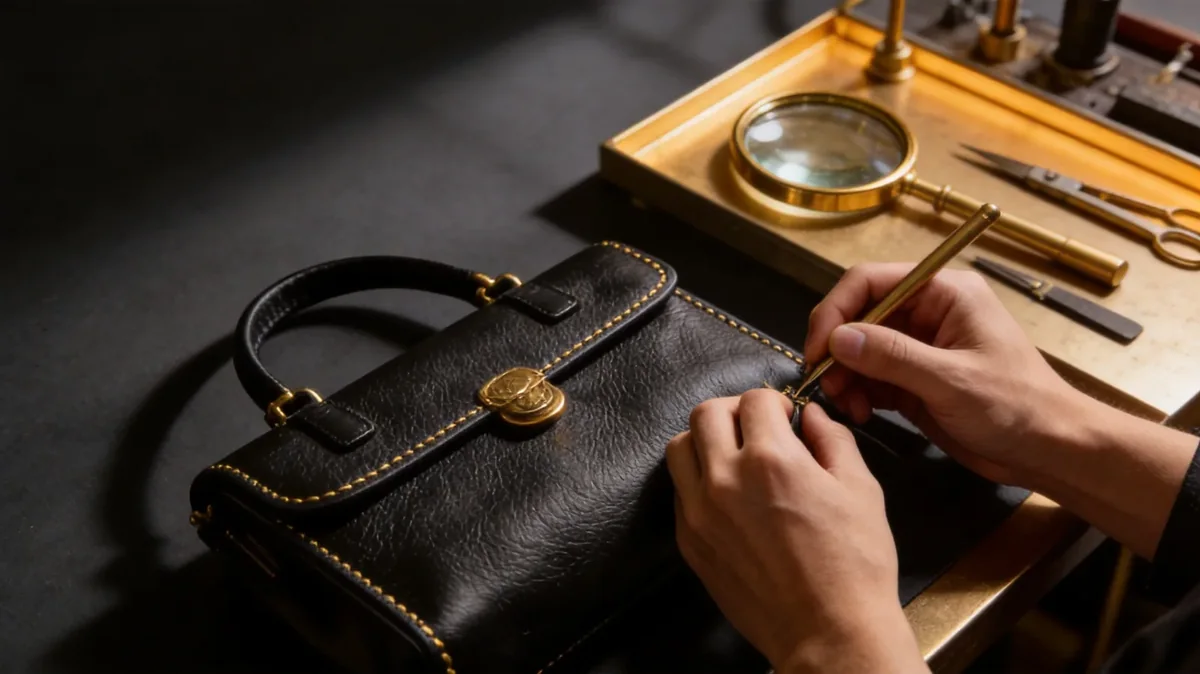
If you want to know where artisan skill actually enters a premium piece, follow the bench in order. Four decisions are taken by eye and by hand, and everything else on the sequence is a repetition of a setting someone else made. They are: hide placement, skiving depth, thread draw, and edge readiness. Taken in that order they take about 150 minutes of bench time on a structured body; skipped or delegated to a fixed setting, they are what turns a premium piece into an ordinary one that photographs well.
- Hide placement: which part of the skin takes the visible face, decided in 30-45 seconds per hide.
- Skiving depth: how much is taken off, held to a residual 0.6-0.8 mm at the fold.
- Thread draw: how hard each stitch is pulled, so the thread sits 0.1-0.2 mm below the surface.
- Edge readiness: when the previous coat has flashed enough to take the next one.
What to buy, in one line
- Buy judgment on the four decisions above and repetition everywhere else. Judgement is costly per minute and economical per defect avoided; repetition is the reverse.
The order matters because each decision constrains the next. Placement decides how the panel behaves; skiving decides whether two thicknesses meet cleanly; the draw decides whether the seam holds its line; and edge readiness decides whether the finish survives its second month. A fault introduced at the first cannot be corrected at the fourth.
Judgment One: Where the Panel Sits on the Hide
A clicker reads a hide in 30-45 seconds: where the fibre runs tight, where a scar line sits below the grain, where the belly will stretch. The visible faces of the bag are placed first and the hidden panels take what remains. That ordering is the whole of the skill, and it is worth 8-11 percentage points of usable yield against a marker nested without grade placement.
- Time to read a hide
- 30-45 seconds per skin
- Yield gain from grade placement
- 8-11 percentage points
- Clicking knife
- Honed at 20 degrees, held square to the panel
- Scar and growth marks
- Excluded from every visible face
- Grain direction
- Fixed once on the marker, never at the bench
- Panel placement tolerance
- ±2 mm to the marked outline
The yield figure is the part that surprises buyers, because it looks like a material saving rather than a skill. It is both. A hide is not a uniform sheet, and the person who can read it is the difference between booking 100 skins for a run and booking 112.
Judgment Two: How Deep the Knife Goes
Skiving thins a panel edge so two thicknesses meet without a step. The knife is held at 20-25 degrees to the surface and the depth is judged by the sound and the resistance rather than by a gauge, which is precisely why it is a skill and precisely why it needs a tolerance written beside it. On premium work the residual thickness at the fold is 0.6-0.8 mm across a width of 8-10 mm.
- Too deep and the panel is scrap — there is no repair for a skived through cut.
- Too shallow and the step at the seam shows through the edge paint.
- The knife is honed at 20 degrees and re-honed during the day, not at the end of it.
- A dull blade tears rather than pares, and the tear opens at the fold weeks later.
This is the judgment where apprenticeship shows most clearly. It is the one operation where an error is unrecoverable, and it is the last one handed to a trainee on a premium line.
Judgment Three: How Hard the Thread Is Drawn
Thread tension is set by hand at every stitch on a saddle seam, and the target is not a number on a dial but a position: the thread should sit 0.1-0.2 mm below the surface of the panel. Over-draw and the panel puckers between holes and the seam reads raised; under-draw and the thread lifts out of the hole the first time the fold flexes. Neither is visible at arm's length on the bench.
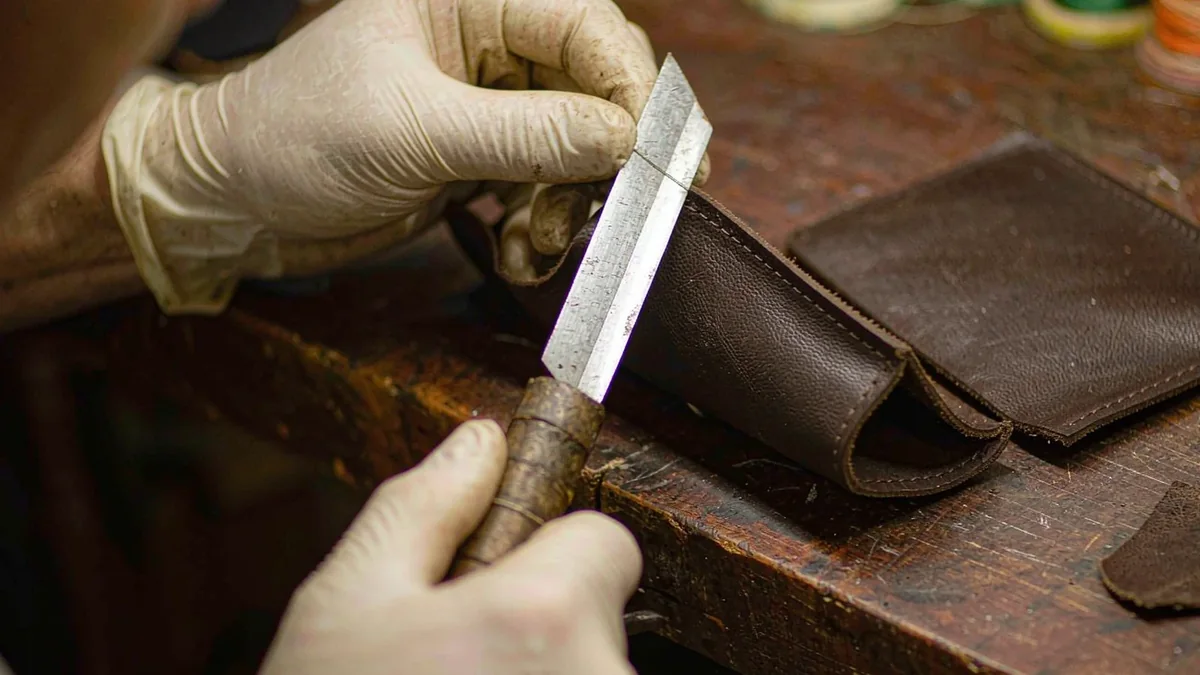
The consequence of getting it wrong is delayed. A seam that is under-drawn looks correct for a fortnight and then begins to show a line of thread standing proud along the fold, which is the point at which the customer notices and the return is raised.
Judgment Four: When the Edge Is Ready
Edge finishing is three coats at 0.08-0.12 mm wet, and the judgment is when the previous coat has flashed enough to take the next. Eight to ten minutes is the specification, but the actual test is touch: the surface should be dry to a fingertip and not drag. Coat applied too early traps solvent; applied too late, the next coat does not key and the edge lifts at the fold.
Ready
Surface is dry to a fingertip, does not drag, and takes the next coat without pulling. Three coats at 0.08-0.12 mm wet, sanded at 400 then 800 grit between the second and third.
Too early
Solvent is trapped beneath a surface that has already skinned over. The edge looks correct at despatch and cracks along the fold in the second month.
Too late
The next coat sits on a cured surface instead of keying into it. The edge lifts away from the fold in a single skin, usually starting at a corner.
Hand-finished edge work at this specification adds roughly USD 4.80 per unit in bench time. It is the single most defensible premium on a structured body, because it is the first thing a hand finds and the last thing a photograph shows.
What Apprenticeship Actually Buys
A bench asks for a three-year apprenticeship before an artisan is trusted with a visible seam on a premium line. In the first year the work is preparation and interior seams; in the second, body seams on hidden panels; in the third, visible seams, corners and edge work. The sequencing is deliberate: every operation a trainee touches first is one whose error can be corrected.
- Year one: preparation, skiving on hidden panels, interior machine seams.
- Year two: body seams on non-visible panels, turning, reinforcement placement.
- Year three: visible seams, corners, edge finishing and the final read.
- Output on a structured body settles at 25-40 pieces per bench per day.
That number is worth holding on to when a schedule is discussed. A bench producing 25-40 structured pieces a day cannot be doubled by adding hands to the last two operations, because the last two are the ones that need the third year. What additional trained hands do buy is throughput across a longer window: a run of 500 pieces at 30 per bench per day occupies roughly three weeks of bench time, and that is the number a delivery date has to respect.
The second thing apprenticeship buys is consistency between pieces. A trainee can produce one excellent piece; the skill being paid for is producing the three hundredth to the same tolerance as the first, on a different hide, in a different week, under a different light. That is the part a buyer is actually purchasing when a premium bench rate is agreed.
Where Judgment Costs Minutes and Where It Saves Them
Judgment is not uniformly worth its cost. It pays on the four decisions above and it does not pay on long straight interior seams, linings and zip insertion, where a fixed setting produces a better result than a hand deciding each time. The table below is the practical way to split a brief.
| Operation | Judgment worth? | Why |
|---|---|---|
| Hide placement | Yes, always | 8-11 percentage points of yield, and it cannot be revisited later |
| Skiving | Yes, always | Error is unrecoverable; a cut through the panel is scrap |
| Visible seam draw | Yes, always | Position of the thread decides whether the seam reads drawn or raised |
| Edge readiness | Yes, always | Flash readiness decides whether the edge survives month two |
| Interior seams | No | Distributed load, hidden, uniformity matters more than judgment |
| Lining and pockets | No | Bulk control benefits from a fixed setting |
| Zip insertion | No | A constant 3 mm margin is held better by a guide than by eye |
How to Buy Judgment at Briefing
Judgment is bought by specifying the decision rather than the outcome. Instead of writing 'hand finished edges', write three coats at 0.08-0.12 mm wet with 8-10 minutes of flash and sanding at 400 then 800 grit. Instead of 'fine stitching', write 8-9 per inch with the thread sitting 0.1-0.2 mm below the surface. The first version is a description and can be substituted; the second is a measurement and cannot.
- Ask which operations are hand-guided and which are fixed-setting, in writing.
- Ask for the tolerance held on skiving depth, not the fact that skiving happens.
- Ask what the flash interval is between edge coats, and whether it is recorded.
- Ask how many pieces per bench per day the line runs on a structured body.
The answers separate a house that has the skill from one that has the vocabulary. A line running 25-40 structured pieces per bench per day with a three-year progression behind it will answer all four without hesitation.
How to Tell Judgment Was Applied
Three checks at goods-in are enough. Count the pitch over 25.4 mm at three points on each seam and confirm it does not vary by more than one; run a fingertip along the edge and confirm there is no ridge at the coat boundaries; and flex the panel at the fold and look for thread rising out of the holes, which is the signature of an under-drawn seam. None of the three needs equipment beyond a loupe and a hand.
Inspection is drawn at AQL 2.5 under ISO 2859-1 with a re-work reserve held, and the material itself is tested against ISO 3376 for tensile strength and ISO 11644 for finish adhesion, so the judgment exercised on the bench is measured against a panel whose behaviour is already on file. Traceability behind that is evidenced through Leather Working Group tannery audits, with restricted substances screened against REACH Annex XVII.
The programme runs through our validated partner factory Quanzhou Yingming Bags, an SGS-validated site with 7 production lines and about 200,000 pcs per month of capacity, holding export experience since 2014. Sampling takes 6-10 working days, or 12-15 on a complex build; bulk occupies 35-50 days; minimums sit at 500 pcs per style and colourway; and shipments leave FOB Xiamen, with FOB, CIF and DDP terms all available.
Buy the judgment, not the vocabulary
Send the drawings, your material direction, quantity per colourway and delivery date. You will receive a costed specification naming which operations are hand-guided and the tolerance held on each. Request a quote.
Frequently Asked Questions
How do artisan skills shape a premium handbag?
Through four judgments a machine cannot make: where a panel sits on the hide, how deep the skiving knife goes, how hard the thread is drawn, and when an edge is ready for its next coat. Each is taken in seconds and each is worth measurable money, starting with 8-11 percentage points of hide yield.
Why does hide placement matter so much?
Because a hide is not a uniform sheet. Fibre runs tight in some areas and stretches in others, and scar lines sit below the grain. Placing visible faces first and taking hidden panels from what remains is worth 8-11 percentage points of usable yield against an ungraded marker.
How long does it take to read a hide?
Roughly 30-45 seconds per skin for a trained clicker. The speed matters: at that rate placement is a judgment rather than a deliberation, and the marker can be nested the same day the lot is released from the tannery.
What is the correct skiving depth?
A residual thickness of 0.6-0.8 mm across a width of 8-10 mm, with the knife held at 20-25 degrees to the surface. Too deep and the panel is scrap with no repair; too shallow and the step at the seam shows through the edge paint.
How hard should a stitch be drawn?
Until the thread sits 0.1-0.2 mm below the surface of the panel. Over-drawn and the panel puckers between holes and the seam reads raised; under-drawn and the thread lifts out of the hole the first time the fold flexes, which a customer notices a fortnight later.
How do you know when an edge coat is ready?
By touch rather than by clock: the surface should be dry to a fingertip and should not drag. Eight to ten minutes is the specification, but the test is the surface. Coat too early traps solvent; too late and the next coat will not key.
Why does edge finishing add so much bench time?
Because flash time is chemical rather than discretionary, so adding hands does not compress it. Three coats at 0.08-0.12 mm wet with sanding between passes add roughly USD 4.80 per unit, and it is the first thing a hand finds on a finished piece.
How long does bench apprenticeship take?
About three years before an artisan is trusted with a visible seam. Year one is preparation and interior seams, year two is hidden body seams and turning, year three is visible seams, corners and edge work. Every operation a trainee touches first is one whose error can be corrected.
How many pieces does a bench produce in a day?
Between 25 and 40 structured pieces per bench per day. That figure cannot be doubled by adding hands to edge finishing or burnishing, because both need the third year of apprenticeship and neither can be compressed without changing the result.
Where should judgment not be used?
Long straight interior seams, linings, pocket bags and zip insertion. These carry distributed rather than concentrated load, they are hidden, and uniformity across a run matters more than a decision taken at each stitch. A guide holds a 3 mm zip margin better than an eye.
How should a buyer specify artisan work?
By specifying the decision as a measurement rather than the outcome as an adjective. Write three coats at 0.08-0.12 mm wet with 8-10 minutes of flash, or 8-9 stitches per inch with thread 0.1-0.2 mm below the surface. A description can be substituted; a measurement cannot.
How can you verify judgment was applied at goods-in?
Count the pitch over 25.4 mm at three points per seam, run a fingertip along the edge for a ridge at coat boundaries, and flex the panel to check no thread rises out of the holes. Then draw inspection at AQL 2.5 under ISO 2859-1 with a re-work reserve.
People Also Ask
What does an artisan actually decide on a handbag?
Four things: where the panel sits on the hide, how deep to skive, how hard to draw each stitch, and when an edge coat has flashed enough to take the next. Everything else is repetition of a setting.
Is hand work always better than machine work?
No. Judgment pays on visible and loaded operations; a fixed setting is better on linings, interiors and zip insertion, where uniformity across the run matters more than a decision at each stitch.
How much hide yield does skill add?
Around 8-11 percentage points against a marker nested without grade placement, which is the difference between booking 100 skins for a run and booking 112.
Why can't a schedule simply be shortened by adding hands?
Because the slowest operations — edge finishing and burnishing — need trained judgment, and flash time between coats is chemical. Neither responds to additional hands on the bench.
How do you tell a skilled bench from one with the vocabulary?
Ask four questions in writing: which operations are hand-guided, the skiving tolerance held, the flash interval between coats, and pieces per bench per day. A real line answers all four immediately.
Sources and further reading
Every figure on this page is either our own programme data or attributed below. Open the originals before you write them into a specification.
- ISO — International Organization for StandardizationISO Publisher of ISO 2859-1 for the AQL 2.5 inspection plan, ISO 3376 for leather tensile strength, ISO 11644 for finish adhesion and ISO 105 for colour fastness.
- Leather Working GroupLeather Working Group Tannery audit protocol that evidences hide traceability, which is the material basis for the placement judgment taken at the clicking bench.
- SATRA Technology CentreSATRA Independent testing body for leather goods, referenced for seam strength, thread abrasion and finish adhesion test methods.
- European Chemicals AgencyECHA Regulator for REACH, whose Annex XVII restrictions apply to the dyes, finishes and edge coatings used on premium leather goods.