How Artisan Ateliers Train Luxury Bag Makers: Four Stages Over Eighteen Months
Artisan ateliers train luxury bag makers in four stages across eighteen months, and the structure is the same everywhere it works: every operation a trainee touches first is one whose error can still be corrected. Progress is marked by three consecutive pieces held inside tolerance rather than by time served, one mentor carries three trainees, and a trainee's scrap rate of 4-6% is carried deliberately against a line average of 1.2%.
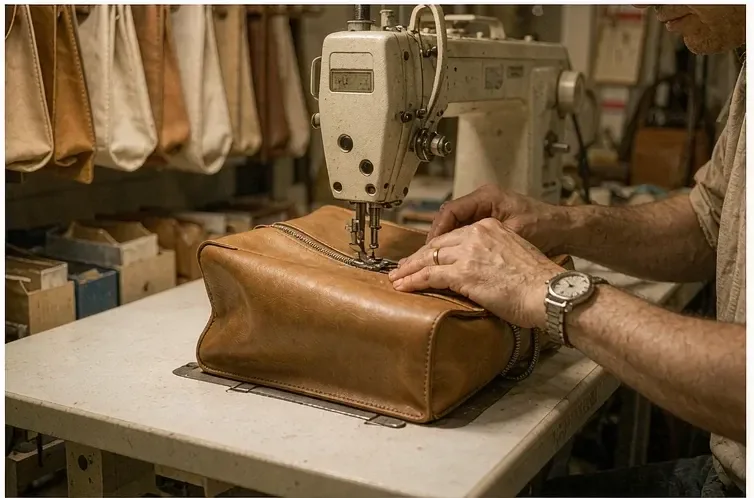
The Case: One Trainee, Four Stages, Eighteen Months
Follow one trainee from the first day on the bench to full sign-off and the shape of the system becomes clear. She spends her first six months on preparation and interior work, the second six on hidden body seams, and the third on visible seams, corners and edge finishing. At every stage boundary the same test is applied and the same record is kept. Nothing in the sequence is there for tradition's sake: the order exists so that the most expensive possible mistake is never the first one a trainee is allowed to make.
- Total to full sign-off
- 18 months across four stages
- Stage length
- 6 months, assessed every 6 weeks
- Pass mark
- 3 consecutive pieces inside tolerance
- Mentor ratio
- One mentor to three trainees
- Trainee scrap rate
- 4-6%, against a line average of 1.2%
- Reference board
- Five fault cards per station
The trainee's scrap rate is the number most buyers react to, and it is worth being direct about it. During training it runs at 4-6% against a line average of 1.2%, and that difference is carried deliberately rather than corrected. It is the cost of the only thing the programme produces: a person who can take the same four judgments correctly at speed, on the three hundredth piece, on a different hide, under different light.
What the First Six Months Cover
Preparation, and nothing that a customer will see. Skiving on hidden panels, interior machine seams, turning practice on scrap, reinforcement placement and the handling of tools. Every one of those operations has a recovery: a skive taken too deep on a hidden panel means the panel is used for practice rather than scrapped, and an interior seam unpicked is an interior seam re-run. The first six months are designed so that failure costs little and happens often.
- Skiving on hidden panels, building toward a residual of 0.9-1.0 mm at the fold.
- Interior machine seams at a constant pitch, judged against a marked line rather than by eye.
- Turning practice on scrap bodies, including corners at three radii.
- Reinforcement placement, cut to finished size rather than traced from the face panel.
- Tool care: honing a knife at 20 degrees and re-honing during the day rather than at its end.
Tool care sits inside the first stage for a reason that is not obvious until it is missed. A knife honed at 20 degrees pares; the same knife at the end of a day tears, and a tear at the fold opens weeks later rather than on the bench. Teaching a trainee to re-hone during the day rather than at its end is teaching the one habit that prevents a class of fault nobody will ever trace back to the blade, because by the time the fold opens the knife has been sharpened again many times.
The Reference Board: Five Faults Per Station
Each station carries a board with five fault cards, and the board is the curriculum. The cards are physical examples rather than descriptions: a seam under-drawn so the thread stands proud, an edge with one thick coat cracked at the fold, a corner with pitch crowding at the radius, a skive taken through the panel, and a plate seated two millimetres off centre. A trainee learns to see the fault before learning to avoid it, because the fault is easier to recognise than the correct result is to reproduce.
Under-drawn seam
Thread standing proud of the surface, which appears a fortnight after the piece was made. The card shows the seam at 10x and again after twenty flex cycles, because the fault is invisible at arm's length on the day it is made.
Single thick edge coat
A rounded bead proud of the panel with a different sheen from the face. The card is cracked deliberately at the fold so the trainee can see the failure mode rather than read about it.
Skive taken through
The one unrecoverable error on the bench, and the reason skiving is taught on hidden panels first. The card is kept beside the knife rather than on the board, which is where the decision is taken.
Five cards per station is not arbitrary. Fewer and the trainee learns to recognise rather than to distinguish; more and the board stops being consulted, which is the failure mode of every training aid that tries to be complete. The cards that matter are the ones whose appearance at goods-in would be expensive, and they are chosen per station rather than shared across the line.
What Counts as Passing
Three consecutive pieces inside tolerance, and not one piece, and not an average. The reason is that anyone can produce one excellent piece; the skill being certified is reproducing it. Consecutive means the third cannot be a lucky recovery after two failures, and tolerance means a number rather than an impression: pitch spread of no more than one stitch across three points, gauge within ±0.1 mm, and no squeeze readable at any seam.
| Stage | Months | Certified by |
|---|---|---|
| Preparation and interiors | 1-6 | Three consecutive panels skived to 0.9-1.0 mm with no cut-through |
| Hidden body seams | 7-12 | Three consecutive bodies with no seam drift over 100 mm |
| Visible seams and corners | 13-18 | Three consecutive bodies passing the goods-in checklist |
| Full sign-off | 18 | Recorded per station, reviewed every 6 weeks thereafter |
Assessment runs every six weeks rather than at the end of a stage, which is the part that catches a trainee who has plateaued. A six-week cycle produces enough evidence to intervene while the stage is still recoverable, and it produces a record that can be shown to a buyer without preparation. A house that assesses only at stage boundaries will discover a plateau at month twelve and lose six months to it.
Months Thirteen to Eighteen: Visible Work
The final stage is where the cost of an error becomes real. Visible seams, corners and edge finishing are taught last because none of them can be re-run: an edge built wrongly on a finished body means the body is scrapped, not corrected. Before a trainee reaches this stage she has already made every recoverable mistake the bench has to offer, which is the entire logic of the sequence.
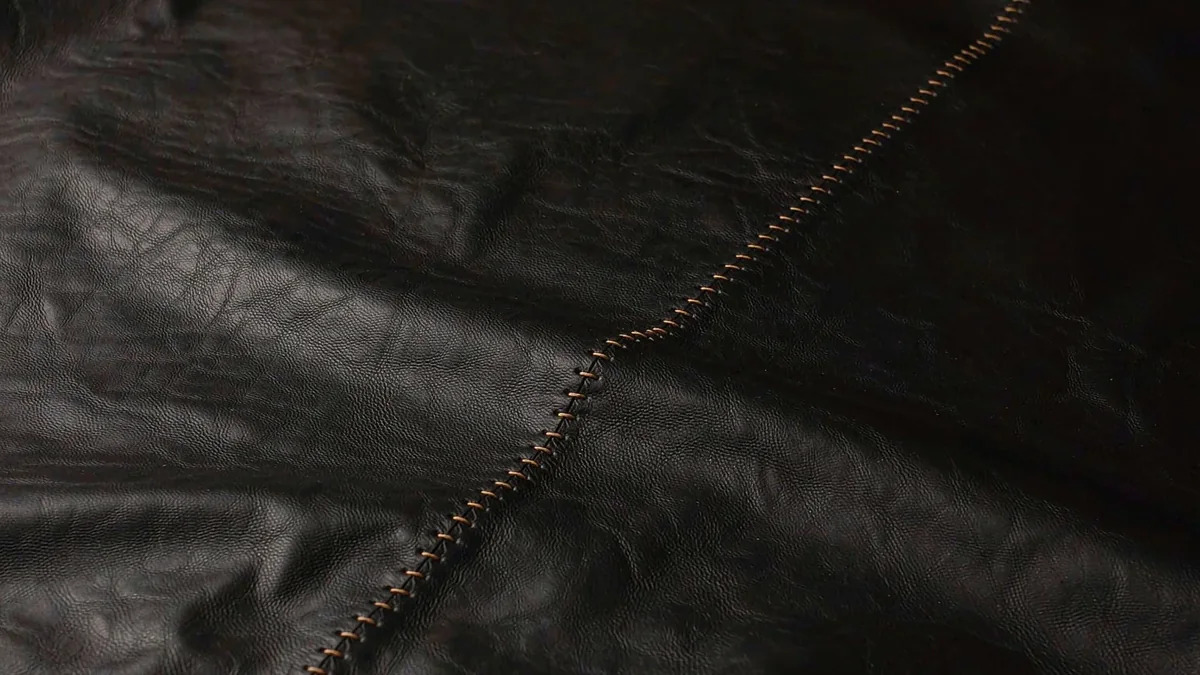
Sign-off at this stage is recorded per station and per person rather than assumed from time served. That record is what lets a house answer a quality question in an afternoon: which person was on station four during the week in question, and what that person's last three pieces measured. A house without the record will guess, and the guess is nearly always wrong in the direction of the newest person on the line.
Two operations inside the final stage are slower to certify than all the rest, and a schedule should assume it. Edge finishing needs the trainee to learn a chemical interval as well as a hand movement, and the interval cannot be practised faster than it runs. Corners need the trainee to vary the pitch while keeping it even, which is the one judgment on the bench that is genuinely difficult rather than merely precise. Certifying those two typically occupies the last four of the eighteen months, and a house that offers to compress them is offering to certify on one piece rather than three.
What Training Costs and Who Carries It
Training costs throughput in the quarter it happens and consistency in every quarter after. A mentor carrying three trainees is working at reduced output herself, the trainee scrap rate of 4-6% sits above the 1.2% line average, and the six-month stage length means the investment is not recovered inside a single season. Houses that skip it run faster for a season and then spend the following one answering returns about edges that cracked at the fold.
Ask to see the sign-off record: which person is certified on which station, and what their last three pieces measured. A house with the programme answers from a file. A house without it answers from memory.
There is a second cost that is rarely named and belongs on the table: what training does to a schedule. A trainee on station two works at roughly half the pace of a signed-off bench for the first three months of a stage, and the bodies she handles occupy space in the six-body buffer that a finished piece would have used. Over a season that is a measurable reduction in output, and the honest way to carry it is to plan the run around a bench that is known to be in training rather than to discover it when the delivery date slips.
How a Buyer Can Tell Whether Training Is Real
Four signals, all of them observable during a single visit. Whether each station has a reference board with physical fault cards. Whether sign-off is recorded per station and per person. Whether the trainee scrap rate is stated openly rather than hidden inside the line average. And whether the newest person on the line is working on interior panels rather than on visible seams. A house that fails the last one is training on the customer's order.
The fourth signal is the one worth insisting on, because it is the only one that cannot be prepared for. Everything else — the board, the record, the stated scrap rate — can be assembled for a visit. Where the newest person is actually placed cannot, and it tells you what the house does when nobody is watching, which is the only version of the answer that matters.
Training in one line
- Train on the operations whose errors are recoverable, certify on three consecutive pieces rather than on time served, and record sign-off per station and per person.
One further signal is worth adding, because it is the only one that survives into the relationship rather than the visit: what happens to a trainee's work before it reaches a customer. A house with a real programme routes every piece made by someone below full sign-off through a second inspection rather than into the general run, and can say how many pieces that route handled last month. A house without one relies on the line average, which is precisely the number that hides the trainee scrap rate rather than accounting for it.
Programme Figures
Our programme runs through our validated partner factory Quanzhou Yingming Bags, an SGS-validated site with 7 production lines and roughly 200,000 pcs per month of capacity, holding export experience since 2014. Sampling takes 6-10 working days, or 12-15 on a complex build; bulk occupies 35-50 days; minimums sit at 500 pcs per style and colourway; and shipments leave FOB Xiamen with FOB, CIF and DDP terms all available. Inspection is drawn at AQL 2.5 under ISO 2859-1 with a re-work reserve held, and leather is tested against ISO 3376 for tensile strength. Apprenticeship frameworks are described by the International Labour Organization, and the bench sequence is set out on the craftsmanship page.
See the sign-off record before you commit
Send the silhouette, hardware direction, quantity per colourway and target delivery date. You will receive a written statement of which stations are certified and how sign-off is recorded. Request a quote.
Frequently Asked Questions
How do artisan ateliers train luxury bag makers?
In four stages over eighteen months, ordered so that every operation a trainee touches first is one whose error can still be corrected. Preparation and interiors first, hidden body seams second, visible seams, corners and edge work last, because a wrongly built edge on a finished body cannot be re-run.
How long does it take to train a bag maker?
About eighteen months to full sign-off across four six-month stages, with assessment every six weeks rather than at stage boundaries. The six-week cycle is what catches a plateau while the stage is still recoverable.
What counts as passing a training stage?
Three consecutive pieces held inside tolerance, not one piece and not an average. Anyone can produce one excellent piece; what is being certified is reproducing it, with pitch spread under one stitch and gauge within ±0.1 mm.
What is a reference board?
A board at each station holding five physical fault cards: an under-drawn seam, a single thick edge coat cracked at the fold, pitch crowding at a corner, a skive taken through, and a plate seated off centre. Trainees learn to see the fault before they can consistently avoid it.
Why is skiving taught on hidden panels first?
Because a skive taken through the panel is the one unrecoverable error on the bench. Teaching it first on hidden panels means the early mistakes cost practice material rather than a finished body.
What is the trainee scrap rate?
Between 4 and 6%, against a line average of about 1.2%. The difference is carried deliberately as the cost of producing someone who can take four judgments correctly at speed on the three hundredth piece of a run.
How many trainees does one mentor carry?
Three. A mentor working at that ratio produces at reduced output herself, which is why training costs throughput in the quarter it happens and returns consistency in every quarter afterwards.
Why is edge finishing taught last?
Because it cannot be re-run. Visible seams, corners and edge work are the final stage precisely because an error there scraps the body rather than being corrected, so trainees reach it having already made every recoverable mistake.
How is sign-off recorded?
Per station and per person, with the measurements from the last three pieces, reviewed every six weeks after full sign-off. That record is what lets a house answer a quality question in an afternoon rather than a week.
How can a buyer tell whether training is real?
Four signals in one visit: a reference board at each station, sign-off recorded per person, the trainee scrap rate stated openly, and the newest person placed on interior panels rather than visible seams. The last cannot be prepared for.
What does skipping training cost?
A season of faster output followed by a season of returns about edges that cracked at the fold and seams whose thread lifted. The faults appear in month two, long after the schedule benefit has been spent.
How long does sampling and bulk take?
Sampling takes 6-10 working days, or 12-15 on a complex build, and bulk occupies 35-50 days at 500 pcs per style and colourway. Shipments leave FOB Xiamen, with FOB, CIF and DDP terms all available.
People Also Ask
Can training be shortened for a simple bag?
Partly. A simple unstructured body needs fewer operations, but the four judgments — placement, skiving, draw and edge readiness — still take about eighteen months to become reliable at speed.
Why not just train people on one station only?
Because attention decays. A person doing one operation for six hours stops seeing it, and the gauge spread across a run widens. Three stations with rotation every 90 minutes holds consistency and covers absence.
Is a high trainee scrap rate acceptable?
Yes, if it is stated openly and carried on practice material. A rate of 4-6% against a 1.2% line average is the normal cost of training; a house claiming no difference is either not training or hiding it.
What should be visible during a bench visit?
A reference board at each station, a sign-off file, and the newest person on interior panels. Those three cannot be assembled at short notice, which is what makes them worth looking for.
How often should sign-off be reviewed?
Every six weeks after full sign-off. A quarterly or annual review discovers drift long after it has reached the customer, and the record stops being useful as evidence.
Sources and further reading
Every figure on this page is either our own programme data or attributed below. Open the originals before you write them into a specification.
- International Labour OrganizationInternational Labour Organization Source for apprenticeship and skills-development frameworks relevant to staged bench training and recorded sign-off.
- ISO — International Organization for StandardizationISO Publisher of ISO 2859-1 for the AQL 2.5 inspection plan and ISO 3376 for leather tensile strength.
- SATRA Technology CentreSATRA Independent testing body for leather goods, referenced for seam and edge test methods used in training assessment.
- Leather Working GroupLeather Working Group Tannery audit protocol evidencing hide traceability behind the material a trainee learns to read at the clicking bench.