Handcrafted vs Mass Produced Luxury Bags: What a Buyer Is Actually Paying For
Handcrafted and mass produced luxury bags are not one object made two ways; they are two different production logics. A bench-built body puts 8-9 stitches per inch on visible seams, builds an edge in three coats to 0.9 mm and holds a handle drop to ±2 mm. A machine-led line runs 1.8-2.4 metres per minute and holds one setting for the whole run. The correct answer for most programmes is a mix, and this piece sets out where each method wins, what it costs in minutes and how to verify the claim before you order.
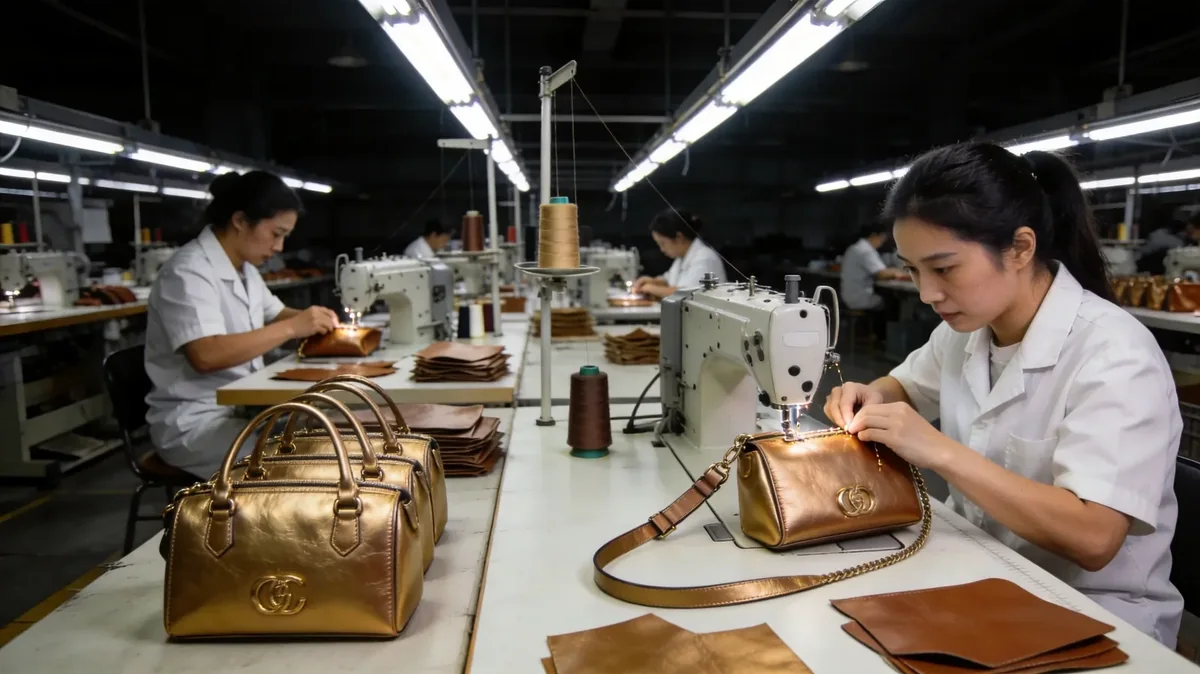
What Actually Changes When a Bag Is Made by Hand?
Hand work changes three things and leaves everything else alone: how a seam fails, how an edge is finished, and how much variation there is between piece one and piece five hundred. It does not change the leather, the hardware or the pattern, and a programme that spends on bench minutes while specifying a 0.6 mm split will not look or behave like a luxury piece however many hours go into it.
The mechanism is not mysterious. A bench hand sets tension at every stitch and dresses an edge in three coats with a flash-off between each, so the result is a seam that can be repaired locally and an edge that stays flexible where the panel folds. A machine sets tension once at the head and applies the finish in a single pass, which is faster and more uniform but leaves fewer options once something has gone wrong.
The third change is variance, and it runs in the opposite direction from what most buyers expect. Bench work introduces variation between operators; machine work reduces it. Across a run at 500 pcs per style and colourway, ten benches will not dress an identical edge, while one finishing head will. That is why the specification has to name tolerances rather than adjectives, and why a tolerance is worth more to you at goods-in than a method is.
Where Does a Machine Line Honestly Beat the Bench?
Long straight interior seams, linings, pocket bags and zip insertion are better done on a machine, and it is worth saying so plainly at briefing because the alternative is a specification asking for hand work everywhere and a costing that quietly substitutes it. The seam is hidden, the load is distributed rather than concentrated, and the uniformity a machine holds across five hundred pieces is worth more than a repairability nobody will ever use.
- Interior seams and pocket bags: hidden, distributed load, and uniformity is the only requirement that matters.
- Zip insertion: the tape needs a consistent 3 mm margin, and a fixed guide holds that better than a hand over a long run.
- Lining assembly on 120 gsm twill: a machine controls fullness at the turn, which is where hand lining bulks.
- Repetitive top-stitching: a guide keeps the line 3 mm from the fold for the whole panel rather than for the first 200 mm of it.
- Dust bag and presentation sewing: no customer consequence, so speed should win without argument.
There is also a bulk argument that gets overlooked. A #46 thread at about 0.24 mm on a machine produces less bulk at a fold than a hand seam of the same length with a 0.45 mm waxed braid, and on a lined body with four interior seams that difference decides whether the panel sits flat or bubbles. Bulk is a quality defect that reads as poor pattern work, so it is worth avoiding on purpose.
How Many Minutes Does Hand Work Add to a Structured Body?
Every argument about hand work is really an argument about minutes, so it is worth writing the minutes down. The figures below are working averages from a structured body with a 1.2-1.4 mm shell; they are not precise to the second, but the ratios hold and the ratios are what you are costing.
| Operation | On the machine | At the bench | Where it normally lands |
|---|---|---|---|
| Visible body seam, 1.2 m | About 30 seconds | About 10 minutes | Bench work wherever the seam is seen |
| Edge dressing, 1.2 m | One pass, about 90 seconds | 3 coats with 20 min flash, about 75 minutes | Bench work on the top edge, machine inside |
| Handle wrap, 260 mm | About 45 seconds | About 6 minutes | Bench work, without exception |
| Turning a structured body | About 25 seconds | About 40 seconds | Either, depending on the construction |
| Creasing a panel edge | About 20 seconds at 110-130 °C | About 2 minutes | Bench work on a visible crease |
| Final press and set | 8 seconds under the press | 15-20 seconds dressed by hand | Either |
Add those lines together and the picture is stable. A structured body with six visible seams, a dressed top edge, a handle wrap and two creased panels carries somewhere between 90 and 130 minutes of bench time that a machine-led line would complete in under 20. That gap is the entire cost argument, and it is also the reason the decision should be taken per operation rather than per bag.
The minutes explain the schedule too. Sampling runs 6-10 working days, or 12-15 working days on a complex build, and most of that window is spent setting, testing and correcting the operations above rather than waiting for materials. Bulk occupies 35-50 days from approval. Neither number moves much with the method; what moves is how many corrections the method tolerates before the piece has to be started again.
What Does the Difference Feel Like in the Hand?
Feel is not mysticism. It is four measurable things, and all four can be written into a brief. Weight and balance: a medium structured body sits at 480-620 g, and where that mass sits decides whether the piece hangs or swings. Edge geometry: an edge built in three coats to a final 0.9 mm reads as round to the thumb, while one heavy coat reads as square and cracks where the panel folds.
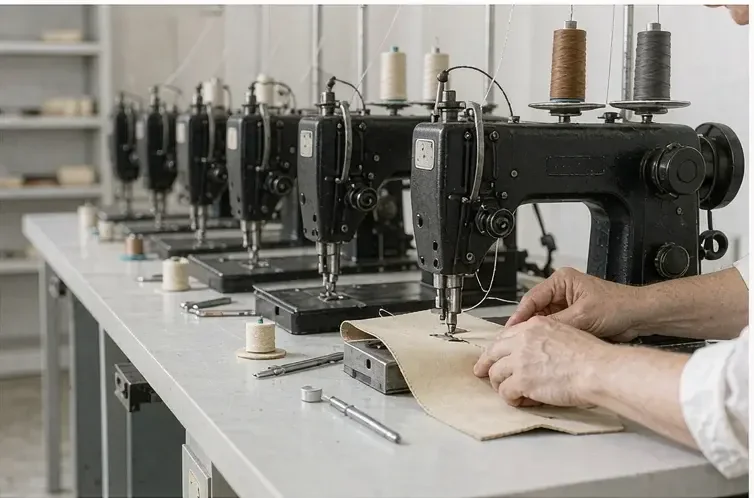
The third is the handle, and the fourth is sound. A handle drop held to ±2 mm with a wrap at 10-12 per inch is the first surface a customer touches and the one that is most often wrong by 5 mm on a first sample. A lined body with 0.8 mm of board under the base does not drum when it is set down on a hard surface; an unlined panel with no board does. Specifying the board is cheaper than specifying more leather, and it is the line most often missing from a brief.
Weight and balance
480-620 g for a medium structured body, with the mass carried low so the piece hangs rather than swings when it is carried.
Edge geometry
Three coats to a 0.9 mm build, each flashed before the next goes on, so the edge stays flexible where the panel folds.
Handle and drop
A drop held to ±2 mm and a wrap at 10-12 per inch, because the handle is the first surface a customer actually touches.
Sound at set-down
0.8 mm of reinforcement board under the base stops the panel drumming when the bag is put down on a hard surface.
Which Operations Should Never Leave the Bench?
Four operations stay at the bench regardless of run length: handle joins and wraps, gusset corners and mitred turns, closure reinforcement patches, and the visible top edge. All four concentrate load at a point rather than distributing it, all four are seen or touched in normal use, and all four are expensive or impossible to put right once the body has been closed.
- Handle joins: the full weight of the contents arrives at two points, and a local repair is the only practical remedy once the piece is in use.
- Gusset corners: load concentrates at the turn, so the panel is skived to about 0.5 mm and the pitch is tightened through the corner.
- Closure patches: the stitch has to be placed around the hardware foot rather than across it, which a machine cannot choose to do.
- Visible top edge: three coats with 20 minutes of flash between each, dressed rather than sprayed, then buffed back.
The one-line rule
- Specify the method per operation and the tolerance per method. A brief that names a method but no tolerance will be argued about at goods-in; a brief that names a tolerance but no method will be substituted at costing.
Everything else is negotiable, and it should be negotiated in minutes rather than in principle. If an operation is neither seen nor loaded, it does not belong at the bench, no matter how the piece is going to be described in a lookbook. The reverse also holds: an operation that is both seen and loaded should not be moved to a machine to save 40 seconds.
How Do You Verify a Handcrafted Claim Before Ordering?
Ask for the operation breakdown rather than the adjective. A genuine hand-finished programme can list which operations are done at the bench, roughly how long each takes and what tolerance it holds. A programme that cannot produce that list is describing an aspiration, and an aspiration cannot be inspected, costed or repeated on the next order.
- Request the operation sheet: every step, the method and the minutes, in the order they are performed.
- Ask for a photographed reference at 1:1 magnification of one approved seam and one dressed edge you can compare against.
- Take a stitch count over 25.4 mm at three points on each seam; the count should not vary by more than one.
- Measure the edge build with a gauge; 0.8-1.0 mm is the working range and a single coat will not get there.
- Flex the panel at the fold and look for the finish lifting, which is the signature of a coat applied too thick.
Then put it on paper. Inspection is drawn at AQL 2.5 under ISO 2859-1, which on a lot of 500 pieces at general inspection level II gives a sample size of 50 with an acceptance number of 3 and a rejection number of 4. Leather itself is tested against ISO 3376 for tensile strength and ISO 11644 for finish adhesion, with colour fastness against ISO 105. Recorded material performance is what turns a discussion about feel into a measurement.
What Goes on the Tech Pack When You Mix the Two?
- Method per operation
- Bench or machine, named on the operation sheet
- Visible seam pitch
- 8-9 per inch, tolerance ±1 stitch over 25.4 mm
- Interior seam pitch
- 6-7 per inch, #46 thread at about 0.24 mm
- Edge build
- 3 coats to 0.9 mm, 20 minutes flash between coats
- Handle drop
- ±2 mm across the run
- Base reinforcement
- 0.8 mm board under the panel
- Hardware
- 4 mm rivet in a 4.2 mm hole, plating 0.15-0.3 µm
- Inspection
- AQL 2.5 under ISO 2859-1, third-party available
Two further lines are worth adding because they are the ones that get dropped when a schedule tightens. Name the finish adhesion requirement for the edge coating, and name the salt spray duration for the hardware, at 24 hours or 48 hours depending on the market the piece is going to. Both cost very little to test during the sampling window and a great deal to discover after the goods have landed.
The programme itself runs through our validated partner factory Quanzhou Yingming Bags, an SGS-validated site with 7 production lines and about 200,000 pcs per month of capacity, holding export experience since 2014. The bench standards behind these tolerances are set out on the craftsmanship page, and the material the panel and thread are tested against is described under luxury materials.
How the Programme Runs: Minimums, Sampling and Inspection
Start with the drawing and the material direction. Sampling takes 6-10 working days, or 12-15 working days on a complex build, and that window is where the method per operation is decided rather than described. Bulk occupies 35-50 days from approval. Minimums sit at 500 pcs per style and colourway, and inspection is drawn at AQL 2.5 under ISO 2859-1 with third-party inspection available alongside the internal audit. Shipments leave FOB Xiamen, with FOB, CIF and DDP all available.
On the compliance side, hides are traced through the tannery audit protocol run by the Leather Working Group, and dyes, finishes and adhesives are checked against REACH Annex XVII for the European market and California Prop 65 for the United States. Where a programme calls for a species listed under CITES, the permit travels with the shipment. These are not finishing details to be settled later; they are the conditions under which the piece can be sold at all.
One practical note on rework. Putting a single closure right on a returned piece costs around USD 4.80 in parts and bench time before freight is counted, which is more than the difference between a hand-set and a machine-set rivet on that operation. The economics favour specifying the method correctly at briefing rather than correcting it after delivery.
Name the method, not the adjective
Send the drawings, your material direction, quantity per colourway and delivery date. You will receive a costed operation sheet naming the method, the minutes and the tolerance for every step on the body. Request a quote.
Frequently Asked Questions
What is the real difference between a handcrafted and a mass produced luxury bag?
The leather, hardware and pattern can be identical. What differs is how a seam fails, how an edge is finished and how much variation there is across the run. Hand work sets tension at every stitch and dresses an edge in three coats; a machine sets tension once at the head and applies the finish in a single pass.
Is a handcrafted bag stronger than a machine-made one?
Not in peak tensile terms. The difference is in failure behaviour and repairability: a hand saddle seam stops the damage at the adjacent stitch and can be unpicked locally, while a machine seam that has released along its length usually has to be re-run from the start.
Which operations should always be done by hand?
Handle joins and wraps, gusset corners, mitred turns, closure reinforcement patches and the visible top edge. All of them concentrate load at a point, all are seen or touched in normal use, and all are difficult or impossible to correct once the body has been closed.
Where is machine work genuinely the better choice?
Long straight interior seams, linings, pocket bags and zip insertion. These are hidden, carry distributed rather than concentrated load, and benefit from the uniformity a machine holds across five hundred pieces. Bulk at the fold is also easier to control with a finer thread on a machine.
How many stitches per inch should a luxury handbag have?
Eight to nine per inch on visible body seams, which is 2.8-3.2 mm between holes. Interior and lining work runs at 6-7 per inch. Handle wraps and fine detail go to 10-12 per inch, but a tighter pitch on a thin shell begins to perforate the panel rather than sew it.
How much bench time does hand finishing actually add?
A structured body with six visible seams, a dressed top edge, a handle wrap and two creased panels carries roughly 90 to 130 minutes of bench work that a machine-led line would complete in under 20. That gap is the entire cost argument for a mixed specification.
What should a leather edge be built to on a luxury bag?
Three coats to a final build of about 0.9 mm, with 20 minutes of flash-off between coats. A single heavy coat reads square, stays tacky for longer and cracks where the panel folds. The build is checked with a gauge at goods-in, and the working range is 0.8-1.0 mm.
How do you verify a handcrafted claim before placing an order?
Ask for the operation sheet rather than the adjective. A genuine programme can list each step, the method and the minutes, and can show a photographed reference at 1:1 magnification. If that list cannot be produced, the claim is describing an aspiration rather than a documented build.
What is AQL 2.5 and what does it mean on a 500 piece order?
AQL 2.5 is the acceptance quality limit drawn under ISO 2859-1. On a lot of 500 pieces at general inspection level II, it gives a sample size of 50 with an acceptance number of 3 and a rejection number of 4. Third-party inspection can be added alongside the internal audit.
How long do sampling and bulk production take?
Sampling takes 6-10 working days, or 12-15 working days on a complex build, and that window is where the method per operation is decided. Bulk occupies 35-50 days from approval. Minimums sit at 500 pcs per style and colourway, and shipments leave FOB Xiamen with FOB, CIF and DDP all available.
Does hand work increase variation between pieces?
Yes, and that is the trade-off most buyers miss. Ten benches will not dress an identical edge, while one finishing head will. The remedy is to specify tolerances rather than methods: a handle drop held to ±2 mm and a stitch pitch within one stitch over 25.4 mm.
What makes a bag feel expensive when you pick it up?
Four measurable things: weight and balance, with a medium structured body at 480-620 g; an edge built to 0.9 mm; a handle drop held to ±2 mm with a wrap at 10-12 per inch; and the sound the piece makes when set down, which 0.8 mm of base board controls.
Which material and chemical standards apply to a luxury bag programme?
Hides are traced through the Leather Working Group tannery audit protocol. Dyes, finishes and adhesives are checked against REACH Annex XVII for Europe and California Prop 65 for the United States. Leather is tested against ISO 3376 for tensile strength and ISO 11644 for finish adhesion.
Can a programme mix hand and machine work on a single bag?
Yes, and most do. The costed answer puts bench work on the operations that are seen or loaded and machine work on the ones that are neither. A mixed specification is not a compromise; it is the correct engineering answer and it is what the majority of maisons actually run.
People Also Ask
What does handcrafted actually mean for a handbag?
It means specific operations are performed at a bench with hand-set tension and hand-applied finishing, not that the piece is built without machines. The credible claim names the operations, the minutes and the tolerance held.
Are handcrafted bags worth the additional cost?
On operations that are seen or loaded, yes, because the seam can be repaired locally and the edge survives the fold. On hidden interior work the extra minutes buy nothing a customer will ever notice or feel.
How can you tell if a bag is really hand finished?
Count the stitches over 25.4 mm at three points, check the slant is constant at 15-20 degrees, and measure the edge build at 0.8-1.0 mm. Then ask for the operation sheet listing each step and its minutes.
Do luxury maisons use machines at all?
Yes. Machine work holds tolerances across a long run that benches cannot match, particularly on linings, interiors and zip insertion. The real distinction is which operations stay at the bench, not whether machines are used.
What tolerance should a luxury handbag be built to?
A handle drop within ±2 mm, a stitch pitch within one stitch over 25.4 mm, and an edge build of 0.8-1.0 mm. Those three are measurable at goods-in and cover most of what a customer perceives as quality.
Sources and further reading
Every figure on this page is either our own programme data or attributed below. Open the originals before you write them into a specification.
- ISO — International Organization for StandardizationISO Publisher of ISO 2859-1 for the AQL 2.5 plan and its sample size of 50 on a 500 piece lot, ISO 3376 for leather tensile strength, ISO 11644 for finish adhesion and ISO 105 for colour fastness.
- Leather Working GroupLeather Working Group Tannery audit protocol used to evidence hide traceability, which fixes the panel before any question of method or minutes arises on the bench.
- European Chemicals AgencyECHA Regulator for REACH, whose Annex XVII restrictions apply to the dyes, finishes and adhesives used on shells, linings and edge coatings.
- CITES — Convention on International Trade in Endangered SpeciesCITES Permit framework governing any programme that specifies a species listed in the appendices; the permit travels with the shipment rather than being issued at destination.