A Handbag Maison Timeline From Sketch to Delivery: Three Calendars Compared Gate by Gate
How long does a handbag maison take to go from sketch to delivery? On a standard route the answer is roughly 55-75 working days, on a compressed one 45-55, and on a calendar involving exotic skins or bespoke hardware 85-105. The three routes pass through the same seven gates: technical pack, material reservation, toile, sampling, spec freeze, bulk, then audit and packing. What changes is not the sequence but how heavily each gate is resourced, how much overlap the calendar allows, and how much slack you are willing to pay for. Below, the three calendars are set side by side stage by stage, followed by the four buffers that keep them honest.
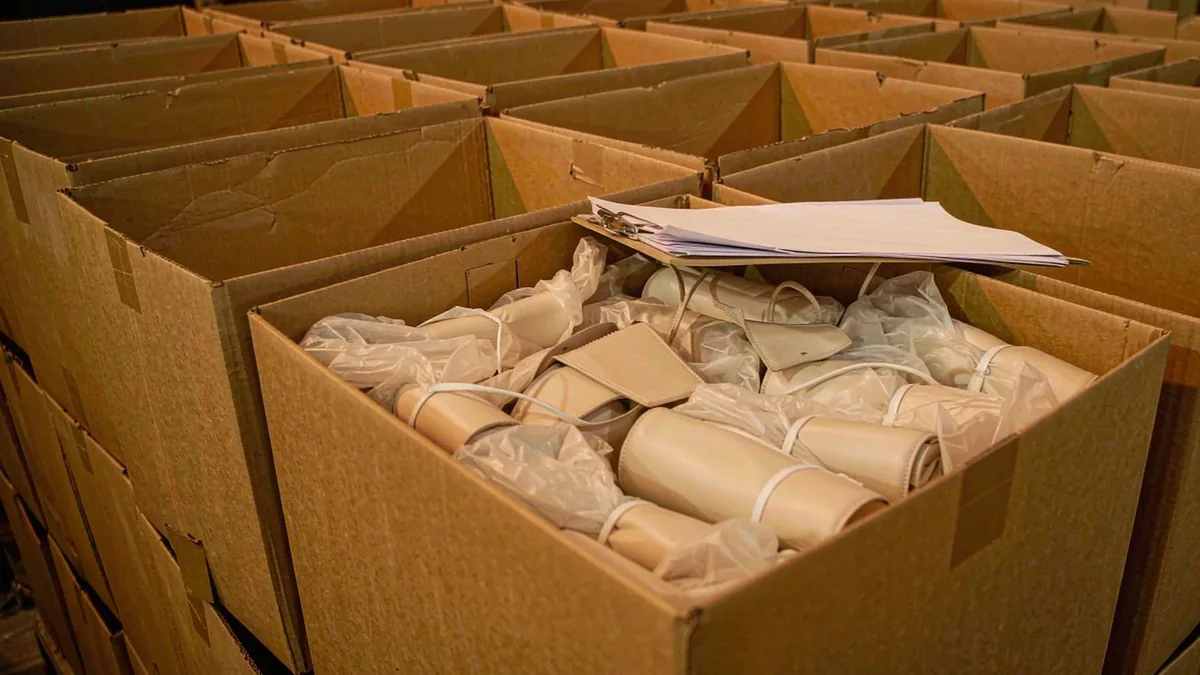
Three Calendars Passing Through Seven Gates
Every maison programme passes through seven gates in the same order, whatever the calendar: technical pack, material reservation, pattern and toile, sampling, spec freeze, bulk, then audit and packing. A compressed calendar does not remove gates; it resources them more heavily and overlaps the ones that can run in parallel.
Founders usually ask for the shortest possible date, which is the wrong question by a margin. The useful question is which gates genuinely need days and which are merely waiting, because those two kinds of time respond to completely different remedies. Waiting can be overlapped; work can only be resourced or simplified.
- Reading a calendar in weeks rather than working days quietly adds around ten days to any twelve-week plan.
- Material lead time is calendar time, and it runs whether or not anyone is working on your panels.
- Approval delays sit between gates rather than inside them, so they never appear on a production schedule.
- Freight booking has its own seasonal peaks, notably around trade shows and the autumn shipping window.
Stage by Stage: Standard, Compressed and Complex
The table below sets the three calendars against each other in working days, using our standard programme as the reference: MOQ 500 pcs per style and colourway, sampling of 6-10 working days and bulk of 35-50 days on FOB Xiamen terms.
| Stage | Standard calendar | Compressed calendar | Complex or exotic calendar |
|---|---|---|---|
| Technical pack | 3-5 days from your brief | 2-3 days taken off a reference style | 5-8 days for framed or structured bodies |
| Material shortlist and reservation | 15-20 days for a named lot | 5-8 days on a held lot | 30-45 days where permit documents apply |
| Pattern and toile | 2-3 days, often two toiles | 1-2 days, single toile | 4-6 days, graded panel set |
| Sampling | 6-10 days for a standard build | 5-7 days with added bench resource | 12-15 days including lock proving |
| Approval and spec freeze | 1-2 days for signature | Same day where the brand is available | 2-3 days where lots must be re-confirmed |
| Bulk | 35-50 days from intake | 30-38 days on a dedicated line | 45-60 days where hand work dominates |
| Audit, packing and handover | 3-5 days including corrections | 3-4 days with a pre-agreed plan | 5-7 days with permit reconciliations |
Read down a column rather than across a row. The compressed calendar saves nothing at the approval gate and almost nothing at audit, while it saves meaningfully at material reservation, where work can begin before the brief is final because the lot already exists.
Where the Days Actually Go
Across a standard calendar the bulk run absorbs roughly two thirds of the elapsed time, material waiting absorbs about a fifth, and every development gate combined accounts for the remainder. Put differently, the decisions that feel urgent at the start account for under two weeks of a three-month plan.
- Bulk absorbs the largest block, 35-50 days, and is the only stage that cannot be shortened without resourcing.
- Material waiting absorbs 15-20 days on a new lot and can often overlap with pack writing.
- Development and sampling together occupy 11-20 days depending on whether toile revisions are needed.
- Audit and packing hold 3-5 days, most of it spent correcting what the previous stage released.
- Everything unaccounted for sits between gates, waiting for a signature, a payment or a courier.
That distribution explains why calendar arguments about the sampling window achieve so little. Two days saved at sampling is real, and it is also about 3% of the elapsed plan, while five days lost waiting for a hide lot is worth several of them.
The Five Gates That Resist Compression
Five gates resist compression regardless of calendar: hide tanning and finishing, plating and proving custom hardware, drying time on edge paint and adhesive, laboratory testing against a named lot, and permit issue for listed skins. Each depends on a process outside the programme's control.
Non-negotiable gates worth planning around
- Hide arrival: materials are held to a lot, and a lot has its own arrival schedule.
- Component plating: plated brass typically waits 20-25 working days, bespoke parts 30-40.
- Adhesive and edge paint drying: multiple thin coats need curing hours between passes.
- Laboratory testing: reports are issued against the lot, on the laboratory timetable rather than yours.
- Permit issue: CITES documents are issued by an authority that does not know your trade show date.
Planning around those five is usually cheaper than fighting them. A calendar that acknowledges drying time produces a better finish than one that squeezes it, and a calendar that books the laboratory when the lot is named avoids the re-testing that follows any material substitution.
What Compression Actually Buys, and Costs
Compression buys roughly ten to twenty working days on a first capsule, mostly by holding a material lot in advance and dedicating line capacity to one style. Its price is reduced flexibility: changes after intake are more damaging, because the savings came from removing slack rather than from working faster.
- Overlapping pack writing with material reservation can save up to two weeks with no cost to quality.
- Holding a lot before approval shortens the calendar but commits you to that leather earlier.
- Dedicated line capacity protects the date and reduces the chance of absorbing corrections across styles.
- Compressed calendars leave less room for second thoughts, so the spec freeze matters more, not less.
Every accelerated calendar that succeeded here did it by overlapping waiting periods rather than shortening operations. Skipping a toile, a drying interval or a re-check removes the only mechanism catching an error before it reaches hundreds of units.
Exotics and Bespoke Hardware Own Their Own Calendar
Exotic skins and bespoke hardware are not slow versions of ordinary components; they sit on separate calendars governed by permit authorities and tooling lead times. Where both are present on one style, add 30-45 working days to the development side before any bulk capacity is discussed.
- CITES documents must match the commercial invoice exactly, so species and quantity are fixed before booking.
- Permit processing runs on an authority calendar and cannot be accelerated by adding capacity.
- Bespoke locks need a proving step on the bench, then tooling, then a second sample before panels are cut.
- Exotic panels are usually cut last, because their yield is lower and re-cutting is rarely possible.
A Milan label we worked with wanted an accent in a listed skin and a bespoke closure on the same body. The realistic answer was to launch the calfskin version first and introduce the second version a season later, which is often the more honest recommendation when two long-lead elements meet one date.
Audit, Packing and the Days at the End
Inspection is drawn at AQL 2.5 under ISO 2859-1, with the sample plan agreed before bulk begins and the result recorded rather than negotiated. Packing follows only once corrections close, which is why the last stage behaves as a gate rather than as an administrative step.
- AQL 2.5 plan at general inspection level II
- A 500 pcs lot uses code letter H: 50 units drawn, accept 3, reject 4
- Same plan at 1,200 units
- Code letter J: 80 units drawn, accept 5, reject 6
- European full-grain calfskin lot
- Reservation to hide arrival typically 15-20 working days
- Plated brass components
- 20-25 working days; bespoke developments around 30-40 days
- Graded pattern step
- Each size change alters panel area by roughly 8%, shifting yield
The plan is worth agreeing early because it changes the arithmetic at the end of the run. A 500-piece order drawn at 50 units exposes around one in ten pieces to inspection, so whatever variation exists will surface there, and it is cheaper to design it out than to argue about accept numbers later.
Four Buffers That Keep a Calendar Honest
A calendar without buffers is a wish in disguise. Over a standard route we keep four: two days between approval signature and bulk intake, three days for corrections and re-check, five days on any newly named material lot, and one week of freight slack around seasonal port peaks.
- Two days at approval cover documents, counter samples and any last recorded correction.
- Three days at the end cover correction of defects found at inspection plus a re-check.
- Five days on a new lot absorb deviations in hide arrival or component plating schedules.
- One week of freight slack absorbs booking volatility around trade fairs and holiday peaks.
Together those buffers total about two weeks, which is precisely why the honest answer to how long a programme takes is given as a range. A calendar quoted to the day is usually a calendar that has quietly spent its own buffers.
Choosing a Calendar: Three Situations
Most first capsules fit one of three situations, and each has a clearly better answer. Choosing deliberately at the start avoids the mid-programme renegotiation that costs more days than any single stage.
Twelve weeks to a trade show
The standard calendar: 3-5 days on the pack, 15-20 on materials, 6-10 on sampling, 35-50 on bulk. Keep all four buffers, and show only what the standard route can genuinely deliver.
A re-order at speed
The compressed calendar on a held lot and an unrevised pattern. This works because every development gate is already closed, so the elapsed time is dominated by bulk alone.
First capsule with exotics
The complex calendar, ideally launching the calfskin version first. Reserve the permit window and component tooling before quoting a delivery date to any retailer.
The second case is the one founders underestimate. A genuine re-order on a frozen pattern with a held lot is the only situation where a much shorter calendar is realistic, because there is nothing left to develop and little left to approve.
What to Send Before Day One
Day one produces a real calendar only if it begins with enough information: dimensioned drawings or a reference style, the material direction, quantity per style and colourway, destination markets, and the immovable date the goods have to reach.
- Send drawings with target dimensions, or bring a reference piece and note every intended change.
- State quantity per colourway, because MOQ 500 pcs applies to each style and colourway combination.
- Name the destination markets, since compliance testing is booked per lot for each one.
- Give the immovable date, so the calendar can be built backwards from it rather than forwards from hope.

The programme runs across 7 production lines with about 200,000 pcs per month of capacity and has held export experience since 2014, carried out through our validated partner factory Quanzhou Yingming Bags, an SGS-validated site. Third-party inspection can be added alongside the internal AQL 2.5 audit.
Build your calendar from the date backwards
Send your drawings, target dimensions and the date you cannot move. You will receive all three calendars against that date, with every gate and buffer marked, within two working days. Request a quote.
Frequently Asked Questions
How long does a handbag programme take from sketch to delivery?
On a standard calendar roughly 55-75 working days, assuming decisions arrive at each gate when due. That spans 3-5 days on the technical pack, 15-20 on material reservation, 2-3 on pattern and toile, 6-10 on sampling, 1-2 on the freeze, 35-50 on bulk and 3-5 on packing and documents.
Why does bulk take longer than everything before it?
Bulk contains the only work that scales with quantity: cutting, skiving, assembly, edge finishing and inspection across hundreds of units. Development work scales with decisions, so however many months the capsule took to design, the physical run still needs 35-50 days of its own.
Can the calendar be shortened without extra cost?
Yes, by overlapping waiting rather than work. Writing the technical pack while the material shortlist is being prepared can save up to two weeks at no quality cost. What cannot be shortened for free is any operation itself, which is why the savings concentrate around material waiting.
What is realistically needed for a trade show in twelve weeks?
The standard calendar, with the date built backwards from the show and the launch quantity set at MOQ 500 pcs per colourway. Twelve weeks is comfortable for calfskin with stock hardware and uncomfortable for exotic skins or a bespoke closure, which should wait a season.
How much time do exotic skins add?
Roughly 30-45 working days on the development side, because permit documents are issued by an authority working to its own timetable and because exotic panels are usually cut last, given lower yield and the impossibility of re-cutting most listable skins.
What does the sampling window include?
Six to ten working days covering a first built sample, measurement against the pack, a written correction list and one corrected round. Complex constructions take 12-15 days, largely to prove hardware and to set framed or heavily reinforced bodies before any leather is committed.
When does the calendar start, at sketch or at quotation?
Strictly at the signed technical pack, because everything downstream depends on agreed geometry. In practice the material window often opens before the pack is finished, since reserving a named lot carries no design risk and removes waiting later in the plan.
How is the inspection plan decided?
At AQL 2.5 under ISO 2859-1, with the general inspection level and lot size agreed before bulk. For a 500 pcs lot at level II, the plan uses code letter H: 50 units drawn, accept 3, reject 4. Third-party inspection can be arranged alongside the internal audit.
What happens if a defect batch is found at inspection?
The units are corrected or replaced, then re-checked, which is why the final calendar stage carries its own buffer of three days. Records are kept so the same failure can be traced to an operation and prevented rather than merely repaired at the end.
How much buffer time should I keep in my own plan?
About two weeks in total: two days between approval and bulk intake, three days for corrections and re-check, five days on any newly named material lot, and one week of freight slack around seasonal peaks such as trade fairs and autumn shipping.
Why does a re-order take less time than the first run?
Because every development gate is already closed: the pattern exists, the lot can be held, and compliance reports may already cover the material. What remains is bulk and packing, which is why genuine re-orders reliably land near the short end of the range.
Which trade terms apply to the handover?
FOB Xiamen is the default, with CIF and DDP available on request. The term decides who carries freight risk and who manages customs documentation, and it should be fixed at quotation rather than at handover, because changing it later re-prices the shipment entirely.
People Also Ask
What are the seven gates in a handbag programme?
Technical pack, material reservation, pattern and toile, sampling, spec freeze, bulk, then audit and packing. Every calendar passes through them in the same order; only the resourcing and overlap between them changes.
Why can't handbag production be rushed?
Because several gates depend on processes outside the programme: hide tanning, component plating, adhesive drying, laboratory testing and permit issue. Compressing those without adding resource tends to surface error during bulk instead.
How long should I allow for handbag sampling?
Six to ten working days for a standard build and 12-15 for complex ones. That window covers the first sample, measurement against the pack, a written correction list and one corrected round rather than a single attempt.
What delays handbag delivery most often?
Time lost between gates rather than inside them: late approvals, a material lot named after quotation, and compliance booked once goods are ready. None of these appear on a production schedule, so they are usually discovered late.
When should I start talking to a maison about a launch date?
Around four months ahead for calfskin with stock hardware, and closer to six months where an exotic skin or bespoke closure is involved, since both are governed by authorities and tooling schedules outside the programme.
Sources and further reading
Every figure on this page is either our own programme data or attributed below. Open the originals before you write them into a specification.
- ISO — International Organization for StandardizationISO Publisher of ISO 2859-1, which sets the sampling plans, code letters and accept and reject numbers used for the AQL 2.5 inspection described here.
- CITES — Convention on International Trade in Endangered SpeciesCITES Appendix listings determine which permit documents are required for listed skins, and those documents must reconcile with the commercial invoice before shipping.
- Leather Working GroupLeather Working Group Tannery audit protocol referenced when a named lot is reserved, which affects how early the material window can open in the calendar.
- FashionUnitedFashionUnited Reporting on European fashion market timing, including trade show seasons and retail calendar pressure that shape launch dates.
- Sourcing JournalSourcing Journal Coverage of freight conditions, port congestion and material lead times that inform the buffer recommendations in this article.