Handbag Maison Project Management Explained: The Numbers, Artefacts and Cadence Behind a Capsule
How is a handbag maison programme managed once the order is placed? Through eight standing artefacts and a decision log. A three-style capsule at 500 pcs per style generates roughly 180-220 recorded decisions, and the elapsed calendar is dominated less by the 35-50 days of bulk than by how long each decision waits for an answer. This article gives the numbers first decision latency, change-order multiples, approval turnaround then explains each variable and the artefacts that keep them visible.

The Numbers Behind a Three-Style Capsule
A three-style capsule at 500 pcs per style runs on about 180-220 recorded decisions, 6-9 revisions of the technical pack, 2-3 sampling rounds and 35-50 days of bulk, and it is managed through eight standing artefacts rather than through email alone.
Founders often assume programme management means chasing. It does not. It means making every open question visible with an owner and a due date, because the questions that damage a calendar are almost never the ones being discussed. They are the ones sitting quietly in an inbox waiting for somebody to answer them.
| Measure | Typical figure on a three-style capsule | Why it matters |
|---|---|---|
| Recorded decisions | 180-220 | Each is a potential wait; unowned decisions are where calendars slip |
| Technical pack revisions | 6-9 before freeze | Every revision after cutting multiplies its own cost |
| Sampling rounds | 2-3 | Each additional round adds 4-6 working days |
| Brand-side approvals | 40-55 | The largest single block of waiting time in the programme |
| Bulk window | 35-50 days | The only stage that scales with quantity |
| Open items at any gate review | 8-14 | A gate with more than fifteen open items is not ready to pass |
| Documents at handover | 11-15 | Commercial, compliance and inspection records travel with the goods |
Read the third and fourth rows together. Sampling rounds are the visible cost of indecision, while brand-side approvals are the invisible one, and only the second of those is usually under the brand's direct control.
Decision Latency: The Variable Nobody Puts on the Schedule
Decision latency is the gap between a question being asked and an answer arriving, and across a standard capsule it averages 2.4 days per decision. Multiplied across 180-220 decisions, waiting absorbs more calendar time than every development gate combined.
The reason latency is invisible is that it never appears on a production schedule. Schedules record operations; waiting happens between operations, in a place no schedule is looking. A programme can therefore be on time at every gate and still land three weeks late.
- Average latency across a capsule runs about 2.4 days per decision where no turnaround rule is agreed.
- Approvals account for roughly 60% of total waiting time, and most of that sits with the brand rather than the bench.
- A single unanswered material question can hold 500 units of panels uncut for a week without appearing anywhere.
- Latency compounds: a decision waiting on another decision does not start its own clock until the first closes.
- Programmes with a written 24-hour turnaround rule typically close a capsule ten to fourteen days sooner.
The remedy is unglamorous and effective: one shared log, one owner per line, one due date per line, and a review that reads only the overdue rows. Most programmes have a version of this already scattered across email threads. Consolidating it is usually worth more than any schedule optimisation.
The Change-Order Curve, in Multiples
A change costs 1x before the technical pack is frozen, 6-10x after material has been reserved and cut, and 25-40x once units are in assembly. The multiplier is not a penalty; it is the arithmetic of rework, because each stage has more work behind it to undo.
| When the change lands | Cost multiple | What has to be undone | Calendar cost |
|---|---|---|---|
| During pack writing | 1x | A drawing and a measurement note | 0-1 working days |
| After pattern and toile | 3-5x | Pattern, second toile, re-measurement | 3-5 working days |
| After material reservation | 6-10x | Panels cut to the wrong geometry, lot re-ordered | 15-20 working days |
| After bulk intake | 15-25x | Cut panels, skived parts, part-assembled bodies | 20-35 working days |
| During assembly | 25-40x | Finished and part-finished units, plus re-inspection | 30-45 working days |
Two consequences follow. First, the least costly possible moment to change your mind is during pack writing, which argues for spending longer there rather than shorter. Second, a spec freeze is not bureaucracy: it is the line where the multiplier steps from 1x to 6-10x, and it deserves a signature.
That is also why the technical pack typically runs to 6-9 revisions. Those revisions are not wasted effort; they are the low-cost end of the curve absorbing changes that would otherwise be paid for at the expensive end.
Eight Artefacts Every Programme Should Hold
Eight documents carry a programme from brief to handover, and a programme is only as manageable as the least maintained of them. None is complex; the discipline is keeping them current rather than complete at the start and stale by week four.
- Technical pack: dimensioned drawings, materials, hardware, construction notes, held under version control.
- Decision log: every open question with an owner, a due date and a recorded answer.
- Material schedule: tannery, lot reference, finish, quantity reserved and arrival date.
- Component schedule: hardware drawings, plating specification, plating batch and proving result.
- Sampling record: each round, the correction list issued, and the correction confirmed closed.
- Inspection plan: AQL 2.5 under ISO 2859-1, the sample size and the accept and reject numbers agreed before bulk.
- Compliance file: test reports per lot against each destination market, plus permit documents where they apply.
- Handover pack: packing list, commercial documents, inspection result and the retained reference piece.
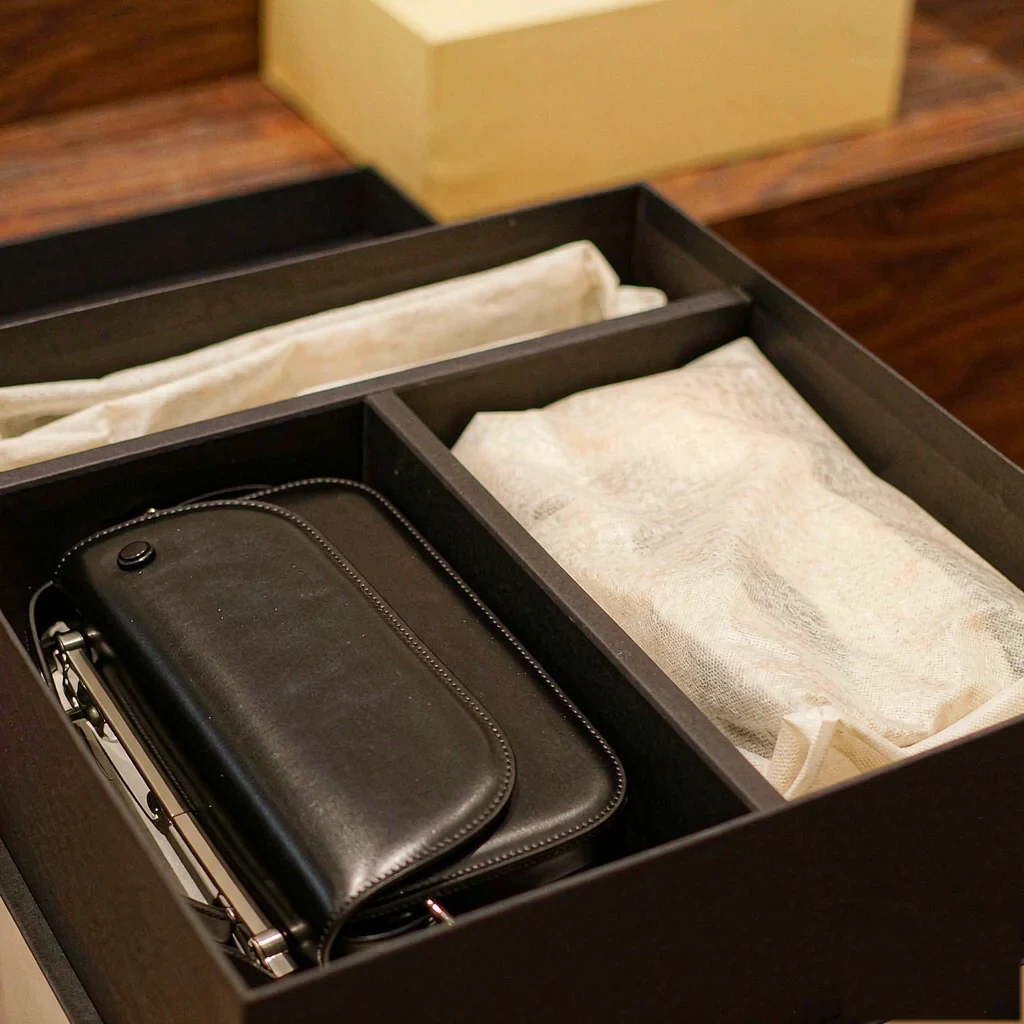
The material and component schedules are the two most often skipped, and they are also the two that decide whether a substitution is caught early. When a tannery cannot supply, the schedule is what turns a quiet replacement into a conversation.
Version control deserves a word. A technical pack that has been revised nine times and exists as nine attachments in nine emails is not under control. One file, one version number, one place, and every previous version retrievable.
Who Owns Which Decision
Every recurring decision on a programme has an owner on one side or the other, and ambiguity about which side is the single most common cause of a missed date. The allocation below is the one we work to, and it can be agreed in a single call.
- Design intent and geometry
- Brand. Signed off at the technical pack, then frozen.
- Material selection
- Brand chooses; the programme partner confirms availability and yield.
- Lot reservation timing
- Programme partner, once the brand names the material direction.
- Pattern and grading
- Programme partner, measured against the approved drawing.
- Correction lists after sampling
- Programme partner raises; brand confirms closure within 24 hours.
- Compliance testing scope
- Programme partner books; brand states the destination markets.
- Inspection sample plan
- Agreed jointly before bulk; neither side changes it afterwards.
- Freight and trade terms
- Brand selects; FOB Xiamen is the default, with CIF and DDP available.
Decisions the brand should never delegate
Design intent, material direction, destination markets and the immovable date. Each of these is a commercial judgement about the label, and each becomes expensive to revisit once the run has started.
Decisions the partner should always own
Pattern geometry, grading, sequence of operations, inspection planning and booking the laboratory. These are technical judgements that sit with the people performing the work.
Decisions that must be joint
The inspection sample plan, the spec freeze, and any material substitution. Joint decisions need a signature from both sides, because a unilateral one will be relitigated later.
The third card is where programmes most often fray. A substitution agreed over the telephone is not agreed. It needs the same written confirmation as a specification change, precisely because it is the kind of change that only becomes visible once it is too late to reverse.
The Weekly Rhythm That Keeps a Programme Honest
A capsule is kept honest by a fixed weekly cadence rather than by ad hoc chasing: one written status note, one gate review, one bench walk-through and one overdue-items read. Four touchpoints, the same day each week, is usually enough.
- Monday: a written status note covering progress, open items and anything the brand must decide this week.
- Tuesday: gate review of 45 minutes, reading only the items that block the next stage.
- Wednesday: a bench walk-through with photographs, so geometry questions are settled before cutting.
- Thursday: the overdue-items read, where any line past its due date gets either an answer or an owner change.
Photographs on Wednesday matter more than they sound. Most geometry disputes that reach assembly began as a three-millimetre disagreement nobody could see, and a photograph taken at the bench settles in minutes what a written description argues about for days.
Escalation: The 24 and 48 Hour Rule
Agree two numbers before the programme starts: a 24-hour target for any answer the programme is waiting on, and a 48-hour point at which the question automatically escalates to a named person on each side. Without the second number, the first is decoration.
The escalation rule in four lines
- Any question the programme is waiting on gets an answer within 24 hours, including an answer of not yet.
- At 48 hours the item escalates automatically to a named individual on each side, not to a department.
- An item escalated twice is treated as a scope change and re-priced rather than chased again.
- Nothing escalates by email alone; escalated items are read out at the next gate review.
The third line is the one that makes the rule work. A question that has gone unanswered for four days is usually not a delay; it is a decision nobody wants to make, and treating it as a scope change forces the conversation that chasing never would.
Escalating to a named person rather than a department matters for the same reason. A message addressed to a team is owned by nobody, and it will sit exactly as long as the question was always going to sit.
Risk Register: Twelve Items Worth Tracking
A programme risk register works when it holds twelve items or fewer and each has a named trigger. Longer registers are written once and never read. The eight below account for the great majority of what actually goes wrong.
| Risk | Trigger that opens it | Standing response |
|---|---|---|
| Named lot unavailable | Tannery confirms it cannot supply the reserved quantity | Present two substitutes with test implications before any substitution |
| Plating batch deviation | Plated components arrive outside the agreed colour range | Compare against the retained reference under standard lighting |
| Pattern does not hold geometry | Toile measurement falls outside tolerance | Second toile before any production leather is cut |
| Handle attachment fails load test | Static load result below 15 kg | Reinforcement board raised to 0.8 mm and re-tested |
| Edge finish cracks in transit | Sample shows crazing after a transit trial | Three thinner passes with defined drying intervals |
| Colour drift between lots | Delta between lots exceeds the agreed tolerance | Reserve against a retained reference rather than matching by eye |
| Permit delay on listed skins | Authority indicates a date later than the shipping window | Launch the calfskin version first and defer the second |
| Inspection result above AQL | Defect count reaches the reject number | Correct and re-check inside the three-day correction buffer |
The value is in the trigger column. A risk without a trigger is an anxiety; a risk with one is an instruction, and it can be acted on by whoever happens to be on the bench that morning.
What a Good Status Report Contains
A useful status report fits on one screen and answers four questions: what moved, what is blocked, what you must decide this week, and whether the date still holds. Anything longer is read by nobody.
- What moved since the last report, stated as progress against the current gate rather than as activity.
- What is blocked, with the owner named and the number of days it has been waiting.
- What the brand must decide this week, with a recommended option and the cost of not deciding.
- Whether the delivery date still holds, stated plainly, with the reason if it does not.
- A photograph of the current bench state, because most disputes are geometry and most geometry is visible.

The fourth line is the one reports usually omit, and it is the only line most readers actually want. A report that says a date still holds is useful; one that says it has slipped by four days and why is far more useful, because four days can still be recovered.
How to Close a Programme Properly
Closure is a gate like any other: inspection result recorded, corrections closed and re-checked, documents reconciled, and a retained reference piece set aside for the re-order. Skipping it is why so many second seasons start from scratch.
The retained reference is the item brands most often forget to ask for. It is the physical record of what was approved, and the only thing that settles a colour or finish dispute eighteen months later.
Inspection is drawn at AQL 2.5 under ISO 2859-1, with corrections closed and re-checked inside a three-day buffer. Only then does the handover pack travel with the goods, and only then is the retained reference piece signed and stored.
Our programme works to MOQ 500 pcs per style and colourway, sampling at 6-10 working days and bulk at 35-50 days on FOB Xiamen terms. It runs across 7 production lines with about 200,000 pcs per month of capacity and export experience since 2014, delivered through our validated partner factory Quanzhou Yingming Bags, an SGS-validated site.
See the artefacts before you commit
Ask for the eight-artefact programme file and a sample decision log. We will walk you through how your capsule would be tracked, gate by gate, within two working days. Request a quote.
Frequently Asked Questions
How many decisions does a typical handbag capsule involve?
Around 180-220 recorded decisions for a three-style capsule at 500 pcs per style. Most are small material, hardware and construction choices. The number matters because each decision is a potential wait, and unowned decisions are where calendars quietly slip. Log every one with an owner and a due date.
What is decision latency and why does it matter?
It is the gap between a question being asked and an answer arriving, averaging about 2.4 days per decision. Multiplied across 180-220 decisions it absorbs more calendar time than every development gate combined, and it never appears on a production schedule. Schedules record operations, not waiting.
How much does a change cost at different stages?
Roughly 1x during pack writing, 3-5x after pattern and toile, 6-10x after material reservation, 15-25x after bulk intake and 25-40x during assembly. The multiple is rework arithmetic rather than a penalty: each stage has more completed work behind it to undo. Freeze before it steps up.
Why does the technical pack need six to nine revisions?
Because revisions at that stage cost 1x while the same change after cutting costs 6-10x and adds 15-20 working days. Six to nine revisions is the low-cost end of the curve absorbing changes that would otherwise be paid for at the expensive end. The pack is where change belongs.
Who owns material selection on a programme?
The brand chooses the material direction and the programme partner confirms availability and yield. Where a named lot cannot be supplied, any substitute must be presented with its test implications and agreed jointly rather than applied quietly. Any substitution must be put in writing, always.
What is the 24 and 48 hour escalation rule?
Any question the programme is waiting on gets an answer within 24 hours, including an answer of not yet. At 48 hours the item escalates automatically to a named individual on each side. Items escalated twice are re-priced as scope changes. Escalate to a person, not a team.
How often should a programme meet?
Four touchpoints each week is usually enough: a written status note, a 45-minute gate review, a photographed bench walk-through, and a read of overdue items. The last of these saves the most time, because it exists purely to clear blockage. Keep them on the same days.
What should a weekly status report contain?
Progress against the current gate, what is blocked with its owner and waiting days, what the brand must decide this week, whether the delivery date still holds and why if not, and a photograph of the bench state. Add the slipped days and the reason.
What does closing a programme involve?
Recording the inspection result, closing corrections and re-checking them inside a three-day buffer, reconciling the handover documents, and setting aside a retained reference piece signed by both sides for the re-order. Each of the four is a gate in its own right, and none is a formality.
Why is a retained reference piece worth insisting on?
It is the physical record of what was approved. Eighteen months later, when the lot, the tannery and everyone's memory have moved on, it is the only thing that settles a colour or finish dispute without a fresh argument. Store it with the frozen pack.
People Also Ask
What is programme management in a handbag maison?
Keeping every open question visible with an owner and a due date, supported by eight standing artefacts. It is less about chasing progress and more about clearing the blockages that sit between operations.
Why do handbag programmes slip even when each stage is on time?
Because waiting happens between stages, in a place no schedule records. A programme can pass every gate on time and still land weeks late, since decision latency accumulates invisibly.
When is the least costly moment to change a design?
During technical pack writing, where a change costs 1x. The same change after material reservation costs 6-10x and adds 15-20 working days, so spending longer on the pack is almost always cheaper.
How do you stop a programme stalling on unanswered questions?
Agree a 24-hour answer target and a 48-hour automatic escalation to a named person on each side. Treat anything escalated twice as a scope change to be re-priced rather than chased again.
Sources and further reading
Every figure on this page is either our own programme data or attributed below. Open the originals before you write them into a specification.
- ISO — International Organization for StandardizationISO Publisher of ISO 2859-1, which sets the sampling plans, code letters and accept and reject numbers used in the inspection plan described here.
- Leather Working GroupLeather Working Group Tannery audit protocol referenced in the material schedule when a named lot is reserved and when a substitute is proposed.
- ECHA — European Chemicals AgencyEuropean Chemicals Agency Administrator of REACH, the restricted substance list against which each material lot is tested for the compliance file.
- CITES — Convention on International Trade in Endangered SpeciesCITES The permit documentation held in the compliance file where listed skins appear in a capsule.
- Sourcing JournalSourcing Journal Reporting on freight conditions, port congestion and material lead times that inform the risk register and buffer recommendations.