Designer Handbag Production Lead Times Explained Through One Capsule That Missed Its Date by Nine Days
How long does designer handbag production take? On a standard programme, 6-10 working days for sampling and 35-50 days for bulk, with 15-20 working days for a named hide lot and 20-25 for plated components on top. Those four windows are the whole answer, and the reason they are quoted as ranges is that three of them are governed by processes outside the bench. Below, one capsule is followed from brief to handover, including the nine days it lost, and the six rules that came out of it.
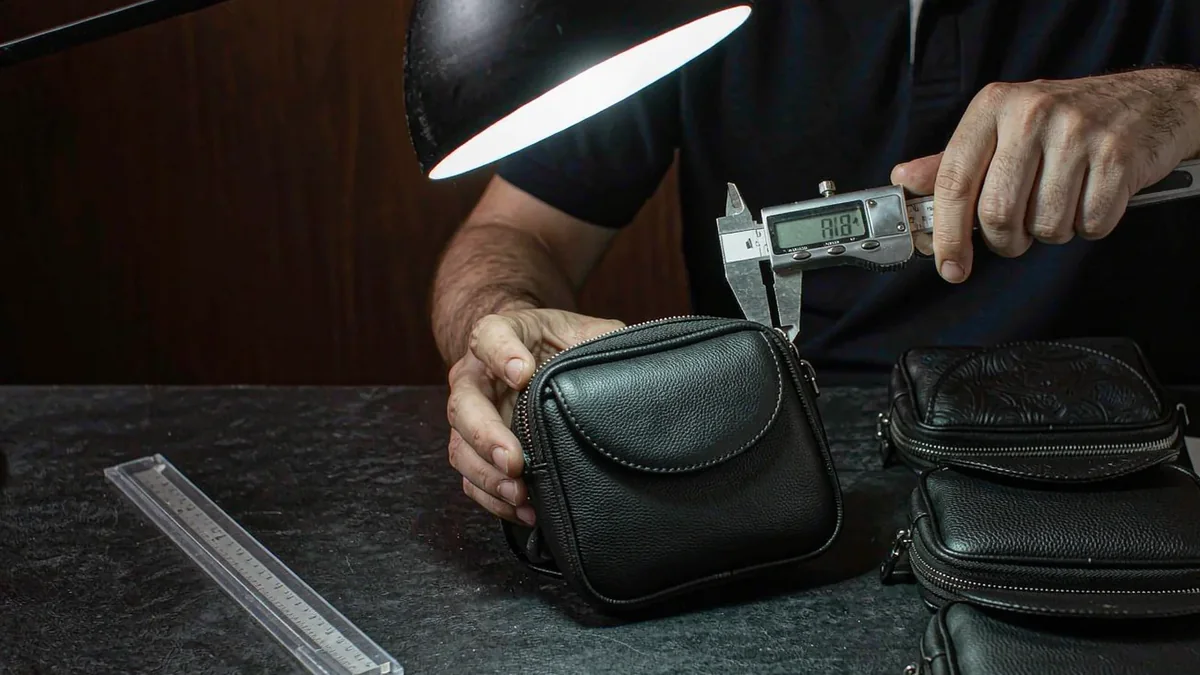
The Capsule: Three Styles, One Date, Fourteen Weeks
A Copenhagen label came to us with three styles, two colourways each, and a showroom opening it could not move. Fourteen weeks of calendar looked generous against a standard programme of sampling at 6-10 working days and bulk at 35-50 days, and on paper it was.
What the plan did not contain was a window for the hide. The brief named a shade rather than a lot, which meant the material clock had not started on the day the drawings arrived, and it would not start until the shade was matched and the tannery confirmed a lot. That single omission accounted for most of the nine days the capsule eventually lost.
- Three styles, two colourways, MOQ 500 pcs per style and colourway, six lots in total.
- A fixed showroom date fourteen weeks out, which is comfortable for calfskin and tight for anything bespoke.
- A named shade rather than a named lot, so no material window had opened yet.
- Stock hardware on two styles and a bespoke turn-lock on the third.
Reading a Calendar Backwards From the Date
A lead time quoted forwards from today is a guess with better manners. The only defensible way to build one is backwards from the date the goods must land, subtracting freight, then bulk, then the material windows, and seeing what is left for development.
- Sea freight to northern Europe
- 25-35 days door to port, plus clearance and inland delivery
- Bulk
- 35-50 days from material intake
- Audit, packing and documents
- 3-5 days including any correction and re-check
- Material window on a named lot
- 15-20 working days from reservation to hide arrival
- Component plating
- 20-25 working days in stock finishes, 30-40 for a bespoke development
- Sampling
- 6-10 working days, or 12-15 where complex construction applies
Run those numbers against fourteen weeks and the plan is visibly thin at exactly one point. Freight and bulk alone consume around nine to twelve weeks, which leaves two to five for everything else, and one of the six lots still had no tannery behind it.
The Four Windows Inside Every Lead Time
Every designer programme contains four windows, and only one of them is genuinely under the bench's control. Understanding which is which is most of what lead time management consists of.
| Window | Duration | Who controls it |
|---|---|---|
| Development and sampling | 6-10 working days, 12-15 complex | The bench, and your speed of approval |
| Bulk | 35-50 days from intake | The bench, within the plan agreed |
| Material reservation | 15-20 working days to hide arrival | The tannery and the lot you named |
| Component plating | 20-25 working days, 30-40 bespoke | The plating house and its queue |
Two of the four sit outside the bench. That is why the honest answer to how long a programme takes is always given as a range: half the calendar is not ours to promise, and pretending otherwise produces a date that fails politely.
Sampling: 6-10 Working Days, and What Eats Them
Six to ten working days covers a first built unit, measurement against the technical pack, a written correction list and one corrected round. It does not cover waiting for a decision, and it does not cover a structural change made after the freeze.
- Days 1-2: pattern checked, panels cut, interlining bonded at 0.8 mm on load panels.
- Days 3-5: body closed at 8-9 stitches per inch, hardware set, first dressing of edges.
- Day 6: measurement against the drawing, within ±0.5 mm, and the correction list written.
- Days 7-9: corrections applied, edges taken to three thin coats, second measurement.
- Day 10: release for approval, and the pack updated to match the approved unit.
Complex builds take 12-15 working days because two extra steps appear: proving a bespoke closure on the bench and setting a framed or heavily reinforced body before any leather is committed. Neither can be overlapped with anything else.
Bulk: 35-50 Days and Why the Range Is Wide
Bulk runs 35-50 days from material intake, and the fifteen-day spread is not vagueness. It reflects how much of the body is done by hand, how many colourways share the line, and how much correction the lot generated at inspection.
- Cutting and preparation: 4-6 days, including skiving to 0.6-0.7 mm over 8-10 mm turn-ins.
- Closing and assembly: 12-18 days, the longest single block on the line.
- Edge finishing: 6-9 days, driven entirely by drying intervals between coats.
- Setting hardware and dressing: 4-6 days, slower where a bespoke lock must be fitted.
- Inspection, correction and packing: 5-7 days at AQL 2.5 under ISO 2859-1.
The edge finishing line is the one buyers underestimate. Three thin coats with drying between them cannot be compressed by adding hands, which is why a calendar that squeezes this block produces bags that look right on day one and wrong by month three.
Materials and Hardware: The Windows Outside the Line
Materials and components run on their own clocks. A named hide lot takes 15-20 working days to arrive; plated components take 20-25 in stock finishes and 30-40 where a bespoke part must be tooled and proved.
Named hide lot
15-20 working days to arrival, plus laboratory reports issued against that lot. Reserving early is the single most effective thing a brand can do to shorten a calendar.
Stock plated components
20-25 working days, with salt spray proving at 24 hours as a floor and 48 hours for antique finishes.
Bespoke closure
30-40 working days including tooling and a bench proving step, before a single panel is cut.
Listed skin
30-45 working days on top, because permit documents are issued by an authority working to its own timetable.

In the Copenhagen case the bespoke turn-lock was the surprise. It was specified on one of three styles and it quietly became the critical path, because tooling had to finish before panels could be cut for that style.
Where the Capsule Lost Its Nine Days
Nine days, itemised: four waiting for the shade to be matched against a tannery lot, three while a corrected sample waited for a signature over a trade show weekend, and two in re-checking after a hardware batch failed salt spray at 24 hours.
- Four days: shade matched to a lot rather than bought to a description, opening the material clock late.
- Three days: a corrected sample sat unsigned across a weekend while the team was at another fair.
- Two days: one hardware batch showed base metal at 24 hours and had to be re-plated and re-proved.
Not one of those days was lost inside bulk. All nine were lost between windows, in the gaps that never appear on a production schedule, which is the general rule rather than the particular misfortune of this capsule.
Six Rules the Case Produced
Six rules came out of it, and none of them is specific to Copenhagen. They are the rules worth applying to any capsule with a date attached.
Six rules for a calendar that holds
- Reserve the lot before the drawings are finished: it carries no design risk and opens a 15-20 day window early.
- Never put a bespoke closure on the critical path of a first capsule: launch it on the second version.
- Name an approver who is available during sampling, not someone who will be at a fair.
- Agree the AQL 2.5 plan before bulk, so the end of the run is a check rather than a negotiation.
- Build the calendar backwards from the landing date and subtract freight first, not last.
- Keep four buffers totalling about two weeks: two days at approval, three at correction, five on lots, four on freight.
The first rule is worth restating because it is counter-intuitive. Reserving material before the design is final feels premature, and it is the least costly two weeks available anywhere in the plan, since a lot can be held against a shade without committing a single panel.
How to Quote a Date You Can Defend
A defensible date is quoted as a range with its assumptions written down. Give the landing window, state which material windows are already open, and mark the gates where a decision from the brand is required.
| If this is true | Then quote | Because |
|---|---|---|
| Calfskin, stock hardware, lot reserved | Landing in 11-14 weeks | Bulk and freight dominate, both predictable |
| Calfskin, bespoke closure on one style | Landing in 14-17 weeks | Tooling and proving add 30-40 working days |
| Listed skin on any style | Landing in 16-20 weeks | Permit documents add 30-45 working days |
| Re-order, frozen pattern, held lot | Landing in 8-10 weeks | Every development gate is already closed |
The re-order row is the one founders underestimate. A genuine re-order on a frozen pattern with a held lot is the only situation where the calendar collapses towards bulk alone, because there is nothing left to develop and little left to approve.
What to Send to Get a Real Calendar
A real calendar can be produced in two working days from four pieces of information. Without them, any date offered is an illustration.
- Dimensioned drawings or a reference piece, with the intended structure described.
- Quantity per style and colourway, since MOQ 500 pcs applies to each combination.
- The material direction and the destination markets, because compliance testing is booked per lot.
- The immovable date, so the plan can be built backwards from it rather than forwards from hope.
Swatch card sets are billed at USD 4.80 and credited against the first bulk order, which settles a shade question in days rather than the four the Copenhagen capsule spent on it. Our programme runs across 7 production lines with about 200,000 pcs per month of capacity and has held export experience since 2014, carried out through our validated partner factory Quanzhou Yingming Bags, an SGS-validated site. Handover is on FOB Xiamen terms, with CIF and DDP available. The sampling window in detail sits under luxury sampling, and the full route on the designer handbag production page.
Get a calendar built backwards from your date
Send your drawings, quantity and the date the goods must land. You will receive a week-by-week calendar with every window and buffer marked, within two working days. Request a quote.
Frequently Asked Questions
How long does designer handbag production take?
Sampling takes 6-10 working days and bulk 35-50 days from material intake. Add 15-20 working days for a named hide lot, 20-25 for plated components and 25-35 days for sea freight to Europe. Landing windows therefore run from about 11 weeks on a simple calfskin capsule to 20 with a listed skin.
Why is bulk quoted as a range of 35-50 days?
Because the spread reflects real variables: how much of the body is done by hand, how many colourways share the line and how much correction the lot needs at inspection. Edge finishing alone absorbs 6-9 days and cannot be compressed, since three thin coats need drying time between them.
What does the sampling window actually include?
Six to ten working days covering a first built unit, measurement against the technical pack within ±0.5 mm, a written correction list and one corrected round. It does not include time waiting for an approval signature, which is why naming an available approver matters more than most brands expect.
How long do materials add to a lead time?
A named hide lot takes 15-20 working days to arrive, with laboratory reports issued against that lot. Plated components take 20-25 working days in stock finishes and 30-40 where a bespoke part needs tooling and bench proving. Reserving the lot early is the least costly two weeks in any plan.
How much time do exotic skins add?
About 30-45 working days, because permit documents under CITES are issued by an authority working to its own timetable and no amount of bench resource accelerates them. Panels are also cut last, since yield is lower and a mis-cut piece is rarely replaceable from the same lot.
What is the minimum quantity and does it change the calendar?
MOQ 500 pcs per style and colourway. Quantity affects bulk length modestly but affects material commitment significantly, because a lot is reserved per combination. Six lots across three styles and two colourways should be planned as one reservation rather than six separate ones.
Which stage most often delays a capsule?
The gaps between windows rather than the stages themselves: a shade matched to a description rather than a lot, a corrected sample waiting for a signature, and a hardware batch failing salt spray. In the capsule described here, all nine lost days sat between windows, not inside bulk.
Can a first capsule be delivered in twelve weeks?
Yes for calfskin with stock hardware, provided the lot is reserved early and an approver is available during sampling. Twelve weeks is uncomfortable where a bespoke closure is involved, because tooling and proving alone run 30-40 working days before panels can be cut.
How much buffer should I keep in my own plan?
About two weeks in total: two days between approval and bulk intake, three days for correction and re-check, five days on any newly named material lot, and around four days of freight slack around seasonal port peaks. A calendar quoted to the day has usually spent its own buffers.
How is inspection scheduled at the end of a run?
At AQL 2.5 under ISO 2859-1, with the general inspection level and lot size agreed before bulk begins. On a 500 pcs lot at level II that is code letter H: 50 units drawn, accept 3, reject 4. Packing follows only after corrections close, which is why the last stage behaves as a gate.
Why does a re-order take far less time?
Because every development gate is already closed: the pattern exists and is graded, the lot can be held, and compliance reports may still cover the material. What remains is bulk and packing, which is why genuine re-orders land around 8-10 weeks rather than 14-17.
What can I do to shorten a first calendar?
Reserve the material lot before the drawings are finished, use stock hardware on the first version of a silhouette, and name an approver who is actually available during sampling. Together those three actions remove more time than any acceleration of the bench itself.
What trade terms and shipping assumptions apply?
Handover is on FOB Xiamen terms, with CIF and DDP available on request. Sea freight to northern Europe typically runs 25-35 days plus clearance and inland delivery, and that block should be subtracted first when the calendar is built backwards from a landing date.
How quickly can I get a calendar for my own brief?
Within two working days of a completed brief containing drawings or a reference piece, quantity per style and colourway, the material direction with destination markets, and the immovable date. Without those four items any date offered is an illustration rather than a plan.
People Also Ask
How long does it take to produce a designer handbag?
Sampling takes 6-10 working days and bulk 35-50 days from material intake. Including a 15-20 day hide lot, 20-25 day components and 25-35 days of sea freight, a first calfskin capsule lands in roughly 11-14 weeks.
Why are handbag lead times always given as ranges?
Because two of the four windows sit outside the bench: the tannery controls hide arrival and the plating house controls components. Only development and bulk are ours to promise, so an honest date is a range with its assumptions written down.
What is the slowest stage of handbag production?
Bulk, at 35-50 days. Within it, closing and assembly run 12-18 days and edge finishing 6-9. Edge finishing cannot be compressed, because three thin coats need drying intervals between them.
How early should I reserve leather for a launch?
As early as the shade is settled, ideally before the drawings are final. Reserving a lot carries no design risk and opens a 15-20 working day window that would otherwise sit at the front of your calendar unused.
Can I launch a capsule with exotic skins on a normal calendar?
Not on a standard one. Permit documents add 30-45 working days, so the usual advice is to launch the calfskin version first and introduce the listed-skin version a season later, once the pattern is frozen.
Sources and further reading
Every figure on this page is either our own programme data or attributed below. Open the originals before you write them into a specification.
- ISO — International Organization for StandardizationISO Publisher of ISO 2859-1, which sets the sampling plans and accept and reject numbers used at the end of the bulk window described here.
- CITES — Convention on International Trade in Endangered SpeciesCITES Appendix listings determine permit requirements for listed skins, the longest single addition to a designer production calendar.
- Leather Working GroupLeather Working Group Tannery audit protocol behind lot qualification, which governs how early the material window can open in a calendar.
- Sourcing JournalSourcing Journal Reporting on freight conditions, port congestion and seasonal shipping peaks that inform the freight buffer recommended here.
- FashionUnitedFashionUnited Coverage of European fashion market timing, including showroom and trade show seasons that shape immovable launch dates.