Designer Handbag Production for Fashion Graduates: The Numbers Behind a First Capsule
What does a fashion graduate need to know before turning a degree collection into a bag capsule? Six numbers, and they change most decisions: MOQ 500 pcs per style and colourway, a structured panel set that converts 55-65% of purchased hide area, a stock trim set at USD 4.80 per bag, sampling at 6-10 working days, bulk at 35-50 days, and a landed material share of 40-50% of the unit cost. A degree collection is usually designed without those figures in view, which is why the first costing conversation is often the moment a collection becomes a business. Below, the numbers come first, then the variables that move each one, then the calendar they imply.
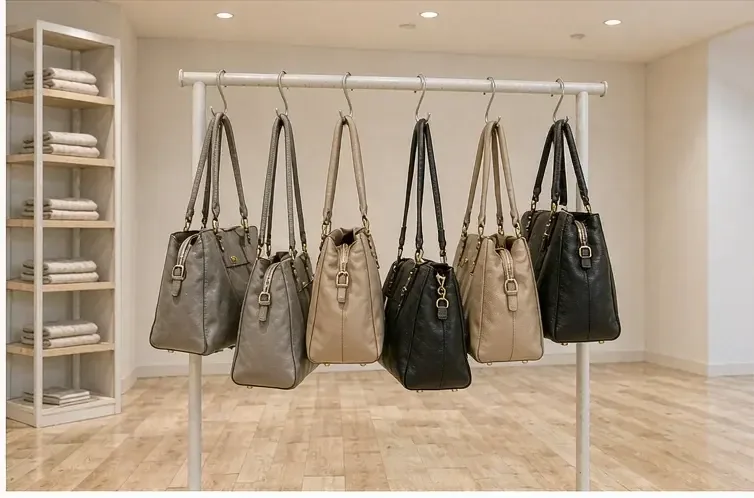
Six Numbers That Decide a Graduate Capsule
A graduate collection is usually designed to be judged on a rail. A capsule has to be designed to be cut, assembled, tested, shipped and sold at a figure, and that changes which decisions matter. These six numbers are the ones worth knowing before the first conversation.
- MOQ
- 500 pcs per style and colourway, not across the whole collection
- Yield on a structured panel set
- 55-65% of purchased hide area reaches the finished piece
- Stock trim set
- Around USD 4.80 per bag for plated brass feet, rings and a closure
- Sampling
- 6-10 working days, or 12-15 where the construction is complex
- Bulk
- 35-50 days from material intake to inspection
- Material share of unit cost
- 40-50%, with labour at 20-28% and trim at 12-18%
Two of these numbers surprise graduates most: the minimum and the yield. A collection of eight styles does not share one minimum across them, and a hide is not bought by the bag, so the shape of the panels decides what the material really costs.
What the First 500 Units Cost, Line by Line
The largest single adjustment a graduate makes is from designing to a cost per piece and designing to a share. Material is 40-50% of a landed unit cost, labour 20-28%, hardware and trim 12-18%, and development, compliance and freight carry the remaining 8-15%.
| Line | Share of landed unit cost | The variable a graduate controls |
|---|---|---|
| Exterior material | 40-50% | Panel nesting: fewer pieces and a folded gusset convert more hide area |
| Labour | 20-28% | Stitch density 8-9 per inch and three-coat edge finishing at 8-10 minutes per pass |
| Hardware and trim | 12-18% | Stock brass at 0.15-0.3 µm rather than a bespoke lock |
| Development and sampling | 4-8% | How many rounds, since each adds a pattern revision and a bench build |
| Compliance and testing | 2-4% | Naming markets before booking tests against the lot |
| Packing and presentation | 3-6% | Dust bag and box construction chosen at brief stage |
Read the third column as a to-do list. Three of the six variables are settled before a single panel is cut, and the remaining three are settled before the first round, which is why development is the stage where a capsule is actually won or lost.
Development: The Fixed Cost Divided by 500
Development is the number graduates underestimate, because it exists whether the capsule is 500 pieces or 5,000. A pattern, a graded size set, two toiles and the sampling rounds are fixed, and the per-unit share falls sharply as the run grows.
- At 500 pcs per colourway, development carries its full per-unit weight on one run.
- Across three colourways of 500, the same pattern and toiles are shared three ways.
- A graded size set costs more than a single size, since each size changes panel area by roughly 8%.
- Each additional sample round adds a pattern revision and a bench build, not only a courier charge.
- Freezing before the second round is the least costly saving available at this stage.
The practical consequence is that a collection designed as eight styles and made as 500 pieces in total will rarely work. The same design effort concentrated into three styles at 500 each is a different business, and usually the one that survives the first season.
Three Capsule Sizes and the Figures Behind Each
Most graduate capsules fit one of three shapes, and the differences between them are almost entirely in how development is amortised and how much material waiting the calendar carries.
500 pcs, one colourway
The whole development cost sits on one run, so the per-unit figure is at its highest. One lot, one reservation window of 15-20 working days, one test booking.
1,500 pcs across three colourways
Development shared three ways and each colourway meets the minimum. Three lots reserved, with yield confirmed on all three at 55-65% before cutting.
3,000 pcs with a bespoke lock
The best per-unit development share, offset by closure tooling. Allow 30-40 working days and 48 hours of salt spray proving before panels are cut.
The middle option is the sensible target for a first season. It shares the pattern three ways without committing the collection to a bespoke closure, and it leaves the shape of the second season genuinely open.
The Calendar Those Numbers Imply
Numbers and days are the same subject viewed twice. A capsule built on a reserved lot, a toile and two sampling rounds lands around 55-75 working days; one that leaves the material open until after approval lands considerably later.
- Material reservation on a named lot: 15-20 working days, best run alongside the toile.
- Toile in 10 oz calico: 1-2 days, resolving proportion, handle drop and closure position.
- Sampling: 6-10 working days, or 12-15 for structured or complex builds.
- Approval and the specification freeze, then bulk at 35-50 days from intake.
- Inspection at AQL 2.5 under ISO 2859-1, then packing and documents over 3-5 days.
A 500-piece lot at general inspection level II uses code letter H under ISO 2859-1: 50 units drawn, accept 3, reject 4. That plan is agreed before bulk begins, and third-party inspection can be arranged alongside the internal audit.
What a Degree Collection Does Not Yet Contain
A degree collection is designed to be looked at, so it contains imagery, intention and usually a strong point of view. It rarely contains the four things a bench needs, and supplying them is most of the work between graduation and a first sample.
The four gaps, in the order they bite
- Dimensions: overall size in millimetres, with a working tolerance of ±1.5 mm on panels.
- Thickness and structure: 1.2-1.4 mm for a semi-structured body, with 0.8 mm interlining behind it.
- Construction notes: stitch density 8-9 per inch, edge specification, reinforcement and seam sequence.
- A commercial date: the one date the goods must reach the warehouse, which is what the calendar is built from.
There is a fifth gap, and it is the one that surfaces at the first costing conversation: thickness. A degree collection usually specifies the look of a leather and not its substance, and a body drawn without stating 1.2-1.4 mm with 0.8 mm interlining cannot be cut, because the panels, the reinforcement and the yield all depend on that figure.
- Thickness sets how a fold holds, and 0.2 mm is enough to change it.
- It sets the reinforcement, since 0.8 mm interlining is specified against a known substrate.
- It sets the yield of 55-65%, measured on a lot bought by area and not by the bag.
None of these gaps are failings; they are simply not what a degree asks for. The useful reframe is that supplying them is design work of the highest kind, because it is where a shape becomes a thing that exists in three dimensions.
Turning a Degree Collection Into a Brief
The translation is a one-page brief, and it is the single artefact that turns a collection into a quotation. Nine items fit on it, and a brief covering all nine can be quoted within two working days.
- Geometry: dimensions in millimetres with the ±1.5 mm tolerance, handle drop and strap width.
- Material: type, thickness and finish, with 1.2-1.4 mm for structured bodies, named as a lot.
- Hardware: stock or bespoke, finish at 0.15-0.3 µm, #5 zip for openings and #3 for pockets.
- Construction: stitch 8-9 per inch, the edge specification and every reinforcement point.
- Colourways and quantity at 500 pcs each, the destination markets and the immovable date.
The final item is the one that graduates omit. Without a date, a calendar can only be built forwards from hope, and that is how a sampling window ends up colliding with a launch.
Saving Without Lowering the Quality
There are three savings available to a first capsule that cost nothing in quality, and they all work by removing operations rather than substance. Everything else that looks like a saving tends to move the cost somewhere less visible.
- Nest the panels better: a folded gusset saves two seams and one skiving pass on every body.
- Keep the closure stock at USD 4.80 per bag rather than tooling a bespoke lock.
- Choose the edge specification deliberately: a raw edge removes three passes with 8-10 minutes each.
- Use a toile to settle proportion, because a change there costs a marker stroke and not a round.
- Concentrate the collection into fewer styles, so development is shared across more units each.
The fifth saving is the least popular and the most effective. Eight styles at 500 pieces in total is eight development charges spread very thinly; three styles at 500 each is three charges spread across units that will actually be sold.
Four Numbers Graduates Commonly Get Wrong
The same four figures cause most of the friction in a first costing conversation, and each is a reasonable belief that happens not to survive contact with a cutting table.
- That the minimum applies to the collection. It applies at 500 pcs per style and colourway.
- That hide is bought by the bag. It is bought by area, and a structured set converts 55-65%.
- That a sample is one attempt. A round is a build, a measurement, a correction list and a rebuild.
- That bulk is the slow part. It is, at 35-50 days, but the days between gates are what slip.
Correcting those four beliefs usually moves a first capsule more than any negotiation. They are also the reason a costing discussion held before design is finished is worth more than one held after it.
What to Send to Start a First Capsule
Six inputs are enough to produce a costed answer and a calendar. Send them together and the reply arrives in two working days rather than after a fortnight of questions.
- Drawings or a reference piece, with every intended change noted in writing.
- The material direction, including thickness, and whether a lot has already been chosen.
- Quantity per style and colourway, remembering the 500 pcs minimum on each.
- The hardware direction and finish, and whether any part is intended to be bespoke.
- Destination markets, since ISO 105, ISO 3376 and REACH Annex XVII work is booked per lot.
- The date the goods must arrive, so the calendar can be built backwards from it.
The programme is delivered through our validated partner factory Quanzhou Yingming Bags, an SGS-validated site with 7 production lines and about 200,000 pcs per month of capacity, holding export experience since 2014. Third-party inspection can be arranged alongside the internal AQL 2.5 audit on FOB Xiamen terms.
Turn your degree collection into a costed capsule
Send your sketches, the material direction and the quantity you are considering. You will receive the costing, the calendar and the three capsule sizes compared, within two working days. Request a quote.
Frequently Asked Questions
What is the minimum quantity for a graduate handbag capsule?
MOQ 500 pcs per style and colourway, not across the collection. A degree collection of eight styles cannot share one minimum between them, which is why concentrating the same design effort into three styles at 500 each usually produces a viable first season. The minimum also governs how thinly development is spread.
Why does material dominate the unit cost?
Because hide is purchased by area and the piece only receives a portion of it. A structured panel set converts 55-65% of purchased area into usable panels, and the shortfall pays for nesting constraints, consistent grain direction and keeping flaws off visible faces. Every panel lost is paid for twice.
What does a trim set cost on a first capsule?
Around USD 4.80 per bag for a stock plated brass set covering feet, rings and a closure at 0.15-0.3 microns plating. A bespoke lock is the alternative, and it carries tooling and 30-40 working days of its own calendar, which is usually the single largest addition a first capsule can make.
How long does a graduate capsule take from brief to delivery?
Around 55-75 working days: 15-20 on material reservation, one to two on the toile, 6-10 on sampling, 35-50 on bulk, and three to five on inspection, packing and documents. Reserving the lot during the toile removes three weeks of that total by overlapping the waiting.
What does a degree collection need before it can be quoted?
Four additions: dimensions in millimetres with a tolerance of plus or minus 1.5 mm, thickness and structure notes, construction notes including stitch density of 8-9 per inch, and a commercial date the goods must arrive by. Without the last one the calendar can only be built forwards from hope.
How can a graduate lower the cost without lowering the quality?
Three ways that remove operations rather than substance: nest the panels better with a folded gusset, keep the closure stock, and choose the edge specification deliberately. Combined with sharing development across fewer styles rather than eight, those are the savings that actually hold up in a first season.
How many styles should a first capsule contain?
Three at 500 pieces each rather than eight at 500 in total. Development is a fixed cost per style, so the same creative effort concentrated into fewer shapes spreads it across units that will be sold. It also concentrates the material reservation, since fewer lots need to be held.
What is a toile and why is it needed?
A full-size test piece in 10 oz calico, cut before any hide is committed. It settles proportion, handle drop and closure position in one to two days, and a change there costs a marker stroke rather than a six to ten day sample round. Two are often better than one.
How is a 500-piece lot inspected?
At AQL 2.5 under ISO 2859-1 with the plan agreed before bulk intake. A 500 pcs lot at general inspection level II uses code letter H, meaning 50 units are drawn, with acceptance at 3 defects and rejection at 4. Third-party inspection can be arranged alongside the internal audit.
Which standards apply to a first capsule?
Colour fastness under ISO 105, tensile strength under ISO 3376 and finish adhesion under ISO 11644, with chemical restrictions under REACH Annex XVII for Europe and California Prop 65 and CPSIA for the United States. All are booked per lot, and each market adds its own line.
What is the most common costing mistake graduates make?
Assuming the minimum covers the collection rather than each style and colourway. Correcting that one belief usually changes a first capsule more than any negotiation, because it changes the quantity every other figure is divided by, including the development share, the material yield and the test bookings.
Should a first capsule include a bespoke lock?
Rarely. Stock brass at 0.15-0.3 microns holds the trim line and the calendar, while a bespoke closure adds tooling, 48 hours of salt spray proving and 30-40 working days, which is a long commitment for a shape that is still unproven. Keep it for the second season.
People Also Ask
How many bags should a fashion graduate make first?
Three styles at 500 pieces each rather than many styles at 500 in total. Development is a fixed cost per style, so fewer shapes spread it across units that will actually be sold.
Why is a 500-piece minimum standard for handbags?
Because material is bought as whole lots and development is a fixed cost. Below roughly that quantity, the per-unit share of the pattern, the toiles and the sampling rounds stops making commercial sense for either side.
What should a fashion graduate send to get a quotation?
Drawings with dimensions in millimetres, the material direction and thickness, quantity per colourway, the hardware direction, the destination markets and the delivery date. Six inputs, and they produce a costed answer in two working days.
How long does it take to make a first bag collection?
About 55-75 working days on a reserved lot: 15-20 days on material, 6-10 on sampling, 35-50 on bulk and 3-5 on packing. Leaving the material open until after approval pushes it later.
Can a graduate collection be produced without technical drawings?
Yes, using a reference piece plus a list of intended changes and a material card. That combination is enough to produce a quotation and a calendar within two working days without formal drawings.
Sources and further reading
Every figure on this page is either our own programme data or attributed below. Open the originals before you write them into a specification.
- ISO — International Organization for StandardizationISO Publisher of ISO 2859-1 for the AQL 2.5 plan, ISO 105 for colour fastness, ISO 3376 for tensile strength and ISO 11644 for finish adhesion.
- Leather Working GroupLeather Working Group Tannery audit protocol, relevant when the lot behind a first capsule has to evidence its origin for boutique distribution.
- ECHA — European Chemicals AgencyEuropean Chemicals Agency Administrator of REACH Annex XVII, the restricted substance list that determines the compliance lines booked per destination market.
- Business of FashionBusiness of Fashion Reporting on emerging designer economics and the commercial pressures on first collections entering the accessories market.
- FashionUnitedFashionUnited Market reporting on the accessories sector and the launch calendars a first capsule is planned against.