From Concept to Couture Bag With a Handbag Maison: Three Routes Compared Across Nine Dimensions
How does a concept become a couture bag? Through one of three routes, and they differ far more than founders expect. A single atelier build runs 25-40 working days at roughly 92-96% hand work; a mini-series of 20-50 units runs 45-60 days at 45-60%; a couture-detailed programme at 500 pcs runs 55-75 days at 22-35%. This article compares the three across nine dimensions, then identifies which detailing survives the move towards scale and which has to be re-designed rather than merely reproduced.
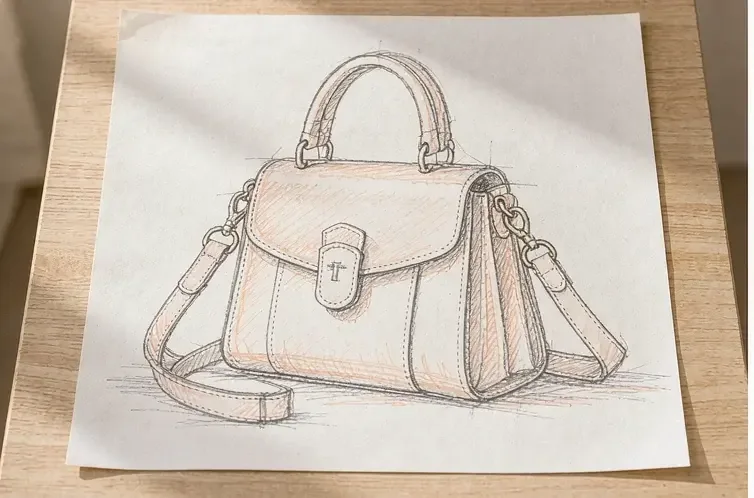
Three Routes From Concept to Couture Bag
A couture bag reaches the market by one of three routes: a single atelier build made for one client, a mini-series of 20-50 units made for a presentation or a small clientele, or a couture-detailed programme of 500 pcs built to repeat. They share a vocabulary and almost nothing else.
The routes differ in the same nine places: how the pattern is made, how much of the work is done by hand, how the material is selected and cut, what tolerance is achievable, how long it takes, what it costs per unit, whether it can be repeated, who can perform it, and what documentation it carries. Comparing them side by side is the fastest way to stop asking the wrong route for the wrong outcome.
The most common mistake is asking the third route to behave like the first. A single build can be adjusted on the bench as it is made, because the maker is looking at it. Five hundred units cannot, which is why couture detailing at scale has to be designed for repetition rather than discovered during making.
Route One: The Single Atelier Build
A single build is made from a card pattern drafted for that piece, with the maker selecting the area of each hide by eye and adjusting the construction as the piece develops. Roughly 92-96% of the work is done by hand, and the piece takes 25-40 working days.
- Pattern drafted as card for the piece in hand, with no graded set and no intention of repeating it.
- Material selected by eye from the hide, choosing the area rather than maximising yield.
- Saddle stitching by hand in waxed linen at 6-7 stitches per inch, which a machine cannot reproduce.
- Edges hand-burnished in five to seven passes with a heated tool and a waxed finish.
- Adjustments made during construction, which is the defining freedom of the route.
That last freedom is what makes the route expensive and what makes its results distinctive. It is also what prevents the piece from being repeated: a bag whose geometry was settled on the bench cannot be reproduced from a drawing, because the drawing was made after the decisions rather than before them.
Cutting yield is the clearest evidence of the difference. A single build consumes roughly one hide per 1.2 finished units, because the maker is choosing the best area of each skin rather than arranging panels for economy.
Route Two: The Mini-Series
A mini-series of 20-50 units sits between the two: the pattern is drafted to be repeated, cutting is arranged for reasonable yield, and the hand work that defines the piece is retained on the operations where it shows.
Hand work typically falls to 45-60%, concentrated on edge finishing, handle attachment and any visible stitching, with machine work carrying the long internal seams. Development runs 12-15 working days and the full route 45-60 days, since sampling and material selection still behave as development rather than repetition.
- Pattern drafted to a standard, with the geometry fixed before the first unit is cut rather than during.
- Panels arranged for yield, giving roughly one hide per 2.6-3.2 units rather than one per 1.2.
- Visible stitching retained by hand; internal seams machine sewn at 8-9 stitches per inch.
- Edges hand-burnished, since that operation is where the eye reads couture most directly.
- Correction loop formalised, because twenty units carrying the same defect is not a prototype problem.
The correction loop is what separates a mini-series from a set of prototypes. Once more than a handful of units carry the same construction, a defect found on unit eighteen is a defect on units one to seventeen as well, and it has to be recorded rather than simply repaired.
Route Three: The Couture-Detailed Programme
A programme of 500 pcs with couture detailing retained is a different discipline again: the construction is designed from the outset so that the detailing which reads as couture can be executed repeatedly, within tolerance, by more than one bench hand.
Hand work settles at 22-35%, concentrated on operations where it is visible and where a machine genuinely cannot match the result. Development runs 6-10 working days and the full route 55-75 days, with MOQ 500 pcs per style and colourway and bulk at 35-50 days.
- Pattern
- Graded block set, frozen at the spec freeze and retained for ten years
- Material selection
- Panels arranged for yield, roughly one hide per 4.5-5.2 finished units
- Leather substance
- Full-grain calfskin at 1.2-1.4 mm for body panels, 0.8-1.0 mm for gussets
- Stitch density
- 8-9 stitches per inch on Tex 40 bonded nylon thread, counted over 25 mm
- Edge build
- Three passes of edge paint with 8-12 minutes of drying between each pass
- Hardware
- Brass with a 0.15-0.3 µm finishing layer, proven to 48 hours of salt spray
- Hand work share
- 22-35%, concentrated on edge finishing, handle attachment and final dressing
The phrase worth underlining is designed for repetition. The detailing on a programme piece is not a reduced version of couture; it is couture re-specified so that its result is achievable within a tolerance, which is a design problem rather than a compromise.
The Matrix: Nine Dimensions Compared
Set against each other across nine dimensions, the three routes stop looking like versions of one thing and start looking like three different answers to three different briefs. The table below is the comparison most founders ask for after seeing their first sample.
| Dimension | Single atelier build | Mini-series (20-50) | Programme (500 pcs) |
|---|---|---|---|
| Units produced | 1-5 | 20-50 | 500 per style and colourway |
| Hand work share | 92-96% | 45-60% | 22-35% |
| Pattern | Card, drafted for the piece | Drafted to repeat, not graded | Graded block set, frozen and retained |
| Material selection | By eye, one hide per 1.2 units | Arranged, one hide per 2.6-3.2 units | Arranged, one hide per 4.5-5.2 units |
| Stitching | Hand saddle stitch, 6-7 per inch | Hand on visible seams, machine inside | Machine at 8-9 per inch, hand at finishing |
| Edge | Hand-burnished, 5-7 passes | Hand-burnished | Three paint passes, 8-12 minute intervals |
| Tolerance | Judged on the piece, about 2 mm | About 2 mm, measured | About 1 mm, measured and recorded |
| Elapsed route | 25-40 working days | 45-60 working days | 55-75 working days |
| Repeatable? | No, geometry settled on the bench | Partly, with pattern retained | Yes, from retained tooling and reports |
The seventh row surprises people. Tolerance on a programme is tighter than on a single build, not looser, because a repeated operation can be measured against a retained reference and held within a millimetre, while a one-off is judged on the piece by the person who made it.
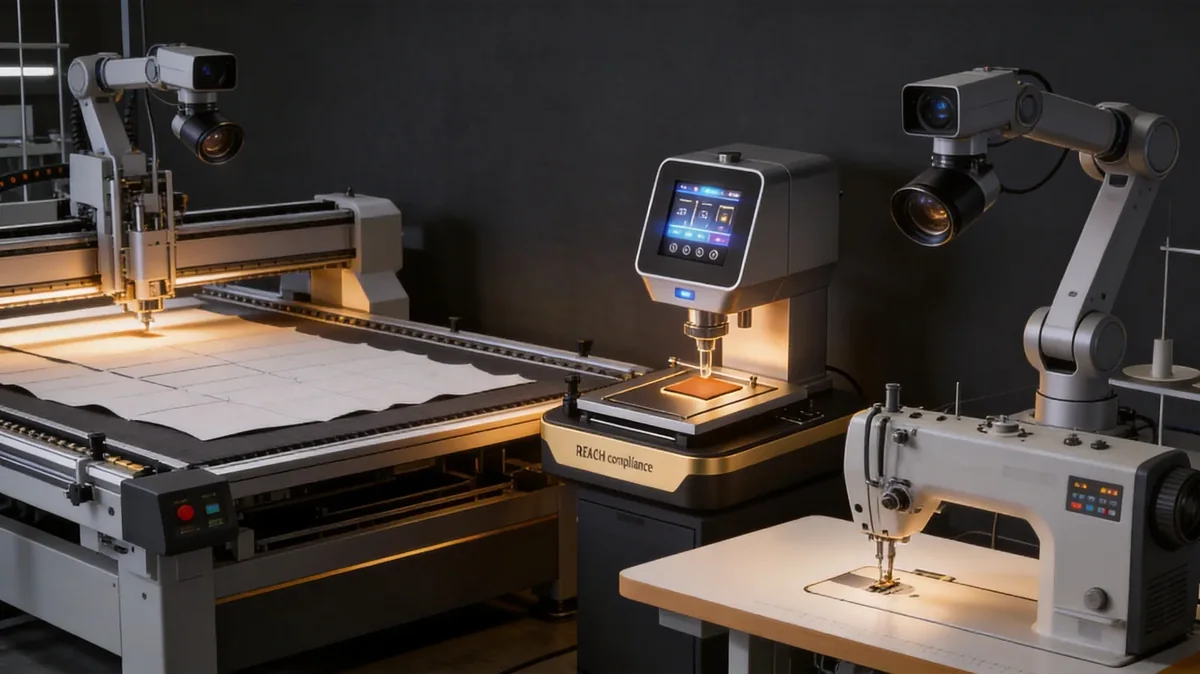
Where Couture Detail Survives the Move to Scale
Five categories of couture detailing survive the move from bench to programme largely intact: edge quality, handle attachment, hardware quality, material selection rules and the dressing of the finished piece.
Edge quality
The eye reads an edge before it reads a seam. Three thin passes with defined drying intervals, sanded between coats, produce an edge that survives transit where one heavy pass crazes.
Handle attachment
A handle carrying a loaded bag daily needs reinforcement and a defined test: 15 kg static load held for 60 seconds, with a board at 0.8 mm where the panel needs support.
Hardware quality
A plated closure is where a piece feels expensive in the hand. Brass with a 0.15-0.3 µm finishing layer, proven to 48 hours of salt spray and cycle tested to 5,000 openings.
Material selection rules
Choosing by eye cannot scale, but a rule can: substance, grain direction, acceptable marking and a retained reference compared under D65 to a tolerance of ΔE 1.5.
Final dressing
Pressing, shaping, thread trimming and inspection under standard lighting is where a programme piece either reads finished or reads assembled. It is hand work and it stays hand work.
Notice what the five have in common. Each is either an operation that a machine cannot perform to the same standard, or a rule that converts a judgement into something a bench hand can apply without asking.
Where It Does Not Survive
Four things do not survive the move without being re-designed: geometry settled during making, selection of hide area by eye, hand saddle stitching on long seams, and any construction that depends on the skill of one named person.
- Geometry settled on the bench, which has to be fixed in a drawing before it can be graded or repeated.
- Hide selection by eye, which has to become a written rule about grain, marking and acceptable variance.
- Hand saddle stitching on long internal seams, which is replaced by a machine seam at 8-9 stitches per inch.
- Construction held by one person, which has to be specified with tolerances for several hands to follow.
- Adjustment during assembly, which a repeated construction cannot permit without breaking its own tolerance.
The honest framing is that these are not losses but translations. A hand saddle stitch at 6-7 stitches per inch in waxed linen has a particular look and a particular failure mode, and the programme equivalent has to be designed to give the look without inheriting the failure mode.
Costing the Three Routes
Unit price falls sharply as volume rises, but not evenly, and the reason is the fixed block of preparation rather than the value of the work. Understanding where the fall comes from stops founders misreading a quotation.
| Cost element | Single build | Mini-series | Programme at 500 pcs |
|---|---|---|---|
| Pattern and development | High per unit, absorbed by 1 piece | Spread across 20-50 | Spread across 500 |
| Tooling | Minimal, cut by hand | One die set | Die set amortised over the run |
| Material | One hide per 1.2 units | One hide per 2.6-3.2 units | One hide per 4.5-5.2 units |
| Bench labour | Dominant, 92-96% hand work | 45-60% hand work | 22-35% hand work |
| Testing and compliance | Rarely booked | Sometimes booked | Booked per lot per market |
| Fixed preparation | Near zero | Modest | 6-10% of the run, plus 2-4% testing |
The last row is the one to watch: testing and compliance appear only at programme scale, because a single piece has no lot and no destination market in the regulatory sense. It is the clearest marker that the third route is a commercial proposition rather than an artistic one.
Choosing a Route: Four Situations
Four situations cover most briefs, and each has a clearly better route. Choosing deliberately at the start avoids the mid-programme discovery that a couture detail cannot be repeated at five hundred units.
- A showpiece for a presentation or a client: the single atelier build, at 25-40 working days and 92-96% hand work.
- A limited release for a small clientele: the mini-series, at 45-60 days, retaining hand finishing where the eye reads it.
- A commercial capsule with couture detailing: the programme route at 500 pcs, with detailing re-specified for repetition.
- A showpiece that must later become a capsule: build it twice, once by hand for the presentation and once from a frozen pack.
The fourth situation is where most of the avoidable pain occurs. A showpiece built by hand establishes a look that clients will ask to buy, and by then the geometry has been settled on the bench rather than in a drawing, which means the pack has to be reverse-engineered from a finished piece.
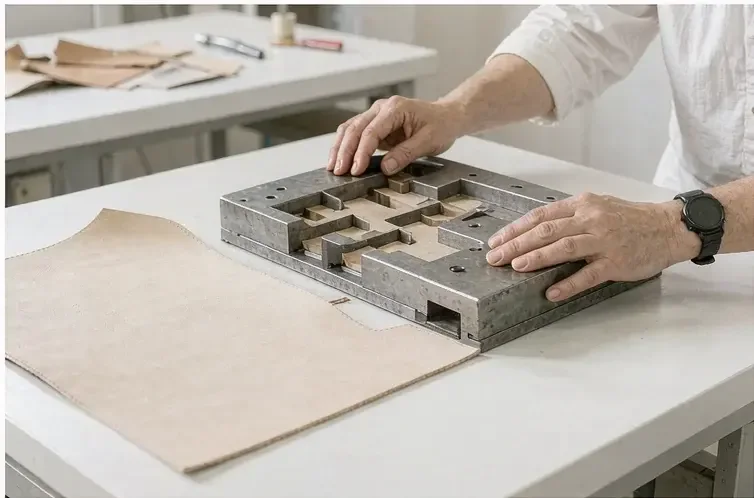
What Changes in the Brief for Each Route
The brief you write should differ by route, because each route needs a different kind of information and each makes a different promise about what can still be changed and when.
Brief requirements by route
- Single build: an intent, a silhouette and a material direction, with geometry deliberately left open for the bench.
- Mini-series: dimensioned drawings, a fixed construction, and a named list of operations to be finished by hand.
- Programme: dimensioned drawings with tolerances, graded sizes, quantity per colourway and destination markets.
- All three: a retained reference for the finish, agreed before the first unit rather than after the last.
The second and third items are where briefs most often fall short. A mini-series brief that does not name which operations are finished by hand will come back machine finished, and a programme brief without tolerances will come back measured against nobody's standard but the bench's own.
Couture detailing reaches scale only when it is specified as a tolerance rather than as an intention. Three passes, 8-12 minutes, 0.15-0.3 µm, 15 kg for 60 seconds: each is a couture idea written in a form five hundred units can inherit.
Our programme works to MOQ 500 pcs per style and colourway, with sampling at 6-10 working days and bulk at 35-50 days on FOB Xiamen terms, inspected to AQL 2.5 under ISO 2859-1. It runs across 7 production lines with about 200,000 pcs per month of capacity and export experience since 2014, delivered through our validated partner factory Quanzhou Yingming Bags, an SGS-validated site.
Bring the concept and we will map the route
Send your drawings, the detailing you want retained and the quantity you need. You will receive all three routes costed against your concept, with what survives scale marked, within two working days. Request a quote.
Frequently Asked Questions
What is the difference between a couture bag and a programme bag?
A couture bag is adjusted on the bench as it is made, at 92-96% hand work, while a programme bag has its geometry frozen in a drawing so five hundred units can repeat it. The difference is not quality but whether the detailing was specified as a tolerance.
How long does a single atelier build take?
Twenty-five to forty working days for one to five pieces. The range is wide because the route allows adjustment during construction, and because material is selected by eye from the hide rather than arranged for yield in advance. Selection by eye is the reason it varies.
How much hand work remains on a 500-piece programme?
Around 22-35%, concentrated on edge finishing, handle attachment and final dressing. Those are operations a machine cannot match; long internal seams are machine sewn at 8-9 stitches per inch on Tex 40 bonded nylon. The figure marks where the eye and the hand read couture.
Why does cutting yield differ so much between routes?
Because selection differs. A single build chooses the best area of each hide by eye and consumes one hide per 1.2 units; a programme arranges panels for economy and consumes one hide per 4.5-5.2 units on the same body size. Matching costs skins, deliberately.
Is tolerance looser on a programme than on a handmade piece?
No, it is tighter. A repeated operation is measured against a retained reference and held to about 1 mm, while a single build is judged on the piece by its maker at roughly 2 mm. Repetition is what makes measurement possible. Tolerances need repetition to exist.
Which couture details survive the move to scale?
Five: edge quality, handle attachment, hardware quality, material selection rules written as specifications, and final dressing. Each is either an operation a machine cannot match or a rule converting judgement into something repeatable. Write each of the five as a tolerance rather than an intention.
What is the advantage of hand saddle stitching?
At 6-7 stitches per inch in waxed linen it produces a seam that fails gradually rather than unravelling at a break. On a programme, the equivalent look is achieved with a machine seam at 8-9 stitches per inch in bonded nylon. The failure mode is the difference.
How is a hand-burnished edge different from a painted one?
A hand-burnished edge is built in five to seven passes with a heated tool and wax, which a maker can adjust to the piece. A programme edge is three paint passes with 8-12 minutes of drying between, sanded between coats and cured for 24 hours.
Why does the elapsed time rise as volume rises?
Because bulk scales with quantity while development does not. A single build needs 25-40 days, a mini-series 45-60, and a programme 55-75, but the programme produces five hundred units rather than five, so time per unit falls sharply. Time per unit falls as volume rises.
Can a showpiece built by hand become a programme later?
Yes, but the pack has to be written from the finished piece rather than the other way round. The cleaner approach is to build twice: once by hand for the presentation, and once from a frozen pack for the capsule that follows. Build twice rather than once.
People Also Ask
What makes a handbag couture?
Construction adjusted on the bench as the piece is made, material selected by eye from the hide, hand saddle stitching, and hand-burnished edges built in five to seven passes.
Can couture quality be produced at scale?
Yes, where the detailing is re-specified as a tolerance rather than an intention. Edge build, handle loads, plating thickness and colour tolerance all survive; bench-side adjustment does not.
How much hand work is in a luxury handbag?
About 92-96% on a single atelier build, 45-60% on a mini-series of twenty to fifty, and 22-35% on a programme of five hundred, concentrated where the eye and hand read it.
Should I build a showpiece before a capsule?
Build both. A showpiece made by hand establishes the look, and a separate pack written from the frozen geometry makes the capsule repeatable without reverse-engineering a finished piece.
Sources and further reading
Every figure on this page is either our own programme data or attributed below. Open the originals before you write them into a specification.
- ISO — International Organization for StandardizationISO Publisher of ISO 2859-1, which sets the sampling plans, code letters and accept and reject numbers used on the programme route.
- Leather Working GroupLeather Working Group Tannery audit protocol referenced when a lot is reserved for a programme, and when material selection rules are written.
- CITES — Convention on International Trade in Endangered SpeciesCITES Permit documentation that applies to listed skins, which is one reason exotic couture work follows a different route.
- ECHA — European Chemicals AgencyEuropean Chemicals Agency Administrator of REACH, the restricted substance list tested per lot on the programme route where destination markets require it.
- Business of FashionBusiness of Fashion Reporting on couture structures, atelier economics and how houses move detailing from showpiece into repeated production.