Can Machine Craft Match Couture Bag Work: Six Decisions Before You Choose
Machine craft can match couture bag work on long straight seams, linings and zip insertion, and it cannot match it on corners, thick stacks and visible seams whose pitch has to vary. The deciding questions are six, taken in order: where the seam sits, how thick the stack is, what happens when one stitch breaks, whether the pitch varies, what the volume is, and what the customer actually reads.
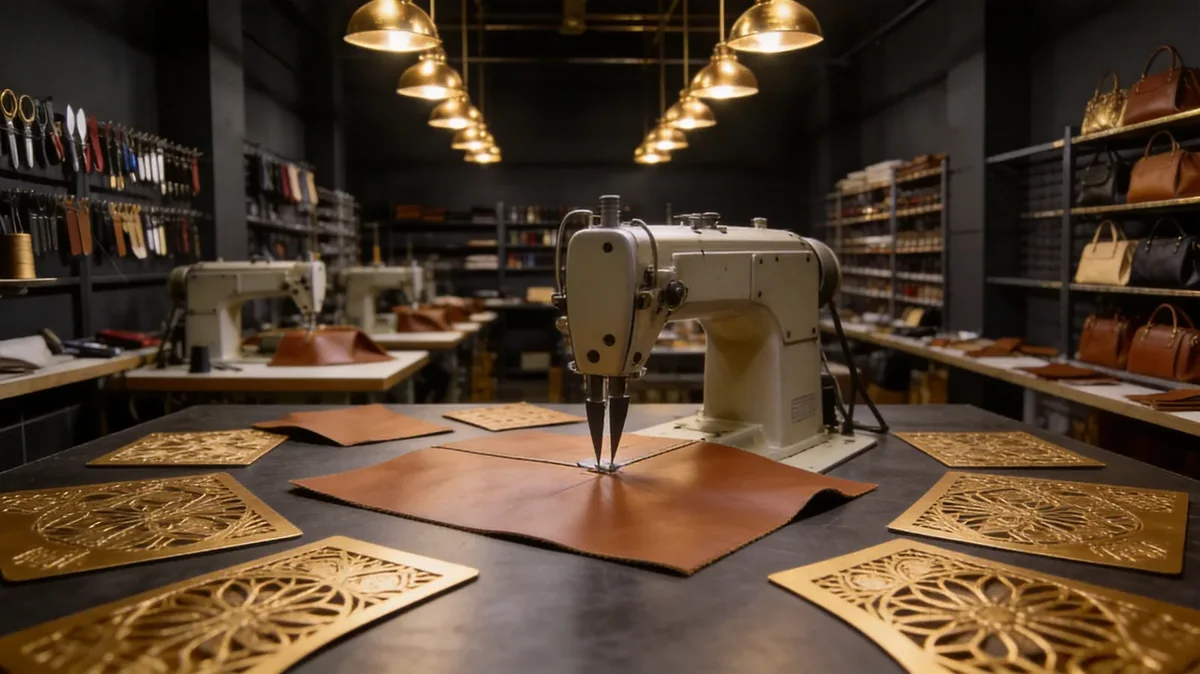
The Decision Order: Six Questions, Taken in Sequence
Whether a machine can stand in for couture bench work is not one question but six, and the order matters because an answer at any point can end the enquiry. Most buyers start with the sixth question, which is what the customer reads, and work backwards to the first; that is why the same argument gets had on every programme. Taken from the top, the six resolve in about ten minutes and produce a drawing that says which operation gets which method.
- Where does the seam sit — visible face, corner, or hidden interior?
- How thick is the stack at the seam — under 3.5 mm or over it?
- What happens when one stitch breaks — does the seam hold or run?
- Does the pitch need to vary along the length of the seam?
- What is the volume, and does it justify a bespoke setting?
- What does the customer read at arm's length in a boutique?
The sequence is deliberately ordered from the most constraining to the least. A seam on a hidden interior panel fails the first question and never reaches the fifth, which is the point: most of a handbag needs no bench judgment at all, and saying so early is what keeps a couture specification couture on the parts that earn it.
Question One: Where Does the Seam Sit?
Position decides more than any other single factor. A seam on a visible face, at a corner, or along a handle join is read by a customer and loaded in use, which argues for the bench. A seam along a lining, a pocket bag or a hidden interior panel is read by nobody and carries distributed load, which argues for a machine held to a constant setting. That single split usually resolves half the operations on a body before any other question is asked.
There is a second, quieter reason to favour the bench on visible faces: repair. A visible seam is the one a customer will ask to have restored in five years, and a seam that can be unpicked and re-sewn through the same holes is the one a restoration specialist can work with. A machine seam through a face panel can be replaced but rarely re-sewn in the original holes, because the needle has displaced rather than opened the fibre. Nobody specifies for the repair, and everybody pays for it eventually.
Question Two: How Thick Is the Stack?
Thickness is the hard physical limit. A standard walking-foot machine handles a stack up to about 3.5 mm; beyond that the presser foot cannot hold the layers square and the needle deflects. A hand awl and two needles have no such limit and are routinely used through 6 mm and more at a handle join. If the stack is over 3.5 mm, the question is settled by geometry rather than by preference.
- Machine stack limit
- About 3.5 mm before the foot loses grip
- Hand awl capacity
- 6 mm and beyond at a handle join
- Awl profile
- 1.2 mm diamond, opening the hole rather than cutting it
- Machine needle profile
- 1.0 mm round, piercing the fibre
- Machine pitch range
- 6-14 stitches per inch, adjustable
- Hand pitch on heavy gauge
- 7-8 stitches per inch, set by eye
The profile difference is the part that is easy to miss. A round needle pierces between fibres and displaces them; a diamond awl opens a slit and closes around the thread. On a stack that flexes, the slit closes and grips, which is why a hand seam through thick leather holds its line where a machine seam through the same stack tends to wander as the layers settle.
Question Three: What Happens When One Stitch Breaks?
This is the question that actually separates the two methods, and it is the one buyers rarely ask. In a machine lockstitch, one broken stitch releases the tension along the seam and the run propagates: pull one end and the seam opens like a zip. In a saddle seam, each stitch is locked independently across the thread, so a broken stitch stays where it is and the rest of the seam holds.
Machine lockstitch
Top and bottom thread interlock in a continuous chain. Fast and uniform, but a single break releases tension along the run and the seam opens progressively from the point of failure unless it is back-tacked at intervals.
Hand saddle seam
Two needles cross through the same hole in opposite directions, locking each stitch independently. A break stays local, and the seam retains most of its strength around it, which is why the method survives on loaded joins.
Practical consequence
On a handle join or a base corner, where load concentrates and repair is difficult, the failure behaviour matters more than the appearance. On a lining seam it does not matter at all.
Question Four: Does the Pitch Need to Vary?
A machine holds one pitch for the length of a seam, which is exactly what a long straight run wants. A corner does not: the pitch should tighten as the radius closes so the seam reads even rather than crowded, and that adjustment is a judgment taken stitch by stitch. Any seam that changes direction therefore argues for the bench, and any seam that does not argues against spending bench time on it.
Question Five: What Is the Volume?
Volume decides whether a bespoke setting is worth building. A machine seam of 100 mm takes about 12 seconds; the same 100 mm by hand takes 6-7 minutes. Across 500 pieces with 400 mm of visible seam each, that difference is the whole schedule. Which is precisely why the honest answer is a split: hand work on the corner and the visible join, machine work on the long run, and a written note on the drawing saying where the changeover happens.
| Operation | Machine | Hand | Recommended |
|---|---|---|---|
| Long straight body seam | 12 seconds per 100 mm | 6-7 minutes per 100 mm | Machine, pitch held to a setting |
| Visible corner | Crowds at the radius | Pitch tightens as the curve closes | Hand, without exception |
| Handle join over 3.5 mm | Beyond foot capacity | Awl handles 6 mm and more | Hand, for geometry and failure behaviour |
| Lining and pocket bags | Uniform and fast | No advantage | Machine, 10 mm allowance |
| Zip insertion | 3 mm margin held by a guide | Eye is less consistent | Machine, on a guide |
| Edge finishing | Single pass, proud bead | Three coats, sanded between | Hand, three coats at 0.10-0.14 mm |
Question Six: What Does the Customer Read?
The last question is the commercial one. At arm's length in a boutique, a customer reads pitch evenness at a corner, thread position in the channel, and whether the edge is flush with the face. A machine seam on a long straight run is read as even; the same seam crowding at a corner is read as hurried. That is the whole of the sixth question, and it is why the split between methods is a design decision rather than a cost decision.
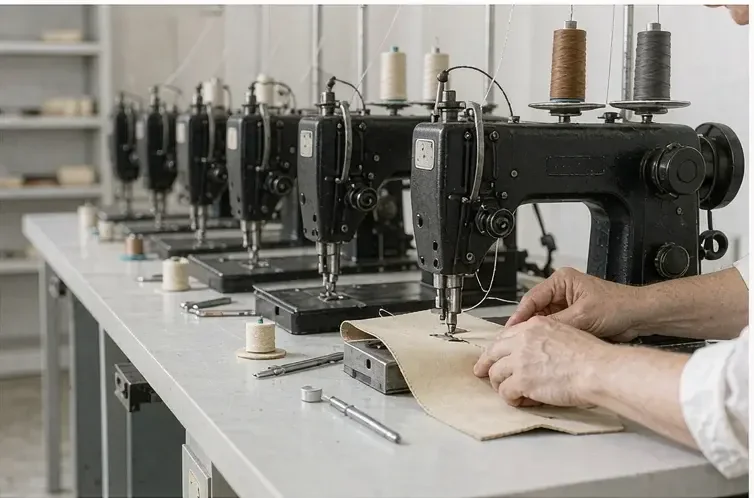
The same question can be asked about the thread channel, and it usually returns the same answer. A channel that has been cut rather than pressed keeps the thread below the surface and protected from abrasion on any face that will rub against a coat or a car door. Cutting a channel is a bench operation, it is slow, and it is impossible to imitate on a machine without a dedicated attachment that most lines do not carry. Where the drawing calls for it, it should be named explicitly, because 'stitched' will otherwise be interpreted as the fastest thing that produces a seam.
Where Machine Work Is Genuinely Better
Three operations are better on a machine, and saying so plainly protects the bench time that is genuinely needed. Long straight interior seams are more uniform when the feed is constant than when a hand decides each stitch. Linings and pocket bags benefit from a fixed 10 mm allowance and a constant feed. Zip insertion is more accurate on a guide, which holds a 3 mm margin better than an eye does across five hundred pieces.
- Interior seams: uniformity across the run matters more than judgment at each stitch.
- Linings and pocket bags: a constant allowance and feed beat a hand varying them.
- Zip insertion: a 3 mm guide margin is held more consistently than an eye.
- Basting and temporary holding: faster by machine, and removed later anyway.
Ask what happens when one stitch breaks, and whether the pitch needs to vary along the seam. If either answer favours the bench, machine substitution will show in month two rather than at despatch.
How to Write the Choice on a Drawing
The choice is written per operation, with the changeover point marked. 'Machine at 8 per inch from the base to 40 mm before the corner, hand saddle at 7-8 per inch through the corner and the handle join' is a specification a bench can follow and an inspector can check. 'Hand finished' is not, and it is the phrase under which most silent substitutions are made. Marking the changeover point on the pattern is what makes the split enforceable.
Two further lines belong beside it: the thread specification and the failure expectation. Waxed linen at 0.45-0.55 mm for hand work, bonded filament at about 0.30 mm for machine work, and a written expectation that a visible seam holds after a single stitch is broken. Both are measurable, both are checkable at goods-in, and neither costs anything to put on the drawing.
The answer in one line
- Machine craft matches couture work on straight, hidden, uniform operations and does not match it at corners, thick stacks or any seam whose pitch has to change. Write the split per operation.
Programme Figures
Our programme runs through our validated partner factory Quanzhou Yingming Bags, an SGS-validated site with 7 production lines and roughly 200,000 pcs per month of capacity, holding export experience since 2014. Sampling takes 6-10 working days, or 12-15 on a complex build; bulk occupies 35-50 days; minimums sit at 500 pcs per style and colourway; and shipments leave FOB Xiamen with FOB, CIF and DDP terms all available. Inspection is drawn at AQL 2.5 under ISO 2859-1, with seam strength and leather tested against ISO 3376. Material and hardware direction is covered on luxury materials.
Get the split written per operation
Send the silhouette, hardware direction, quantity per colourway and the seams you care about. You will receive a drawing-level specification naming the method and pitch for each operation. Request a quote.
Frequently Asked Questions
Can machine craft match couture bag work?
On long straight seams, linings and zip insertion, yes, and often better. It cannot match it at corners, through stacks over 3.5 mm, or on any visible seam whose pitch has to vary. The honest answer is a split written per operation rather than a single choice for the whole body.
What is the thickest stack a machine can sew?
About 3.5 mm, at which point the presser foot can no longer hold the layers square and the needle begins to deflect. A hand awl and two needles have no comparable limit and are routinely used through 6 mm and more at a handle join.
What happens if one stitch breaks in each method?
In a machine lockstitch the tension releases along the seam and the run propagates from the break. In a hand saddle seam each stitch is locked independently, so a break stays local and the rest of the seam keeps most of its strength.
Why does pitch have to vary at a corner?
Because a constant pitch crowds as the radius closes and the seam reads hurried. A hand tightens the pitch stitch by stitch as the curve turns, so the seam reads even. A machine holds one setting for the whole length and cannot do that.
How much slower is hand stitching?
Roughly thirty-five times slower on the same length: about 12 seconds per 100 mm by machine against 6-7 minutes by hand. Across 500 pieces with 400 mm of visible seam, that difference is the entire production schedule.
When is machine stitching actually better?
On long straight interior seams, linings, pocket bags and zip insertion. All four carry distributed rather than concentrated load, are hidden, and benefit more from uniformity across the run than from a decision taken at each stitch.
What needle and awl profiles are used?
A machine needle is about 1.0 mm and round, so it pierces between fibres and displaces them. A hand awl is about 1.2 mm and diamond-shaped, opening a slit that closes around the thread and grips when the stack flexes.
How should the choice be written on a drawing?
Per operation, with the changeover point marked on the pattern: machine at 8 per inch up to 40 mm before the corner, then hand saddle at 7-8 per inch through the corner and handle join. Marking the changeover is what makes it enforceable.
What thread suits each method?
Waxed linen at 0.45-0.55 mm for hand work, because the wax grips in the slit the awl opens. Bonded filament at around 0.30 mm for machine work, where the thread runs through a tension disc rather than being drawn by hand.
How can you tell which method was used at goods-in?
Look at the back of the seam and at any corner. A saddle seam shows two threads crossing in each hole and a pitch that tightens through the curve; a lockstitch shows a single interlock and a pitch that does not change.
Does hand stitching make a bag last longer?
At loaded joins, yes, because the failure behaviour is local rather than progressive. Elsewhere it makes no measurable difference to service life, which is why the method should be chosen per operation rather than applied to the whole piece.
How long does a split-method programme take?
Sampling takes 6-10 working days, or 12-15 on a complex build, and bulk occupies 35-50 days at 500 pcs per style and colourway. Shipments leave FOB Xiamen with FOB, CIF and DDP terms all available.
People Also Ask
Is hand stitching always superior on a luxury bag?
No. It is superior at corners, thick stacks and loaded joins. On long straight interior seams and linings a machine held to a constant setting produces a more uniform result than a hand deciding each stitch.
Why do luxury houses still use hand seams?
Because the two things a machine cannot do — vary the pitch through a corner and keep a break local — are exactly what a loaded join needs. Both matter at the handle and the base corner.
Can you mix machine and hand work on one bag?
Yes, and most well-specified pieces do. The machine runs the long lengths and the interiors; the hand takes the corners, the handle joins and any visible seam that changes direction.
How much does the method choice affect cost?
Materially, because bench time is about thirty-five times slower per unit length. Restricting hand work to the operations that need it is the largest single lever on unit cost that does not affect how the piece reads.
What should be checked at inspection if both methods are used?
The changeover point. Look for a pitch step or a thread change where the machine run meets the hand run, and confirm the pattern marks the transition rather than leaving it to whoever is holding the piece.
Sources and further reading
Every figure on this page is either our own programme data or attributed below. Open the originals before you write them into a specification.
- ISO — International Organization for StandardizationISO Publisher of ISO 2859-1 for the AQL 2.5 inspection plan and ISO 3376 for leather tensile and seam strength testing.
- SATRA Technology CentreSATRA Independent testing body for leather goods, referenced for seam strength, stitch failure and thread abrasion test methods.
- Leather Working GroupLeather Working Group Tannery audit protocol that evidences hide traceability behind the leather used in both machine and hand seams.
- ISO technical committee on leatherISO Committee responsible for the ISO leather test series referenced in seam and material specifications.