Building an Artisan Team for Luxury Handbag Lines: Three Bench Models Compared
Building an artisan team for luxury handbag lines is a choice between three bench models: one maker per piece, nine specialist stations, or a hybrid cell of three or four skills. Generalists suit a complex first drop, specialists suit 500 pcs per colourway, and cells suit both. Skill, not headcount, is the constraint: 400 bench hours to proficiency, 2,000 before independent exotic work.
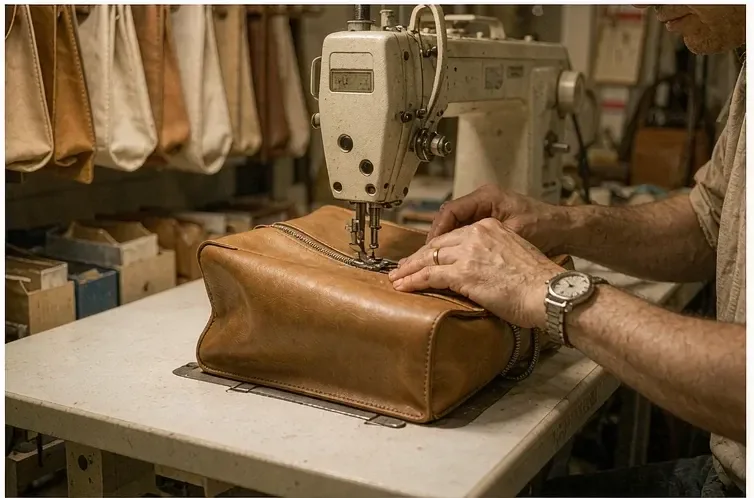
Three Ways to Organise a Bench, Compared
There are three workable ways to organise a luxury bench and they are not variations of each other, they are different answers to the same question: who is accountable when a measurement is wrong. In the generalist model one maker takes a piece from lay to inspection. In the station model nine specialists each own one measurement. In the cell model a small group of three or four makers covers a contiguous run of stations and shares the accountability between them.
| Factor | One maker per piece | Nine specialist stations | Hybrid cell |
|---|---|---|---|
| Accountability | Unambiguous, one name per piece | One measurement per station | Shared across three or four makers |
| Consistency across 500 | Depends on the maker's day | Highest, repetition sharpens each step | High within a cell, needs a bridge between cells |
| Suits | Complex first drops, exotic builds | Repeat colourways at volume | Mixed programmes, seasonal change |
| Training load | Longest, 2,000 hours or more | Shortest per station, 400 hours | Medium, three stations per maker |
| Flexibility | High, any piece any day | Low, a missing role stops the line | Medium, cells can be re-balanced |
| Risk | A single absence stops the piece | Drift if stations are not bridged | Boundary faults between cells |
The recommendation follows the programme rather than the philosophy. A complex or exotic first drop belongs with a generalist, because the decisions are interdependent and a piece that is laid, skived and closed by the same hand does not suffer from handover error. A repeat colourway at 500 pcs belongs with stations, because repetition is what produces the consistency a buyer is paying for. A mixed seasonal programme belongs with cells.
What a Maker Can Do After 400 Hours, and After 2,000
Skill on a luxury bench is measured in hours at the board, and the two thresholds worth knowing are 400 and 2,000. At around 400 hours a maker can hold pitch at 8-9 per inch on a calf body, take a consistent bevel, and produce an edge film inside 0.10-0.15 mm dry without supervision. At around 2,000 hours the same maker can be trusted with an exotic panel, where a misplaced hole is permanent.
- Basic bench proficiency
- 400 hours
- Independent on a structured calf body
- 800-1,000 hours
- Independent on a turned or bound edge
- 1,200-1,500 hours
- Independent on an exotic shell
- 2,000 hours or more
- Pitch held at 8-9 per inch
- From 400 hours on a calf body
- Edge film inside 0.10-0.15 mm dry
- From 400 hours with a check at inspection
- Hardware seating within 0.2 mm
- From 600 hours
- Exotic tile matching within 3 mm
- From 2,000 hours
Those figures are why a luxury line cannot be scaled by adding hands quickly. The scarce resource is not the bench, it is the hours already accumulated at one, and the only way to shorten the path is to narrow what each maker has to learn. That is the entire argument for the station model, and it is also its limit: a maker who knows one station deeply cannot cover for the one next to them.
The Nine Roles and Which Ones Are Scarce
A luxury bench carries nine roles, matching the nine stations a piece moves through: layer, clicker, skiver, closer, stitcher, edger, setter, finisher and inspector. They are not equally scarce. Skiving, edge work and exotic laying are the three that take longest to learn and the three where a substitute cannot be found quickly, because each is a judgement made against a surface rather than a step performed to a setting.
Scarce: skiver
Judges thickness by feel against a moving knife, holding 0.6-0.7 mm on exotic and 0.8 mm on calf. Takes 1,200 hours or more and cannot be substituted at short notice.
Scarce: edger
Holds a dry film of 0.10-0.15 mm across three coats and reads cure by touch. The single most common cause of a piece being rejected at inspection.
Scarce: exotic layer
Matches tiles within 3 mm across a centre line and decides what the shell will allow. Two thousand hours before the role is independent.
Abundant: clicker
Cuts to a pattern within ±0.5 mm. Reaches proficiency fastest of the nine, at roughly 400 hours, and is therefore the first role a new line fills.
The practical consequence is that a line should be planned around its scarcest role rather than its fastest. If one maker can edge 40 pieces in a day and the line needs 60, the line runs at 40 regardless of how many clickers are on it, and the fix is either a second edger trained over a season or an edge specification that takes less bench time.
Cross-Training Without Losing Tolerance
Cross-training is how a bench covers absence without losing tolerance, and the method is to train adjacent stations only. A closer learns skiving, a stitcher learns closing, an edger learns finishing. Three stations per maker is the workable ceiling: beyond that the hours are spread thin enough that no single measurement is held reliably, and the bench produces generalists by accident rather than by design.
- Train adjacent stations, never random ones; adjacency is what makes the handover clean.
- Hold three stations per maker as the ceiling, and record which three against the maker's name.
- Re-check a maker's tolerance on a station after any gap longer than four weeks.
- Keep the approved sample at the station, not in a office, so judgement has a reference.
- Rotate on a schedule rather than in response to an absence, so the skill stays warm.
The fourth item is the one that makes the others work. Judgement on a luxury bench is comparative: does this piece match the approved one. A maker with the sample at the board holds a tolerance; a maker working from memory drifts towards their own average, which is how a run slowly stops matching the sample it was approved against.
Rotation also has to be recorded, because an unrecorded rotation is indistinguishable from an absence. A board at the end of the line showing which maker covered which station on which day costs nothing to keep and answers, in a minute, the question that otherwise takes a week of reconstruction after a finding at inspection.
How a Team Holds a Sample Across a 500-Piece Run
Holding a run to the approved sample is a team problem rather than a document one. The mechanism is simple and takes four steps: the sample stays on the line, a piece is pulled from every group and placed beside it, readings are taken on five pieces rather than one and recorded, and any drift is corrected at the station that produced it rather than at inspection.
Ask where the approved sample sits while the run is being made. If the answer is anywhere other than on the line, the run will drift towards the bench's own average by piece 200.
Inspection itself is drawn at AQL 2.5 under ISO 2859-1, which sets the sample size and the accept and reject numbers, with a re-work reserve held so a finding is corrected on the bench rather than at the destination. Material is tested alongside it against ISO 3376 for tensile strength, ISO 11644 for finish adhesion and ISO 105 for colour fastness, and hide traceability is evidenced through Leather Working Group tannery audits.
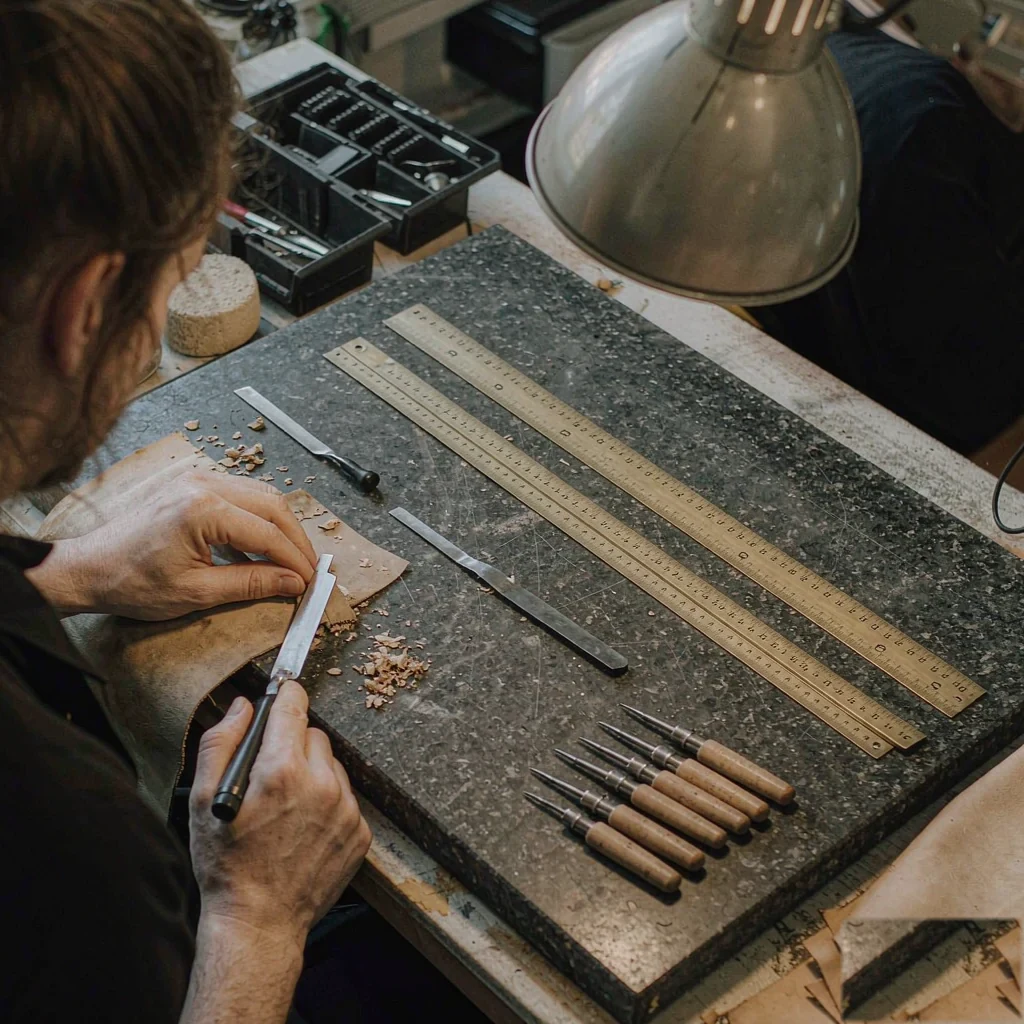
Paying for Skill: What Bench Time Actually Buys
A structured designer piece occupies 90-140 minutes of bench time, and the distribution is what matters: edge work 18-25 minutes, closing 15-20, stitching 20-30, hardware 10-15, finishing 12-18, with the remainder in lay, skive and inspection. Moving from an ordinary tolerance to the figures named in this article adds roughly USD 4.80 per unit, concentrated almost entirely in the two scarcest roles.
| Operation | Bench minutes | Skill threshold | Where the time goes |
|---|---|---|---|
| Lay and click | 10-15 | 400 hours | Grain direction, defect avoidance |
| Skive | 6-9 | 1,200 hours | Bevel width, thickness at the turn |
| Close | 15-20 | 600 hours | Glue line, open time, press |
| Stitch | 20-30 | 400 hours | Pitch, slant, back-tack |
| Edge | 18-25 | 1,200 hours | Three coats, cure, corner |
| Hardware | 10-15 | 600 hours | Seating, feel, repeat test |
| Finish and inspect | 12-18 | 800 hours | Surface, readings, record |
Read the table as a planning tool. The two operations with the highest skill thresholds are also the two with the longest bench times, which means the scarce roles are not a side constraint on a luxury line, they are the line. A programme that plans its capacity around clicking will always be surprised by its edge station.
Where an Exotic Line Changes the Team
An exotic line changes three things about a team. Laying becomes the scarce role rather than skiving, because tile matching within 3 mm across a centre line is a layout judgement made against what the shell offers. Pitch drops to 6-8 per inch, which is a different muscle memory from the 8-9 a calf bench has trained for. And the cost of an error rises to the value of the panel, so inspection moves earlier and the reserve is larger.
The practical rule is that an exotic line is not staffed by moving makers across from a calf line for a week. It is staffed by makers who have the hours on exotic, with a calf bench continuing alongside it, because the two bodies punish different mistakes and a maker who is excellent on one is not automatically safe on the other. Where a shell is listed, CITES documentation is reconciled with the tag before a panel is released.
Onboarding a New Line Within the Sampling Window
The programme runs through our validated partner factory Quanzhou Yingming Bags, an SGS-validated site with 7 production lines and about 200,000 pcs per month of capacity, holding export experience since 2014. Sampling takes 6-10 working days on a standard build and 12-15 on a complex one, bulk occupies 35-50 days, minimums sit at 500 pcs per style and colourway, and shipments leave FOB Xiamen with FOB, CIF and DDP terms available.
Onboarding inside that window is a matter of sequencing. The layer and clicker start on day one against the pattern, the skiver and edger join on day three once panels exist, and the setter and finisher join on day six once the first closed piece exists. The approved sample is on the line from day four, and the tolerance sheet is written before the second piece rather than after the fifth.
What to have ready before a line starts
- An approved sample on the line; a tolerance sheet naming pitch, edge film and hardware gap; a station map with three stations per maker; the scarce roles named and covered; inspection drawn at AQL 2.5 under ISO 2859-1; a re-work reserve held above the run quantity.
Plan a bench around the roles that are scarce
Send drawings, material direction, quantity per colourway and delivery date. You will receive a station map, a skill plan and a costed bench estimate for the line. Request a quote.
Frequently Asked Questions
What are the three ways to organise a luxury handbag bench?
One maker per piece, nine specialist stations, or a hybrid cell of three or four skills. Each answers the same question differently: who is accountable when a measurement is wrong. The choice follows the programme rather than a philosophy.
Which bench model suits a 500-piece run?
Nine specialist stations. Repetition at volume is what produces consistency, and a station bench lets each maker hold one measurement deeply. A complex or exotic first drop is better served by one maker per piece.
How long does it take to train a maker?
About 400 bench hours to hold pitch at 8-9 per inch and an edge film of 0.10-0.15 mm on calf, 1,200 to 1,500 for skiving and edge work, and 2,000 or more before a maker works an exotic panel independently.
Which roles are hardest to fill?
Skiver, edger and exotic layer. Each is a judgement made against a surface rather than a step performed to a setting, which is why substitutes cannot be found quickly and why a line should be planned around them.
How many stations should one maker cover?
Three, and only adjacent ones. Beyond three the hours are spread too thin for any single measurement to be held reliably, and the bench ends up with generalists by accident rather than by design.
How does a bench hold a run to the approved sample?
By keeping the sample on the line, pulling a piece from every group and placing it beside the sample, taking readings on five pieces rather than one, and correcting drift at the station that produced it.
What is AQL 2.5 and how does it apply here?
It is the sampling plan under ISO 2859-1 that sets how many pieces are drawn from a run and what accept and reject numbers apply. It turns a claim of careful checking into a figure that can be enforced.
How much bench time does a structured piece take?
Between 90 and 140 minutes, distributed across lay, skive, closing, stitching, edge work, hardware and finishing. Edge work alone accounts for 18-25 minutes, which is why the edger is a scarce role.
What does it cost to hold luxury tolerances?
Roughly USD 4.80 per unit above an ordinary tolerance, concentrated in edge work and hardware seating, the two operations with the highest skill thresholds. It is worth paying on visible and loaded areas.
Can a maker move from a calf line to an exotic one?
Not for a week and not automatically. Exotic work runs at 6-8 stitches per inch with permanent holes and tile matching within 3 mm, so it needs its own accumulated hours and its own bench alongside the calf line.
How is a new line onboarded inside the sampling window?
In sequence: layer and clicker from day one, skiver and edger from day three once panels exist, setter and finisher from day six once the first piece is closed, with the sample on the line from day four.
What should be ready before a line starts?
An approved sample on the line, a tolerance sheet naming pitch, edge film and hardware gap, a station map with three stations per maker, the scarce roles covered, and a re-work reserve above the run quantity.
People Also Ask
Is one maker per piece better than stations?
For a complex first drop, yes, because the decisions are interdependent and handover error disappears. For 500 pcs of a repeat colourway, stations win because repetition is what produces consistency.
Why is skiving considered a scarce skill?
Because thickness is judged by feel against a moving knife, holding 0.6-0.7 mm on exotic and 0.8 mm on calf. It takes 1,200 hours and cannot be substituted at short notice.
How does a bench avoid drift on a long run?
Keep the approved sample at the board, pull a piece from every group, and take readings on five pieces. Drift happens when judgement is made from memory rather than against a reference.
What happens if a scarce role is absent?
The line runs at that station's pace regardless of how many makers sit elsewhere. The fix is a second maker trained over a season, or a specification that takes less bench time.
Does an exotic line need separate inspection?
It needs earlier inspection and a larger reserve, because a rejected exotic panel cannot be replaced quickly and the cost of an error is the value of the panel itself.
Sources and further reading
Every figure on this page is either our own programme data or attributed below. Open the originals before you write them into a specification.
- ISO - International Organization for StandardizationISO Publisher of ISO 2859-1 for the AQL 2.5 inspection plan, ISO 3376, ISO 11644 and ISO 105 for material testing.
- SATRA Technology CentreSATRA Independent testing body for leather goods, referenced for the test methods behind the skill thresholds described above.
- Leather Working GroupLeather Working Group Tannery audit protocol through which hide traceability is evidenced for the lay station.
- CITES - Convention on International Trade in Endangered SpeciesCITES The convention whose Appendices determine which exotic shells require documentation before a panel is released to a bench.