Best High-End Handbag Sourcing Questions to Ask Before You Sign Anything
What are the questions worth asking a high-end handbag sourcing partner? Ask these six, in this order: who makes the bag, what is in the leather specification, how is the hardware tested, what does the inspection cover, what happens when something goes wrong, and what will you tell me that I did not ask. Each is answered below with the parameters our programme works to, so you can score the reply you receive.
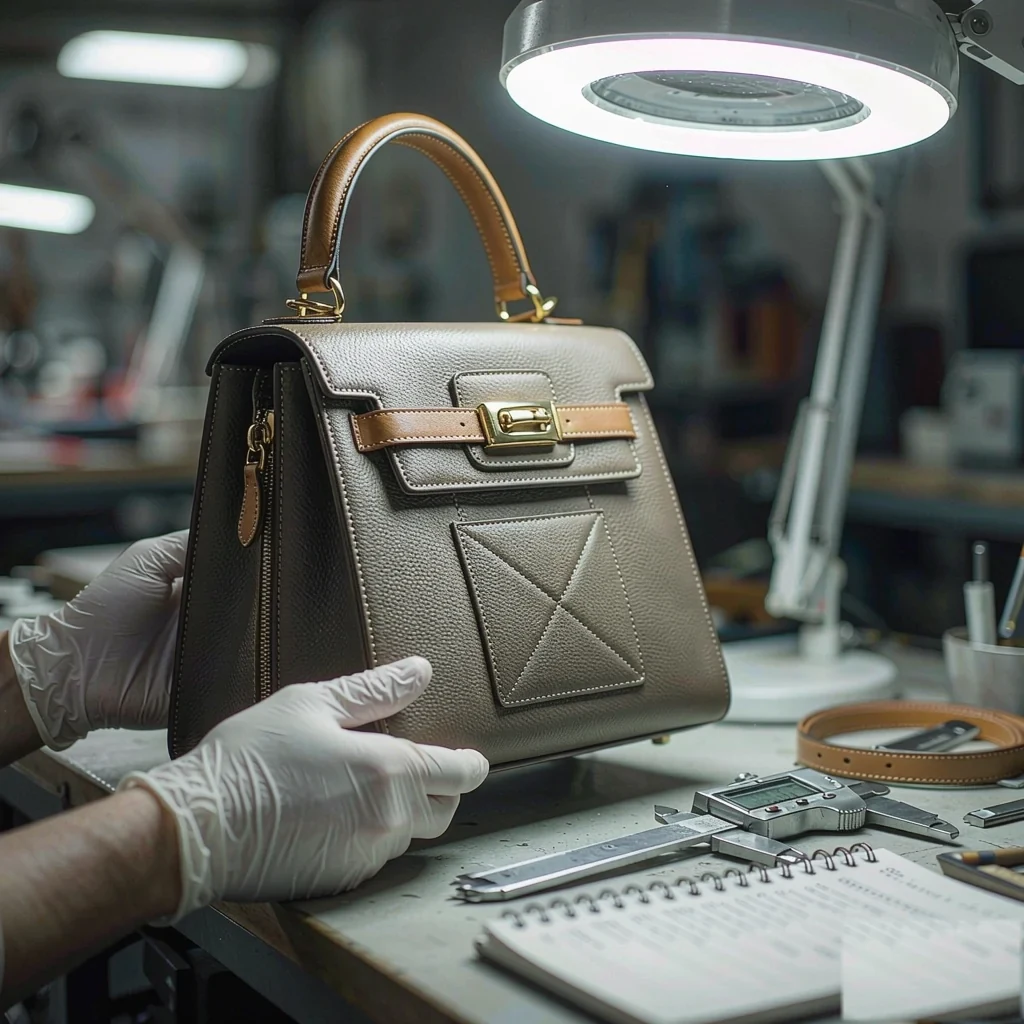
Question one: who actually makes the bag?
Ask it first, and ask it plainly. A sourcing conversation that opens with a unit price and never reaches the bench is a conversation about a photograph. The answer you are looking for names the production partner, the number of lines it runs and the monthly output those lines release, and it should arrive without your having to press for it. Our answer is that the work is placed with our validated partner factory Quanzhou Yingming Bags, across 7 production lines releasing about 200,000 pcs per month, with export experience since 2014.
The follow-up matters more than the reply. Ask what happens to your order if the named line is already full. A partner that schedules you against a specific line answers with dates; one that offers a slot in an anonymous pool answers with reassurance. The first is a plan and the second is a wish, and the difference only becomes visible when a launch calendar is hanging on it.
Question two: what is inside the leather specification?
Most briefs say full-grain calfskin and stop there. Full-grain is a grade, not a specification. A specification has to carry the tannery, the thickness band in millimetres, the finish, the temper, the rubbing fastness and the chemical limits. Ours for a structured day bag reads as 1.2-1.4 mm full-grain calfskin with a semi-aniline finish, colour fastness to rubbing of at least grade 4 dry and grade 3-4 wet under ISO 105-X12, and chrome VI held below 3 mg/kg under the REACH Annex XVII restriction.
Ask for the thickness tolerance as well as the thickness itself. A 1.2-1.4 mm band exists because a hide varies across its own back and flank, and because a panel cut at 1.0 mm will not take the same edge finish as one cut at 1.4 mm. If the answer comes back as a single number, the specification has been sketched rather than written, and the sample will always be more forgiving than the production lot that follows it.
Question three: how is the hardware tested?
Hardware is where a fine bag fails first and fails fastest. Ask for the plating thickness in micrometres, the number of hours it is held in salt spray and the standard used, and the nickel release result if the part touches skin. The answer to expect on a serious programme is a zamak or brass base, 0.15-0.3 micrometre of precious metal plating, 48 hours of neutral salt spray under ISO 9227 without base metal corrosion, and nickel release below 0.5 microgram per square centimetre per week under EN 1811.
Then ask about the zip. Metal zips on a structured bag are usually #5 gauge at the main opening and #3 at interior pockets, and that number describes the closed-chain width, not the quality of the chain. What matters is the cycle test: a #5 metal zip on a bag made for daily use should be pulled 20,000 times without tooth failure, and the slider should be tested on a finished bag rather than on a loose chain in isolation.
Question four: what does the inspection cover?
Ask which standard is written on the order, at which level, and what a rejected lot triggers. Our answer is AQL 2.5 under ISO 2859-1 at general inspection level II, single sampling, with an accept number of 3 and a reject number of 4 on a 50-piece draw taken from a 500-pcs lot. Third-party inspection is optional and can be added on top of the in-house pass whenever you ask for it.
Push one level further and ask what the inspection does not cover. A visual and dimensional pass at AQL 2.5 will not tell you whether the plating survives a humid summer, whether the edge paint stays flexible at low temperature, or whether the thread holds after two years of daily carry. Those are laboratory questions and they belong in the material specification on the front of the order, not in the inspection report at the back of it.
Question five: what happens when something goes wrong?
Every programme eventually has a bad lot. Ask what the remedy is, and ask it in writing, before you need it. A partner that answers with a sequence of steps, meaning re-inspect, re-sort, re-make and a defined credit where re-work is impossible, has thought about the problem. One that answers that it will never happen has not, and the tone of that answer predicts more than any certificate in a folder.
Ask about the paperwork trail too. On a rejected lot you will need the inspection report, the photographic record, the lot number and the packing list, and all four have to match. If those documents are not produced routinely on a good lot, they will not appear on a bad one. Our lots leave with all four plus the material batch reference for the hide and the hardware, which is what makes a claim possible months after the cartons have been opened.
Question six: what will you tell me that I did not ask?
The last question is the one that separates a counter from a maison. Ask it directly and then stop talking. The worth of the answer lies not in its length but in whether it changes your plan: that a 1.2 mm hide will not hold a rigid frame without reinforcement, that a bespoke lock adds three weeks you have not budgeted, that a two-drop delivery can cost less in duty than a single one, or that a reference unit price of USD 4.80 on the entry tier will not survive a move to a plated bespoke fitting.
A partner with nothing to volunteer has either read every risk in your brief already or has not read the brief at all. You can tell which by asking them to repeat it back. If they can, you have found someone worth working with. If they cannot, the six questions have done their job and you should take them somewhere else.

How to run all six in a single call
- Open with the production question and do not move on until you have a named line and a monthly output figure.
- Move to material and demand numbers: the thickness band, the fastness grade and the chemical restriction being met.
- Spend the longest time on hardware, because it fails in the field rather than at the bench.
- Confirm the inspection standard, the level, and what a rejected lot triggers.
- Close with the unasked question, then say nothing until the answer arrives.
Thirty minutes is enough for all six if the answers are short. If they are long, evasive or circular, that is itself the reply, and it is the one the other five were designed to expose. The luxury materials page carries the fuller version of the material and hardware questions if you want to send them ahead of the call rather than read them out.
Then ask one last thing before the call ends, and ask it about yourself: what does the partner need from you, and by when? A sourcing relationship is a two-way document flow, and the speed of the inbound side sets the speed of the outbound one. A tech pack, a graded pattern and a hardware drawing arriving together start the 6-10 working days of sampling clock immediately. The same three documents arriving a week apart move the start by three weeks, and the loss is invisible in the unit price because it shows up only as a later delivery week on the order.
Scoring the six answers
| Question | Answer to expect | Answer to treat as a warning sign | Weight |
|---|---|---|---|
| Who makes the bag | A named partner, 7 production lines, about 200,000 pcs per month | A pool, or a refusal to say where the bench sits | High |
| Leather specification | 1.2-1.4 mm band, ISO 105-X12 grade 4, chrome VI below 3 mg/kg | A grade word with no numbers attached to it | High |
| Hardware testing | 0.15-0.3 micrometre plating, 48 hours ISO 9227, EN 1811 result | A plating colour with no thickness and no hours | High |
| Inspection cover | AQL 2.5 under ISO 2859-1, level II, plus a written remedy | A pass rate percentage with no standard behind it | Medium |
| Remedy on a bad lot | Re-inspect, re-sort, re-make, then a defined credit | An assurance that it will never happen | High |
| Unasked question | A specific warning that changes your own plan | A compliment, or a list of names nobody can verify | Medium |
Weight the answers rather than counting them. A partner can pass four of the six and still be the wrong choice if the two it failed were the bench and the remedy, because those are the two you will lean on when the season turns. Equally, a partner that volunteers a problem with your own brief in the first meeting has usually told you something a perfect scorecard could not.
The markers that reveal the most
What to listen for, not only what to hear
- A named production partner with a line you can be scheduled against, rather than a pool.
- Numbers attached to every claim: millimetres, micrometres, hours, grades and parts per million.
- A willingness to say which part of your brief will not work as drawn.
- A remedy written as a sequence of steps, not as a reassurance.
- Documents produced on a good lot, so that they already exist on a bad one.
Those five markers are what the six questions are really testing. None of them can be maintained under pressure for long, and all of them show up in the first conversation if you ask in the right order and then wait through the silence that follows. The craftsmanship page explains why the bench questions carry the weight they do.
Turning the six answers into a purchase order
The six answers become six clauses. Name the production partner and the line, the leather thickness band and fastness grade, the plating thickness and salt spray hours, the inspection standard and level, the remedy on a rejected lot, and the delivery week. A quote received against that document is comparable with the next one, because both were written to the same specification instead of to two different readings of the same drawing.
Add the two commercial constants and the document is complete: MOQ 500 pcs per style / colourway and FOB Xiamen. With those on the page, sampling at 6-10 working days and bulk at 35-50 days become commitments rather than estimates, and the conversation can move from what might happen to what will. That is the point at which a sourcing relationship starts being useful.
Keep the document short. Six clauses, two commercial constants and a delivery week fit on a single page, and a one-page order is the one that gets read at the bench rather than filed in a folder and answered three weeks later.
Send the six questions in one email
Put the six in one message in this order and we will answer each one with the number that belongs to it, plus the two it did not ask for. Request a quote
Frequently Asked Questions
What is the first question to ask a high-end handbag sourcing partner?
Who makes the bag, and against which line the order will be scheduled. The answer should name the production partner, the number of lines and the monthly output. Our answer is our validated partner factory Quanzhou Yingming Bags, 7 production lines and about 200,000 pcs per month, with export experience since 2014.
Why is a leather grade not enough in a specification?
Because full-grain describes a grade, not a behaviour. A usable specification carries the thickness band, the finish, the temper, the rubbing fastness under ISO 105-X12 and the chemical limits under REACH Annex XVII. Without those numbers a sample can be passed and a production lot rejected on the same drawing.
How do I check that hardware will last on a luxury bag?
Ask for the plating thickness, the salt spray hours and the standard, plus the nickel release result if the part touches skin. Expect 0.15-0.3 micrometre of plating, 48 hours of neutral salt spray under ISO 9227, and nickel release under 0.5 microgram per square centimetre per week under EN 1811.
Which inspection standard should be written on a handbag order?
AQL 2.5 under ISO 2859-1 at general inspection level II, single sampling, which on a 500-pcs lot means a 50-piece draw with an accept number of 3 and a reject number of 4. Third-party inspection is optional and can be added to the in-house pass on request.
What should happen when a lot is rejected?
A written sequence: re-inspect, re-sort, re-make, and a defined credit where re-work is not possible. Ask for it before you need it. A partner that answers with an assurance that it will never happen has told you more about the remedy than it intended to.
How can I tell a production partner from a broker?
Ask for the monthly output, the number of lines and what happens when the named line is full. Then ask for the material batch reference on the last lot shipped. A partner answers with dates and numbers; a broker answers with a network and a photograph.
What documents should leave with every lot?
The inspection report, the photographic record, the lot number and the packing list, all matching, plus the material batch reference for the hide and the hardware. If those are not produced routinely on a good lot, they will not appear on a bad one, and a claim months later becomes impossible.
What should a first sample round cost and how long should it take?
Sampling runs 6-10 working days for standard constructions and 12-15 for framed, hand-stitched or exotic work, and the charge is credited against the bulk order once it is placed. A reference unit figure of USD 4.80 applies on the entry tier; a bespoke plated fitting and an exotic skin move it well above that.
What production capacity should I ask about?
Ask for the line count and the monthly output, and then for the date your order would be scheduled against a named line. Our programme runs 7 production lines releasing about 200,000 pcs per month, which is only useful to you if the slot is booked in your name.
How long should a sampling round take before bulk?
6-10 working days for standard work, 12-15 working days for complex work, and 35-50 days for bulk afterwards, measured from an approved sample and a booked hide lot. The clock starts when a complete tech pack arrives, not when a sketch does.
Which trade term should a first order use?
FOB Xiamen, because it keeps the freight decision with your own forwarder and makes landed cost easy to model. CIF and DDP are available when you would rather have the freight handled for you. The Incoterms 2020 rules of the International Chamber of Commerce set out where risk transfers in each case.
What is the question most buyers forget to ask?
What will you tell me that I did not ask? It is the only question that cannot be answered from a catalogue. The answer worth having changes your plan: a thickness that will not hold a frame, a lock that adds three weeks, or a duty saving from splitting the delivery.
People Also Ask
What are the most important sourcing questions for handbags?
Who makes the bag, what is in the leather specification, how the hardware is tested, what the inspection covers, and what happens when a lot is rejected. Ask them in that order and demand a number with every answer.
How do I know a handbag partner is real?
They name the production line you will be scheduled against and give a monthly output figure. They also volunteer a problem with your brief. Evasiveness on either point is the answer, and it arrives without your having to ask twice.
Should I ask for certificates before placing an order?
Ask for the test standards instead: ISO 2859-1 for inspection, ISO 9227 for plating, EN 1811 for nickel release. A named standard with a number attached is harder to fake and easier to verify than a certificate number.
How many questions is too many in a first call?
Six is right. More than that and the answers get shorter; fewer and you leave without the bench, the remedy or the unasked warning, which are the three that decide whether the relationship survives a season.
What should I do with the answers once I have them?
Turn them into clauses. Put the partner, the thickness band, the plating hours, the AQL level, the remedy and the delivery week into the purchase order, and then every quote you receive becomes comparable with the next one.
Sources and further reading
Every figure on this page is either our own programme data or attributed below. Open the originals before you write them into a specification.
- ISO 2859-1 and ISO 9227 test standardsInternational Organization for Standardization ISO 2859-1 sets the AQL 2.5 sample plan; ISO 9227 sets the neutral salt spray method used for plating on hardware.
- REACH Annex XVII restrictionsEuropean Chemicals Agency Sets the chrome VI limit in leather and the azo dye restriction that a finished bag has to meet for the EU market.
- California Proposition 65Office of Environmental Health Hazard Assessment The listed-substance warning regime a bag has to satisfy when it is sold into California.
- Leather Working Group audit protocolLeather Working Group The environmental audit protocol used to grade a tannery before it is admitted to a luxury leather route.