ISO 2859-1 Sampling in Luxury Handbag QC Explained: Code Letters, AQL 2.5 Accept Numbers and Switching Rules
What does ISO 2859-1 actually decide during a luxury handbag inspection? It fixes two numbers: how many pieces get pulled from the cartons, and how many defects force the lot to fail. For a 500-piece style examined at General Inspection Level II the code letter is H, the sample is 50 pieces, and at AQL 2.5 the booking passes with three major defects or fewer and fails at four. Critical defects always carry an accept number of zero. Every bulk booking on our programme is inspected to AQL 2.5 before release, with bulk running 35-50 days from approved sample and FOB Xiamen terms.
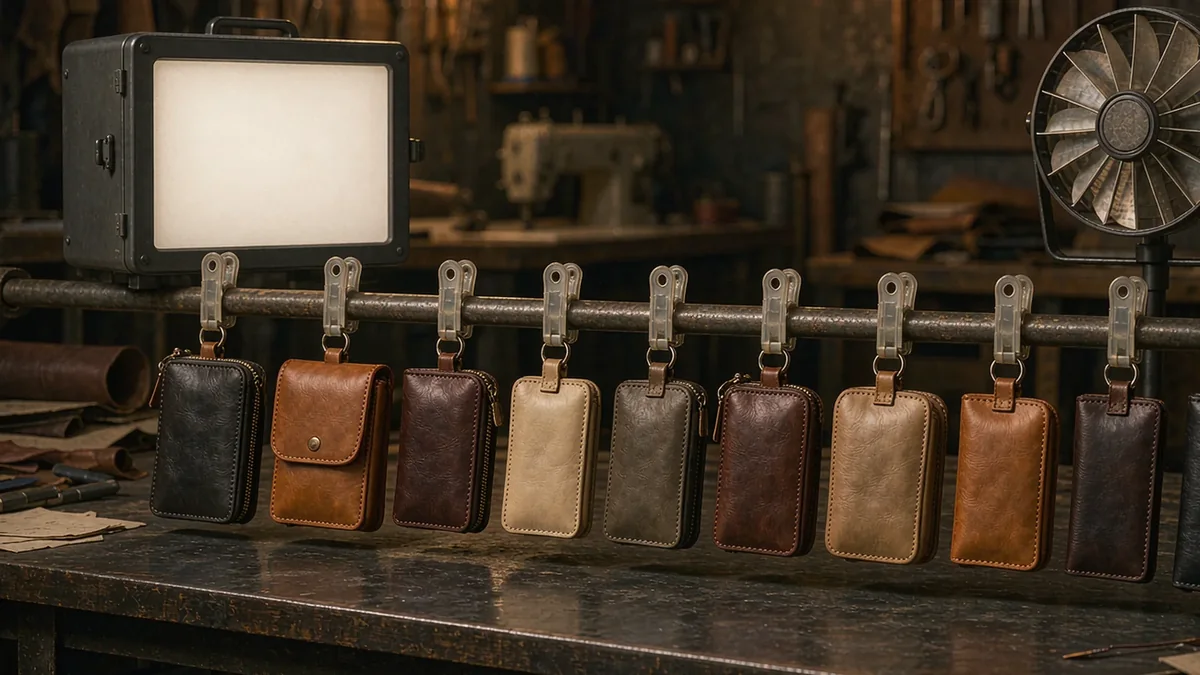
What ISO 2859-1 Settles That a Written Specification Cannot
A handbag specification describes what a good piece looks like. ISO 2859-1 answers a completely different question: how much evidence you need before you are willing to believe the entire carton looks that way. The standard does not define stitching quality, leather grain or hardware finish. It defines the arithmetic of trust — sample size, accept number, reject number and the rules for moving between strict and relaxed plans. Keeping the two documents separate is what stops an inspection from turning into an argument about taste at the carton table.
That separation matters even more in the luxury segment, where a defect is often a matter of degree rather than a broken part. A turn-lock that closes with a slightly longer throw is not broken, but it is also not the piece the designer approved. ISO 2859-1 gives you a neutral, pre-agreed counting rule so that judgement calls are made on the sample, not on the invoice. The standard is built around inspection by attributes — each piece is simply classed as conforming or non-conforming against each defect class — which is exactly how a bench check on a finished handbag works.
- Standard
- ISO 2859-1, sampling procedures for inspection by attributes
- Inspection level used
- General Inspection Level II (default on our programme)
- AQL applied
- 2.5 for major defects, 4.0 for minor, 0 for critical
- Sample on a 500-piece lot
- Code letter H, 50 pieces
- Accept / reject at AQL 2.5, n = 50
- Ac 3 / Re 4
- Switching rules
- Normal, tightened, reduced per ISO 2859-1 Section 9
The Code Letter: How a 500-Piece Order Becomes 50 Inspected Pieces
Every sampling plan starts with a lot size, moves through a code letter, and ends with a sample size. Under General Inspection Level II, a lot of 281-500 pieces carries code letter H and a sample of 50; a lot of 501-1,200 pieces carries code letter J and a sample of 80; a lot of 1,201-3,200 pieces carries code letter K and a sample of 125. Because our minimum booking is 500 pieces per style and colourway, most single-colourway orders land on code H and most four-colourway bookings land on code K. Nothing in this chain is negotiable on the day — it is read straight off the table.
The practical consequence surprises first-time buyers: sample size grows far more slowly than order size. Going from 500 pieces to 3,200 pieces multiplies the order more than six times but only takes the sample from 50 pieces to 125. That is deliberate. The standard is designed so that the statistical protection stays roughly constant while inspection effort stays within reach. It also means the buyer who wants real assurance on a very large booking should not simply ask for a bigger sample — they should raise the inspection level or tighten the AQL, both of which change the accept number rather than the effort.
Reading the AQL 2.5 Line: Accept Three, Reject Four
Once the sample size is fixed, the accept and reject numbers come from the AQL column. At AQL 2.5 and a sample of 50, the lot is accepted when the sample holds three or fewer major defects and rejected at four. At AQL 2.5 and a sample of 80, the thresholds move to five and six. At 125 they move to seven and eight. The AQL is not a promise that the shipment contains 2.5% defective pieces; it is the defect rate that the sampling plan is designed to accept most of the time. Reading it as a percentage is the single most common error in handbag inspection reports.
| Sample size | Code letter | AQL 2.5 accept | AQL 2.5 reject | AQL 4.0 accept | AQL 4.0 reject |
|---|---|---|---|---|---|
| 50 | H | 3 | 4 | 5 | 6 |
| 80 | J | 5 | 6 | 7 | 8 |
| 125 | K | 7 | 8 | 10 | 11 |
| 200 | L | 10 | 11 | 14 | 15 |
| 315 | M | 14 | 15 | 21 | 22 |
Two things follow from that table. First, small samples have very coarse discrimination: on 50 pieces the difference between a pass and a fail is a single defect. Second, minor defects sitting at AQL 4.0 can accumulate without failing the lot, which is why a booking can technically pass while the bench feels wrong. Our own booking file closes that gap by capping minor defects per unit rather than relying on the lot total alone, and by treating any repeat of the same minor defect across three or more pieces as a major.
Three Defect Classes, Three Different Accept Numbers
ISO 2859-1 lets you run several AQLs at once, and a handbag inspection should always run three. Critical defects take an accept number of zero because they make the piece unsafe or illegal — a sharp exposed burr on a metal frame, a detachable small part on a child-appeal product, a restricted substance finding. Major defects sit at AQL 2.5 because they are visible to the customer and would trigger a return. Minor defects sit at AQL 4.0 because they are workmanship noise that a retail client would not reasonably reject on its own. Classifying before the inspection opens is the whole discipline.
Critical — Ac 0
Sharp edges, broken locking parts that could release, restricted substances above REACH Annex XVII limits, or any finding that touches California Prop 65. One piece fails the lot.
Major — AQL 2.5
Visible grain damage on the front panel, misaligned flap by more than 2 mm, stitch density outside 8-9 stitches per inch, edge paint missing a third coat, plating flake on a visible face.
Minor — AQL 4.0
Loose thread end under 3 mm on an interior seam, light handling mark on the dust bag, carton label off by one character. Recorded, counted, and capped per unit.
Not a defect
Natural grain variation inside the approved swatch range, shade difference within ΔE 1.0 of the master, or hand-finished asymmetry the approved sample already showed.
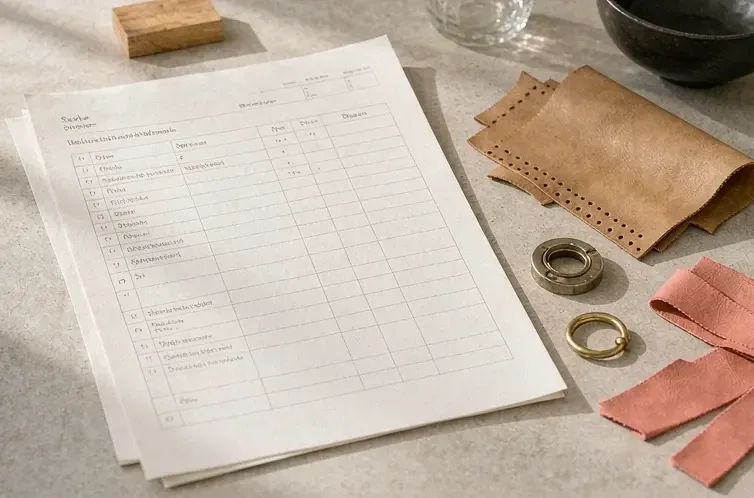
The cards deliberately include a fourth box, because half of all inspection disputes come from things that should never have been counted at all. Hand-finished leather goods carry variation by nature. If the approved sample shows a slightly softer roll on the left gusset, the bulk pieces will show it too, and counting it as a major defect will fail a booking that is actually correct. The cure is to keep the approved sample on the inspection table and mark any natural variation on the sample itself before counting starts, so the bench and the brand are reading from the same reference.
Switching Rules: The Section Most Programmes Forget
ISO 2859-1 is not a single plan but a system of three, plus a stopping rule. Normal inspection is the default. The standard moves you to tightened inspection when two out of five or fewer consecutive lots are rejected on original inspection, and back to normal only after five consecutive lots have been accepted under tightened. Reduced inspection becomes available after ten consecutive lots have been accepted under normal, provided output is steady and the responsible authority agrees. If five consecutive lots stay on tightened inspection, the standard tells you to discontinue and fix the process.
A brand that inspects every booking at AQL 2.5 but never records lot history gives away the strongest lever in the standard. Tightened inspection on the next booking is a contractual consequence, not a favour — put it in the order file before the first carton is packed.
Tightened inspection usually means the same code letter with a lower AQL, or the next larger sample at the same AQL, depending on how the clause is drafted. We draft it as: keep the code letter from the lot size, drop the major AQL from 2.5 to 1.0, and hold that until five consecutive bookings pass. That is easy to administer because the inspector does not need a second table. Reduced inspection, by contrast, is rarely worth invoking on luxury goods — the saving is a few pieces of inspection effort against a real risk of letting a drifting shade pass on a small sample.
Where Sampling Stops and Your Written Specification Starts
ISO 2859-1 will never tell you whether 1.2-1.4 mm calfskin is right for a structured top-handle, nor whether a 0.15-0.3 µm gold plating will survive a season. Those are specification decisions, and the sampling plan only counts how often the specification is missed. A useful handbag specification therefore has to be written in countable language — a number, a tolerance, and a reference sample — or the inspector has nothing to count against and the AQL becomes decorative.
- Dimensions with a stated tolerance, normally ±2 mm on bodies up to 300 mm and ±3 mm above that, measured on the stuffed piece.
- Stitch density given as a range, typically 8-9 stitches per inch on structural seams and 7-8 on turned interior seams.
- Edge paint expressed as a number of coats, normally three, plus a finish test that the coating does not crack when folded at room temperature.
- Hardware finish expressed as plating thickness in microns plus a salt spray duration, commonly 24 hours for light gold and 48 hours for palladium finishes.
- Colour acceptance expressed as a ΔE limit against a master swatch, measured under a specified light source rather than by eye.
Each of those lines converts a matter of opinion into a count. That is the test for whether a specification is ready for AQL inspection: if two experienced inspectors could disagree about whether a piece passes, the line needs a number. It is also the reason we ask for the specification at quotation stage rather than at packing stage — the sampling plan and the specification are one document, and splitting them across two months is how the same defect gets argued twice.
The Time and Effort Behind One Inspection Visit
A final inspection on structured handbags is slower than most apparel checks because every piece is measured, opened, closed, and handled. Working a 125-piece sample with full measurement, hardware cycling and packing verification typically occupies one inspector for most of a working day, and the report is issued the same evening. That is why inspection is booked as part of the 35-50 day bulk window rather than added after it — the visit has to be scheduled against a packing completion date, and a lot that is not packed cannot be sampled.
Cost is worth stating plainly. A single re-inspection visit on a rejected lot typically costs more than the rework it was meant to catch, and at a nominal rework allowance of USD 4.80 per piece the arithmetic on a 500-piece booking is uncomfortably tight. The cheaper sequence is always the same: a pre-production meeting on the specification, a first-article check before the line runs, and one properly scheduled final inspection. Three well-timed gates beat one expensive argument.
Building the Sampling Clause Into the Order File
- State the standard by name and edition: inspection by attributes to ISO 2859-1, single sampling, General Inspection Level II.
- State the three AQLs: critical 0, major 2.5, minor 4.0, with a written defect classification list attached to the same file.
- State the switching clause: two rejections in five consecutive lots moves the next booking to tightened at major AQL 1.0.
- State who books the visit, who pays for it, and what happens if the lot is not packed on the agreed date.
- State the re-inspection rule: rework followed by a fresh sample at the same level, never a re-count of the same cartons.
- Attach the approved sample reference number and the swatch range, and require both to be on the inspection table.
Put your inspection plan in writing before the line starts
Send us your specification and target AQL. We will return a sampling plan with the code letter, sample size, accept and reject numbers, and a defect classification list you can attach to the order file.
A Worked Example: 2,000 Pieces Across Four Colourways
Take a structured top-handle booked at 500 pieces in each of four colourways. Shipped as one lot, 2,000 pieces falls in the 1,201-3,200 band: code letter K, sample 125, AQL 2.5 gives accept seven and reject eight. Shipped as four separate 500-piece lots, each is code H, sample 50, accept three and reject four — so the four lots together can carry twelve major defects against eight for the single lot. Sampling each colourway separately actually protects the brand better on shade, because a drift in one colourway fails only that lot instead of hiding inside a combined sample.
Frequently Asked Questions
What is ISO 2859-1 in plain terms?
ISO 2859-1 is the international standard for sampling finished goods by attributes. It tells you how many units to pull from a lot and how many defects are allowed before the lot is rejected. It does not define quality itself; your specification does that. The standard only supplies the counting rule that makes an inspection result defensible.
How many handbags are checked on a 500-piece order?
At General Inspection Level II a lot of 281-500 pieces takes code letter H, which gives a sample of 50 pieces. Those 50 are pulled at random across cartons, not from the top layer. Every measurement, hardware cycle and visual check is then run on the same 50 pieces.
What is a code letter and where does it come from?
A code letter is a row label linking lot size to sample size under a chosen inspection level. You read the lot size band on one axis of the standard's table and take the letter at the intersection. The letter then determines the sample size and, with the AQL column, the accept and reject numbers.
What does AQL 2.5 mean for a handbag shipment?
AQL 2.5 is the defect rate the sampling plan is built to accept most of the time, not a promise that 2.5% of pieces are faulty. On a 50-piece sample it converts to accept three major defects and reject four. The same AQL on a larger sample produces proportionally larger accept numbers.
Is AQL 2.5 the same as 2.5 percent defective pieces?
No. The Acceptable Quality Limit is expressed as a percentage only because the tables are indexed that way, but the operating result is an accept and reject number on a specific sample. A lot can pass at AQL 2.5 with a real defect rate above or below that figure, because sampling carries statistical risk on both sides.
Why is the accept number for critical defects always zero?
Critical defects make a piece unsafe, illegal or unsellable in a way that no customer would accept: sharp metal burrs, locking parts that release under load, or restricted substances above REACH Annex XVII limits. Because the consequence is not commercial but legal, no statistical risk is tolerable and one occurrence fails the lot.
What is the difference between inspection levels I, II and III?
The three general levels change the sample size for a given lot size. Level I gives a smaller sample and is used when inspection is expensive or the process is proven. Level II is the default. Level III gives a larger sample and is used when the cost of a wrong decision is high, such as a first booking with a new partner.
When does inspection switch from normal to tightened?
ISO 2859-1 moves inspection from normal to tightened when two out of five or fewer consecutive lots are rejected on original inspection. Tightened inspection stays in force until five consecutive lots have been accepted under it. If five consecutive lots remain on tightened, the standard instructs you to discontinue and correct the process.
Can inspection move to a reduced plan?
Reduced inspection becomes available after ten consecutive lots pass under normal inspection, provided output is steady and the responsible authority agrees. In luxury handbag programmes it is rarely used, because the saving in inspection effort is small against the risk of a shade drift passing on a smaller sample.
Does ISO 2859-1 cover measurement tolerances?
No. The standard governs how many pieces are examined and how defects are counted. Tolerances belong to your specification: body dimensions within ±2 mm, stitch density at 8-9 per inch, edge paint at three coats. Write those numbers first, then let the AQL plan count the misses.
Can a brand ask for a larger sample than the standard requires?
Yes, and it is often worth doing on a first booking. The cleaner route is to raise the inspection level to III rather than invent a custom sample size, because the accept and reject numbers in the standard's tables remain valid and the result stays comparable across bookings.
Who pays when a lot is rejected at final inspection?
The order file should settle this before packing. The usual arrangement is that rework and a fresh inspection are charged to the party responsible for the defect, documented in the report. Re-inspection always uses a new random sample; re-counting the same cartons is not a valid result under the standard.
People Also Ask
What is the sample size for a 500-piece handbag order?
At General Inspection Level II the lot band 281-500 gives code letter H and a sample of 50 pieces. The 50 are drawn across cartons at random, then measured, cycled and visually graded against the approved sample.
What is AQL 2.5 in handbag inspection?
AQL 2.5 is the major-defect limit used on our programme. On a 50-piece sample it means the lot passes with three major defects and fails at four. It is a counting rule, not a guaranteed percentage of faulty pieces.
How many defects fail an AQL 2.5 inspection?
The reject number depends on sample size: four defects on 50 pieces, six on 80, eight on 125, eleven on 200 and fifteen on 315. Critical defects fail the lot at one occurrence regardless of sample size.
What is the difference between AQL 1.0 and AQL 2.5?
AQL 1.0 roughly halves the accept number for a given sample, so it is used for tightened inspection after repeated rejections. On a 50-piece sample AQL 2.5 accepts three defects while AQL 1.0 accepts only one.
Is ISO 2859-1 the same as ANSI/ASQ Z1.4?
They are technically equivalent approaches to attribute sampling and use the same code letters and tables, but they are separate publications. Naming ISO 2859-1 in the order file removes the ambiguity when an inspection is booked across borders.
Sources and further reading
Every figure on this page is either our own programme data or attributed below. Open the originals before you write them into a specification.
- ISO 2859-1: Sampling procedures for inspection by attributesInternational Organization for Standardization The source standard for code letters, sample sizes and accept/reject numbers used in our inspection plans.
- REACH legislation and Annex XVII restrictionsEuropean Chemicals Agency Defines the restricted substance limits that critical defects are measured against.
- Proposition 65California Office of Environmental Health Hazard Assessment The California listing that drives zero-tolerance critical findings on metal components and coatings.
- Leather Working GroupLeather Working Group Tannery audit framework referenced when leather origin and finishing are documented on a booking.