How to Run a Luxury Handbag Pre-Shipment Inspection: Nine Gates From Packing List to Release Decision
A pre-shipment inspection on a luxury handbag booking is a nine-gate sequence run in a single day: carton verification, randomisation, measurement, construction, hardware cycling, material and shade, function and load, compliance documentation, then the verdict. On a 500-piece style the sample is 50 pieces drawn from at least eight cartons, graded at AQL 2.5 with critical defects at zero. Booked against a packing completion date inside the 35-50 day bulk window, the visit protects the release decision without adding a day to the sailing.
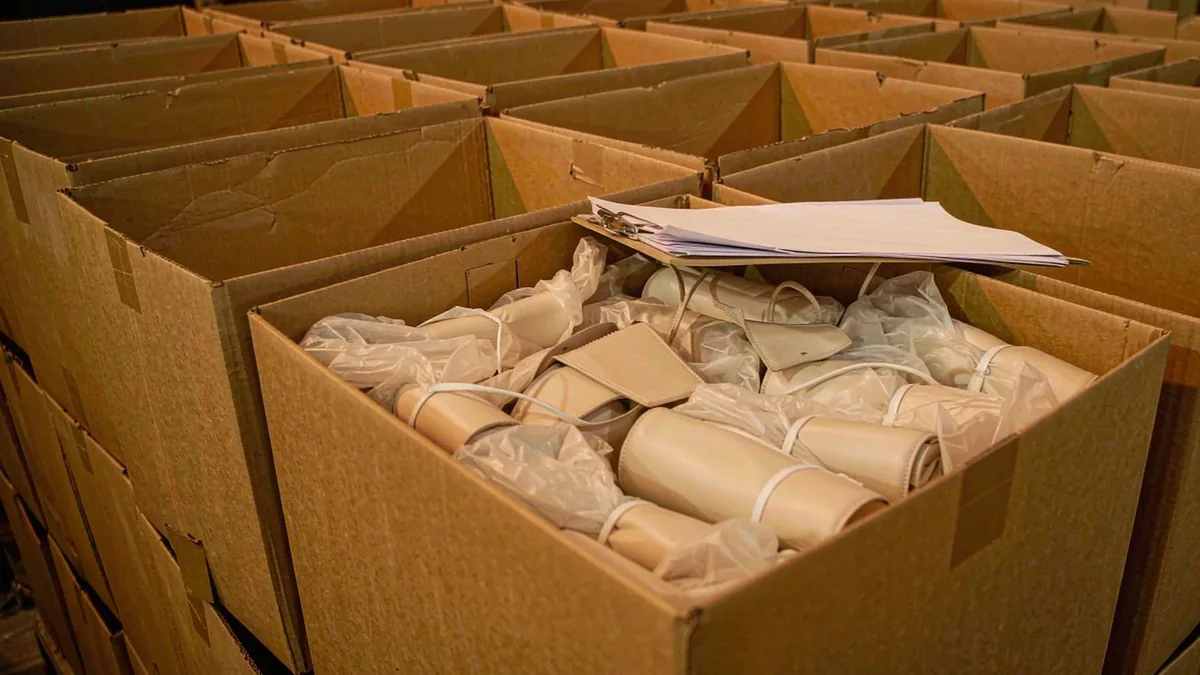
The Booking That Nearly Shipped
A European maison booked 1,500 structured top-handles across three colourways in January, targeting a retail floor date in early April. Bulk ran to plan and the packing list arrived on time. The brand's own representative arrived for a two-hour visit, opened four cartons from the top of the stack, found nothing wrong, and released the booking. Six weeks later, 212 pieces came back from three stores with the same complaint: the flap sat 2.5 mm proud of the body on the right side, and the turn-lock needed a firmer push than the boutique sample.
The failure was not in the goods. It was in the procedure. Four cartons from the top of a stack are not a sample, a two-hour visit cannot measure 125 pieces, and a flap misalignment of 2.5 mm is visible on a shelf but not in a hurried look. The rebuilt procedure that the same maison now uses is the nine-gate sequence set out below, and it is the sequence we run on every bulk booking before release under our luxury quality control programme.
The rule the case proves
- An inspection that is not randomised, not measured and not timed is a formality. Any one of those three gaps is enough to pass a booking that the retail floor will reject.
Gate One: Carton Verification Before Any Piece Is Judged
The first gate has nothing to do with the handbag. It is a reconciliation of the packing list against the physical cartons: count, carton numbering, gross and net weight, dimensions, shipping marks and the ratio of inner polybags to declared pieces. Weight is the fastest detector of a short shipment, and the tolerance normally applied is ±5% against the declared gross weight per carton. A carton that is light by more than that is opened and recounted on the spot, before the sample is drawn rather than after.
Carton condition is checked in the same pass — crushed corners, tape that has lifted, wet marks, and whether the carton was packed to the declared layer count. This gate also captures the packing method: pieces interleaved with acid-free tissue, dust bags oriented the same way, silica sachets present and not in direct contact with leather. Packing damage is a real defect class on luxury goods because it arrives at the boutique before the customer does, and it is far easier to prove at the bench than after a container has moved.
- Carton count and numbering reconcile to the packing list with no gaps.
- Gross weight per carton within ±5% of the declared figure.
- Shipping marks, style code, colourway code and carton sequence all legible and matching.
- Inner packing method matches the approved packing specification: tissue, dust bag, silica placement.
- No evidence of compression, moisture or tape failure on any carton face.
Gate Two: Randomisation and Carton Selection
Randomisation is where most inspections quietly fail. The standard does not prescribe how cartons are chosen, but the working rule used on our bookings is to draw from at least the square root of the carton count, rounded up: 40 cartons means eight, 100 cartons means eleven. Within each selected carton the pieces are taken from different layers, not the top. The pulled pieces are then allocated to the sample size the code letter requires — 50 pieces for a 500-piece lot at General Inspection Level II.
The discipline is worth defending because it is the only gate the brand cannot reconstruct later. Once the cartons go into the container, the sample is gone. We therefore record the carton numbers and the layer for every pulled piece in the report, so that if a complaint arrives six weeks later the same cartons can be traced and, if the goods are still held, re-examined against the original findings.
Gate Three: Measurement Against the Approved Sample
Measurement is run on the stuffed piece, because an unstuffed structured bag measures differently from the one on the shelf. Bodies up to 300 mm are held to ±2 mm and larger bodies to ±3 mm; handle drop is measured from the top of the arch to the highest point of the body; strap length is measured pin-to-pin under a light 1 kg tension. Every measurement is taken against the approved sample sitting on the same table, not against the drawing, because the drawing is the intent and the sample is the contract.
- Body dimensions up to 300 mm
- ±2 mm
- Body dimensions above 300 mm
- ±3 mm
- Handle drop
- ±2 mm measured from arch apex to body top
- Strap length
- ±3 mm measured under 1 kg tension
- Flap alignment left to right
- Within 1.5 mm across the closure line
- Base flatness on a glass surface
- Rocker not exceeding 1 mm
Gate Four: Construction and Stitch Audit
Stitch work is graded on density, straightness, tension and termination. Structural seams on our bookings run 8-9 stitches per inch; turned interior seams run 7-8. Below seven the seam is visibly coarse and above nine the leather is being perforated to the point of weakness. Tension is judged by whether the thread sits slightly below the surface rather than proud of it, and termination by whether the back-tack is hidden rather than clipped at the surface. A visible loose thread end under 3 mm on an interior seam is a minor defect; the same length on an exterior seam is a major one.
Edge finishing is graded in the same pass. Edge paint is applied in three coats on our structural work, sanded between coats, and the finished edge should not crack when the panel is folded at room temperature through 180 degrees. Coverage gaps, bubbling at the turn, or a colour that does not match the body are counted as major defects because they are the first thing a customer sees at the opening edge. This is also the gate where the reinforcement hidden behind the handle attachment is verified — a 0.8 mm non-woven interlining where specified, present on 100% of the sample rather than most of it.
Gate Five: Hardware Cycling and Finish
Hardware is not inspected, it is cycled. A #5 metal zip is opened and closed 200 times on the sample pieces and must not snag, split or lose a tooth; a turn-lock is cycled 100 times and must return to the same closing force. Plating is checked for thickness — 0.15-0.3 µm for light gold — and for flake at the highest wear points, which on a top-handle are the underside of the lock plate and the base feet. Salt spray exposure of 24 hours for light gold and 48 hours for palladium finishes is the laboratory backstop when a plating system is new.
Zips
Number 5 metal chain, 200 cycles, no snag or split, puller returns flush, tape dye matches the approved swatch within ΔE 1.0.
Locks and turn-locks
100 cycles, consistent closing force, no plating flake at the plate edge, engraving legible at 300 mm viewing distance.
Feet and base studs
Seated flush to the base, no rocker above 1 mm, no sharp burr detectable by a lint-free cloth drawn across the face.
Chain and strap hardware
Soldered links show no seam gap, swivel rotates freely through 360 degrees, weight matches the approved component record.
Gate Six: Material, Shade and Hand-Feel
Shade is judged under a single specified light source, normally D65 at approximately 1,000 lux, and never under the mixed lighting of a packing hall. The pulled sample is placed beside the master swatch and the approved sample, and any piece drifting beyond ΔE 1.0 from the master is counted. Within one carton the pieces should be indistinguishable from each other; the defect that matters most at this gate is not a wrong colour but two right colours in the same carton, which reads as a mistake on a boutique shelf even when both are inside tolerance.
Hand-feel and grain are graded against the approved swatch range rather than against an ideal. Full-grain calfskin at 1.2-1.4 mm for a structured body carries natural variation in grain tightness and in the depth of the finish; the swatch range defines what is acceptable, and anything inside it is not a defect. What is counted is scar tissue on a visible panel, looseness or wrinkle at the turn of a gusset, and finish damage from handling. Exotic skins carry an additional documentation check at this gate, with the CITES documentation reconciled to the pieces in the sample.

Gate Seven: Function, Load and Closure Testing
Function testing is the gate most often skipped, and it is the one that predicts returns. Top handles on our bookings are statically loaded to 8 kg for 60 seconds with no seam creep above 1 mm and no distortion at the handle attachment after release. Shoulder straps are loaded to 5 kg for the same duration. Closures are tested loaded rather than empty: the bag is filled to its intended carry weight and the flap or frame must close without forcing, and must not open when the filled piece is lifted by one handle and rotated through 90 degrees.
A closure that works on an empty bag frequently fails on a filled one, because the body distorts under load. Every functional test in this gate is run with the piece at its intended carry weight.
Gate Eight: Labelling, Compliance and Documentation
The final substantive gate covers everything that makes the piece legal to sell in the destination market. Fibre and material composition statements follow EU Regulation 1007/2011 where textile content is declared; restricted substances are held to REACH Annex XVII limits for the European market and to California Prop 65 for the United States; country-of-origin marking is checked for legibility, permanence and correct placement. Care cards, authenticity inserts and any serial numbering are reconciled to the packing list, because a mismatch at this level is a customs problem rather than a quality one.
Documentation is then assembled: the inspection report with carton numbers and piece locations, the defect photographs with piece references, the measurement sheets, and where applicable the laboratory report for plating or restricted substances. Our bookings are inspected to AQL 2.5 (ISO 2859-1) and third-party inspection is available where the brand prefers an external signature. Export documentation has been handled on this programme since 2014, and the same paperwork set is reused across bookings so that a repeat style clears without a fresh round of questions.
Gate Nine: The Verdict, the Report and the Release Decision
The verdict is arithmetic, not opinion. At AQL 2.5 on a 50-piece sample the booking passes with three major defects or fewer and fails at four; critical defects carry an accept number of zero. The report is issued the same evening as the visit and states the count by class, the carton numbers involved, and whether the failures are systematic or isolated. Systematic failures — the same defect on many pieces — trigger a full re-sort rather than a spot rework, because a spot fix on a systematic problem simply moves the defect into the next carton.
| Gate | What is checked | Typical failure found | Class |
|---|---|---|---|
| 1 Carton | Count, weight ±5%, marks, packing method | Short pack or crushed corner | Minor to major |
| 2 Randomisation | Carton numbers, layers, traceability record | Top-of-stack selection | Procedural |
| 3 Measurement | Body, handle drop, strap length, flap alignment | Flap 2.5 mm proud | Major |
| 4 Construction | Stitch density 8-9 SPI, edge paint 3 coats | Coarse seam, edge bubbling | Major |
| 5 Hardware | Zip 200 cycles, lock 100 cycles, plating thickness | Plating flake at lock plate | Major |
| 6 Material | Shade within ΔE 1.0, grain, CITES documentation | Two shades in one carton | Major |
| 7 Function | Handle 8 kg / 60 s, closure under load | Closure opens under load | Critical |
| 8 Compliance | REACH, Prop 65, origin marking, inserts | Illegible origin mark | Critical |
Release is then a decision with a price attached. A re-inspection visit on a rejected booking is scheduled as a fresh sample at the same level, never a re-count of the same cartons, and the visit has to fit inside the remaining sailing window. At a nominal rework allowance of USD 4.80 per piece, a 500-piece booking that fails twice has spent more on inspection and rework than the margin on the defects it caught. That arithmetic is the reason the nine gates are run in sequence: the early failures are caught first, and the expensive ones never reach the container.
Book a pre-shipment inspection against your packing date
Tell us your style, colourway count and packing completion date. We will schedule the nine-gate visit inside your 35-50 day bulk window and return a same-evening AQL 2.5 report.
Frequently Asked Questions
What is a pre-shipment inspection on handbags?
A pre-shipment inspection is a final check run after packing and before the container moves. It reconciles cartons, draws a random sample, grades pieces against the approved sample, and issues an accept or reject result. On luxury handbag bookings it is normally a full day rather than a two-hour visit.
How many cartons should be opened during the inspection?
The working rule is at least the square root of the carton count, rounded up: eight cartons out of forty, eleven out of a hundred. Pieces are taken from different layers inside each carton, and the carton numbers are recorded in the report for traceability.
How long does a pre-shipment inspection take?
A structured handbag sample of 125 pieces with full measurement, hardware cycling and packing verification occupies one inspector for most of a working day, with the report issued the same evening. The visit is booked against a packing completion date.
What sample size is used on a 500-piece booking?
At General Inspection Level II a 500-piece lot falls in the 281-500 band, giving code letter H and a sample of 50 pieces. Each of those 50 is measured, cycled and graded, not just looked at.
Should the handbag be measured empty or stuffed?
Stuffed. An unstuffed structured bag measures differently from the piece on a boutique shelf, and handle drop in particular shifts when the body is supported. Our measurement tolerances are written against the stuffed piece.
What measurement tolerance is normal on a luxury handbag?
Bodies up to 300 mm are normally held to ±2 mm and larger bodies to ±3 mm. Handle drop is held to ±2 mm measured from the arch apex to the body top, and strap length to ±3 mm under a light 1 kg tension.
How many stitches per inch should a handbag have?
Structural seams on our bookings run 8-9 stitches per inch and turned interior seams run 7-8. Below seven the seam looks coarse and above nine the leather is perforated to the point of weakness, so the range is a quality limit rather than a preference.
How is hardware tested rather than just looked at?
Hardware is cycled: a number 5 metal zip is opened and closed 200 times, and a turn-lock is cycled 100 times with the closing force compared before and after. Plating is checked for flake at the highest wear points and verified for thickness.
How is colour shade judged on a bulk booking?
Shade is judged under one specified light source, normally D65 at about 1,000 lux, with the pulled sample beside the master swatch. Any piece drifting beyond ΔE 1.0 from the master is counted, and two acceptable shades inside one carton is itself a defect.
What load should a handbag handle be tested to?
Top handles on our bookings are statically loaded to 8 kg for 60 seconds with no seam creep above 1 mm and no distortion at the attachment after release. Shoulder straps are loaded to 5 kg for the same duration.
What compliance documents are checked before release?
Material composition statements under EU Regulation 1007/2011, restricted substances against REACH Annex XVII for Europe and California Prop 65 for the United States, country-of-origin marking, and CITES documentation where exotic skins are used.
What happens if the booking fails the inspection?
The report states the count by defect class and whether the failures are systematic or isolated. Systematic failures trigger a full re-sort; isolated ones trigger targeted rework. Re-inspection always uses a fresh random sample at the same AQL, never a re-count of the same cartons.
Can an external inspection house be used instead?
Yes. Third-party inspection is available and the same nine gates apply. The important point is that the defect classification list and the AQL are agreed before the visit, so the external report and the internal record count the same things.
People Also Ask
What does PSI mean in handbag production?
PSI is the pre-shipment inspection run after packing and before loading. On a luxury handbag booking it covers carton reconciliation, a random sample graded at AQL 2.5, measurement, hardware cycling and compliance documents.
How many pieces are inspected in a PSI?
Sample size follows the lot size through a code letter. A 500-piece lot at General Inspection Level II gives 50 pieces; 1,201-3,200 pieces gives 125. The whole sample is measured and cycled, not spot-checked.
How long before shipping should a PSI be booked?
It should be booked against the packing completion date, not the sailing date. A lot that is not packed cannot be sampled, so the visit sits inside the 35-50 day bulk window with the report issued the same evening.
What is the difference between PSI and final inspection?
They are the same visit under different names. The distinction that matters is between a final inspection after packing and a during-production check, which catches systematic problems while the line can still be corrected.
What should be on a pre-shipment inspection report?
Carton numbers and piece locations, defect counts by class with photographs, measurement sheets, hardware cycling results, compliance documentation, and a clear accept or reject verdict with the AQL applied.
Sources and further reading
Every figure on this page is either our own programme data or attributed below. Open the originals before you write them into a specification.
- ISO 2859-1 sampling procedures for inspection by attributesInternational Organization for Standardization Sets the sample size and accept/reject arithmetic used at the verdict gate.
- Regulation (EU) No 1007/2011 on textile fibre names and labellingEUR-Lex The labelling rule referenced at the compliance gate for material composition.
- CITES Appendices I, II and IIICITES Secretariat Documentation checked at the material gate when exotic skins appear in a booking.
- Proposition 65California Office of Environmental Health Hazard Assessment The United States listing that sets zero-tolerance critical findings on metal components.