How Luxury Bag Consumers Judge Quality: The Eleven-Second Sequence Every Piece Survives or Fails
How do luxury bag consumers judge quality before anyone has spoken to them? They run a short sequence: lift it, run a hand over the panels, turn it over, look at the edges and seams, open it, and check the base. The whole thing takes eleven seconds or so, and it is decided almost entirely by specification lines: leather substance near 1.2-1.4 mm, edges dressed flush, seam alignment within a millimetre.
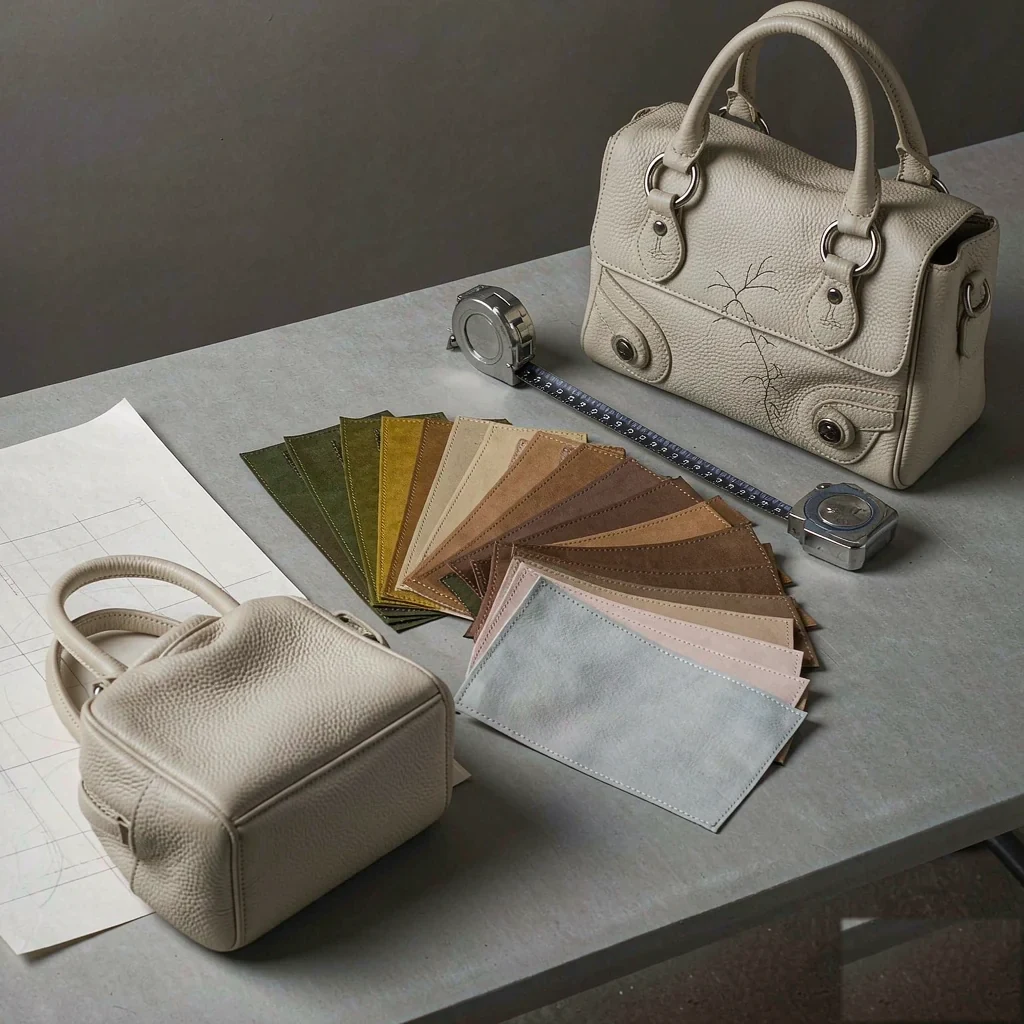
Eleven seconds in an Antwerp appointment
A client lifted two similar bags from a table in an Antwerp appointment last spring, put one down within four seconds, and spent seven more inspecting the other before asking the price. Nobody had said anything yet. The difference was not design or branding; it was that the first piece felt hollow at the handle and had a visible ripple where two panels met, while the second had weight in the right places and an edge that disappeared under a thumb.
What makes the episode worth recounting is how little of it was conscious. Ask someone afterwards why they rejected a bag and they will usually describe fabric or proportion, because those are the things they have vocabulary for. In practice the rejection happened in the hands, and the reasons are all measurable: substrate density, panel tension, edge build, and whether anything moved when it should not have.
None of those qualities are accidental and none are expensive once understood. Every one of them corresponds to a line already sitting in your specification file, usually written as a description rather than a number, which is exactly why they vary from one batch to the next. The route from a lukewarm reception to a confident one is mostly a matter of replacing adjectives with tolerances.
The sequence every shopper runs
The order is remarkably consistent and worth designing for explicitly. Lift first, because weight and balance arrive before anything is looked at. Then touch, usually along the panel rather than across it. Then the piece is turned over to see the back and the base, then the edges and seams are examined at close range, then it is opened, and finally it is set down and looked at from a short distance.
- Lift and judge weight against apparent size, which is where density and hardware mass are detected.
- Run a palm across the largest panel, because that single movement finds ripples, slack substrate and poor lay.
- Turn it over: backs and bases are examined more carefully than fronts by anyone who has owned a bag before.
- Look along the seam line and the edge, since alignment and build are judged here rather than anywhere else.
- Open it and look inside, where construction quality is harder to disguise than on an exterior.
- Set it down and step back, because silhouette is judged from roughly a metre away rather than at arm's length.
Each of those six steps rewards a particular specification line and punishes its absence. Put together they form something useful: a quality plan built from how the piece is actually handled rather than from what is easiest to check on a bench. That reversal of perspective tends to change which tolerance matters most.
Weight and density: the first judgement in the hand
Weight is read against expectation rather than in absolute terms. Nobody objects to a heavy bag; they object to a bag that appears substantial and feels hollow, or looks slim and sags. What is detected in the first two seconds is therefore density and distribution: whether hardware has mass, whether the leather has substance, and whether anything rattles or shifts when the piece is moved.
- Leather substance for a structured body
- Commonly 1.2-1.4 mm, below which panels tend to need heavy reinforcement to hold shape
- Interlining and reinforcement
- Specified together with leather weight rather than separately, since the pair decides how the piece behaves
- Solid versus hollow hardware
- Solid brass and steel components read as mass; hollow-cast fittings read as lightness under the same finish
- Base construction
- A reinforced base with feet keeps structure off the surface and keeps the silhouette when the piece is set down
- Handle variety
- Handles with a core keep their cross-section; hollow-rolled handles flatten visibly within a season
- Balance with straps
- Strap hardware should sit comfortably rather than pull, which is checked when loaded rather than empty
The third line causes more silent rejections than anything else in this list. Two fittings can look identical under the same plating and behave completely differently in the hand, because one has mass and the other does not. Specifying that a fitting is solid rather than hollow costs a little and removes an entire class of adverse first impressions.
Touch: what the hand actually detects
The palm running across a large panel detects three things in order: whether the surface is flat, whether anything moves beneath the leather, and how the material responds to pressure. A ripple along a seam is almost always a construction problem rather than a material one, and it is read instantly as a lack of care regardless of how the rest of the piece is built.
Response to pressure is the subtlest of the three and the one most tied to material choice. A good full-grain calfskin springs back with a slight warmth and a fine surface break; a heavily corrected article with a thick finish film tends to feel cooler and flatter, and its surface creases rather than breaking finely. Both can be right for different pieces, but they must be chosen deliberately rather than inherited.

Edges, seams and lines: what the eye measures
The eye is better at judging straightness and parallelism than any other attribute, and it does it from further away than people expect. A seam that wanders by two millimetres over its length is visible at arm's length, while a colour difference between panels usually needs to be considerably worse before anyone notices. Wobble in a line therefore matters more than precision in colour.
Straightness of stitch line
Judged along the whole run rather than at any point. A consistent line is read as competence even when the stitch count is modest.
Seam alignment at joins
Where two panels meet, displacement is noticed immediately. Set tolerance per intersection rather than per piece and it stops being argued.
Edge thickness and flushness
The edge should read as part of the leather rather than as something sitting on it. Thick or raised edges are felt before they are seen.
Symmetry under turning
Symmetry is checked by rotation. Turn the piece slowly and asymmetry at the gusset or handles shows itself quickly.
Hardware alignment
Fittings should sit square to the panel and to each other; out-of-square closure plates are read as carelessness even when functional.
Silhouette from one metre
Shape is judged from a distance, which is where slack interlining or an under-supported base becomes obvious rather than merely noticeable.
The last card deserves a note because it contradicts how pieces are usually approved. Approval tends to happen close up, under good light, on a bench at comfortable height. The customer is standing, the light is different, and the piece is a metre away in a different orientation. Approving from that distance occasionally changes what gets reworked.
Inside the piece: the second look
Interiors are inspected more rigorously than exteriors, and the reason is simple: an exterior can be finished to hide its construction, while an interior shows seams, raw edges, lining joins and the honesty of every shortcut. A clean interior cannot be faked at the end of a process, which is precisely why it is looked at so carefully.
- Clean seam allowances with no stray thread ends, since nothing reads faster as poor finishing than a thread tail.
- Lining laid without puckers at the base, which is where linings are most visibly wrong and most rarely checked.
- Pocket placement that aligns to the body's proportion rather than merely fitting inside the available space.
- No adhesive visible anywhere, because visible adhesive is remembered long after the piece has been adopted.
- Interior hardware that matches the exterior set rather than being treated as an afterthought.
- Odour absent, which is a construction discipline rather than a material property and is decided by cure intervals.

How the sequence changes with the price tier
| Check in the sequence | Entry of the category | Middle of the category | Top of the category |
|---|---|---|---|
| Weight and hardware mass | Judged loosely, against expectation | Judged carefully against the leather | Judged against preceding pieces owned |
| Panel flatness | Minor ripple tolerated | Ripple noticed and remembered | Ripple disqualifies immediately |
| Edge and seam build | Obvious flaws noticed only | Build compared across pieces | Thickness and flushness scrutinised |
| Interior cleanliness | Briefly glanced at | Examined on every piece | Examined with the lining turned |
| Silhouette at distance | Barely considered | Noticed if the piece slumps | Assessed before anything is touched |
| Documented material | Rarely asked about | Asked about at point of sale | Expected without being requested |
The point of that table is not to set different standards for different tiers. The acceptance basis stays identical: AQL 2.5 under ISO 2859-1, agreed in writing with a defect library before the line starts. What changes is how a discrepancy is perceived, and therefore which defects deserve to be treated as critical rather than minor.
Turning the sequence into a specification
Take the six steps of the sequence and write one measurable line for each, and quality stops being a feeling defended in meetings. Weight and hardware mass become a material and component clause; panel flatness becomes a lay-and-tension clause; edges and seams become tolerances; the interior becomes a finishing clause; silhouette becomes a distance check; and documented materials become a declaration.
Our own frame sits unchanged beneath whichever checks you prioritise. Minimum is 500 pcs per style and colourway; sampling runs 6-10 working days and 12-15 for a complex construction; bulk runs 35-50 days on FOB Xiamen terms; inspection is agreed at AQL 2.5 under ISO 2859-1 with a written defect library; the base reference unit is USD 4.80 before material. Capacity runs across 7 production lines at about 200,000 pcs per month with export experience since 2014, delivered through our validated partner factory Quanzhou Yingming Bags.
Add one step to every sample approval: stand, hold the piece at arm's length in daylight, rotate it slowly, then look inside. Those four movements catch more of what a shopper notices than any bench checklist, and each takes seconds rather than days.
What the eleven seconds are really testing
Every one of the checks comes down to one question the shopper cannot articulate: does this piece behave like the thing it appears to be? Discrepancies between appearance and substance — heavy-looking but light, structured-looking but slack, expensive-looking but rough inside — are what get rejected, and they are all discrepancies rather than absolutes.
That reframing is unusually practical. It means the goal is not maximum quality everywhere, which would be unaffordable, but consistency between what a piece promises and what it delivers. A simple, honest piece built within its own terms survives those eleven seconds more reliably than an ambitious one that falls short of what it advertised.
Write the tolerances rather than the adjectives
Send us the checks that matter most to you and we will return measurable specification lines for each — leather substance, seam alignment, edge build and interior finishing — in writing, before sampling begins. Request a quote.
Frequently Asked Questions
What is the first thing a shopper notices about a bag?
Weight against apparent size, judged within about two seconds of lifting it. That single impression is detecting hardware mass, leather substance and whether the piece is balanced. It is not an absolute judgement but a comparison against what the piece appears to be, which is why hollow fittings undermine heavy-looking designs.
Why does panel flatness matter so much?
Because the palm detects any ripple instantly and interprets it as poor construction regardless of everything else. Ripples almost always come from laying and tension rather than from material quality, which is why they are preventable by specification. A perfectly adequate hide laid badly reads worse than a better one laid well.
How thick should leather be for a structured bag?
Commonly 1.2-1.4 mm for a body expected to hold its shape, though it depends entirely on what it is paired with. Substrate and reinforcement should be specified alongside leather weight rather than separately, because the combination rather than either number decides how the panel behaves when handled.
Do shoppers really examine the inside?
Yes, and often more carefully than they examine the exterior. LINING lays, seam allowances, pocket placement and any visible adhesive are all obvious inside, because an interior cannot be finished to conceal its construction. It is examined harder precisely because it is the most honest part of the piece.
How straight does a stitch line need to be?
Straight enough that it does not wander along its length, which the eye detects from further away than most people expect. A consistent line reads as competence even at moderate stitch counts. Set an alignment tolerance at each panel junction rather than leaving it to interpretation at approval.
Is heavier always better for hardware?
Not necessarily, but it must agree with the rest of the piece. Solid fittings have genuine mass and close with more resistance, hollow castings do neither. Both can look identical under the same plating, which is why the specification should state whether a fitting is solid rather than describing only its finish.
How should the silhouette be judged?
From about a metre, standing, in daylight, after rotating the piece. Approval habitually happens on a bench at close range, where slack substrate and an under-supported base go unnoticed. Adding that one standing check to every approval catches most of what a shopper will see in the first seconds.
What causes the smell sometimes noticed inside new bags?
Usually adhesive that was not given its stated cure interval before packing. It is a scheduling discipline rather than a material problem, and it is the fastest way to lose a piece that is otherwise well made. Write the cure interval into the plan and respect it rather than relying on judgement.
Do these checks change at different price levels?
The checks stay identical while severity increases with price. Tolerances and the acceptance basis do not change: AQL 2.5 under ISO 2859-1, agreed before bulk. What changes is how forgivingly a discrepancy is received, which is an argument for setting critical defect classes deliberately rather than uniformly.
What single habit improves perceived quality most?
Approving pieces the way they are bought. Stand up, lift the piece, run a palm across the largest panel, look inside, then step back a metre and turn it slowly. Those movements take about ninety seconds and consistently surface faults that a bench review will pass without comment.
People Also Ask
Why do some bags feel insubstantial despite being heavy?
Because hardware is hollow cast and panels are lightly reinforced, so the mass sits in the wrong places. The eye reads the piece as substantial and the hand disagrees. That mismatch is what produces an immediate sense of something being wrong before anyone can name it.
How is leather quality judged without touching it?
By how light breaks across the surface: fine irregular surface break indicates a fuller grain, while a uniform flattening suggests heavy correction and coating. Damaged hides are best judged under daylight rather than shop lighting, which flatters almost everything equally.
What should be checked before approving a sample?
Weight and balance, panel flatness under a palm, edge thickness and flushness, seam line straightness, interior finishing, absence of odour, and silhouette from a metre away. Writing those seven into the approval sheet removes most disputes later.
Are the front and the base equally important?
The base and back are examined more carefully by experienced buyers, because that is where reinforcements, feet and panel joins tend to be resolved. Pieces are also turned over instinctively, so anything that only looks resolved from the front will be noticed immediately.
Which defect should never be tolerated?
Any functional failure of a closure, strap anchor or seam under load. Those go into the critical class at zero acceptance under the agreed inspection plan, because everything else — however visible — is recoverable, while a failure in these three is not.
Sources and further reading
Every figure on this page is either our own programme data or attributed below. Open the originals before you write them into a specification.
- ISO — standards catalogueInternational Organization for Standardization Publisher of ISO 2859-1 inspection sampling, ISO 11644 finish adhesion, ISO 3376 tensile strength and ISO 3377 tear resistance.
- Leather Working GroupLeather Working Group Publishes tannery audit protocols referenced when specifying where an article comes from and how consistently it is produced.
- Business of FashionBoF Insights Publishes reporting on how perceived quality and value are assessed by buyers across personal luxury goods.
- Sourcing JournalSourcing Journal Documents how construction specifications, component choices and finishing standards are set across the sector.
- The RealRealThe RealReal Publishes condition grading categories that show how construction, hardware and edges are assessed after real use.