Final Random Luxury Bag Inspection vs Full Check: Hours, Detection Rates and the Hybrid Most Programmes Actually Need
Should a luxury bag lot be released on a final random inspection or on a full check? Random sampling at AQL 2.5 draws 50 pieces from 500 and takes a few hours; a full check examines all 500 and takes roughly three to five inspector-days. Neither finds everything: sampling misses faults outside the sample, and a full check degrades with fatigue after about the second hour. The answer most programmes need is a hybrid — full on critical characteristics, sampled on cosmetic ones.

The Choice in One Table
The two methods differ on five dimensions, and four of them are decided before anyone thinks about the fifth, which is price. Read the table as a description of what each method can and cannot say, rather than as a ranking, since the two are used together more often than they are used instead of each other.
| Dimension | Final random inspection | Full check | Practical consequence |
|---|---|---|---|
| Coverage | A sample of 50 from 500 at AQL 2.5, Level II | Every piece in the lot | Sampling bounds a rate; a full check does not |
| Hours on a 500-piece lot | Roughly 2.5 to 5 hours | Roughly 25 to 50 hours, or 3 to 5 inspector-days | A full check needs a calendar slot, not an afternoon |
| Statistical meaning | Yes: a defined risk allocation per lot | None: it is a count, not a plan | Only sampling can be described as an AQL result |
| Fatigue exposure | Low, because the count is short | High: vigilance falls after roughly two hours | A long full check is not as thorough as it appears |
| Best used on | Cosmetic and functional attributes across a settled style | Critical characteristics, first lots and high-value pieces | The two are complements rather than alternatives |
What Each Method Actually Detects
Detection is the dimension people assume and rarely calculate: sampling detects a fault only if it falls inside the sample, and a full check detects a fault only if the inspector is still attending to it.
- Sample drawn on 500 pieces at AQL 2.5
- 50 pieces, accept 3, reject 4
- Share of the lot physically examined
- About 10% under sampling, 100% under a full check
- Inspection time per structured bag
- Commonly 3-6 minutes for a thorough examination
- Pieces per inspector per hour
- Roughly 10-20 depending on the complexity of the piece
- Upper bound after zero faults in 50
- About 5.8% at 95% confidence
- Vigilance decrement
- Detection falls measurably after roughly two continuous hours
Read the fourth line against the third. Twenty pieces an hour is a fast pace for a structured bag with hardware to cycle, and it is the pace a full check tends to drift toward as the day goes on.
The Hours: What a Full Check Really Costs
The cost of a full check is not money first but calendar, and the calendar is what usually decides the question in practice.
| Lot size | Sampled pieces at Level II | Sampling hours | Full check hours | Inspector-days for a full check |
|---|---|---|---|---|
| 500 | 50 | About 2.5-5 | About 25-50 | Roughly 3-5 |
| 1,200 | 80 | About 4-8 | About 60-120 | Roughly 8-15 |
| 3,200 | 125 | About 6-13 | About 160-320 | Roughly 20-40 |
| 10,000 | 200 | About 10-20 | About 500-1,000 | Roughly 60-125 |
The fourth row is the argument. At 10,000 pieces a full check is measured in months of one person's time, and the lot is rarely worth the delay, which is why volume programmes sample and invest the saved hours in the process instead.
The Vigilance Problem Nobody Prices
A full check sounds like certainty and is not, because sustained attention degrades: detection of subtle faults falls after roughly two continuous hours, and the decline is not restored by goodwill.
- Rotate inspectors every two hours rather than extending a single shift, and the detection rate holds.
- Separate the critical pass from the cosmetic pass, so the critical one happens first and fresh.
- Vary the fault being looked for across a session, since a repeated search narrows attention.
- Seed a known faulty piece into the run occasionally to measure whether the check is actually working.
- Record start and finish times on the report, so an unusually fast full check is visible as one.
The seeding line is the one worth adopting. A full check that has never been tested against a known fault is a full check of unknown effectiveness, and one seeded piece per session tells you whether it is working. It also tells you something uncomfortable and useful: most checks, seeded for the first time, discover that their real detection rate is lower than everyone in the room assumed.
When a Full Check Is the Right Call
Five situations justify examining every piece, and in each of them the reason is consequence rather than volume.
- A critical characteristic where one failure is unacceptable, such as a closure that must fasten.
- A first lot on a new style, where the specification is still being established.
- A very high unit value, where the cost of one escape exceeds the cost of the hours.
- After a process change or a material change, when the failure modes are not yet known.
- A small lot, where the hours are manageable and the statistical argument for sampling is weakest.
The second and fourth are the ones founders under-use. A first lot is not a sampling problem; it is a discovery exercise, and examining every piece is the fastest way to learn what the style actually fails at before the specification is fixed and the second lot is already running.
When Random Sampling Is the Right Call
Sampling is the better answer in five situations, nearly all of which come down to the value of the hours saved.
- A settled style with a history of accepted lots, where the failure modes are known.
- Volume programmes, where a full check is measured in months rather than days.
- Where the result needs to be described statistically, since only a sample supports an AQL statement.
- Where the calendar cannot absorb several inspector-days without delaying the handover.
- Where the saved hours are reinvested in the process rather than simply removed.
The last line is the honest condition on all of them. Sampling is only the better answer if the hours it frees are spent on the process; if they are simply removed, the programme gets slower to learn and no faster to deliver.
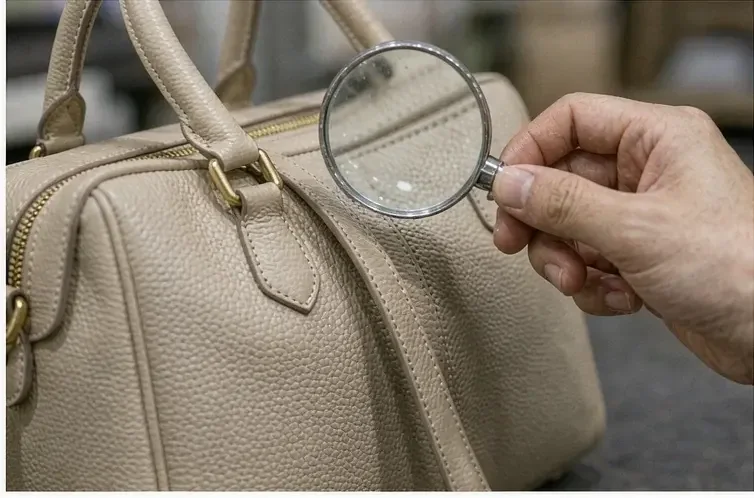
The Hybrid: Full on Critical, Sampled on Cosmetic
The arrangement most programmes actually need splits the defect library in two and applies a different method to each half.
How the split works
- Critical characteristics are examined on every piece: closure function, needle reconciliation, metal detection result.
- Major functional characteristics are examined on every piece for a first lot and sampled thereafter.
- Cosmetic attributes are sampled at AQL 2.5, since an occasional minor mark is tolerable in use.
- The critical pass runs first and fresh, before any cosmetic work begins in the same session.
- Both results are recorded on one report, and the AQL statement refers only to the sampled portion.
- Inspectors rotate every two hours, and a seeded faulty piece is used to verify the critical pass.
The fifth line is a discipline point rather than a technical one. It is tempting to describe a hybrid result as an AQL result, and doing so misstates what was actually examined. A buyer reading the report later needs to know which half was sampled and which half was not, because the two halves carry entirely different evidential weight.
Checklist: Twelve Questions Before You Decide
Work these twelve in order and the decision usually makes itself, without a debate about preference.
- Is the style new or settled? New leans full, settled leans sampled.
- Is there a critical characteristic that must not fail? If so, examine it on every piece.
- How many pieces are in the lot, and what does a full check cost in hours?
- Can the calendar absorb those hours without delaying handover?
- What is the cost of one fault reaching a customer, in rework and in reputation?
- Has there been a material or process change since the last accepted lot?
- Is a statistical statement needed for the record? Only sampling provides one.
- Are inspectors available for several consecutive days, or for an afternoon?
- How will fatigue be managed: rotation, seeding, or separate critical and cosmetic passes?
- Are the failure modes known well enough to target them, or is this a discovery exercise?
- What happened on the last three lots, and does that history argue for more or less coverage?
- Will the hours saved by sampling be reinvested in the process, or simply removed?
Questions three and eleven together resolve most cases. History and hours are the two inputs that are known in advance, and preference is the one that should decide least. Written down and answered once, the list also stops the same argument recurring at the end of every season, which is where it otherwise always happens.
What Changes After a Rejected Lot
The two methods behave very differently after a rejection, and this is where the choice is felt rather than calculated.
Under sampling, a rejected lot is reworked and re-presented, and the next inspection draws a fresh sample under tightened rules if two of the last five lots failed. The process learns nothing from the sample itself, because the sample identifies the outcome and not the cause. Under a full check, every faulty piece has been identified and often tagged, so the rework is targeted and the pattern is visible: if eleven of fourteen faults sit on the same operation, the cause is on that operation rather than in the material.
That difference is the strongest argument for a full check on a first lot. It is not that it catches more; it is that it tells you where to look next, which a sample of fifty does not.
Afterwards the two converge. Once the cause is known and the correction is in place, subsequent lots on the same style can be sampled with confidence, because the failure mode is no longer unknown.
Writing the Decision Into the Clause
The clause should state which method applies to which class of defect, because a clause that says inspection will be performed leaves the most important question open.
Around it the programme is unchanged: MOQ 500 pcs per style and colourway, sampling in 6-10 working days and 12-15 for complex constructions, bulk in 35-50 days, inspection at AQL 2.5 under ISO 2859-1, and handover on FOB Xiamen terms. Export experience on this programme runs since 2014 across 7 production lines with about 200,000 pcs per month of capacity, delivered through our validated partner factory Quanzhou Yingming Bags.
The arithmetic stays short. Reworking one closure on a piece that has already shipped costs around USD 4.80 in parts and bench time before freight, so a full critical pass on 500 pieces pays for itself if it catches a small number of escapes.
Nearly every programme that argues about this ends in the same place: examine what must not fail on every piece, sample what merely must look right, and say which was which on the report. The debate is usually about method when it should be about the defect library.
Decide the method before the lot is finished
Tell us the style, the quantity and the history and we will return the inspection method, the defect library and the hours before bulk begins. Request a quote.
Frequently Asked Questions
What is the difference between final random inspection and a full check?
Random inspection draws a statistically defined sample, 50 pieces from 500 at AQL 2.5, and allocates risk between the parties. A full check examines every piece, produces no statistical statement, and costs roughly 3 to 5 inspector-days on that lot.
How long does a full check take on 500 bags?
At 3 to 6 minutes per piece, roughly 25 to 50 hours, which is 3 to 5 inspector-days. Compare that with about 2.5 to 5 hours for the 50-piece sample, and the calendar rather than the money usually decides it.
Does a full check find every fault?
No. Sustained attention degrades and detection of subtle faults falls after roughly two continuous hours. Rotating inspectors every two hours, separating critical from cosmetic passes, and seeding a known faulty piece all restore effectiveness.
Can a passed sample lot still contain faulty pieces?
Yes, because only about 10 percent of the lot was examined. Zero faults in a sample of 50 bounds the true rate at roughly 5.8 percent at 95 percent confidence, which is a bound rather than a clean result.
When is a full check worth the hours?
On a first lot, after any material or process change, on critical characteristics that must not fail, on very high unit values, and on small lots where the hours are manageable and sampling argues least.
When is random sampling the better answer?
On a settled style with accepted history, at volume where a full check takes months, where a statistical statement is needed, and where the calendar cannot absorb several inspector-days without delaying handover.
What is the hybrid inspection method?
Examine critical characteristics such as closure function, needle reconciliation and metal detection on every piece, and sample cosmetic attributes at AQL 2.5. Record both on one report, and refer to the sampled portion only when stating an AQL result.
Why should the critical pass run first?
Because fatigue is the enemy of a full check and the critical pass matters most. Running it first and fresh, before any cosmetic work starts in the same session, is the least costly way to protect its detection rate.
What is a seeded faulty piece?
A piece with a known fault introduced into the run to measure whether the inspection is actually detecting it. One per session is enough, and a check that has never faced a seeded fault is of unknown effectiveness.
How many pieces can one inspector examine per hour?
Roughly 10 to 20 for a structured bag with hardware to cycle, corresponding to 3 to 6 minutes per piece. A pace much faster than that usually means closures are being looked at rather than operated.
Can a hybrid result be described as an AQL result?
Only the sampled portion can. Describing a hybrid outcome as an AQL 2.5 result misstates what was examined, and the report should distinguish the full critical pass from the sampled cosmetic count.
What should the inspection clause say about method?
Which method applies to which defect class. A clause that says inspection will be performed leaves the important question open, and the question is then decided at the worst possible moment, when the lot is already finished.
People Also Ask
Is a 100% check better than AQL sampling?
Not always. It examines every piece but produces no statistical statement and degrades with fatigue after roughly two hours. Sampling detects change efficiently at a fraction of the hours, which matters at volume.
How many hours does inspecting 500 bags take?
About 2.5 to 5 hours for the 50-piece sample at AQL 2.5, and roughly 25 to 50 hours for a full check. At 3 to 6 minutes per piece, a full check is three to five inspector-days.
Why does a full check miss faults?
Sustained attention declines. Detection of subtle faults falls measurably after about two continuous hours, so rotation every two hours, separate critical and cosmetic passes, and seeded faulty pieces are needed.
What should be checked on every bag?
Critical characteristics: closure function, needle reconciliation and the metal detection result. These are examined on every piece and run first in the session while attention is fresh.
Which method suits a first production lot?
A full check. A first lot is a discovery exercise rather than a sampling problem, and examining every piece is the fastest way to learn what the style actually fails at before the specification is fixed.
Sources and further reading
Every figure on this page is either our own programme data or attributed below. Open the originals before you write them into a specification.
- ISO — International Organization for StandardizationISO Publisher of ISO 2859-1, the sampling standard that defines the code letters, sample sizes and accept and reject numbers used in final random inspection.
- ASQAmerican Society for Quality Reference body for acceptance sampling, inspection planning and the human factors affecting sustained inspection performance.
- NISTNational Institute of Standards and Technology Engineering statistics handbook covering acceptance sampling, operating characteristic curves and inspection planning methods.
- CPSCU.S. Consumer Product Safety Commission Oversees consumer product safety requirements behind the critical characteristics examined on every piece.
- Sourcing JournalSourcing Journal Reporting on inspection practice, coverage decisions and quality disputes across the accessories trade.