Evening Bags: Luxury Silhouette Planning — Six Questions Before the First Toile
An evening silhouette is planned by answering six questions in order: how small it can be, what it has to hold, which structure carries it, how it is carried, what closes it, and where the millimetres land. The answers are narrower than they are for a day bag, because an evening piece works at 180-240 mm across and 50-70 mm deep, a scale at which every seam and every millimetre of drop is visible. It is also the scale at which the commonest errors happen, since a proportion that reads well at 300 mm can collapse at 200 mm. Below, each question is answered with the figure it settles and the working days it consumes, ending with the record that lets the piece survive a run.
What Makes an Evening Silhouette Different from a Day One
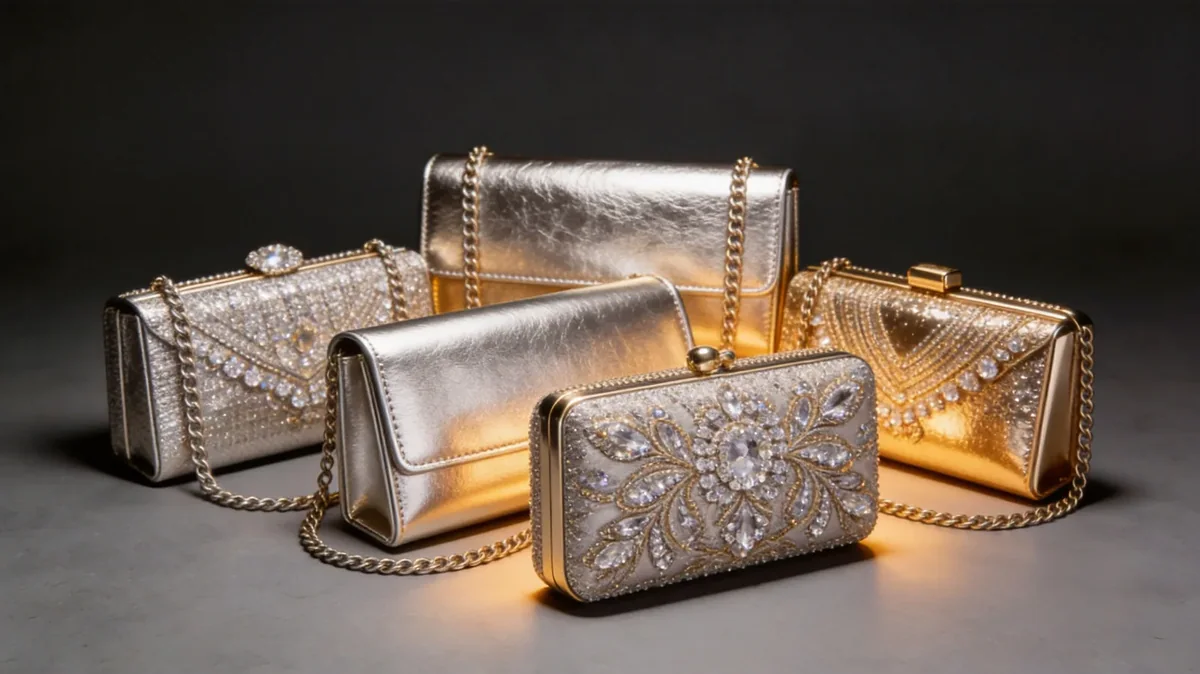
An evening body is a day body working at a smaller scale, and scale is not neutral. At 180-240 mm across, a seam that was invisible at 300 mm bisects the piece, a handle that was comfortable at 220 mm drop reads as a loop, and a closure that was proportionate becomes the largest object on the front.
- Every seam is visible, because there is less uninterrupted panel around it.
- The closure dominates the front, since the front is only 180-240 mm wide.
- Proportion errors that a day body absorbs are exposed on an evening one.
- Weight matters more in the hand than on the shoulder, and it is noticed immediately.
- The base has to hold a line at a width where a 1.6 mm board is visibly thick.
The practical consequence is that an evening piece earns its own toile and its own proportion pass. Borrowing the proportions of a day piece and scaling them down uniformly produces a body that looks correct in a drawing and wrong held in the hand.
How Small Can an Evening Piece Be and Still Work
Small is not the same as narrow. The workable range is set by what the piece must contain, and the figures below are the ones that hold up in use rather than in a photograph.
- Body width
- 180-240 mm across the base, the range in which the piece still holds a phone
- Body depth
- 50-70 mm, which holds a phone, a card holder and a lipstick without bulging
- Height
- 110-160 mm, taller than it is deep so the contents lie flat
- Chain drop
- 300-360 mm, short enough to sit at the hip and not at the waist
- Short handle drop
- 55-80 mm, measured on the finished body and not on the pattern
Below 180 mm wide the piece stops holding a phone and becomes an accessory to an outfit rather than a container. Above 240 mm it begins to compete with a day piece, which is a commercial problem rather than a design one. The usable range is narrower than those two figures suggest, because the seam allowances and the 0.8 mm interlining are taken out of it before the contents go in.
What an Evening Body Has to Hold
Capacity is the constraint that fixes the dimensions, and it is worth listing the contents before the shape is drawn. The table gives the four items that appear in most briefs and the dimension each one forces.
| Item | What it forces | Working figure |
|---|---|---|
| A large phone | Interior width and height | 160 mm of clear interior width, so 180 mm minimum outside |
| A card holder | An interior pocket with a slip | A #3 zip or a slip pocket on the back panel |
| A lipstick | Depth at the base | 50-70 mm of depth with a flat base line |
| Keys | A split ring anchored inside | A ring on a 12 mm tab, set at the side seam |
Two of the four are usually enough to fix the size. Once the interior clear width is known, the outside width follows from the panel thickness and the seam allowance, and the depth follows from the contents lying flat rather than stacked.
Which Structure Carries an Evening Piece
Evening work sits at the two ends of the structure range. A soft body at 1.0-1.2 mm slumps attractively and holds nothing; a framed body at 1.2-1.4 mm with a base board holds its line empty and is the more usual choice for a piece that will be put down on a table.
- Soft at 1.0-1.2 mm with no interlining: the lightest option and the least formal.
- Semi-structured at 1.2-1.4 mm with 0.8 mm interlining: the common evening choice.
- Framed on a 1.2 mm base board: thinner than the 1.6 mm used on day bodies, because the width is smaller.
- Every structure level still returns 55-65% of purchased hide area as usable panels.
- A base board at evening scale is visible from the side and has to be skived to disappear.
The middle level is where most evening pieces land. It is light enough to be carried in one hand and structured enough to hold a base line when the piece is set down, which is the moment the wearer and everyone else forms an opinion of it.
How the Piece Carries: Handle, Chain or Under the Arm
An evening piece is carried three ways, and they are not interchangeable accessories but different bodies. A chain needs reinforcement at two points and a drop of 300-360 mm; a short handle needs a drop of 55-80 mm and a different reinforcement arrangement; an underarm piece needs neither and depends entirely on the height of the body.
| Carry | Working figures | What it demands of the body |
|---|---|---|
| Fine chain | 300-360 mm drop, 4-6 mm link | Two anchor points through the 0.8 mm interlining, plus a split ring each |
| Short handle | 55-80 mm drop, 12-14 mm wide | Reinforcement under the panel, sewn at 8-9 per inch |
| Under the arm | No strap, height 110-160 mm | A body tall enough to be gripped, with a flat base line |
A convertible evening piece, with a chain that tucks inside, is possible and costs two anchor points, a clip at each end and one more sample round. Most first evening capsules are specified with one method and add the second on the following season.
What Closure Works on a Small Body
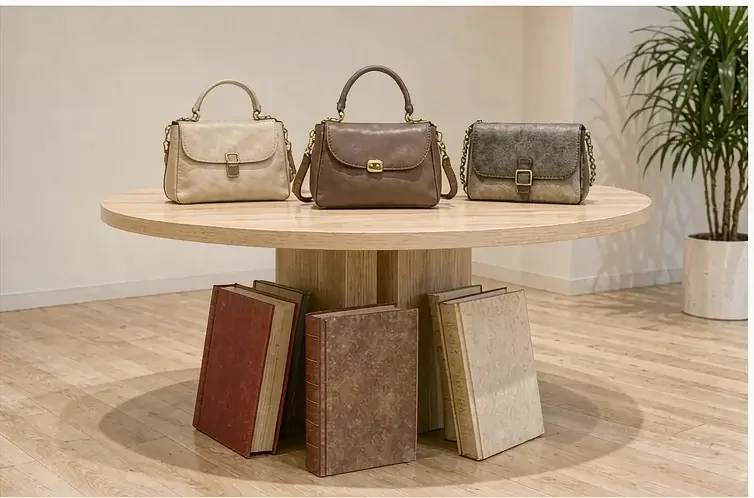
On a 180-240 mm front, the closure is the largest single element and it is chosen as much for its size as for its function. A lock that reads as refined at 340 mm across reads as oversized at 200 mm.
- A #3 zip serves an evening main opening; a #5 is too heavy for the scale.
- A turn lock at 18-22 mm across is the largest that holds proportion on a 200 mm front.
- A magnetic tab keeps the front clean and adds no visible trim at all.
- Stock brass at 0.15-0.3 µm plating holds the trim line near USD 4.80 per bag.
- Bespoke locks add tooling and 30-40 working days, which is a long commitment at evening scale.
The closure also decides the opening, and the opening decides the height of the front panel. A frame closure at evening scale needs a minimum opening of 140 mm to be usable, which sets a floor under the width of the whole piece.
How Proportion Is Settled at Evening Scale
Proportion at evening scale is settled on a 10 oz calico toile, at full size, in one to two days. The reason it cannot be settled on paper is that the errors are small: 4 mm, not 20 mm, and 4 mm is below the threshold of a drawing and above the threshold of the eye.
What the evening proportion pass settles
- The height of the front panel, moved in 4 mm steps rather than the 8 mm used at day scale.
- Where the top edge falls, which is the line the eye reads first.
- The position of the closure, tested at 55-80 mm drop rather than at 220-260 mm.
- The base line, confirmed empty and then filled, since both states are seen.
- The overall read at full size, which is never the read obtained from a sketch.
Two passes at the toile are worth more than one here than anywhere else. The steps are half the size used on a day body, so the number of corrections is larger and each of them is cheaper on calico than on a hide.
What an Evening Piece Costs to Develop
Development cost is measured in working days, and the three common specifications differ mainly in whether the closure and the trim are stock. These three cases cover the majority of evening briefs.
The soft, hand-carried piece
Soft at 1.0-1.2 mm, a magnetic tab, no chain. Two or three days on the pattern, one on the toile, then one leather round at 6-10 working days. The fastest evening route.
The semi-structured chain piece
1.2-1.4 mm with 0.8 mm interlining, a #3 zip under a short flap and a 4-6 mm chain at 300-360 mm drop. Two leather rounds at 6-10 working days.
The framed piece
Framed on a 1.2 mm base board with a proved frame closure and a short handle at 55-80 mm. Sampling at 12-15 working days, plus 30-40 for bespoke hardware.
The second case is the reference point. It exercises every decision an evening piece involves, it uses stock trim throughout, and it still leaves the bespoke hardware track available for the season after.
What Has to Be Recorded Before the Run
An evening piece is the hardest silhouette to repeat, because its tolerances are a fraction of the size of the object. The record is what keeps the 500th unit inside the same 4 mm as the first.
- Panel dimensions in millimetres with the ±1.5 mm tolerance, and the nesting arrangement.
- Material: 1.2-1.4 mm body, 0.8 mm interlining, 0.8-1.0 mm lining, named as a reserved lot.
- Stitch density of 8-9 per inch with 0.45 mm braided polyester thread throughout.
- Chain or handle drop, stated with the link size or the strap width beside it.
- Trim list: closure, anchors, split rings and 6 mm feet, each with its plating thickness.
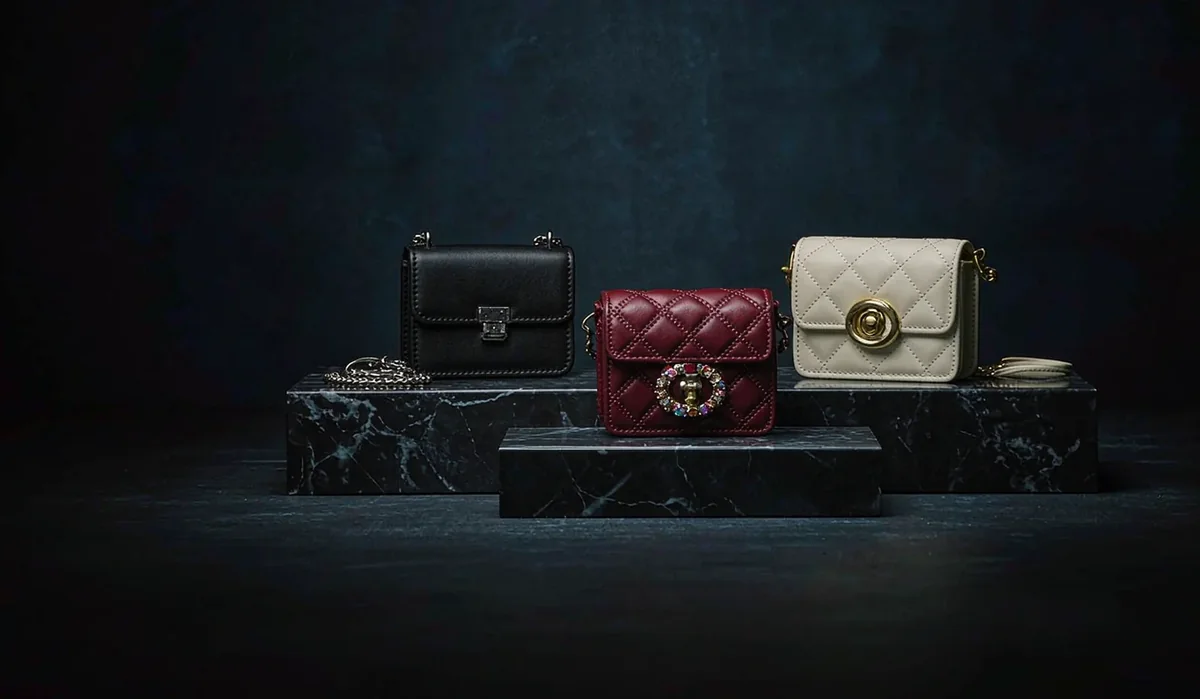
Once recorded, the piece moves to sampling at 6-10 working days, or 12-15 for complex builds, then to bulk at 35-50 days, with each style and colourway committed at MOQ 500 pcs and inspection drawn at AQL 2.5 under ISO 2859-1. Handover is on FOB Xiamen terms. The programme is delivered through our validated partner factory Quanzhou Yingming Bags, an SGS-validated site with 7 production lines and about 200,000 pcs per month of capacity, holding export experience since 2014.
Plan the evening silhouette before the toile
Send the sketch, the contents the piece has to hold and how it should be carried. You will receive the six questions answered for your shape, with the dimensions and the working days, within two. Request a quote.
Frequently Asked Questions
How wide should an evening bag be?
Between 180 and 240 mm across the base. Below 180 mm the piece stops holding a phone and becomes decorative; above 240 mm it begins to compete with a day piece, which is a commercial problem rather than a design one. The interior has to clear 160 mm for a large phone.
What depth works for an evening piece?
Between 50 and 70 mm, which holds a phone, a card holder and a lipstick lying flat rather than stacked. The depth is recovered from the height, since an evening body is taller than it is deep and the contents lie down the front panel.
What drop should an evening chain have?
Between 300 and 360 mm, so the piece sits at the hip rather than at the waist. The chain itself is usually 4-6 mm link, and it is anchored through the 0.8 mm interlining at two points, each on a split ring.
How is a short evening handle measured?
From the top of the handle to the top of the body on a finished piece, at 55-80 mm. It is 12-14 mm wide and attached to the reinforcement beneath the panel, not to the panel itself, and sewn at 8-9 stitches per inch.
Which closure suits a small evening body?
A #3 zip, a magnetic tab, or a turn lock no more than 18-22 mm across. On a 200 mm front the closure is the largest element of the piece, so its size is a proportion decision before it is a functional one.
Why is a thinner base board used at evening scale?
A 1.2 mm board is used instead of the 1.6 mm fitted to day bodies, because at 180-240 mm across a thicker board is visible from the side and reads as an edge rather than as a base. It is also skived so that it disappears into the seam.
Can an evening piece be carried more than one way?
Yes, with a chain that tucks inside and a short handle, or a chain that removes entirely. Each addition brings two anchor points, a clip at each end and one further sample round, which is why most first capsules specify one method only.
How long does an evening piece take to develop?
Roughly 9-14 working days for a semi-structured piece: two or three on the pattern, one or two on the toile, then two leather rounds at 6-10 working days. A framed or bespoke piece moves to 12-15 days of sampling, plus 30-40 working days of tooling.
What is a toile and why is it cut at evening scale?
A full-size test piece in 10 oz calico. It is cut because the errors at evening scale are 4 mm rather than 20 mm, which is too small to see in a drawing and too large to miss in the hand. It resolves in one to two days.
How much usable material does an evening panel set return?
Between 55 and 65% of purchased hide area. Evening work does not improve the figure, since the nesting constraint and the grain direction requirement are the same; it does mean the shortfall is felt more, because the panels are smaller.
What stitch density is used on an evening body?
8-9 stitches per inch with 0.45 mm braided polyester thread. It holds a handle join and a chain anchor, and at evening scale the stitches are read as a line on the front panel, so the density is also a visible part of the proportion.
What has to be recorded before an evening run?
Panel dimensions to ±1.5 mm with the nesting, the material thicknesses, the stitch density and thread, the chain or handle drop with the link size beside it, and every trim piece with its plating thickness. Without it the 500th unit drifts outside the 4 mm.
People Also Ask
What size should an evening bag be?
180-240 mm wide, 50-70 mm deep and 110-160 mm tall, with 160 mm of clear interior width so a large phone lies flat.
Why does proportion matter more at evening scale?
Because the errors are 4 mm rather than 20 mm: too small to see in a drawing, too large to miss held in the hand.
What is the fastest evening silhouette to develop?
A soft piece at 1.0-1.2 mm with a magnetic tab and no chain, which needs one leather round at 6-10 working days.
Should a first evening capsule use bespoke hardware?
No. Stock brass at 0.15-0.3 µm plating holds the trim line near USD 4.80 per bag and avoids 30-40 working days of tooling.
How many toile passes does an evening piece need?
Two, in 4 mm steps. The corrections are half the size used on a day body, so there are more of them and each is cheaper on calico.
Sources and further reading
Every figure on this page is either our own programme data or attributed below. Open the originals before you write them into a specification.
- ISO — International Organization for StandardizationISO Publisher of ISO 2859-1, the standard behind the AQL 2.5 inspection plan applied to evening bulk.
- Leather Working GroupLeather Working Group Tannery audit protocol, relevant when the light lots behind 1.0-1.2 mm evening panels need their origin evidenced.
- ISO Online Browsing PlatformISO Public catalogue used to confirm standard names and scopes, including ISO 3376 for tensile strength and ISO 11644 for finish adhesion.
- WWDWWD Reporting on evening proportion and carrying position across the European and American accessories market.
- FashionUnitedFashionUnited Market reporting on the accessories sector, including the seasonal calendars that evening capsules are planned against.