Common Luxury Handbag Defects and Fixes: A Diagnostic Order
What are the common defects on a luxury handbag and how are they fixed? Diagnose by location before naming the fault: panel, seam, edge, shape, hardware, lining and colour, in that order. Most faults trace back to four decisions made before production: substance, reinforcement, edge build and fold radius. This guide walks the order, gives the cause and the fix for each, and shows how each is counted at AQL 2.5 under ISO 2859-1.

Step One: Locate the Defect Before Naming It
Defects are named by what they look like and fixed by where they are. The same visual symptom has different causes in different places: a line can be a crease in a panel, a pucker at a seam or a sink at an edge, and each has a different remedy. Locating first converts a description into a diagnosis, which is the entire point of a defect classification.
Work through seven locations in a fixed order: panel, seam, edge, shape, hardware, lining and colour. Most faults fall into the first four, and most of those trace back to one of four decisions made before production began: the substance specified, the reinforcement drawn, the edge build chosen and the fold radius allowed. Diagnosing in order finds the cause rather than the symptom.
Panel Defects: Marks, Grain and Substance
Panel faults are visible marks: scars healed into the grain, scratches from handling, a shade break across a seam or a substance that is thinner at one end of the panel than the other. The first three are sorting problems and belong to intake, where panels are graded and banded before cutting. The last is a specification problem and belongs to the substance band on the order.
| Defect | Where it comes from | Fix that holds |
|---|---|---|
| Healed scar in a prime panel | Grading allowed it into the wrong selection | Grade per panel area and band before cutting |
| Scratch from handling | Bench or packing contact | Panel sleeves during build; padded separation in packing |
| Shade break across a seam | Two lots on one body | Shade band panels; assemble within one band |
| Substance thin at one end | Band not held across the hide | Specify 1.2-1.4 mm with a permitted variation |
| Quill or scale flattened | Sustained pressure in packing | Pack stuffed and flat with nothing on the panel |
Seam Defects: Pucker, Skip and Broken Stitch
Seam faults are the most common finding at inspection and the easiest to prevent. Pucker comes from a stitch density too high for the material, or from a skive that left one side thicker than the other. A skipped stitch comes from a needle that was dull or a thread that was tensioned unevenly. A broken stitch on a saddle-sewn line stays put; on a machine chain it unravels.
- Pucker: lower the density to 8-9 per inch, or 7-8 on suede and other bulky materials.
- Skip: change the needle on a schedule and check tension at the start of each run.
- Broken stitch: use a saddle stitch where the seam carries load or will be repaired.
- Uneven line: mark the stitch path on the panel rather than following the eye.
- Gaping seam: check the interlining; a panel without discipline pulls away from the line.
Edge Defects: Sinking, Cracking and Ridge
Edge faults are almost always a build problem. An edge that sinks along the seam was painted with too few coats or sanded before the previous coat had cured. An edge that cracks was built too thick and too hard for a fold that flexes. A ridge along the arris comes from a coat applied over an imperfectly sanded surface. All three are prevented by three coats, sanded between, with the final coat dressed.
Suede is the exception and deserves its own line: it does not take edge paint at all. A suede body uses a turned and stitched edge, a lightly sealed raw edge or a narrow binding cut from grain leather. Specifying a painted edge on a suede panel is a specification error rather than a workmanship one, and no amount of bench skill makes it hold.
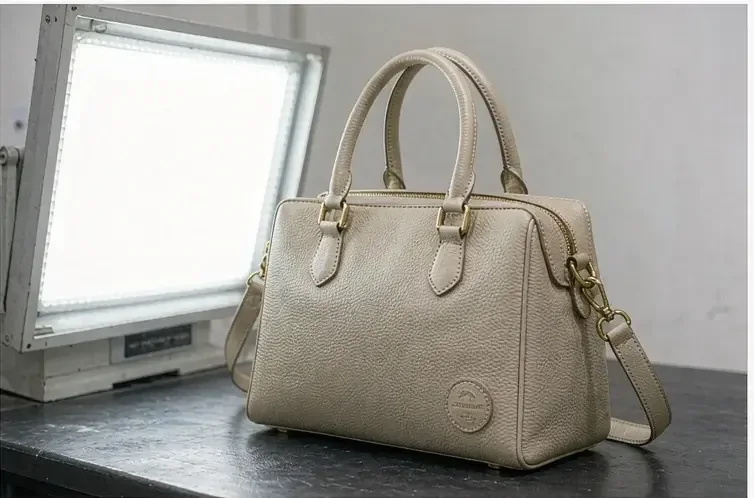
Shape Defects: Slump, Twist and Asymmetry
Shape faults appear after the body has stood for a while, which is why they are missed at the bench. A slump means the substance or the interlining was too light for the silhouette. A twist means the panels were cut off-grain or the gusset was set unevenly. Asymmetry means one panel was laid out differently from its pair, usually on a body where matching was not specified.
Slump
The body loses its base or its corners. Raise the substance to 1.2-1.4 mm and add 0.8 mm interlining on load-bearing panels.
Twist
The body does not stand square. Cut panels on-grain and set the gusset symmetrically from the centre outwards.
Asymmetry
Two halves read differently. Specify pair matching and band panels before assembly.
Creep
A structured shape relaxes over weeks. Use a firmer temper and store the finished body stuffed until dispatch.
Packing faults deserve a mention here because they arrive as shape faults and are blamed on the material. A body packed flat under weight, or stacked panel to panel with nothing between, arrives creased and is reported as a slump. Stuff the body, separate it from its neighbours, keep the carton dry, and check a shipped sample from every new route before the delivery is accepted.
Hardware Defects: Alignment, Plating and Loose Setting
Hardware faults fall into three groups. Alignment faults are drawing faults: a closure set a millimetre off centre is visible for the life of the bag. Plating faults are specification faults: a film at 0.15-0.3 µm wears through at a contact surface and shows the underlayer. Loose setting faults are reinforcement faults: a fitting without a patch behind it works loose and then pulls.
- Alignment tolerance
- Set in millimetres on the drawing and checked against a jig
- Plating thickness
- 0.15-0.3 µm decorative; heavier or harder route at contact faces
- Corrosion check
- Neutral salt spray exposure of 24 or 48 hours, graded after
- Reinforcement patch
- 0.8 mm behind any cast fitting; 1.2 mm behind a strap root
- Rivet flange
- Around 8 mm to spread load into the panel
- Ring wire
- Around 3.5 mm so a strap fold radius stays open
- Setting check
- Alignment and tightness verified before the maker moves on
- Release count
- Defects classified and counted under AQL 2.5, ISO 2859-1
Lining and Interior Defects
Interior faults matter more than they are given credit for, because the interior is what a client sees first when the bag is opened. A lining that sags was cut too generously or set with too little tension. A pocket mouth that gapes needs a stay. A lining that rubs against a zip tape wears through at that point within a season. None is expensive to fix and all are visible immediately.
Colour and Shade Defects
Colour faults are measurement faults. A panel outside tolerance was either banded incorrectly or came from a different lot. A body whose two halves differ crossed a lot boundary. A pale colourway that reads differently under retail lighting is metamerism, which is a property of the dye rather than a fault, and it is caught by checking the approved reference under the lighting of the market as well as under D65.
The fix for every colour fault is upstream: seal a reference, band the panels, assemble within one band and pack by band. Panel-to-panel tolerance is usually held at delta E 0.8 and lot-to-lot at delta E 1.5, measured under a D65-equivalent source with the instrument geometry declared. Without those four, a colour argument can only be settled by opinion.
The Fix Path: Repair, Rework or Reject
Once a defect is located and caused, there are three dispositions. Repair suits a fault that can be corrected without disassembly: an edge re-dressed, a stitch replaced, a surface cleaned. Rework suits a fault that needs a stage repeated: a panel replaced before assembly, a fitting reset. Reject suits everything else, and on a cut exotic panel, reject is the only option available.
Disposition rules
- Repair what can be corrected without disassembly: edge, stitch, surface.
- Rework what needs a stage repeated, and only before the body is closed.
- Reject anything found after a panel is cut on an exotic skin.
- Never rework a structural fault into a cosmetic one; it will return.
- Record the disposition against the lot so the cause can be removed, not the symptom.
How Defects Are Counted at Release
Defects are classified as critical, major and minor and counted against the sample size drawn under AQL 2.5 following ISO 2859-1. Critical means the body is unsellable or unsafe. Major means a client would notice and object. Minor means a client might notice on close examination. The acceptance number scales with the delivery, so a larger lot tolerates a larger count, not a larger rate.
Preventing the Four Root Causes
Four decisions account for most of what appears at inspection. Substance: specify 1.2-1.4 mm with a permitted variation and hold it. Reinforcement: draw the patches behind fittings and strap roots. Edge build: three coats, sanded between, dressed to the arris. Fold radius: set a minimum per material and respect it in the pattern. Four lines on a specification, and most of this article becomes unnecessary.
Programme terms underneath are unchanged: MOQ 500 pcs per style and colourway, sampling at 6-10 working days and 12-15 for a complex construction, bulk at 35-50 days on FOB Xiamen terms, inspection at AQL 2.5 under ISO 2859-1 with third-party inspection available, and a base reference unit of USD 4.80 before material. Capacity runs across 7 production lines at about 200,000 pcs per month with export experience since 2014, delivered through our validated partner factory Quanzhou Yingming Bags.
Seeing a recurring defect in your deliveries?
Send the body, the location of the fault and the lot reference. We will return a cause, a fix and a specification change. Request a quotation
Frequently Asked Questions
What is the most common defect found on a luxury handbag?
Seam faults, followed closely by edge faults. Pucker at a seam comes from a stitch density too high for the material or an uneven skive; edge faults come from too few coats or sanding before the previous coat cured. Both are process faults rather than material faults and both are preventable at specification stage.
How do you fix a sunken edge on a leather bag?
By rebuilding it. A sunken edge was painted with too few coats or sanded before the coat underneath had cured. Strip back, apply three coats with sanding between each, and dress the final coat to the arris. Prevention is the same process done once, correctly, during the original build.
Why does a seam pucker on a leather panel?
Usually because the stitch density is too high for the material or one side of the seam was skived thinner than the other. Work at 8-9 stitches per inch on grain leather and 7-8 on suede and bulky materials, and specify the skive so both sides of the fold match.
What causes a structured bag to slump over time?
Substance or interlining that is too light for the silhouette. A self-standing body needs calfskin at 1.2-1.4 mm with 0.8 mm interlining on the load-bearing panels. A softer skin will slump however well it is made, because the material is being asked to do work it cannot do.
Can a defect on an exotic leather panel be repaired?
Rarely. Once a belly or a quill field is cut, a fault cannot be corrected without visible loss of pattern or symmetry. This is why exotic panels are approved before cutting, under a D65-equivalent light source against a sealed reference, and why reserve skins are booked against every programme.
What is the difference between a critical, major and minor defect?
Critical means the body is unsellable or unsafe. Major means a client would notice and object. Minor means a client might notice on close examination. The three classes are counted separately against the acceptance number drawn under AQL 2.5 following ISO 2859-1.
How is AQL 2.5 applied to a handbag delivery?
A sample is drawn from the lot according to ISO 2859-1, defects are classified as critical, major and minor, and the count is compared with the acceptance number for that sample size. The number scales with the delivery, so a larger lot permits a larger count rather than a larger rate.
Why does hardware come loose on a soft leather body?
Because there was no reinforcement behind it. A cast fitting on lambskin at 0.8-1.0 mm works the panel until the setting pulls. A patch of 0.8 mm behind the fitting, and 1.2 mm behind a strap root, spreads the load into the body and prevents it entirely.
How do you stop plating wearing through at a contact point?
Specify the thickness per surface and mark which faces actually rub. Decorative gold at 0.15-0.3 µm is a thin film and will wear where a strap moves against a ring. Either specify a heavier stack at that surface or choose a harder route such as physical vapour deposition for the ring.
What causes two halves of a bag to look different in colour?
A lot boundary crossed inside one body. Panels from two dye lots were assembled together, or panels were not shade-banded before cutting. Seal a reference, band the panels, assemble within one band and pack by band; a panel-to-panel tolerance of delta E 0.8 keeps it invisible.
Is metamerism a defect on a leather bag?
No. It is a property of a dye formulation that makes two samples match under one light and differ under another. It is caught by checking the approved reference under the retail lighting of the destination market as well as under a D65-equivalent source, and it is corrected by adjusting the dye rather than the tolerance.
What should be recorded when a defect is found?
The location, the classification, the disposition and the lot reference. Those four turn a single finding into a removable cause. Without the lot reference the same fault will appear in the next delivery and be treated as a fresh mystery rather than a repeat.
How long does a defect investigation take?
Diagnosis is usually immediate once the location is known, and a specification correction sits inside the standard 6-10 working days of sampling window. What takes longer is confirming that the correction holds, which means producing another sample and inspecting it, so plan a round rather than a phone call.
Can a defective body be reworked instead of rejected?
Yes, if the fault needs a stage repeated and the body has not yet been closed: a panel replaced, a fitting reset, an edge rebuilt. It should not be reworked into a cosmetic fix for a structural fault, because the structural fault will return, usually after the bag has reached a client.
People Also Ask
What are the most common handbag defects?
Seam faults such as pucker and skipped stitches, then edge faults such as sinking and cracking, then shape faults such as slump and asymmetry. Most trace back to substance, reinforcement, edge build or fold radius.
How do you fix a cracked leather edge?
Rebuild it in three coats, sanded between each, with the final coat dressed. Cracking means the build was too thick and too hard for a fold that flexes, so the specification should also set a minimum fold radius.
What does AQL 2.5 mean in bag inspection?
An acceptance quality limit applied under ISO 2859-1. A sample is drawn from the lot, defects are classified critical, major or minor, and the count is compared with an acceptance number that scales with the delivery.
Why does hardware loosen on a bag?
No reinforcement behind the fitting. A 0.8 mm patch behind a closure and 1.2 mm behind a strap root spreads the load into the panel and stops the setting working loose.
Can colour mismatch between panels be fixed?
Not after assembly. Prevent it by sealing a reference, shade-banding panels and assembling within one band, holding panel-to-panel tolerance at delta E 0.8 under a D65-equivalent source.
Sources and further reading
Every figure on this page is either our own programme data or attributed below. Open the originals before you write them into a specification.
- ISO — international standardsISO Publisher of ISO 2859-1, the sampling standard behind the AQL 2.5 classification of critical, major and minor defects.
- ASQ — acceptance sampling resourcesASQ Explains how an acceptance quality limit and its sample size relate to the acceptance number used at release.
- SATRA — leather and materials testingSATRA Independent test house whose seam, edge and abrasion methods are used to confirm that a fix holds.
- CIE — international commission on illuminationCIE Defines the D65 standard illuminant under which colour defects and metamerism are judged.