9 Steps in Designer Handbag Production, From Brief to Shipped Carton
Designer handbag production runs in nine fixed steps, from brief and feasibility through to packed cartons and shipping documents, and five branch points decide which version of each step you take. The sequence never changes; the route through it does. Standard constructions sample in 6-10 working days, complex ones in 12-15, bulk runs 35-50 days, inspection sits at AQL 2.5 under ISO 2859-1, and the default trade term is FOB Xiamen. This article gives the nine steps, the branch points in front of them, and the output each step must produce.

The Nine Steps and Where the Route Branches
Read the branch points before the steps. The sequence of nine is fixed, because each step produces something the next one needs, but five decisions change how long each takes and what it costs. Most schedule surprises are a branch point that was not recognised as one.
| Step | What happens | Output it must produce | Branch that changes it |
|---|---|---|---|
| 1. Brief and feasibility | Silhouette assessed against material and construction limits | A feasible direction with constraints named | Standard or complex construction |
| 2. Technical pack | Drawings dimensioned and specification written | A pack with a revision number and date | New style or repeat of an archived one |
| 3. Pattern and toile | Panel breakdown researched and a toile built | An approved panel breakdown | Structured or soft body |
| 4. Material and lot | Grade selected and the hide lot reserved | A named lot recorded against the pack | Full-grain, corrected grain or exotic |
| 5. First sample | Sample built in production material | A physical approval sample | Stock or bespoke hardware |
| 6. Correction and freeze | Corrections applied and specification signed | A signed specification and named lot | One colourway or several |
| 7. Bulk release | Material committed and the line scheduled | Bulk scheduled inside 35-50 days | Single line or shared capacity |
| 8. Final inspection | AQL sampling against the signed specification | A report with defect classification | In-house or third-party |
| 9. Packing and shipment | Presentation packing, cartons and documents | Shipped cartons with full documentation | FOB Xiamen, CIF or DDP |
The five branch points, in the order they arrive
- Standard or complex: 6-10 working days of sampling against 12-15 for complex builds.
- Stock or bespoke hardware: bespoke adds tooling, a proving step and two to three weeks.
- One colourway or several: MOQ of 500 pcs applies per colourway, so each addition multiplies committed units.
- European Union, United States or both: every destination adds its own compliance scope and report.
- FOB Xiamen, CIF or DDP: the trade term decides who carries freight, insurance and duty.
Notice the timing. Four of the five branches are settled before step five, which means the decisions that shape a season are made in the first third of it. This is why the brief and the pack deserve more attention than they usually receive.
Step 1 — Brief and Feasibility
The brief is where a silhouette is tested against what material will actually do. Leather has grain, a thickness limit and a limit on how far it will stretch before it distorts, and each of those constrains a drawing long before anyone cuts anything.
Feasibility produces three answers: whether the silhouette can be built as drawn, what it costs to build it closer, and which element of the drawing is carrying the risk. That third answer is the valuable one, because it is usually a single detail such as a handle root, an unsupported flap or a gusset depth that cannot open as imagined.
- Bring a reference bag whose proportions you admire, whether or not you like its material.
- Name the elements you will not compromise on, so the conversation starts from constraints.
- Ask which single detail carries the most risk, and address it before the pack is written.
- Confirm the quantity per style and per colourway, since MOQ shapes the whole route.
Step 2 — Technical Pack and Specification
The pack converts a drawing into a specification. It is the longest step in calendar terms on a first style and the shortest on a repeat, because an archived pack with a revision history lets step two take days rather than weeks.
- Body leather
- 1.2-1.4 mm full-grain calfskin, tolerance plus or minus 0.1 mm, tannery named
- Interlining
- 250 gsm non-woven at 0.8 mm on structured panels
- Lining
- Cotton twill at 210 gsm with the colour reference stated
- Stitch density
- 8-9 per inch, recorded at three points per unit
- Edge build
- Three coats at 12-15 µm, sanded between passes, heat set
- Panel tolerance
- Plus or minus 1 mm, written beside each dimension
Write the gradeable properties rather than the desirable ones. Thickness, tolerance, weight and microns can be checked against an instrument; supple, rich and beautiful cannot, and arguments about adjectives are the longest ones in any development cycle.
Step 3 — Pattern Research and Toile
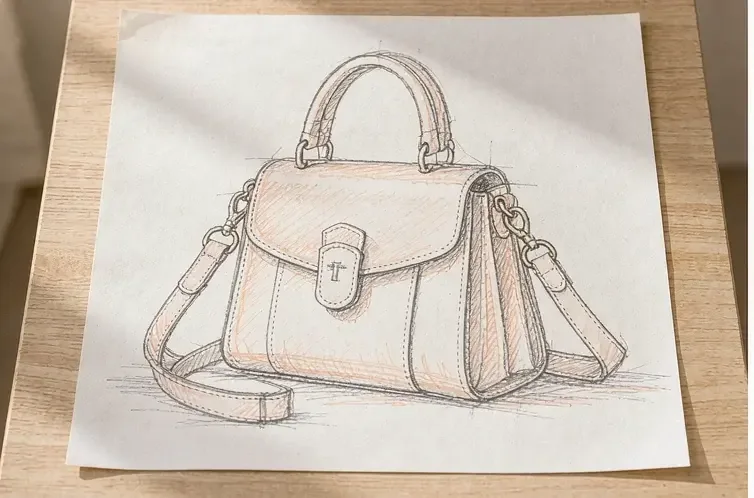
A pattern maker decides where the body breaks into panels, and a toile tests that decision in three dimensions. The two together are the least expensive correction opportunity in the entire route, which is why they come before any hide is cut.
A structured body typically breaks into 14-22 pattern pieces depending on gusset depth and pocket build. More panels cost assembly time and buy a sharper line at the base; fewer cost sharpness and buy minutes. There is no correct answer, only the answer that matches the drawing.
Step 4 — Material Selection and Lot Reservation
Material selection is the branch point with the longest shadow, because it determines both the largest cost line and whether a second season can match the first. Reserving a named lot while the first sample is being built, rather than after approval, removes roughly two weeks from most calendars.
- Name the tannery and the grade, not the country the hide came from.
- Record graded usable area per hide, typically 47-53 sq ft, against the lot reference.
- Expect cutting yield of 64-72% on a structured body with grain direction held constant.
- Condition hides flat for 24-48 hours at ambient room conditions before cutting.
- Declare exotic content here, since CITES permits under Appendix II or III are not on the production calendar.
Grain direction deserves a line of its own. Holding one direction across every panel costs a little more at cutting and saves considerably more in returns, because a body built with mixed grain twists after a month on a shoulder.
Step 5 — First Sample and Correction Round
The first sample is the first object anybody can hold, and holding it is when proportion problems surface. Two rounds are included in the development fee: the first answers whether the object is right, the second whether the specification is right.
Approved as built
The sample matches the drawing and the specification holds. The route moves to the freeze at step six, with the lot named and compliance booked against it.
Approved with corrections
Proportion is right and the specification needs adjustment. Corrections are recorded in writing and applied in the second round at 4-6 working days.
Returned to pattern
Proportion is wrong, which no specification change will fix. The pattern returns to step three and a fresh toile is built before further material is committed.
The third outcome is the one founders hope to avoid and the one worth recognising early. A proportion problem corrected in the specification wastes a round; the same problem carried into bulk wastes a season.
Step 6 — Specification Freeze and Compliance Booking
The freeze happens when the approval sample is signed and the hide lot is named. From that moment material is committed, testing is booked against a real lot, and bulk can be scheduled. Changes after it re-open costing, testing and the calendar together.
Laboratories keep their own timetables, which sit outside the production calendar entirely. European Union programmes screen against REACH Annex XVII, United States programmes add California Prop 65 assessment and CPSIA documentation, and fibre composition follows EU Regulation 1007/2011. Booking against the named lot is the least expensive compliance decision available.
Courier the approval sample if you cannot attend in person. Photographs flatten the two things that matter most at this stage, which are how an edge catches the light and whether a body stands true on a flat surface.
Step 7 — Bulk Release and In-Process Control
Bulk is not the sample repeated five hundred times; it is the sample reproduced by several hands across several weeks. What holds it together is measurement at the station where a value can still be corrected, rather than inspection applied only at the end.
- Bulk window
- 35-50 days depending on construction and hand-operation count
- Stitch density check
- 8-9 per inch, recorded at three points per unit per shift
- Edge build check
- Three coats at 12-15 µm, verified by coat count at the bench
- Hardware setting
- Press force recorded in kilonewtons, with pull-off force tested
- Zip cycling
- 500 open-close cycles recorded before bulk release
- Colour fastness
- ISO 105-X12, target grade 4 dry and grade 3-4 wet
This programme runs across 7 production lines with about 200,000 pcs per month of capacity and has held export experience since 2014, executed through our validated partner factory Quanzhou Yingming Bags, an SGS-validated site. Capacity is allocated by week, with sampling scheduled separately from bulk so development work does not compete with release dates.
Step 8 — Final Inspection at AQL 2.5
Final inspection is the release gate, and on this programme it sits at AQL 2.5 under ISO 2859-1 using general inspection level II. The standard turns an opinion about a shipment into a procedure with a defined sample size and a defined accept and reject count.
Ask for the report to name defect types rather than totals. Classification practice tells you more about a programme than the count does, and a record with no rejections in six months usually means generous classifying rather than perfect output.
Step 9 — Packing, Documentation and Shipment
Packing leads its own schedule outside the bulk window, which is the practical reason to specify it in the pack rather than after approval. Carton count and dimensions then set the freight quotation, so these figures belong in the specification and not in a conversation at the end.
- Dust bag, rigid box, tissue and care card, which together add about USD 4.80 per unit.
- Export carton count and dimensions, typically 10-12 units per carton.
- Country of origin labelling, which affects print on the box and care card, not only the carton.
- Compliance documentation filed against the lot and travelling with the shipment.
- Freight booking against the confirmed carton count and gross weight.
On FOB Xiamen the unit price covers goods to the port of loading, after which freight, insurance and duty belong to you. CIF and DDP can be arranged, but the term should be fixed at quotation, because changing it later re-prices the shipment rather than merely adding a line.
Walk your programme through the nine steps
Send your pack, quantity per colourway and destination markets. You will receive a step-by-step calendar with the branch points marked and a costing within two working days. Request a quote.
Frequently Asked Questions
What are the nine steps in designer handbag production?
Brief and feasibility, technical pack, pattern and toile, material selection with lot reservation, first sample, correction and specification freeze, bulk release with in-process control, final inspection at AQL 2.5, then packing and shipment. The order is fixed because each step produces something the next one needs.
What are the branch points that change the route?
Five: standard or complex construction, stock or bespoke hardware, one colourway or several, European Union against United States destinations or both, and the trade term. Four of the five are settled before the first sample, so the decisions shaping a season are made in its first third.
How long does the whole route take?
Twelve to eighteen weeks is the honest range from a signed pack to cartons on a shelf. Sampling takes 6-10 working days for standard builds and 12-15 for complex ones, correction rounds 4-6 days each, bulk 35-50 days, and ocean freight 3-5 weeks by destination.
Why is the hide lot reserved before approval?
Because it removes roughly two weeks from most calendars and because hides from one lot share dye behaviour. Waiting until the specification freeze to reserve means the second season may not match the first, and the delay lands at the worst possible point in the schedule.
What happens at the specification freeze?
The approval sample is signed and the hide lot is named. Material is committed, compliance testing is booked against a real lot, and bulk can be scheduled. Any change after this point re-opens costing, testing and the calendar together rather than any one of the three separately.
How many sample rounds are included?
Two. The first answers whether the object is right, meaning proportion, volume, handle drop and gusset opening. The second answers whether the specification is right, meaning stitch density, edge build, hardware setting and interlining behaviour. Record corrections in writing, because a verbal note does not survive a change of shift, and further rounds are charged at 4-6 working days each.
What if the first sample is wrong in proportion?
Return to pattern rather than adjusting the specification. A proportion problem corrected in the specification wastes a round; the same problem carried into bulk wastes a season. Building a fresh toile before further material is committed is the least expensive response available at that point.
How is bulk controlled across several weeks?
Through measurement at the station where a value can still be corrected, rather than inspection applied only at the end. Stitch density is recorded at three points per unit, edge coats are counted at the bench, press force is logged in kilonewtons and zips are cycled 500 times before release.
What does AQL 2.5 mean for my shipment?
It is the acceptable quality limit applied under ISO 2859-1 at general inspection level II. A lot of 501-1,200 units draws 80 units for inspection, with an accept number of 5 and a reject number of 6 for major defects. Critical defects trigger rejection regardless of the count.
When should compliance testing be booked?
At the specification freeze, against the named lot. Laboratories run their own timetables, which sit outside the production calendar entirely. Booking at packing rather than at lot selection is the most common cause of a shipment waiting on a report rather than on production, so book when the lot is named and the result arrives before the cartons are ready.
What does packing cost and when is it ordered?
A dust bag, rigid box, tissue and care card together add about USD 4.80 per unit and lead a schedule outside the 35-50 day bulk window. Specify them in the pack rather than after approval, and request carton count, dimensions and gross weight, since those set your freight quotation.
What does FOB Xiamen cover at the end of the route?
It covers goods to the port of loading. Freight, insurance, import duty and destination handling belong to you, so the landed figure is higher than the unit quote. CIF and DDP can be arranged, but fix the term at quotation because changing it later re-prices the shipment.
Can sampling and bulk run at the same time?
They are scheduled separately so development work does not compete with release dates. On this programme capacity is allocated by week across 7 production lines, with about 200,000 pcs per month available, and sampling occupies its own window rather than borrowing from bulk. That separation is why a correction round does not automatically delay a release date.
People Also Ask
What are the steps in designer handbag production?
Brief and feasibility, technical pack, pattern and toile, material and lot reservation, first sample, correction and freeze, bulk release, final inspection at AQL 2.5, then packing and shipment. Five branch points sit between them, and four of the five are settled before the first sample.
How long does designer handbag production take?
Twelve to eighteen weeks from a signed pack to cartons on a shelf. Sampling is 6-10 working days, complex builds 12-15, bulk 35-50 days and ocean freight 3-5 weeks. Reserve the hide lot early and the range narrows towards twelve rather than eighteen.
When should I reserve the leather lot?
While the first sample is being built, not after approval. It removes roughly two weeks from the calendar and ensures hides share dye behaviour so a second season can match the first.
What is inspected before a handbag shipment is released?
Final inspection at AQL 2.5 under ISO 2859-1, general inspection level II. A lot of 501-1,200 units draws 80 units, with an accept number of 5 and a reject number of 6 for major defects.
What documents travel with a handbag shipment?
The inspection report, compliance documentation filed against the lot, packing list with carton count and gross weight, country of origin labelling and, where exotic skins are used, the CITES permit.
Sources and further reading
Every figure on this page is either our own programme data or attributed below. Open the originals before you write them into a specification.
- ISO — International Organization for StandardizationISO Publisher of ISO 2859-1 for AQL sampling inspection, the ISO 105 series for colour fastness, ISO 9227 for salt spray testing and ISO 11644 for finish adhesion.
- Leather Working GroupLeather Working Group Tannery environmental audit protocol referenced when a specification names a tannery and grade for full-grain calfskin.
- CITES — Convention on International Trade in Endangered SpeciesCITES Permit framework for exotic skins, including the Appendix II and III listings whose documentation is declared at material selection and travels with the shipment.
- European Chemicals AgencyECHA Authority for REACH obligations, including the Annex XVII restrictions screened for European Union destinations at the specification freeze.
- U.S. Consumer Product Safety CommissionU.S. Consumer Product Safety Commission Administrator of CPSIA requirements applied to metal components, recorded alongside California Prop 65 assessment for United States programmes.