Premium Handbag Manufacturer Sampling Timelines: Four Routes Compared Day by Day
How long does premium handbag sampling take? On a standard build the window is 6-10 working days; a structured body with bespoke hardware takes 12-15; a reference-style adaptation can close in 5-7; and an exotic-panel version needs the same 12-15 days on the bench plus a permit window that runs on a separate authority calendar. What separates those four routes is not how fast the bench works but how many decisions are already closed when the first panel is cut. This page sets the four routes side by side, breaks the standard window down day by day, and marks the three places where your own response time, rather than the bench, decides the finish date.
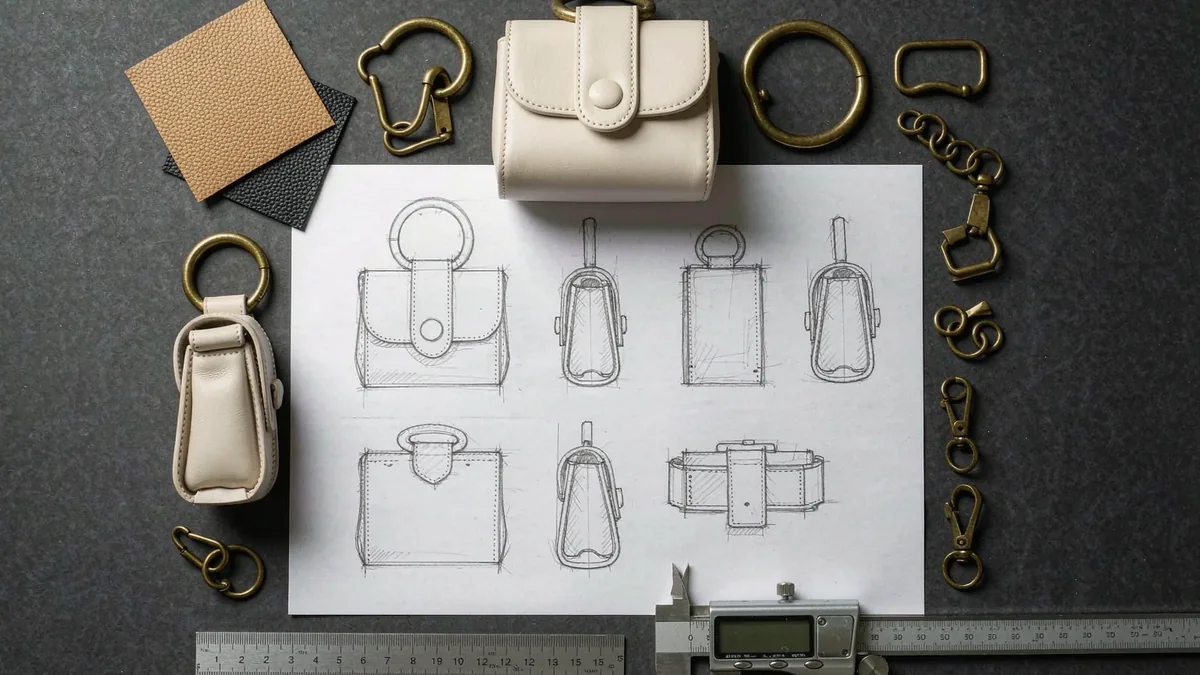
Four Sampling Routes Compared, Day by Day
Premium handbag sampling has four realistic routes, and the honest answer to how long it takes depends on which one your brief fits: reference-style adaptation at 5-7 working days, a standard build from a technical pack at 6-10, a complex or structured body with custom hardware at 12-15, and an exotic-panel version whose bench time is the same 12-15 while permit documents run separately.
Those routes are usually compared on duration alone, which is the least useful column in the table. What matters more is how much of the design is still open when sampling starts, because an open question about geometry costs a full round, while an open question about colour costs an afternoon.
| Route | Bench time | What is already decided | What still has to be approved | Where it fits |
|---|---|---|---|---|
| Reference-style adaptation | 5-7 working days | Pattern, construction and hardware taken from an existing body | Leather, colour, lining and surface branding | A first capsule that needs to look coherent quickly |
| Standard build from technical pack | 6-10 working days | Dimensions, panel count and construction method | Material lot, hardware finish, stitch specification | Most launch capsules |
| Complex or structured build | 12-15 working days | Framed or reinforced geometry and the closure type | Lock proving, reinforcement weight, edge build-up | The signature style meant to carry a collection |
| Exotic-panel version | 12-15 working days plus a permit window | Species, panel placement and documentation route | Lot identity, permit reconciliation, cutting sequence | Accent panels on an already proven body |
Read the third column before the second. A route whose decisions are already closed finishes when it says it will; a route carrying three open questions will need three rounds however much resource sits on the bench.
Day by Day Inside the Standard 6-10 Day Window
The standard window of 6-10 working days is not six days of sewing; it is two builds separated by a measurement and a written correction list. Days 1-2 cover pattern plotting, cutting and skiving, days 3-4 the first assembly and closing, day 5 measurement against the pack, days 6-8 the corrected build, and days 9-10 edge finishing, hardware fit and photography.
- Days 1-2: the pattern is plotted to 1:1, panels are cut, and every joining edge is skived to 8-10 mm at roughly 0.6 mm residual thickness.
- Days 3-4: the body is closed at 8-9 stitches per inch with bonded nylon Tex 40 on a size 90/14 needle.
- Day 5: the sample is measured against the technical pack and a written correction list is issued rather than debated on a call.
- Days 6-8: the corrected build is made, which is where geometry errors surface and are resolved.
- Days 9-10: edge paint goes on in three coats of 0.08-0.10 mm wet film with 4 hours between coats, then hardware is fitted.
- The last half day produces the photograph set, which is what most approvals are actually signed against.
Roughly two days of that window is waiting rather than working: adhesive flash-off and edge paint curing. Removing it produces a sample that looks right on day three and cracks by week six, which is why the window is given as 6-10 rather than as a single number.
Why a Reference Style Saves Days and Some Distinctiveness
Adapting an existing body removes patterning and geometry work entirely, which is worth two to three days, and it also removes most of the risk that a first build fails. The cost is that your silhouette starts from someone else's decisions about proportion, handle drop and gusset depth.
- Panel geometry is already proven, so the first build is far more often the corrected build.
- Handle drop and strap anchor positions can still be changed without re-patterning the whole body.
- What cannot easily change is gusset depth, because it drives the entire panel set behind it.
- A reference route suits a first capsule where speed to market matters more than a signature shape.
A London label we worked with took this route for its first two styles and moved to a full technical pack from the third, which is a common and sensible sequence: prove the commercial side first, then spend the extra days on a shape nobody else has.
Where the Complex Build Earns Its 12-15 Days
A structured or framed body earns its longer window at three specific points: proving the closure, setting the reinforcement, and building the edge. None of those can be compressed, because each is a physical process rather than a decision that can be brought forward.
What the extra days buy on a complex build
- Closure proving: a bespoke lock is cycled on the bench before panels are cut, usually 2-3 days.
- Reinforcement setting: 0.8 mm board is tested at the stress points, then the lining is re-cut to suit.
- Edge build-up: three coats with curing between them, then a sanding pass, then a final seal.
- Second round: complex bodies almost always need one corrected round, and it is planned into the window.
- Hardware fitting: plating at 0.15-0.3 µm is verified with a 24-hour neutral salt spray exposure.
The pattern inside that list is that every extra day is a test rather than a task. A complex build is slow because it contains more places where an untested decision would be expensive to discover once hundreds of units are in motion.
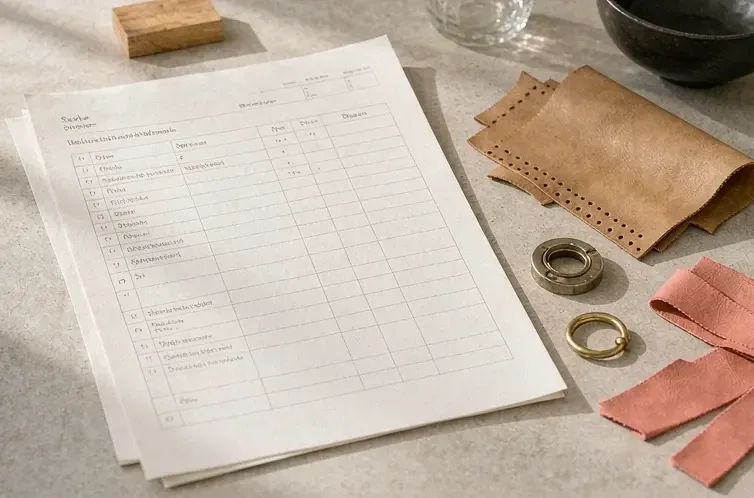
Hardware Proving: The Gate Most Underestimated
Hardware is the single most common cause of a sampling window overrun, because a lock that works on paper still has to be cycled, plated and fitted. Stock components keep you inside the standard window; bespoke ones add 2-3 days on the bench and, where tooling is needed, 30-40 days before that bench work can even begin.
- Stitch density on structural seams
- 8-9 stitches per inch, bonded nylon Tex 40, needle size 90/14
- Skive width and residual thickness
- 8-10 mm skive at about 0.6 mm on every joined edge
- Edge paint build
- 3 coats, 0.08-0.10 mm wet film each, 4 hours flash-off between coats
- Hardware plating thickness
- 0.15-0.3 µm, verified by a 24-hour neutral salt spray exposure
- Reinforcement board
- 0.8 mm at stress points, re-cut into the lining after fitting
- Sample photograph set
- 12 frames per sample: 4 overall angles and 8 macro details
Those six numbers are the ones worth writing into your technical pack, because they are the difference between a sample that approves in one round and one that needs three. A pack that specifies only dimensions leaves the bench to choose, and the bench will choose what it can make rather than what you meant.
Exotic Panels Run on a Second Calendar
An exotic-panel version does not take longer on the bench; it takes the same 12-15 working days and then waits. CITES documentation for listed species is issued by an authority working to its own timetable, and the documents must reconcile with the commercial invoice, so species and quantity are effectively frozen before sampling begins.
- Permit processing cannot be accelerated by adding bench resource or by paying more for the work.
- Panels in listed skins are cut last, because yield is lower and re-cutting is rarely possible.
- A calfskin version can launch first, with the exotic version introduced a season later.
- Any change of species after documentation is issued means starting the paperwork again.
The practical recommendation for a first capsule is to launch the calfskin body and hold the exotic accent for the following season. That keeps the launch date honest and gives the permit window somewhere to run without blocking the rest of the collection.
What You Must Send Before the Clock Starts
A sampling clock only starts when the bench has something to cut. Five inputs make that happen on day one: dimensioned drawings or a reference piece, the material direction with an acceptable substitute, quantity per colourway, destination markets, and the date the goods have to reach.
- Dimensioned drawings with tolerances, or a reference piece with every intended change written down.
- Material direction plus one named alternative, so a failed lot does not stop the window.
- Quantity per style and colourway, since MOQ 500 pcs applies to each combination separately.
- Destination markets, because compliance testing is booked per lot for each one.
- The immovable date, so the window is built backwards from delivery rather than forwards from hope.
Reading a Sampling Quote: Rounds, Counter Samples and Fees
A sampling quote should state how many rounds are included, what a counter sample costs, and what happens to the fee if the style proceeds. Those three lines tell you more about how a house works than the headline figure does.
One round included
The lowest headline figure and usually the highest real one. Acceptable where the pack is already proven, punishing where geometry is still open.
Two rounds with a written correction list
The structure that suits most first capsules. The first build is treated as information and the second is the one you sign against.
Counter samples shipped for approval
Worth paying for on complex bodies. A second physical piece in your office settles in an afternoon what a photograph set can leave open for a week.
Fee credited against the bulk order
Common where the style proceeds. Ask whether the credit applies per style or per order, and whether it survives a change of material lot.
One number to watch: a component change quoted as a small delta, for instance a move from a stock zamak closure to a plated brass one at USD 4.80 per unit, is a permanent cost on every unit rather than a sampling fee, and it should be approved on that basis.
How the Sample Gate Connects to Bulk
The sample gate closes with a signed spec freeze, and bulk intake of 35-50 days begins the day after. Anything left open at the freeze does not disappear; it returns as a change order part way through bulk, which is the most expensive place any decision can be made.
The programme runs across 7 production lines with about 200,000 pcs per month of capacity and has held export experience since 2014, carried out through our validated partner factory Quanzhou Yingming Bags, an SGS-validated site. Inspection is drawn at AQL 2.5 under ISO 2859-1, with the sample plan agreed before bulk opens, and third-party inspection can be added alongside it. Terms are FOB Xiamen by default, with CIF and DDP available on request.
Open a sampling window with a date attached
Send your drawings, material direction and quantity per colourway. You will receive all four routes against your date, with rounds, counter samples and fees marked, within two working days. Request a quote.
Frequently Asked Questions
How long does premium handbag sampling take?
Six to ten working days for a standard build from a technical pack, and 12-15 working days where the body is structured or carries bespoke hardware. A reference-style adaptation closes in 5-7 days. Those windows cover two builds separated by a written correction list, not a single attempt, so the range reflects rounds rather than speed.
What happens during the first two days of sampling?
The pattern is plotted to 1:1, panels are cut from the reserved lot, and every joining edge is skived to 8-10 mm at roughly 0.6 mm residual thickness. Getting the skive right at this point decides whether the seam sits flat later, so the stage is measured against the pack rather than judged by eye.
Why does a complex build need 12-15 days instead of 10?
Because three operations are added: cycling a bespoke closure on the bench, testing reinforcement at the stress points, and building the edge in three coats with curing time between them. Each is a physical process that cannot be brought forward by adding hands, which is why the window is longer rather than merely busier.
Can sampling be shortened without losing quality?
Yes, by closing decisions earlier rather than by working faster. Adapting a reference body removes two to three days, and naming the material lot before the technical pack is finished removes waiting. What cannot be shortened is curing, plating and proving, all three of which run on their own clocks regardless of pressure.
How many sample rounds should a first capsule plan for?
Two. The first build is treated as information about how the drawings behave in leather, and the second is the one you sign against. Capsules that plan for a single round usually end up paying for a third, because questions about proportion and handle drop surface only once a physical body exists.
What is a counter sample and when is it worth ordering?
A second physical piece kept in your office while the first stays with the bench as reference. It is worth ordering on structured bodies and on anything with a custom closure, where proportion and closing feel cannot be judged reliably from a photograph set, however well it is shot.
Does an exotic panel change the sampling window?
It does not change bench time, which stays at 12-15 working days, but it adds a permit window that runs outside the bench entirely. Documents for listed species are issued by an authority on its own timetable and must reconcile with the commercial invoice before goods can ship.
What causes most sampling overruns?
Hardware, followed by late approvals. A bespoke lock needs 2-3 days of proving on the bench and, where tooling is required, 30-40 days before that proving can start. The second cause sits between gates rather than inside them: a correction list waiting three days for a signature that could have been given in ten minutes.
What should a sampling quote state?
How many rounds are included, what a counter sample costs, and whether the fee is credited against the bulk order once the style proceeds. It should also state what happens if the material lot changes, since a changed lot is the most common reason a second round becomes necessary on an otherwise settled style.
When does bulk start relative to sampling?
The day after the signed spec freeze. Bulk then takes 35-50 days from intake. Anything left open at the freeze returns as a change order part way through the run, which is why the freeze is treated as a gate rather than a formality, and why two days of buffer sit either side of it.
How is the sample inspected before it is sent?
It is measured against the technical pack, and the result is written as a correction list rather than discussed verbally. Stitch density, skive width, edge build and hardware function are recorded on one sheet, so the second round can be checked against the same measurements instead of against memory or a phone photograph.
What do I need to send before sampling can begin?
Dimensioned drawings or a reference piece, the material direction with one named substitute, quantity per style and colourway, the destination markets, and the date the goods must reach. With those five in hand, a window can be built backwards from delivery rather than forwards from hope.
People Also Ask
What are the four sampling routes for a premium handbag?
Reference-style adaptation at 5-7 working days, a standard build from a technical pack at 6-10, a complex or structured build at 12-15, and an exotic-panel version at the same 12-15 plus a permit window outside the bench.
Why is handbag sampling given as a range rather than a fixed number?
Because roughly two days of the window are waiting: adhesive flash-off and the 4 hours between edge paint coats. Material arrival and approval signatures add further variance that no bench can control.
How many stitches per inch should a premium handbag have?
Eight to nine stitches per inch on structural seams, sewn with bonded nylon Tex 40 on a size 90/14 needle. Lower density looks loose at the edge; higher density perforates the leather and weakens the seam it decorates.
Should a first collection use a reference style or a new pattern?
Start with a reference body to prove the commercial side quickly, then commission a new pattern once the silhouette sells. Many labels make that switch on their third style, when speed matters less than owning a shape.
What is the difference between a sampling fee and a component cost?
A sampling fee is paid once and may be credited against bulk. A component change, such as moving to plated brass at USD 4.80 per unit, is charged on every unit for as long as the style runs.
Sources and further reading
Every figure on this page is either our own programme data or attributed below. Open the originals before you write them into a specification.
- ISO — International Organization for StandardizationISO Publisher of ISO 2859-1, which sets the sampling plans and accept and reject numbers used for the AQL 2.5 inspection referenced here.
- CITES — Convention on International Trade in Endangered SpeciesCITES Appendix listings determine which permit documents apply to listed skins, and those documents must reconcile with the commercial invoice before shipping.
- Leather Working GroupLeather Working Group Tannery audit protocol referenced when a hide lot is reserved, which decides how early the material window in a sampling plan can open.
- European Chemicals AgencyECHA Administrator of REACH Annex XVII restrictions on substances in articles, which governs which material testing is booked per lot and per market.
- Sourcing JournalSourcing Journal Coverage of material lead times, component availability and freight conditions that shape realistic sampling windows for premium programmes.