How to Build a Luxury Bag QC Process
A quality control process for luxury bags is not a checklist, it is a sequence of decisions. Each gate asks a question, and each answer routes the lot somewhere different: accept, sort, rework, escalate or refuse. Build the process around five decision points — material intake, first piece sign-off, inline monitoring, final inspection and disposition — and you stop relying on the judgement of whoever happens to be on the bench that week. Our programmes run four inspection gates against AQL 2.5 under ISO 2859-1, with 50 pieces drawn on a 500-piece lot and zero tolerance for critical findings. This guide sets out the gates, the decision tree at each one, and the records that make the whole thing auditable.
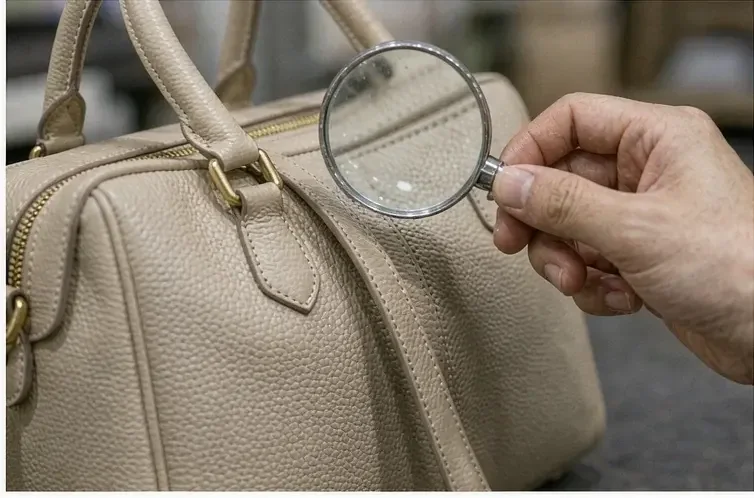
What a bag quality process is actually for
The purpose of a quality process is not to find faults. It is to find them early enough that the correction costs little, and consistently enough that they can be traced to a cause. A process that only inspects finished pieces will catch faults at the most expensive possible moment, after the leather is cut, the hardware is set and the bench hours are spent. A process with gates upstream catches the same fault while it is still a material decision.
The second purpose is consistency of judgement. Two artisans looking at the same topstitch will disagree. A written standard with a measurement and a reference removes the disagreement, which is worth more than any individual inspector's skill.
Decision point one: incoming material
The first gate sits at intake, before anything is cut. Leather is checked for shade against the signed reference, for substance against the specified thickness, for surface damage, and for hand. Hardware is checked for finish, plating shade and mechanical function. Lining and thread are checked against their references. If material fails here, the decision tree is short: it does not enter production.
- If shade measures inside the agreed Delta E limit under D65, release the lot to storage.
- If shade is outside the limit but bandable, sort into families and allocate one family per order.
- If substance or temper is outside specification, return the lot to the tannery; never cut and hope.
- If hardware plating shade drifts against the reference clasp, quarantine the batch and log the bath identity.
- If damage or scar density exceeds the cutting allowance, downgrade the lot to a style where it can be cut around.
Decision point two: first piece sign-off
Once cutting begins, the first complete piece off the line is built slowly, by the most experienced hands available, and then examined against every line of the specification. This is the single highest-value hour in the whole process. A construction error found here affects one piece; found at final inspection it affects five hundred. The first piece becomes the working reference that inspectors compare against for the rest of the run.
What the first piece must prove
It must prove that the pattern works, that the material behaves as expected under the machine settings chosen, that the hardware seats without distortion, and that the finished piece matches the approved sample in every measurable dimension. Where it does not, the pattern, the settings or the material is corrected before the line is released.
Decision point three: inline monitoring
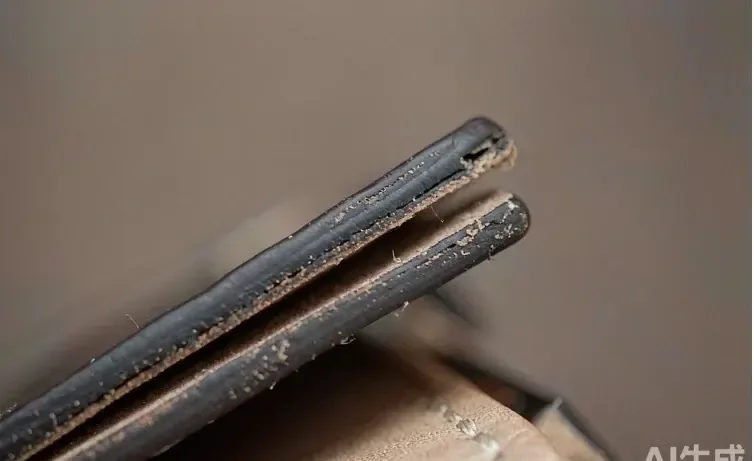
Between the first piece and final inspection, the process needs eyes at intervals rather than at the end. We take a checkpoint every two working hours at each station: edge finishing, topstitch tension, hardware setting and assembly alignment. Each checkpoint is a small sample, but its purpose is trend detection rather than lot acceptance. A stitch tension drifting over a shift is visible in a two-hourly check and invisible in a final inspection that only sees finished pieces.
Decision point four: final inspection
Final inspection is the gate everyone knows, and it is the one that should be doing the least work. Its job is to confirm that everything upstream held. On a 500-piece lot we draw 50 pieces at general inspection level II of ISO 2859-1 and assess each one externally, functionally and dimensionally. Major defects are counted against AQL 2.5, which accepts three and refuses four. Critical defects carry zero tolerance.
| Gate | When | What is examined | Decision if it fails |
|---|---|---|---|
| Material intake | Before cutting | Shade, substance, temper, surface, hardware finish | Return, band, or quarantine the batch |
| First piece sign-off | Before line release | Pattern, construction, dimensions, hardware seating | Correct pattern or settings, rebuild the piece |
| Inline checkpoint | Every two working hours | Edge finish, stitch tension, hardware setting, alignment | Stop the station, reset, recheck within the hour |
| Final inspection | Before packing | 50 pieces on a 500-piece lot, full attribute set | Sort, rework, or refuse the lot |
Decision point five: disposition
A refused lot is not a failed programme; it is a decision to be made. Disposition has three routes. Sorting separates conforming pieces from non-conforming ones and is appropriate when the defect is sporadic rather than systemic. Rework corrects the fault on affected pieces and is appropriate when the correction is stable and verifiable. Refusal returns the lot to the bench for rebuilding, and is the right answer when the cause is not yet understood.
Sort
Right for sporadic faults with a visible signature, such as an occasional misaligned panel. Every piece is examined and separated, and the sorted output is re-presented for inspection.
Rework
Right when the correction is stable, such as re-finishing an edge or replacing a faulty closure. Reworked pieces are always re-inspected at the same level as the original draw.
Refuse
Right when the root cause is unknown. Releasing a lot you cannot explain is how a brand discovers the same fault twice, in two different markets.
Escalate
Required for every critical finding. The atelier lead, not the inspector, decides disposition, and the decision is written into the order file.
The gates in sequence
- Confirm the specification in writing: dimensions, tolerances, materials, hardware, thread and the approved reference sample.
- Gate one: inspect and release material against signed references before any hide is cut.
- Build the first piece slowly, examine it against every line of the specification, and sign it off as the working reference.
- Release the line and run inline checkpoints every two working hours at every station.
- Record every checkpoint finding, including clean ones, so a trend is visible rather than remembered.
- Gate four: draw the sample at general inspection level II, classify every finding, and apply the accept and reject pair.
- Dispose of the lot: sort, rework or refuse, and write the root cause note before the next lot begins.
Records that make the process auditable
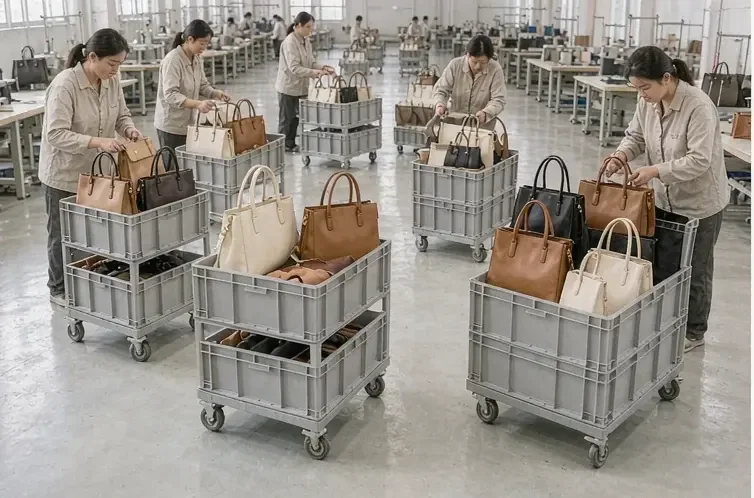
A process without records is a set of good intentions. We keep the material intake report, the first piece sign-off with its measurements, every inline checkpoint log, the final inspection report with photographic evidence, and a retain sample from each lot held for twenty-four months. The retain sample is the piece that settles any later question about what was actually shipped, and it is worth more than any written description when a dispute arises a season later.
A new style versus a repeat order
The process is not identical for every order. A first production run of a new style carries unknowns that a repeat does not: the pattern has never been cut in volume, the material has never been worked at speed, and no first piece reference exists yet. We run that order with a heavier inline presence, checkpoints every hour rather than every two, and a first piece built twice so the second confirms that the corrections to the first were stable.
A repeat order of a style with a clean history can run lighter. The pattern is proven, the first piece reference is in the file, and the stations know the construction. Where ten consecutive lots have passed, the programme qualifies for reduced inspection under the switching rules of ISO 2859-1, which lowers the sample size without lowering the specification. Reduced inspection is withdrawn the moment any lot is refused or any construction change is introduced.
Corrective action: closing the loop
Inspection without corrective action is an expensive way of finding the same fault repeatedly. Every refused lot and every recurring inline finding generates a written note that names the cause, the correction and the date it took effect. The note is attached to the specification, so the next order of that style is built against the corrected document rather than against the one that produced the fault.
Three causes account for most of what we write: a specification that was ambiguous, a material that behaved differently from its reference, and a station setting that drifted out of tolerance. Each has a different correction. Ambiguity is fixed by adding a number, material behaviour by adjusting the intake standard, and station drift by shortening the checkpoint interval until the station is stable again.
What the process costs and what it saves
Inspection is not free. On a 500-piece structured bag lot, a level II final inspection takes about two and a half working hours, and the inline checkpoints add a few minutes at each station across the run. Set against that, reworking one closure on a returned piece costs around USD 4.80 in parts and bench time before freight, and a refused re-order costs more than both. The gates upstream are where the return actually comes from: the first piece sign-off is an hour that protects five hundred pieces.
If you can only fund one gate properly, fund the first piece sign-off. It is the only inspection that catches a construction error before it is repeated five hundred times.
Building the process onto your own programme
Start by writing the specification down. Most programmes that struggle with quality do not have an inspection problem, they have a specification problem: nobody wrote the tolerances, so nobody can enforce them. Once the specification exists, the gates follow naturally, because each gate is simply a point at which the specification is checked against reality.
The second step is to put independence on the other side of the inspection. An inspector who reports to the same lead measured on output will eventually be persuaded to pass a borderline lot, and no written standard survives that pressure. Independence, even at the scale of a single atelier, is what turns a set of gates into a system that lasts through a busy season.
- Standing AQL, major defects
- 2.5, ISO 2859-1, single sampling, normal inspection
- Critical defects
- Zero tolerance, one occurrence refuses the lot
- Final inspection sample
- General level II, 50 pieces on a 500-piece lot
- Accept and reject at AQL 2.5
- 3 accepted, 4 refused
- Inline checkpoint frequency
- Every two working hours at each station
- First piece sign-off
- Full specification check before line release
- Material intake check
- Shade measured to Delta E 1.0 under D65, substance by dial gauge
- Retain sample
- One piece per lot held for 24 months
- Final inspection bench time
- About 2.5 working hours on a 500-piece lot
- Rework cost reference
- Around USD 4.80 in parts and bench time for one closure
- Minimum order quantity
- 500 pieces per style per colourway
- Sampling lead time
- 6 to 10 working days, 12 to 15 for complex constructions
- Bulk lead time
- 35 to 50 days from approved sample
- Programme history
- Export work since 2014 across 7 production lines, about 200,000 pieces per month
- Shipment terms
- FOB Xiamen
The process in one paragraph
- Write the specification first, then put four gates in front of it. Check material at intake before cutting, build and sign off the first piece before releasing the line, monitor every station every two working hours, and draw 50 pieces at general inspection level II for final inspection against AQL 2.5 with zero tolerance for critical findings. Decide disposition deliberately: sort for sporadic faults, rework when the correction is stable, refuse when the cause is not yet understood. Keep the records and a retain sample for twenty-four months, because the piece that settles a dispute a season later is the one you kept.
Build the gates onto your next programme
Send us your specification and we will map it onto the four gates, define the tolerances and return the inspection plan in writing before cutting starts. Request a quality consultation and quotation at /contact-quote/.
Frequently Asked Questions
How many inspection gates should a bag programme have?
Four is the practical minimum: material intake, first piece sign-off, inline checkpoints and final inspection. Fewer than four means faults are found at the most expensive moment, after the material is cut and the bench hours are spent.
Why is the first piece sign-off so important?
It is the only inspection that catches a construction error before it is repeated across the run. A pattern or setting problem found on one piece costs an hour; the same problem found at final inspection costs five hundred pieces.
How often should inline checks run?
Every two working hours at each station. The purpose is trend detection rather than acceptance, so a small sample is enough to reveal stitch tension or edge finish drifting across a shift.
What sample size applies at final inspection?
On a 500-piece lot, 50 pieces at general inspection level II under ISO 2859-1. At AQL 2.5 for major defects the lot is accepted at three findings and refused at four, with zero tolerance for critical findings.
What is the difference between sorting and reworking?
Sorting separates conforming pieces from non-conforming ones and suits sporadic faults with a visible signature. Reworking corrects the fault on affected pieces and suits stable, verifiable corrections such as re-finishing an edge.
When should a lot simply be refused?
When the root cause is not yet understood. Releasing a lot nobody can explain is how a brand meets the same fault twice, in two markets, a season apart.
Who decides what happens to a failed lot?
The atelier lead, not the inspector. Every critical finding is escalated, and the disposition decision is written into the order file so the next lot can be audited against it.
What records should be kept?
Material intake reports, the first piece sign-off with measurements, every inline checkpoint log, the final inspection report with photographic evidence, and a retain sample from each lot held for twenty-four months.
How much does inspection add to the programme?
On a 500-piece structured bag lot, final inspection takes about two and a half working hours, and inline checkpoints add a few minutes per station. Against that, reworking one returned closure costs around USD 4.80 before freight.
Can a programme start with fewer gates and add them later?
Yes, and most do. Start with intake and the first piece sign-off, because those two prevent the majority of faults, then add inline checkpoints once volume justifies the station time.
How is a specification written so it can be enforced?
In numbers with a reference. Name the dimension and its tolerance, the material and its substance, the hardware and its finish, and point every one at a signed reference sample rather than a description.
What happens to the retain sample?
One piece from each lot is held for twenty-four months away from light. It is the physical answer to any later question about what was actually shipped, and it settles disputes faster than any written report.
People Also Ask
What are the stages of quality control in bag production?
Material intake, first piece sign-off, inline checkpoints during assembly, and final inspection before packing. Each stage routes the lot to a different decision rather than simply passing or failing it.
What is a first piece inspection?
The first complete piece off the line is built slowly and checked against every line of the specification. Once signed off it becomes the working reference inspectors compare against for the rest of the run.
How do you stop defects repeating between orders?
Write a root cause note before the next lot begins, and change the specification, the pattern or the setting that allowed the fault. Inspection alone never removes a cause.
What is dispositions in quality control?
The decision made about a non-conforming lot: sort it, rework it, or refuse it. The route depends on whether the fault is sporadic, correctable, or not yet understood.
Should inline checks and final inspection use the same sample size?
No. Inline checks are small and frequent because they detect trends; final inspection uses a statistically meaningful draw, typically 50 pieces on a 500-piece lot, because it decides acceptance.
Sources and further reading
Every figure on this page is either our own programme data or attributed below. Open the originals before you write them into a specification.
- ISO 2859-1:1999 Sampling procedures for inspection by attributesInternational Organization for Standardization Defines general inspection level II, the sample size code letters and the accept-reject pairs used at the final gate.
- ISO 9001:2015 Quality management systemsInternational Organization for Standardization Framework for the documented process, record keeping and corrective action discipline described in this guide.
- Leather Working Group tannery audit and traceability protocolsLeather Working Group Referenced for material intake expectations and tannery traceability behind the first gate.
- Reporting on quality systems and compliance in luxury supply chainsSourcing Journal Industry reporting on why upstream gates reduce escaped defects more effectively than final inspection alone.